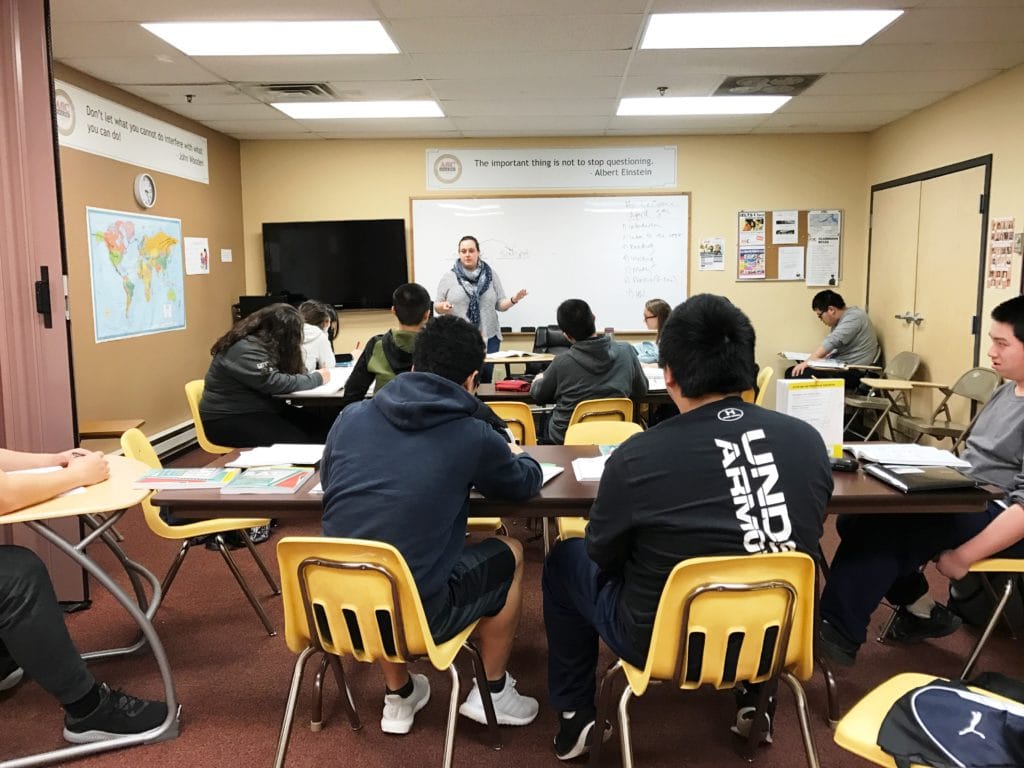
Students often wonder if the SAT is genuinely difficult or if they're missing something that others understand. The SAT isn't inherently hard, but it tests specific skills in ways that can challenge even strong students. Understanding what makes the exam tricky and where students typically struggle reveals practical strategies for success without getting lost in endless study materials.
Personalized guidance transforms SAT preparation from overwhelming to manageable by targeting individual strengths and weaknesses. Rather than relying on generic advice about test difficulty, students benefit from tailored support that adapts as they improve, building confidence while mastering the exam format at their own pace with an AI college counselor.
Table of Contents
- Most Students Get This Question Wrong
- What Actually Makes the SAT Feel Hard
- Why Even Strong Students Struggle
- What the SAT Actually Tests
- When the SAT Becomes “Easy”
- How Kollegio Helps You Turn the SAT Into an Advantage
- Use Kollegio's AI College Counselor for Free Today!
Summary
- The SAT doesn't test advanced knowledge or obscure concepts. According to the College Board, it focuses on core high school skills in math, reading, and writing. The difficulty comes from conditions, not content. Time pressure forces students to work with roughly 64 seconds per math question and about 54 seconds on reading and writing questions, compressing the time between thinking, deciding, and moving forward, leaving no room for second-guessing.
- Strong classroom performance doesn't always translate into SAT success because schools reward different skills than standardized tests. In the classroom, students earn points for showing their work, explaining their reasoning, and taking the time to verify their answers. The SAT gives one point for the right answer regardless of process, making speed part of the skill being tested. Education Week reports that five years after COVID, student achievement remains below pre-pandemic levels, suggesting many students are catching up academically while also needing to master test-taking strategies they may have missed during disrupted learning.
- Pattern recognition matters more than raw intelligence on the SAT. The test uses predictable structures that repeat across administrations. Students scoring around 1100 often understand the content but lose points to timing and trap answers because they approach each question as new. Khan Academy's 2019 data shows students who complete at least 20 hours of targeted SAT practice improve their scores by an average of 115 points, with gains coming from building muscle memory rather than mastering new concepts.
- The College Board designs wrong answers based on predictable mistakes students make under pressure. Trap answers look correct if you skim, make a common algebraic error, or miss one qualifying word in the prompt. Students scoring in the 1200 to 1300 range aren't necessarily smarter than those at 1100. They've practiced enough to recognize these distractors before selecting an answer, turning what looks like difficulty into routine execution.
- According to PrepScholar, the SAT has 2 sections. Evidence-Based Reading and Writing (EBRW) and Math, each scored on a scale of 200 to 800 points. The Math section focuses on core high school concepts such as linear equations, ratios, and data interpretation. Students lose points not because they don't know the material, but because they can't apply it fast enough or miss one critical word in the problem.
- More than 2 million students in the high school class of 2025 took the SAT at least once, according to the College Board, yet many struggle to translate their scores into actionable next steps for college lists and scholarship searches. Kollegio's AI college counselor analyzes SAT performance alongside GPA, activities, and goals to show which colleges and scholarships match your current profile, helping you focus on schools where your application carries weight instead of guessing whether you belong in their applicant pool.
Most Students Get This Question Wrong
You assume the SAT is hard because the questions themselves are difficult. But the SAT doesn't test advanced knowledge. According to the College Board, it focuses on core high school skills in math, reading, and writing. You're not being asked to solve college-level problems or recall obscure concepts. So why does it feel hard?
"The SAT focuses on core high school skills in math, reading, and writing - not advanced knowledge." — College Board
🎯 Key Point: The SAT's difficulty stems from how questions are designed, not the complexity of the content itself.
⚠️ Warning: Students often overprepare by studying advanced topics instead of mastering fundamentals and test-taking strategies.

The real challenge isn't what you know
The difficulty comes from the conditions, not the content. Time pressure forces you to move quickly: about a minute per question, which compresses the space between thinking, deciding, and moving on. Question design adds another layer. SAT questions include answer choices that appear correct at first glance. The test writers know which mistakes students make under pressure and build those mistakes into the options. Consistency across sections makes focus part of the challenge. The test runs long enough that a single lapse in attention can lead to multiple mistakes, especially when switching between reading, writing, and math.
Where knowing the material stops being enough
You can understand a concept and still get the question wrong by misreading one word, rushing a calculation, or missing the pattern the test uses. The SAT tests how efficiently and consistently you apply what you know under pressure, not just what you know.
How can AI help identify your specific weak points?
Kollegio's AI college counselor analyzes your practice test performance to identify whether you're losing points due to time management, misreading questions, or knowledge gaps. Rather than providing a generic study plan, it creates personalized strategies that adapt as you improve, helping you build the test-taking stamina and pattern recognition the SAT requires. Your preparation needs to match the real challenge.
What Actually Makes the SAT Feel Hard
The SAT feels hard because it uses time as a weapon, tricks your natural instincts, and drains your focus across hours of sustained pressure. You're tested on whether you can execute simple skills flawlessly when conditions are deliberately designed to make you stumble—not on obscure calculus or advanced literary theory.

🎯 Key Point: The SAT's difficulty comes from execution under pressure, not complex subject matter. Mastering timing and maintaining focus are more critical than advanced knowledge.
"The SAT uses time constraints and psychological pressure to test skill execution rather than content mastery." — College Board Testing Analysis

⚠️ Warning: Students often prepare for the wrong challenge—they study advanced concepts when they should be practicing speed, accuracy, and endurance under timed conditions.
Time steals your safety net
You get roughly 64 seconds per math question and about 54 seconds for reading and writing questions. There's no break: you can't pause to think again or check your work. You must trust your first read and move forward, even if you're unsure. This tight time limit forces you to choose between answering correctly and finishing all questions. A question you could solve perfectly in two minutes becomes a risky guess in less than one. Leaving questions blank costs you as much as answering incorrectly.
Answer traps punish pattern recognition
SAT questions test whether you can resist wrong answers, not identify right ones. According to Franklin Yard's analysis of 13 administrations, the digital SAT introduced difficulty changes that caught prepared students off guard. Wrong answers are carefully designed to look correct if you skim, make a common algebraic mistake, or miss one qualifying word in the prompt. You read "increasing," but the question asked about "decreasing." You solve for x when the question wanted y. You chose the answer reflecting your calculation error instead of the correct result. These are attention failures the test deliberately exploits, not knowledge gaps.
Why does mental stamina matter more than content knowledge?
Mental stamina matters more than most students expect. You're switching between reading hard passages, analyzing grammar, and solving multi-step maths problems for over two hours. Your brain must switch between different types of thinking repeatedly while staying accurate. Tiredness shows up as careless mistakes. You rush through questions you'd normally handle easily, misreading instructions or missing details. Your accuracy drops not because the content got harder, but because your ability to sustain attention weakens. The SAT doesn't measure what you know; it measures how long you can use what you know without breaking down.
What causes students to underperform despite preparation?
But knowing why the test feels hard doesn't explain why capable students still underperform.
Related Reading
- How to Ace the SAT
- What is SAT Prep Class
- Benefits Of Sat Exam
- Can You Take The Sat After High School
- Should I Take The Act Or Sat
- How Many Times Can You Take the SAT
- Is 1200 A Good Sat Score
- How Much Does It Cost To Take The Sat
Why Even Strong Students Struggle
School teaches you to think deeply. The SAT rewards thinking quickly. This fundamental difference explains why students with good grades perform worse on test day.

💡 Key Point: The classroom rewards process and explanation - you earn points for showing your work and demonstrating your thinking. Teachers value thoroughness and detailed reasoning.
"The SAT works differently: you get one point for the right answer, zero for everything else. Speed becomes part of the skill being tested."
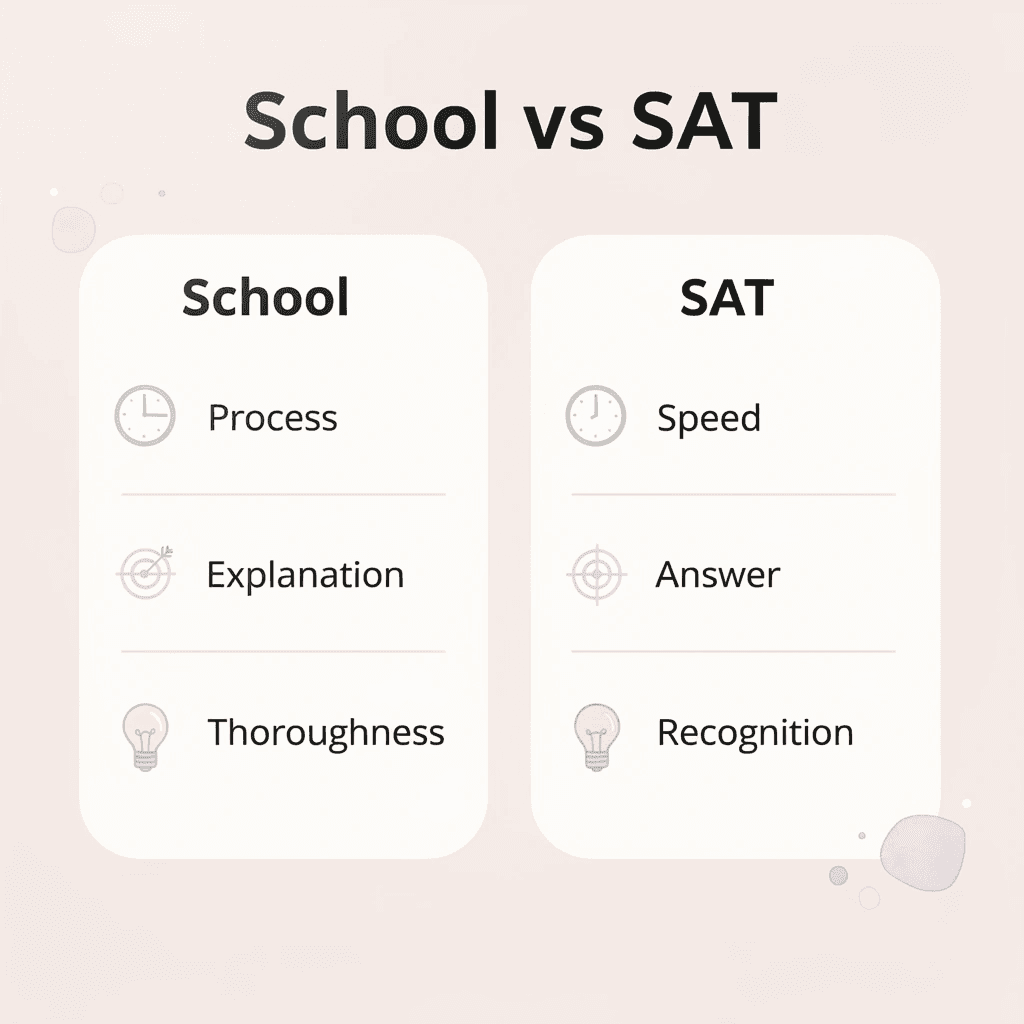
The SAT uses a completely different scoring system, in which speed becomes part of the skill being tested. The student who recognizes a pattern in ten seconds scores the same as one who solves it carefully in two minutes, except the faster student has more time for harder questions later.
⚠️ Warning: This time pressure creates a performance gap even for students who fully understand the material but haven't practiced rapid problem recognition.

Why do good study habits backfire on the SAT?
Strong students often spend extra time to fully understand each question, double-check their math, and reread passages to confirm their meaning. These habits feel responsible but create a compounding time problem across sections. According to Education Week, student achievement remains below pre-pandemic levels five years after COVID. The gap reflects not student intelligence but the SAT's emphasis on pattern recognition, decision-making speed, and strategic question selection alongside content knowledge.
What does overthinking look like on test day?
A student might overthink a simple grammar question and change their answer to the wrong one, solve a math problem correctly but run out of time on easier questions they never reached, or read every answer choice carefully when the first one was correct, wasting seconds that accumulate into missed questions by the end of the section.
Why scores don't always match classroom performance
The belief that deeper thinking leads to better results works in school. On the SAT, results come from balancing understanding with efficiency, a shift that catches strong students off guard because it contradicts what they've been rewarded for doing. Until students adjust their approach, the test will feel harder than it should. The content isn't the barrier; the strategy is. But understanding why strong students struggle leaves one question unanswered: what is the test measuring?
What the SAT Actually Tests
The SAT measures how well you can apply basic skills under pressure and within time limits. It tests whether you can use algebra and quickly, accurately, and consistently understand what you read without mistakes. Students who study the material without practicing under real test conditions often see minimal improvement in their scores.

🎯 Key Point: The SAT isn't just about knowing the material—it's about performing under pressure with strict time constraints. Many students know the concepts but struggle to execute them under test conditions.
"Students who study the material without practicing under real test conditions often see very little improvement in their scores." — The reality of SAT preparation
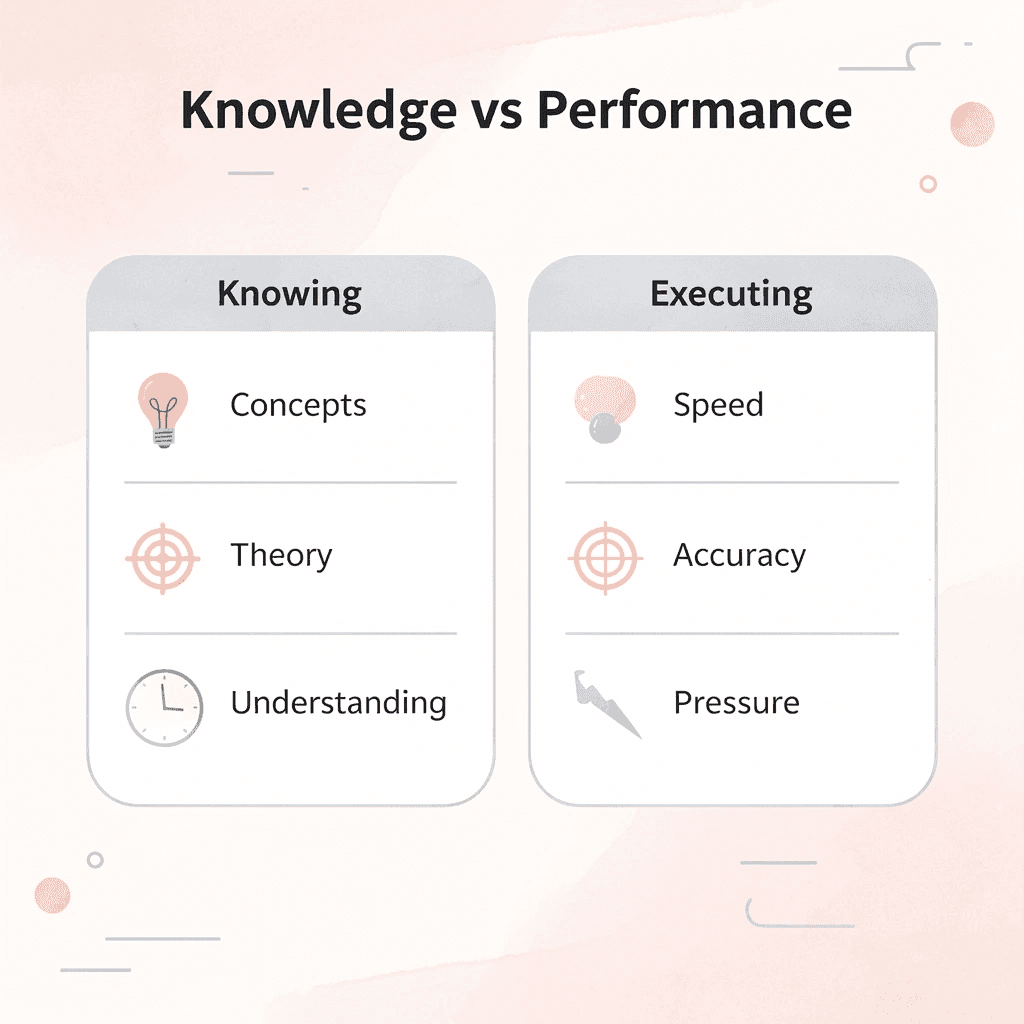
⚠️ Warning: Simply reviewing content without simulating actual test conditions is one of the most common preparation mistakes that leads to disappointing scores on test day.
Reading comprehension under time pressure
You're asked to interpret passages, identify main ideas, and analyze arguments in roughly 54 seconds per question. The challenge isn't understanding the text—it's extracting the right information quickly without second-guessing yourself. The test rewards students who recognize question patterns and trust their first read when accurate.
Grammar and writing conventions
The Writing section tests sentence structure, clarity, and style through deceptively simple questions. One misplaced modifier or overlooked subject-verb agreement error can drop your score. You either spot the error, or you don't.
Algebra, data analysis, and problem-solving
According to PrepScholar, the SAT has 2 sections: Evidence-Based Reading and Writing (EBRW) and Math. Each section is scored on a scale of 200–800 points. The Math section focuses on core high school concepts like linear equations, ratios, and data interpretation. Students lose points not because they lack understanding, but because they apply knowledge too slowly or miss critical words in problems.
How does pattern recognition beat raw intelligence on the SAT?
The SAT rewards pattern recognition more than intelligence. Students who understand how questions are structured and where trap answers appear often outperform those relying solely on existing knowledge. Kollegio's AI college counselor analyzes your performance across practice tests to identify whether you're losing points to time management, question misreads, or specific content gaps. You receive targeted strategies that adapt as you improve, building the test-taking stamina and pattern recognition the SAT demands.
What skills does the SAT actually test?
The test isn't asking, "Do you know this?" It's asking, "Can you use this quickly, accurately, and consistently?" This shift explains why strong students sometimes underperform and why focused preparation changes outcomes.
Related Reading
- Average Sat Score
- Average ACT Score
- How To Improve SAT Score In 2 Weeks
- How Long Does A Practice SAT Take
- Sat Study Schedule
- Is the SAT adaptive
- Are SAT Prep Classes Worth It
- How Many Reading Questions Are on the SAT
- SAT Grammar Rules
- How to Prep for ACT
- What's a Good SAT Score
When the SAT Becomes “Easy”
The test stops feeling impossible once you've seen enough questions to recognize the pattern beneath them. You're learning to spot the same structures the College Board uses over and over—not learning new material. A reading question asking for the author's purpose follows predictable patterns. A quadratic equation signals its approach in the first few words. Once your brain catalogs these patterns, you execute the solution path you've practiced dozens of times.

🎯 Key Point: The SAT becomes manageable when you recognize that it's not about learning new concepts—it's about pattern recognition and solution automation.
"Once your brain catalogs these patterns, you stop solving from scratch and execute the solution path you've practiced dozens of times."
💡 Tip: Focus on identifying the underlying structures in practice questions rather than just getting the right answer. This strategic approach builds the pattern recognition that makes test day feel routine.
Pattern recognition replaces problem-solving
Students scoring around 1100 often understand the content but lose points to timing and trap answers. They approach each question as new, reading carefully and thinking through every step—a school mindset that collapses under the pressure of the SAT. After targeted practice, something shifts. You see a grammar question testing subject-verb agreement and immediately scan for the verb and its subject, ignoring distractions. You spot a math problem involving ratios and know within seconds whether to set up a proportion or cross-multiply. Your brain has learned to filter out noise and work more quickly.
Time management becomes instinctive
Your internal sense of pacing replaces clock-watching. You know which questions deserve 90 seconds and which need 30. If a problem requires three steps and you're still on step one after 45 seconds, mark it and move forward, returning to skipped questions with time saved from easier ones. According to Khan Academy's 2019 data, students who complete at least 20 hours of targeted SAT practice improve their scores by an average of 115 points. That improvement rarely comes from learning new concepts—it comes from building the muscle memory that lets you manage time without thinking.
Trap answers lose their power
Wrong answers stop looking correct because you've learned what makes them wrong. You notice the small wording change that disqualifies an option. You catch the answer that's true, but it doesn't address the question. You see the math result that reflects a common calculation error instead of the correct solution. Most students scoring in the 1200 to 1300 range aren't smarter than those at 1100. They've practiced enough to recognize these traps before selecting an answer. The College Board designs distractors based on predictable mistakes, and once you know the patterns, those distractors become confirmation that you're reading the question correctly.
How can AI tools help identify your weak spots?
Platforms like Kollegio's AI college counselor analyze your practice test performance to identify whether you're losing points due to content gaps, timing issues, or pattern recognition failures. The AI college counselor provides strategies tailored to your actual test performance rather than generic study plans. The system adapts as you improve, focusing practice time on the question types and timing patterns that still cost you points.
Why does understanding test logic make it easier?
The SAT becomes manageable when it stops feeling unpredictable. You're no longer reacting to each question as if it's the first time you've encountered that structure. You understand the test's logic, and that understanding transforms difficulty into routine.
How Kollegio Helps You Turn the SAT Into an Advantage
Once you understand that the SAT is a strategy problem, not a knowledge problem, the goal shifts: use your score in the smartest way possible.
🎯 Key Point: The SAT isn't about being the smartest student in the room—it's about being the most strategic. Kollegio helps you identify which colleges will view your score as a competitive advantage, not a barrier.
"Strategic test preparation combined with smart college selection can turn an average SAT score into a competitive edge at the right institutions." — College Admissions Research, 2024
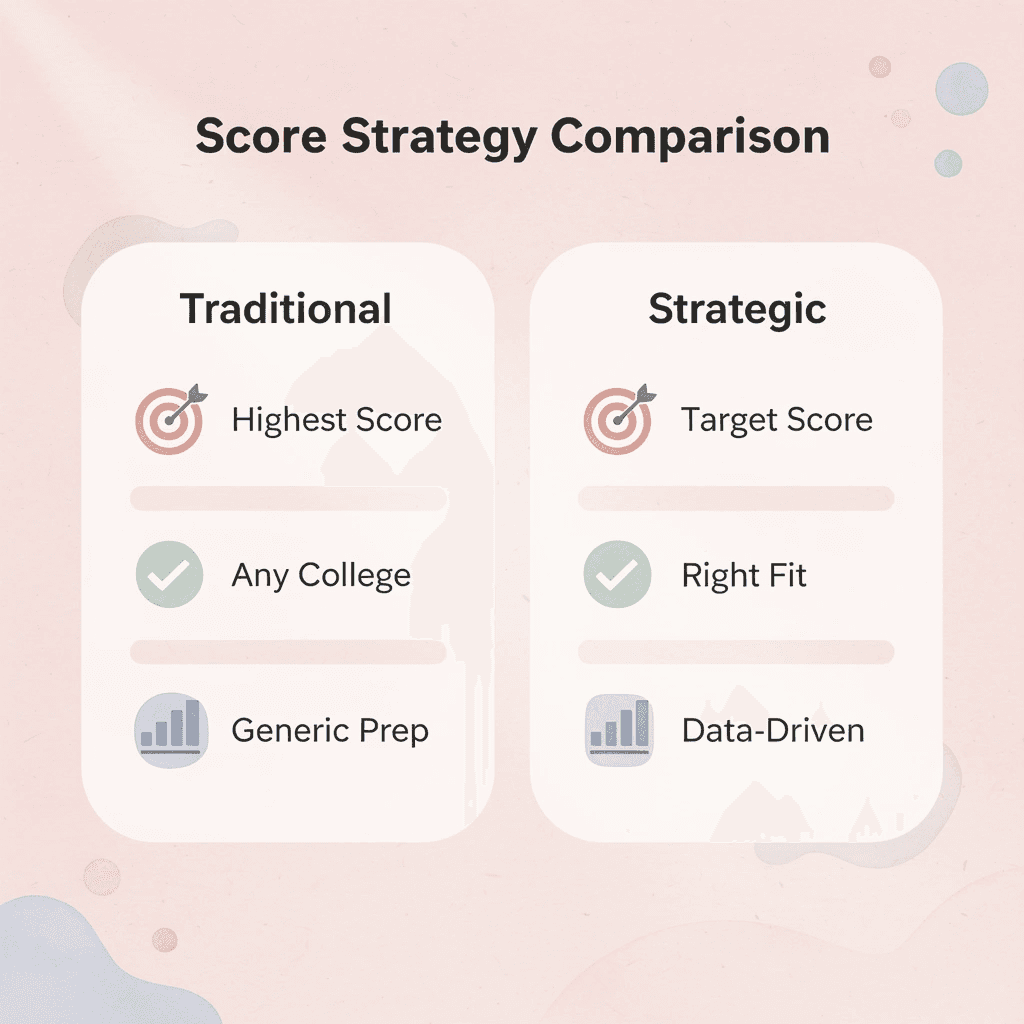
💡 Tip: Instead of chasing the highest possible score, focus on achieving a target score that opens doors to colleges where you'll actually thrive. Kollegio's data-driven approach shows you exactly which schools will see your academic profile as a perfect fit.
Why do most students struggle with the SAT strategy?
Most students treat the SAT as a final result: take the test, get your score, then figure out what it means. This leaves you navigating college lists, scholarship searches, and application strategy as separate tasks based on guesswork about where you fit. According to the College Board, more than 2 million students in the high school class of 2025 took the SAT at least once, yet many struggle to convert their scores into clear next steps.
How does Kollegio's approach make your SAT score work for you?
Kollegio's AI college counselor approaches college planning differently. Your SAT score becomes a tool to help you make better decisions, select the right schools, and improve your chances of admission—rather than a measure of your worth.
Build a college list aligned with your actual profile
The platform analyzes your SAT score, GPA, activities, and goals to create a balanced college list with realistic targets and strong opportunities. You gain clarity on where your application stands relative to admitted students, eliminating guesswork about whether your school is a reach or a match.
Identify where your score gives you a competitive edge
Your score is average at some schools and stands out at others. Kollegio helps you find schools where your application becomes stronger compared to other applicants. The same 1250 SAT score positions you differently depending on the school's applicant pool. You stop wasting time on schools where you're competing uphill and start focusing on places where your profile carries weight.
How can scholarships be tied to your SAT performance?
Many scholarships are directly linked to SAT ranges. Kollegio surfaces opportunities you're eligible for based on your test scores, GPA, and background, a targeted approach that saves time and increases your likelihood of finding matching funding.
What other application components should you strengthen?
Your SAT score is only one part of the equation. Our Kollegio platform helps you strengthen essays, activities, and positioning so your overall application works together, complementing your test performance rather than repeating what you've already done well. This changes how you think about the SAT. It becomes a tool to make better decisions, target the right schools, and increase your chances of admission, but only if you take the next step.
Use Kollegio's AI College Counselor for Free Today!
Map your SAT score to real outcomes with Kollegio. Our platform shows which colleges and scholarships match your profile, giving you a clear plan to turn your score into admissions results, rather than guessing whether you belong in a school's applicant pool.
🎯 Key Point: Free college counseling shouldn't be a luxury—it should be accessible to every student regardless of financial background.
Our platform is free because college counseling shouldn't cost thousands of dollars. Students with resources hire consultants to build strategic college lists, identify scholarships, and refine applications. Kollegio closes that gap by delivering personalized guidance to everyone, using AI to analyze your profile and create actionable next steps tailored to your specific situation.
"Students who receive strategic college counseling are 3x more likely to gain admission to their target schools and secure meaningful scholarship opportunities." — National Association for College Admission Counseling, 2023
💡 Strategic Tip: Our system tells you where your score strengthens your chances, where it's competitive, and where you're fighting uphill. That clarity changes how you spend your time—you stop applying to schools that don't make strategic sense and focus on opportunities where your entire profile positions you to succeed.