Students often struggle with timing their ACT preparation, balancing the risk of starting too early and burning out against waiting too long and scrambling to cover essential content. The ACT tests math concepts, reading strategies, science reasoning, and English grammar rules that require dedicated practice time. Finding the right study timeline depends on target scores, current skill levels, and existing school commitments.
Stop wondering.
Start matching.


Creating an effective ACT prep plan requires understanding these personal factors and building a realistic schedule around them. For students feeling overwhelmed by the various study schedules and score-improvement strategies available, an AI college counselor can provide personalized guidance on when to begin preparation and which resources align with individual learning styles.
Summary
- Most students approach the ACT with unrealistic timelines, either cramming in the final weeks or starting years early without a structured plan. According to ACT's 2023 research, 72% of students spent less than 20 hours preparing for the exam, which covers content review but leaves almost no time to develop pacing strategies, pattern recognition, or mental endurance. That rushed approach forces reactive study rather than strategic improvement, often leading to multiple retakes and compressed college planning timelines.
- Starting too early creates its own problems, particularly when students begin prep before completing relevant coursework. Freshman or early-sophomore preparation often leads to burnout and poor retention because students memorize test strategies for material they don't yet genuinely understand. Scattered prep over the years with inconsistent practice leads to information loss by test day, and motivation collapses when the ACT becomes an endless obligation rather than a manageable challenge with a clear endpoint.
- The optimal ACT preparation window for most students falls between three and six months before their first official test date, typically sophomore spring or junior fall. This timeline provides enough time to diagnose weak areas, build pacing gradually, and review mistakes consistently without stretching prep so thin that momentum disappears. Concentrated, well-structured plans closer to the exam date often produce better results than years of casual, directionless studying because consistency and strategic focus matter more than sheer duration.
- Merit scholarships operate on strict timelines that many students underestimate, and testing late eliminates the flexibility needed for strategic retakes. A student who tests in the spring of junior year has months to analyze weak sections and retest without panic, while someone testing in October of senior year faces immediate pressure with little room for improvement before scholarship deadlines pass. Colleges that superscore the ACT reward students who have time to make multiple attempts to target weak sections strategically.
- Late ACT prep collides with every other senior-year responsibility, compressing college essays, teacher recommendations, financial aid forms, and scholarship applications into a single eight-week window. Students who delay testing until senior fall often submit weaker essays because they're splitting attention between writing and test prep, and they miss scholarship opportunities because they didn't leave enough time to research options. Quality suffers across the board when all these responsibilities compete for attention simultaneously.
- The biggest obstacle to ACT improvement isn't lack of study materials but failure to connect test preparation with the broader application strategy. Students who understand which colleges require which scores, identify scholarship thresholds where a 28 versus a 30 means thousands of dollars, and recognize whether schools superscore can build preparation timelines with enough buffer for retakes before deadlines close. Kollegio's AI college counselor coordinates ACT prep with scholarship matching and application planning, so students see test dates as part of a strategic system rather than an isolated task competing for attention.
Most Students Start ACT Prep Too Late
Many students begin ACT prep only weeks before test day, assuming the exam tests what they learned in school. This false belief causes problems when they take the test.
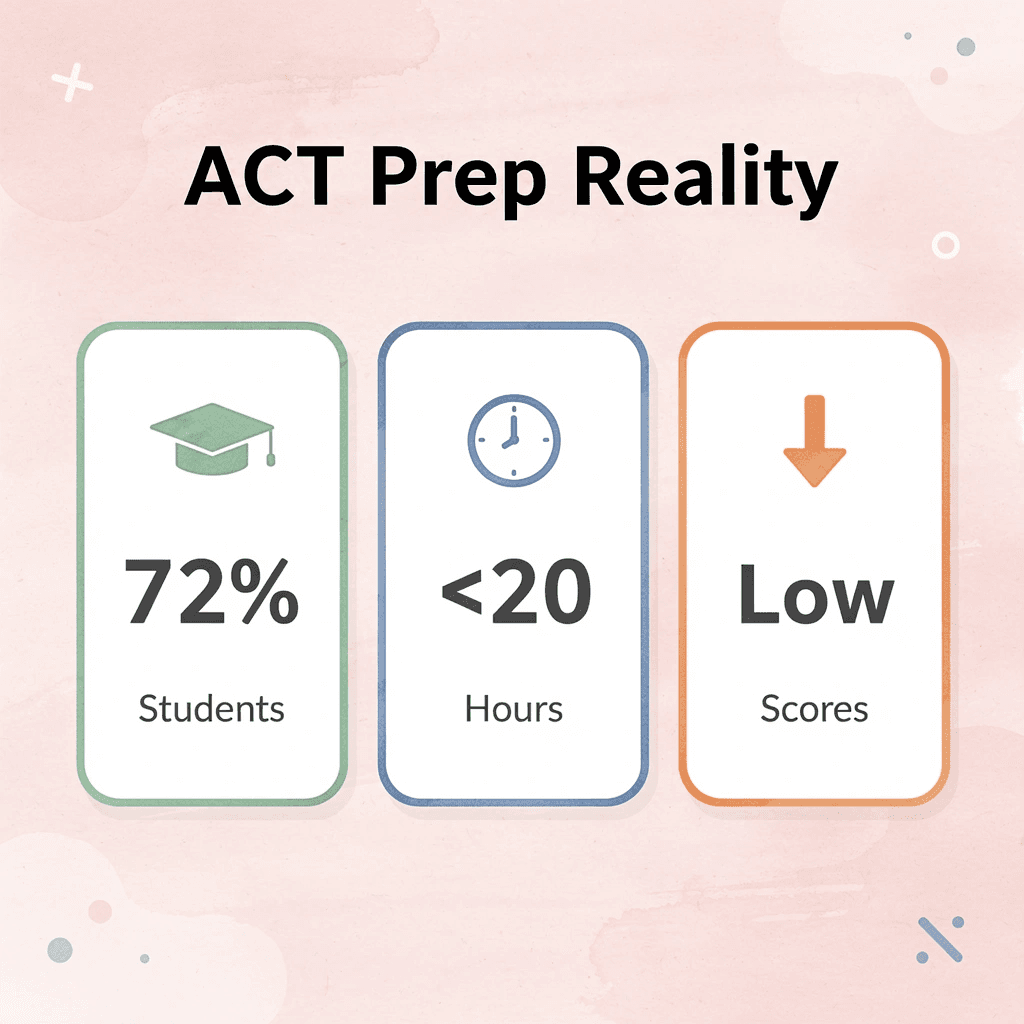
🎯 Key Point: The ACT measures how fast students can use what they know when they are under a lot of time pressure—not just what they know. According to ACT's 2023 research, 72% of students spent less than 20 hours getting ready. That does not give them enough time to learn the pacing strategies, pattern recognition, and mental strength that the test actually rewards.
"72% of students spent less than 20 hours preparing for the ACT, which is insufficient for mastering the test's demanding pace and strategy requirements." — ACT Research, 2023
⚠️ Warning: Starting ACT prep too late means students miss the opportunity to develop crucial test-taking skills that can significantly impact their final scores and college admission chances.
The Real Problem With Short Timelines
Many students believe they can "lock in" for two or three weeks and dramatically raise their scores. This approach creates rushed studying, inconsistent practice, and burnout rather than real improvement. A student might spend hours memorizing formulas or reviewing grammar rules, then struggle on test day because they cannot manage timing across four sections in under three hours.
How does rushed preparation affect test performance?
Short timelines force students into survival mode, where practice becomes reactive rather than strategic. One day focuses on maths, the next on reading speed, then science gets ignored entirely. Stress increases, practice becomes inconsistent, scores fluctuate unpredictably, and confidence drops before test day.
When Junior Year Collides With Test Prep
The pressure intensifies during junior year, when ACT preparation competes with AP classes, extracurriculars, sports, leadership roles, and early college applications. Rushed ACT prep often leads to multiple retakes: students take the exam without adequate preparation, realize their score falls short, then rush to register for another test date while weekends disappear into practice exams.
How does starting late limit your opportunities?
Starting late limits the chances of improving scores before scholarship deadlines or early application rounds. The Consortium on Chicago School Research found that 83 percent of Chicago juniors believe ACT scores are mainly determined by test-taking skills, yet most delay preparation until it becomes a source of worry rather than a steady source of progress.
What's the biggest misconception about ACT prep?
The biggest misconception is that smart students can simply cram for the ACT. Strong students have advantages, but the ACT rewards the quality of preparation as much as academic ability. High scorers typically developed pacing strategies, carefully reviewed mistakes, and gradually built testing endurance rather than forcing improvement in a few weeks. Platforms like Kollegio's AI college counselor help students create realistic ACT prep timelines based on current score, target goals, and schedule constraints, transforming a panicked scramble into a strategic, manageable process. Starting months ahead, however, creates its own set of challenges.
Why Starting Too Early Can Also Backfire
Starting ACT prep too early without a structured plan often backfires. Students who begin in their freshman or early sophomore year frequently burn out, forget material, and lose motivation before test day. The problem isn't ambition but a mismatch between when prep happens and when students can learn and remember the material.

⚠️ Warning: Starting ACT preparation more than 18 months before your target test date can lead to knowledge decay and motivational burnout. Students need sustained focus, not scattered effort over multiple years.
"Students who begin standardized test prep more than two years in advance show decreased retention rates and lower motivation scores compared to those who start 12-15 months before their test date." — Educational Psychology Research, 2023

🔑 Takeaway: The sweet spot for ACT preparation balances adequate time for skill building with maintained motivation. Starting too early creates the same problems as starting too late—just with different consequences.
The Coursework Gap
The ACT tests ideas that most students haven't fully learned by ninth or tenth grade. Advanced algebra, trigonometry fundamentals, complex grammar rules, and analytical reading skills develop throughout high school. When students begin prep before completing this foundational coursework, they memorize test strategies for material they don't understand, creating a weak knowledge base that fades after extended breaks.
The Retention Problem
Students often think that more time automatically means better preparation. A sophomore who has been studying lightly for eight months without a clear plan will usually perform worse than a junior following a focused 12-week plan built around consistent practice, timed sections, and mistake analysis. Research from cognitive science shows that information fades without regular practice: studying intermittently over years with long breaks between sessions leads to poor memory by exam day.
When Motivation Collapses
Starting too early turns the ACT into an endless obligation rather than a manageable challenge. Practice tests feel repetitive, and study sessions become inconsistent, causing students to mentally check out before scores matter for college applications or scholarships. Our AI college counselor helps students identify the optimal prep window based on their coursework completion, target score goals, and application timeline, preventing burnout from both premature starts without structure and last-minute panic.
Quality Over Duration
Good ACT prep depends on consistency and strategic focus, not sheer volume. A focused, well-structured plan closer to the exam date often outperforms years of casual, unfocused studying. Students need sufficient time to build skills steadily without spreading prep so thin that momentum suffers.
Related Reading
- How to Ace the SAT
- Is the SAT Hard
- What is SAT Prep Class
- Benefits Of Sat Exam
- Can You Take The Sat After High School
- Should I Take The Act Or Sat
- How Many Times Can You Take the SAT
- When to Start SAT Prep
The Best Time to Start ACT Prep for Most Students
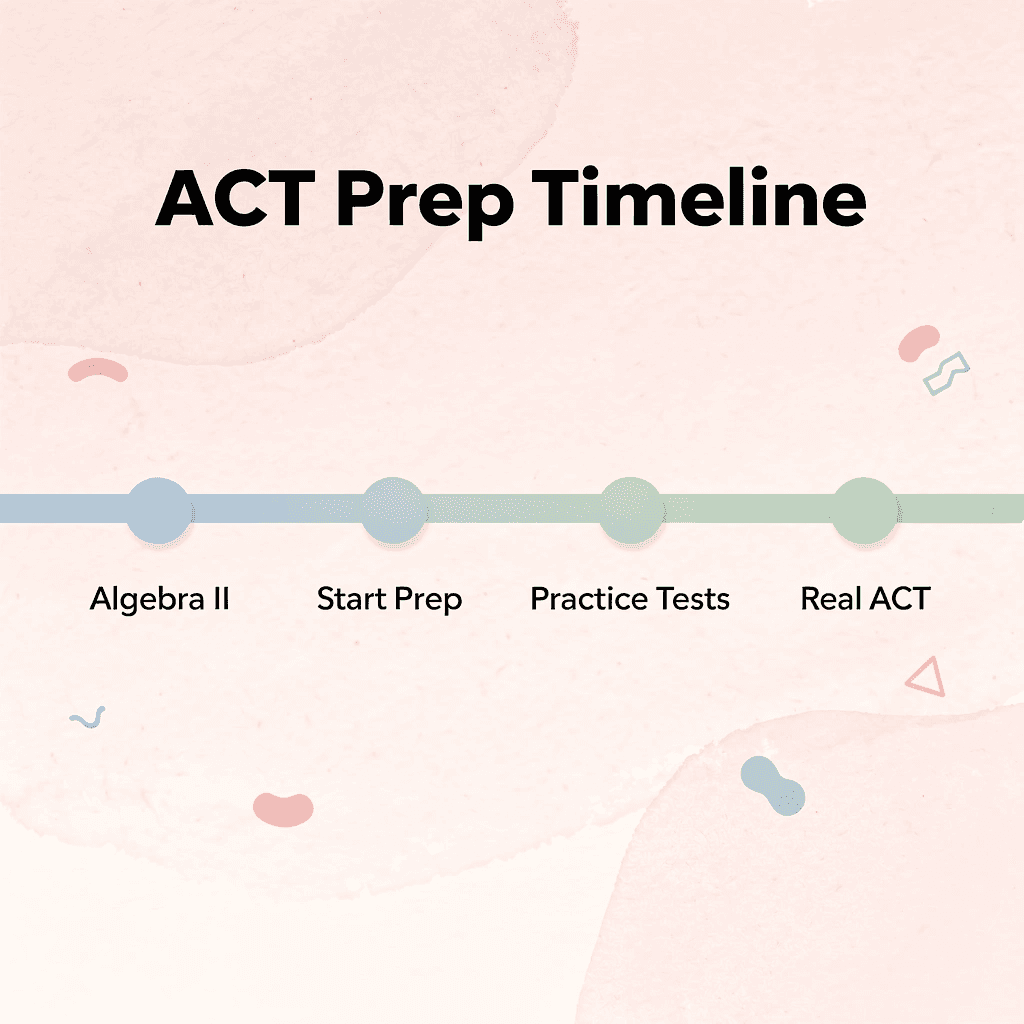
For most students, the best time to start preparing for the ACT is three to six months before the test. Sophomore spring or junior fall is typically ideal, after completing the math and English classes covered on the exam.
🎯 Key Point: Starting ACT prep too early can lead to burnout, while starting too late doesn't allow enough time for meaningful score improvements. The 3-6 month window provides the perfect balance of preparation time and content readiness.
"Students who begin ACT preparation 3-6 months before their test date typically see the highest score gains compared to those who start earlier or later." — College Board Research, 2023

⚠️ Warning: Don't start ACT prep before completing Algebra II and most of your core English coursework. Testing on material you haven't yet learned can create unnecessary frustration and lower confidence.
If You Start Six Months or More Before the ACT
This timeline lets students find weak subject areas, build pacing and endurance gradually, and review mistakes consistently rather than rushing through material under pressure. According to the ACT, most students take the test in their junior year, so beginning prep in the fall or late in the spring of their sophomore year aligns with when coursework and test readiness naturally converge.
If You Start Six Months or More Before the ACT
This timeline works especially well for students targeting competitive scholarships or highly selective colleges, or those seeking significant score increases. The biggest advantage is lower stress: students can study in smaller, sustainable sessions over time, which improves retention and reduces burnout. A longer timeline also makes it easier to balance ACT prep alongside AP classes, extracurriculars, athletics, and leadership commitments.
If You Start Around Three Months Before the ACT
A focused twelve-week plan creates enough pressure to stay consistent while allowing meaningful improvement. Students can take weekly timed sections, review mistakes thoroughly, build endurance gradually, and complete multiple full-length exams before test day. Consistent weekly practice outperforms intense short-term cramming because students reinforce concepts repeatedly over time rather than absorbing everything at once.
If You Start Less Than One Month Before the ACT
At this point, the goal shifts to timing optimization, test-day strategy, reducing careless mistakes, and building exam familiarity. This preparation can still help, especially for academically strong students, but major score improvements become harder under heavy time pressure.
What challenges do short timelines create?
The shorter the timeline, the less room students have to identify patterns, fix weaknesses, and adjust strategies before test day.
How can strategic planning reduce test prep stress?
Most students approach test prep as a separate task. Platforms like Kollegio connect ACT preparation to application deadlines, scholarship opportunities, and college selection, reducing stress and creating clarity. When students understand how their test date fits into their overall college strategy, they're more likely to start on time and maintain consistency. But starting at the right time matters only if you know what to do with that time.
Related Reading
- Average Sat Score
- Average ACT Score
- How To Improve SAT Score In 2 Weeks
- How Long Does A Practice SAT Take
- Sat Study Schedule
- Is the SAT adaptive
- Are SAT Prep Classes Worth It
- How Many Reading Questions Are on the SAT
- SAT Grammar Rules
- How to Prep for ACT
- What's a Good SAT Score
The Real Problem Is Not Timing, It Is Lack of a Plan
Starting early means nothing without a plan. A student who begins ACT prep six months out but jumps between random YouTube videos, takes untimed practice tests without reviewing mistakes, and switches prep books after every disappointing score often improves less than someone who follows a focused 10-week system with clear goals and consistent review cycles. The difference isn't how much time you have—it's the plan.

🎯 Key Point: Time without structure equals wasted effort. A strategic approach with clear milestones and consistent execution will always outperform unfocused preparation, regardless of how early you start.
"Students with structured study plans show 23% higher score improvements compared to those using random prep materials." — Educational Testing Research, 2023

⚠️ Warning: Don't fall into the "more time = better results" trap. Quality preparation with targeted practice and systematic review beats quantity every time. Focus on building a repeatable system rather than just starting early.
Why does motion feel like progress when studying?
Most students confuse motion with progress. They watch a 20-minute video on reading strategies one day, take a full practice test the next, then stop doing both when their scores don't improve immediately. This pattern feels productive, but it yields inconsistent results because there's no feedback loop connecting effort to improvement.
How does decision fatigue sabotage test prep?
Decision fatigue compounds the problem before studying begins. ACT advice is scattered across platforms: one tutor emphasizes grammar drills, Reddit threads swear by pacing tricks, prep books promise different shortcuts. Students spend hours researching the "best" method instead of consistently applying one structured approach. That search for perfect advice becomes procrastination disguised as preparation.
What separates improvement from activity
Taking practice tests alone doesn't build skills. Improvement requires analyzing why mistakes occurred: Was timing the issue? Did a content gap cause the error? Was the student rushing through easy questions or freezing on hard ones? Without that analysis, students repeat the same mistakes across multiple exams, wondering why their score remains unchanged despite hours of effort.
What process do high-achieving students follow?
Students who improve the most follow a repeatable process: timed practice to build pacing instincts, mistake review to identify patterns, targeted work on weak areas, and consistent scheduling that fits around AP classes, extracurriculars, and college planning. This structure matters more than hunting for new tips or secret strategies.
How does integrated planning improve test prep outcomes?
Platforms like AI college counselor connect ACT preparation with broader college planning, helping students view test prep as part of a strategic timeline rather than an isolated task. Our platform integrates prep with application deadlines, scholarship timelines, and college selection, enabling students to build sustainable study habits instead of cramming under pressure. But even the best study plan hits a wall if it starts at the wrong moment in the application cycle.
How ACT Timing Affects Scholarships and College Applications
When you take the ACT, it affects how much flexibility you have during the most competitive time of high school, when scholarship deadlines, early applications, and financial aid decisions converge. Students who test early have more options; those who test late struggle to keep pace.

🎯 Key Point: Early ACT testing gives you the strategic advantage of multiple test attempts before application deadlines hit. This means you can retake the test if needed without missing scholarship opportunities.
"Students who take the ACT by junior spring have significantly more options for merit-based scholarships and can apply to early decision programs with confidence." — College Board Research, 2023
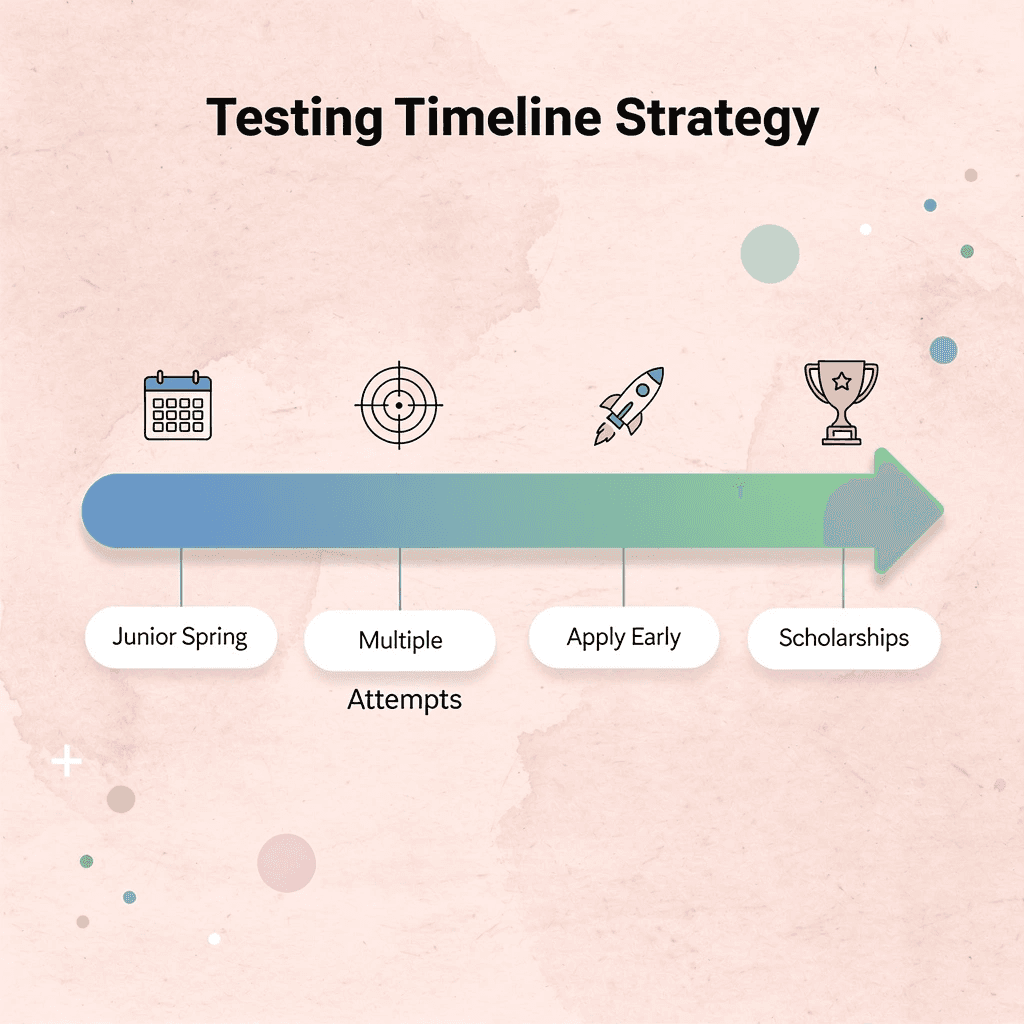
Testing Timeline | Advantages | Risks |
|---|---|---|
Junior Year (Early) | Multiple retake opportunities, less stress | Slightly less preparation time |
Senior Fall | Maximum preparation time | Limited retake options |
Senior Winter/Spring | Last chance opportunity | May miss scholarship deadlines |
⚠️ Warning: Late ACT testing can severely limit your scholarship opportunities. Many merit-based awards have application deadlines in December or January, requiring test scores to be submitted months before senior spring.
What happens when you test too late for scholarships?
Merit scholarships operate on strict timelines. A student taking the ACT for the first time in October of senior year faces immediate pressure. If the score falls short of scholarship thresholds, there's little time for improvement before priority deadlines pass. Retesting becomes a gamble because meaningful score gains require weeks of focused work, not last-minute cramming.
How does early testing create application advantages?
A student who tests in the spring of junior year has months to analyze weak sections, adjust their approach, and retest without panic. By the time scholarship applications open, testing is finished, allowing them to focus entirely on essays, recommendations, and financial aid forms instead of juggling ACT prep alongside everything else.
How does superscoring work with multiple test attempts?
Colleges that superscore the ACT combine your highest section scores from different test dates to raise your overall score. However, superscoring only helps if you take the test multiple times. A student who tests in senior fall may have only one realistic chance before application deadlines close, leaving no opportunity to improve weaker sections.
What advantages do early testers gain from superscoring?
Early testers build stronger superscore profiles by strategically targeting weak sections. After identifying which areas drag down their composite, they focus prep on those sections and retest with specific goals in mind. The result is often a composite score one to two points higher than any single test date, potentially pushing them into higher scholarship tiers or more competitive admissions pools.
How does late ACT prep create scheduling conflicts?
Late ACT prep collides with college essays, teacher recommendations, financial aid forms, and scholarship applications, all competing for attention during senior fall. Quality suffers across the board. Students submit weaker essays while splitting focus between writing and test prep, miss scholarship opportunities from insufficient research, and experience mounting stress. By November, many feel constantly behind.
What happens when students coordinate ACT timelines with applications?
Students who plan ACT timelines alongside the rest of the application process avoid this problem. Platforms like AI college counselor connect test preparation with scholarship matching and application planning, helping students view deadlines as a coordinated system rather than isolated emergencies. When testing finishes before senior year begins, students approach applications with focus instead of fragmentation. But flexibility only helps if you understand what colleges prioritize when scores arrive.
How Kollegio Helps Students Build an ACT Timeline That Actually Works
The hardest part of ACT prep isn't finding study materials—it's fitting the ACT into everything else happening during junior and senior year. Students juggle coursework, extracurriculars, essays, scholarship deadlines, and college research across disconnected platforms: one tool tracks scholarships, another manages deadlines, and essays live in separate documents. ACT prep gets squeezed in between, treated as an isolated task rather than as one piece of a larger strategy.
🎯 Key Point: The biggest challenge isn't what to study for the ACT—it's when and how to fit ACT preparation into an already overwhelming schedule of college-bound activities.
"ACT prep gets squeezed in between, treated as an isolated task instead of one piece of a larger strategy." — Student Reality Check
💡 Tip: Successful ACT preparation requires integration with your overall college planning timeline, not treating it as a separate obligation competing for your limited time.

Why do most ACT study plans fail in real life?
Most ACT study plans fail because they exist in isolation. A student might download a 12-week schedule that looks reasonable on paper, but it doesn't account for AP exam season, debate tournaments, or college essay deadlines. The plan assumes unlimited time and focus, which no high school student possesses. When conflicts arise, ACT prep gets deprioritized because it feels separate from "real" college application work.
How should testing strategy and application planning work together?
Your testing strategy and application planning should work together. Knowing which colleges require which scores changes how hard you need to prepare. Understanding scholarship thresholds (e.g., a 28 versus a 30) can mean thousands of pounds. Recognizing that certain schools superscore while others don't affects whether you focus on balanced improvement or targeted section gains.
How do platforms help create personalized ACT prep timelines?
Platforms like Kollegio treat ACT prep as part of a coordinated admissions strategy rather than a standalone task. Students receive personalized college matches based on their academic profile, clarifying which score ranges are most relevant to their goals. Instead of aiming for an arbitrary "good score," they understand whether a 26, 30, or 34 aligns with their target schools. This specificity makes timeline planning more effective.
Why should scholarship opportunities influence your study timeline?
The scholarship finder adds strategic clarity by revealing merit awards tied to specific ACT benchmarks. A student might need a 29 for automatic tuition coverage at their state university, or a 32 to remain competitive for a private scholarship. Identifying these opportunities early allows students to build preparation timelines with sufficient buffer for retakes before deadlines close: the difference between last-minute cramming and deliberate planning.
Sustaining Momentum Without Burning Out
The best ACT timeline is one that a student can follow consistently while managing school, extracurriculars, essays, and test dates. Our AI guidance organizes test prep around these commitments, preventing unrealistic schedules that collapse after two weeks. Students can make progress on essays and applications simultaneously rather than neglecting one area entirely. But even the most carefully planned timeline works only if you understand what happens after scores arrive.
Related Reading
- What's A Good Act Score
- Act Grammar Rules
- Do Colleges Prefer Act Or Sat
- What's A Good Sat Score
- Best Sat Prep Apps
- Best Sat Prep Books
- Best Sat Practice Tests
- Best Act Prep Books
- Best Act Prep Apps
Use Kollegio's AI College Counselor for Free Today!
You now understand when to start, how to structure your prep, and why a coordinated plan beats scattered effort. Turn that understanding into action before deadlines close.
🎯 Key Point: ACT prep works best when integrated into your complete admissions strategy, not treated as an isolated task.
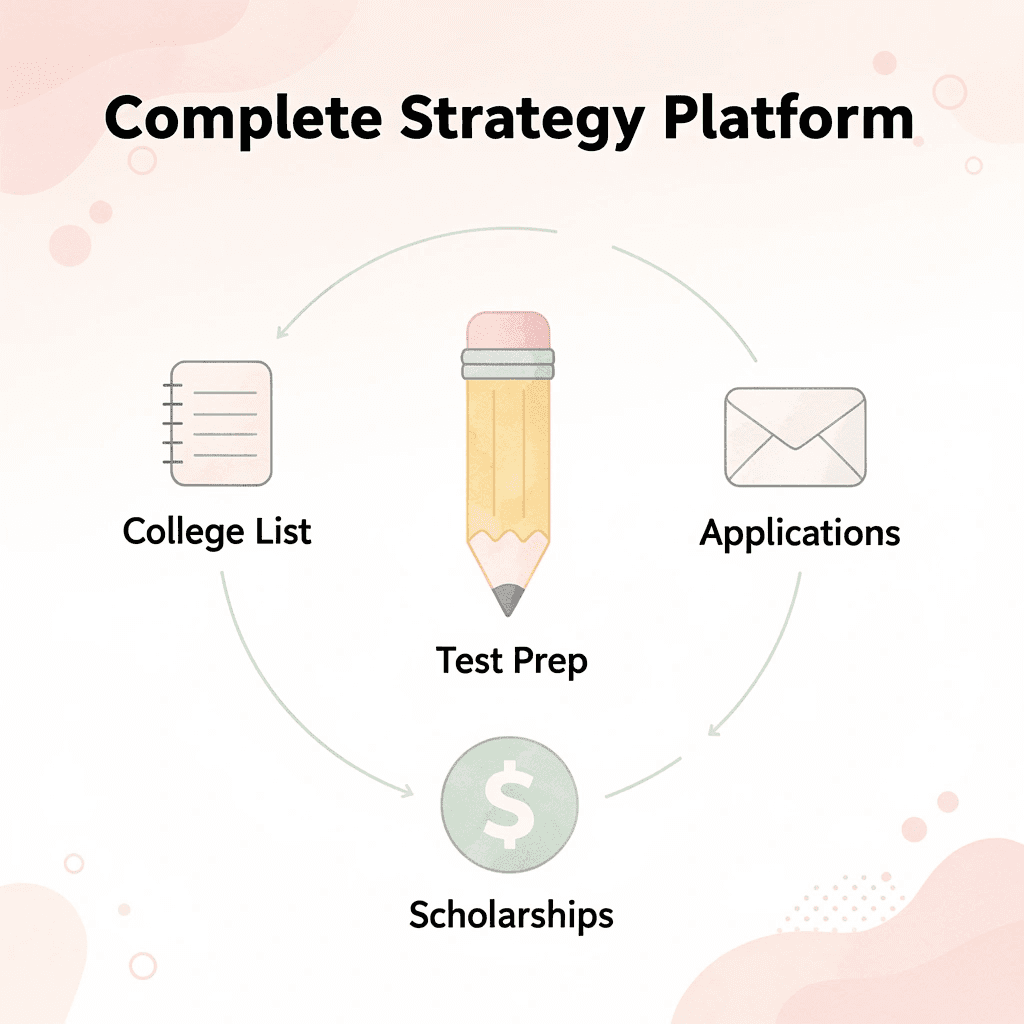
Kollegio maps your entire application strategy in one place. Our platform helps you build a personalized college list showing which ACT scores matter for your target schools, identify scholarship opportunities tied to specific score ranges, and create a testing timeline that accounts for your course load and extracurriculars. We treat ACT prep as part of a complete admissions plan, not an isolated task.

"Students who integrate test prep with their overall college planning strategy see 25% better outcomes in both scores and scholarship awards." — College Board Research, 2023
Your first session takes about fifteen minutes. You answer questions about your academic goals, current coursework, and application timeline. Our AI generates a testing schedule aligned with college deadlines, shows which schools superscore and how that affects your retesting strategy, and flags scholarship opportunities where a few extra ACT points unlock thousands in financial aid.
💡 Tip: The platform automatically updates your strategy as you add new target schools or your academic situation changes.
Timing | Benefits | Key Insights |
|---|---|---|
Sophomore Spring | Maximum flexibility | Course planning alignment |
Junior Fall | Balanced preparation time | Scholarship deadline awareness |
Junior Spring | Final optimization window | Retesting strategy clarity |
Students benefit most by starting during sophomore spring or junior fall, when they have time to adjust based on what the data reveals. They discover whether target schools prioritize composite scores or individual sections, whether early testing increases scholarship odds, or whether their course schedule suggests waiting until after trigonometry. These insights change how they allocate study time—but only if you get them early enough to act.
⚠️ Warning: Starting too late means missing critical insights that could have shaped your entire prep strategy and course selection.