
What’s a Good ACT Score for College Admissions Today?
Standardized test scores play a crucial role in college admissions, but understanding what constitutes a competitive ACT score depends entirely on where students plan to apply. Different universities have vastly different expectations, with some accepting scores in the mid-20s while others expect scores above 30. Knowing these benchmarks helps students set realistic targets and develop effective test preparation strategies. Score percentiles reveal how performance compares with that of other test-takers nationwide, providing valuable context for the admissions process.
Beyond raw numbers, colleges evaluate ACT scores within the broader context of each applicant's academic profile and intended major. Students benefit from understanding how their scores align with the typical admitted student ranges of their target schools. Rather than spending countless hours researching individual college requirements and average scores, students can streamline this process with an AI college counselor that analyzes their complete academic profile and provides personalized college recommendations.
Summary
- The national average ACT score is 19.8 out of 36, providing a baseline for students evaluating their performance. A score of 24 places students at the 75th percentile nationally, meaning they've outperformed three-quarters of test takers. However, these percentiles matter far less than whether a score makes students competitive at their specific target schools or qualifies them for scholarships they need.
- ACT score improvements follow a pattern of diminishing returns, with some jumps dramatically changing opportunities while others produce minimal practical impact. Moving from a 22 to a 28 may substantially increase admissions competitiveness and scholarship eligibility across many universities, but improving from a 34 to a 35 rarely changes outcomes as significantly. Students often invest months chasing marginal improvements without evaluating whether additional points actually unlock different college options or financial aid.
- Test anxiety affects approximately 25 to 40% of students, according to research published by Edutopia, reflecting how students internalize ACT scores as measures of their worth rather than data points. This psychological pressure can actually suppress performance. Research shows that students experienced a 15 percentage-point drop in test scores when tests were high-stakes versus low-stakes, creating a cycle in which anxiety about the score undermines the score itself.
- Scholarship thresholds represent one of the clearest examples where specific ACT score ranges determine eligibility for merit aid, honors programs, or automatic financial support. Crossing these thresholds can translate into thousands of dollars in additional funding. Many colleges use precise cutoffs, making the difference between a 26 and a 27 potentially more valuable than the difference between a 33 and a 35, depending on institutional requirements.
- Colleges evaluate applications holistically, considering GPA, course rigor, essays, extracurricular involvement, leadership, and recommendations alongside test scores. A strong ACT score paired with weak course rigor or minimal activities won't carry the same weight as a slightly lower score supported by a rigorous transcript and meaningful engagement. Every hour spent on practice tests competes directly with time that could be spent strengthening other application components.
- Kollegio's AI college counselor connects ACT scores directly to personalized college matches and scholarship opportunities, showing where current scores position students competitively and whether improvements would meaningfully change outcomes at their specific target schools.
Why Students Stress So Much About "Good" ACT Scores
Students stress about ACT scores because they believe a single number determines their future in college. College acceptance videos celebrate 34s and 35s, Reddit threads debate whether a 28 is "enough," and friends compare subscores in hallways. Students never learn that the context around the score matters more than the raw number itself.

🎯 Key Point: Your ACT score is just one piece of your college application puzzle - not the entire picture that determines your future.
"The pressure to achieve a 'perfect' ACT score has created unnecessary anxiety among students who don't realize that context matters more than the number." — College Admissions Research, 2023

⚠️ Warning: Focusing solely on achieving a "good" score without understanding holistic admissions can lead to misplaced priorities and increased stress.
How does comparing scores without context increase anxiety?
Anxiety worsens when students compare themselves against incomplete information. Someone posts a 32 on social media without mentioning they're applying to engineering programs at state schools where that score opens full-ride scholarships. Another student sees that 32 and panics because they're aiming for Ivy League schools where the middle 50% starts higher. Neither understands the other's context, yet both feel inadequate.
Why do students treat test scores as identity markers?
According to research published by Edutopia, test anxiety affects 25-40% of students. Students begin to believe their ACT score reflects their intelligence, worth, and future potential. When the score becomes their identity rather than a number, each practice test feels like a judgment of who they are.
Why do students fall into the comparison trap?
Most students never see the full picture behind the scores they're comparing themselves against. Online forums overflow with anonymous posts listing ACT composites without mentioning GPA, course rigor, extracurricular depth, or the specific colleges those students got into. A 30 might have been enough for one applicant's goals but not another's, yet that nuance disappears in the comment section. Students absorb these numbers as universal benchmarks when they're individual data points stripped of meaning.
What happens when students chase scores without understanding their impact?
The stress intensifies when students chase higher scores without understanding their value. Improving from a 24 to a 27 might move a student from conditional admission to automatic acceptance at certain state universities. Jumping from a 30 to a 33 could mean the difference between partial and full-tuition merit scholarships at specific schools. But moving from a 33 to a 35 rarely changes outcomes as dramatically as students expect, especially if the rest of their application already positions them competitively.
Platforms like Kollegio's AI college counselor help students understand where their ACT scores fit within their academic profile, showing which colleges match their numbers and what those scores unlock in terms of admission probability and scholarship opportunities. Rather than guessing whether another round of test prep makes strategic sense, students see how their current score positions them across their target schools.
How does stress prevent practical ACT decisions?
The obsession with finding a single "good" score prevents students from making practical decisions. Some retake the ACT four or five times while essays sit unwritten and scholarship deadlines pass. Others become so discouraged by online score comparisons that they assume their score disqualifies them from schools where they'd be competitive. Both groups lose irretrievable time.
Why does pressure actually hurt ACT performance?
Research from Edutopia shows that students experienced a 15 percentage point drop in test scores on high-stakes versus low-stakes tests. The pressure surrounding ACT scores can suppress performance, creating a cycle where anxiety undermines results. Students who view the ACT as one data point among many perform better than those who treat it as a definitive judgment. Understanding what your ACT score means for the colleges you want to attend matters more than the score itself.
What Is Considered a Good ACT Score?
A good ACT score opens doors to your target schools, helps you qualify for scholarships, and demonstrates your academic readiness. What matters is how competitive your score is at your target schools and whether it accurately represents your abilities.
🎯 Key Point: Your target schools determine what constitutes a good ACT score for you. A score of 28 might be excellent for one college but below average for another.
"A good ACT score is context-dependent - it's not about achieving a perfect 36, but about meeting the admission requirements and scholarship thresholds of your chosen institutions." — College Board Research, 2024
💡 Tip: Research the middle 50% ACT scores of admitted students at your target schools. This range shows you where you need to score to be competitive in the admissions process.

Score Range | Percentile | College Tier |
|---|---|---|
32-36 | 99th-95th | Top-tier schools |
28-31 | 94th-88th | Highly selective |
24-27 | 87th-76th | Moderately selective |
20-23 | 75th-58th | Less selective |
What does the national ACT score data tell us?
ACT reports that the average composite score is 19.8 out of 36. Scoring above that average makes you competitive at many colleges, but whether you're a good fit depends on admission rates, program selectivity, and the applicant pool, not the score alone.
How do different score ranges affect college admissions?
A score of 20 to 23 is competitive at regional and less selective universities. A score of 24 to 29 positions you well for public universities and often qualifies you for a merit scholarship. According to PrepScholar, a score of 24 places you at the 75th percentile nationally. A score of 30 to 34 becomes highly competitive for selective universities, while 35 to 36 puts you near the top of national distributions.
Why Context Determines Value
A 27 might make one student highly competitive across their entire college list while qualifying them for significant merit aid. Another student applying mainly to highly selective schools might view that same score differently based on the middle 50% ACT ranges at those schools. The opportunities attached to the score matter more than the percentile rank.
How do colleges evaluate ACT scores within your full application?
Colleges consider far more than test scores: your GPA, course rigor, essays, extracurricular activities, leadership roles, recommendation letters, and personal circumstances. Your ACT score is one piece of a comprehensive review. A strong score paired with weak coursework or limited activities won't carry as much weight as a slightly lower score accompanied by challenging classes and meaningful engagement.
Why should you shift from score obsession to strategic positioning?
Most students treat their ACT score as final, even though it can change. Platforms like AI college counselor help students understand where their scores fit within their unique profile and goals, connecting score interpretation directly to personalized college lists, matching schools, and realistic admission opportunities. This shift from score obsession to strategic positioning changes how students approach both testing and applications. Even when students hit their target score, the outcome doesn't always match their expectations.
Related Reading
- How to Ace the SAT
- Is the SAT Hard
- What is SAT Prep Class
- Benefits Of Sat Exam
- Can You Take The Sat After High School
- Should I Take The Act Or Sat
- How Many Times Can You Take the SAT
- When to Start SAT Prep
Why Higher ACT Scores Do Not Always Change Outcomes
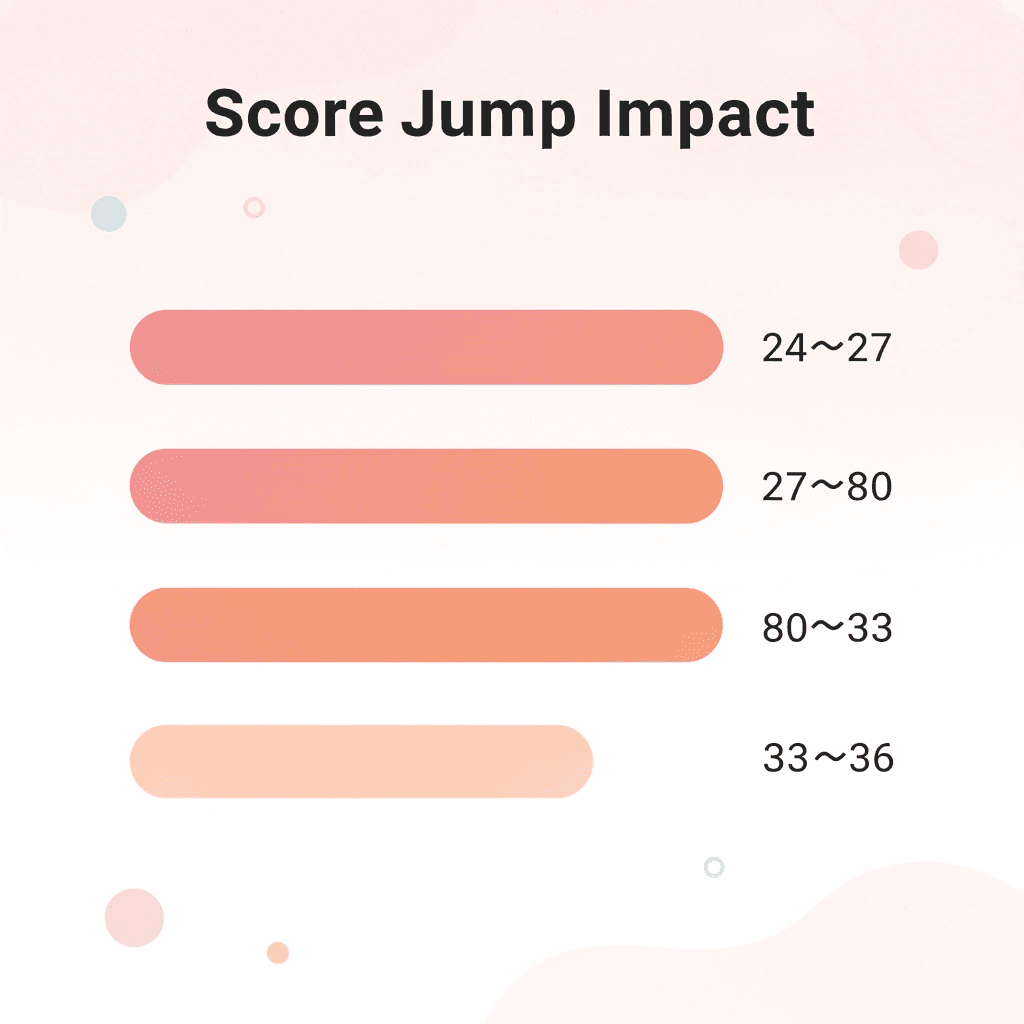
ACT score improvements follow a pattern of diminishing returns. Some jumps dramatically change college opportunities, while others have little practical impact depending on the student's goals and application profile.

🎯 Key Point: A 3-point increase from 28 to 31 opens doors to significantly more selective colleges than a jump from 31 to 34, even though both require similar effort.
"The difference between a 30 and 32 ACT score can mean the difference between merit aid and full tuition, but a 34 versus 36 rarely changes admission outcomes at the same institutions."

Score Range | Practical Impact | Effort Required |
|---|---|---|
24 → 27 | High - Opens state flagship options | Moderate |
27 → 30 | Very High - Merit scholarships unlock | High |
30 → 33 | Moderate - Top-tier college access | Very High |
33 → 36 | Low - Minimal admission advantage | Extremely High |
⚠️ Warning: Students often chase perfect scores when their time would be better invested in strengthening other application components like essays, extracurriculars, or leadership experiences.
When the score actually matters
Scholarship thresholds are one of the clearest examples. Many colleges use specific ACT score ranges to determine eligibility for merit scholarships, honors programs, or automatic consideration for aid. Crossing a threshold can translate into thousands of dollars in additional financial support.
Competitive admissions cutoffs matter. For certain universities or academic programs, moving from one score range to another may place a student within the middle 50 percent of admitted applicants, meaningfully improving admissions positioning.
Why do marginal score improvements often disappoint students?
Once students reach competitive score ranges for their target schools, retaking the test yields diminishing practical benefits. According to ACT Test Enhancements for Higher Education, higher ACT scores often don't change outcomes because many colleges evaluate applicants holistically, considering GPA, course rigor, essays, activities, leadership, recommendations, and personal context.
Improving from a 22 to a 28 substantially increases admissions competitiveness and scholarship eligibility. Improving from a 34 to a 35 may create far less practical impact, especially if already within highly competitive ranges for target schools. The key difference is whether the additional point meaningfully changes admissions or scholarship outcomes.
What should students focus on instead of endless retakes?
Some students retake the test repeatedly to improve scores but neglect essays, scholarship applications, extracurricular activities, and application strategy, which often have a greater impact. ACT scores matter, but they represent only one component of a comprehensive application strategy. Knowing your score is competitive is only half the battle.
Related Reading
- Average Sat Score
- Average ACT Score
- How To Improve SAT Score In 2 Weeks
- How Long Does A Practice SAT Take
- Sat Study Schedule
- Is the SAT adaptive
- Are SAT Prep Classes Worth It
- How Many Reading Questions Are on the SAT
- SAT Grammar Rules
- How to Prep for ACT
- What's a Good SAT Score
How Students Should Actually Use ACT Scores Strategically
The shift from "what score do I need?" to "what does this score unlock?" changes everything. Students who treat ACT scores strategically spend less time chasing smaller improvements and more time building stronger applications. The real question isn't whether your score is good enough in abstract terms—it's whether it opens doors at schools you want to attend, qualifies you for scholarships that matter, or leaves opportunity on the table.

🎯 Key Point: Your ACT score is a tool, not a destination. Focus on what it can unlock, not on chasing perfect numbers.
"Students who approach standardized testing strategically see 25% better outcomes in college admissions compared to those who focus solely on score maximization." — College Board Research, 2023

💡 Strategic Tip: Create a target score matrix that maps your current score against specific scholarship thresholds and admission requirements at your target schools. This helps you identify the minimum effective score rather than wasting time on diminishing returns.
Start with your college list, not your score
Most students evaluate their ACT performance in the wrong order. They take the test, get a score, then wonder if it's competitive. The better approach reverses that process: identify target schools first, research their published middle 50% ACT ranges, check automatic scholarship cutoffs and honors college requirements, then compare your score against those benchmarks. A 28 might be competitive for a strong regional university with generous merit aid, while the same score falls below the 25th percentile at a highly selective school. Context determines strategy.
Understand what score increases actually unlock
Not all score improvements offer the same benefits. A student with a 26 who needs a 27 for a $10,000 yearly scholarship has a clear, high-value goal. Another student with a 32 applying to schools where the middle range is 30-33 gains little from reaching 33. The effort required to improve scores increases significantly at higher ranges, while admissions advantages often diminish. According to Mr. Test Prep - Michael Romano's LinkedIn analysis, students often spend months pursuing one or two additional points without verifying whether that improvement changes their college choices or scholarship eligibility. Before retaking the test, ask: What specific opportunity does one more point create?
How do you know when other application components matter more than ACT scores?
ACT prep competes directly with everything else that strengthens an application. Every hour spent on practice tests is time not spent improving essays, researching scholarships, deepening extracurricular involvement, or building relationships with teachers who write recommendations.
Students who score in the competitive range for their target schools often see better returns from shifting focus elsewhere. A common pattern emerges when students plan a fourth retake after scoring in the middle 50% range for their college list: completing strong supplemental essays and applying for institutional scholarships may create more advantage than another small score increase.
What happens when you build college lists around hoped-for scores?
The familiar approach is building college lists around hoped-for scores rather than current ones. As deadlines approach and scores plateau after multiple attempts, students rush to research new schools, rewrite essays for different prompts, and submit applications without strategic scholarship planning.
Platforms like Kollegio's AI college counselor help students build personalized college lists based on their current profile, then identify which score improvements would expand options versus which schools already match well, allowing students to focus prep time where it yields the highest return.
Evaluate whether retakes make strategic sense
The choice to retake should be based on strategy, not automatic habit. Consider whether your current score suffices, how much realistic improvement is possible based on previous attempts, what that improvement would help you achieve, and whether the time investment justifies the potential results. A student who has taken the ACT three times with only marginal improvement each time will likely see diminishing returns, while one who tested once without adequate preparation may improve significantly with a focused plan. But knowing when to stop testing solves only half the problem; the harder part is understanding how your complete profile positions you at schools you care about.
How Kollegio Helps Students Understand ACT Scores in Context
The challenge isn't figuring out what a 28 ACT score means by itself; it's understanding what that score means for your specific college list, scholarship opportunities, and whether retesting improves your outcomes. Most students compare scores without knowing which schools realistically match their profile or where another two points might unlock meaningful financial aid.
🎯 Key Point: A score's value depends entirely on your target schools and scholarship thresholds—context matters more than percentiles.

"Understanding score context in relation to specific college goals is what transforms test prep from guesswork into strategic planning." — College Admissions Research, 2024
💡 Tip: Before deciding to retest, research the exact score ranges for your target schools' merit scholarships—sometimes just 1-2 points can mean thousands in aid.

How do scattered research tools affect college planning?
Students research colleges on one site, check scholarship requirements on another, and track deadlines in a spreadsheet, making it nearly impossible to see how the testing strategy relates to admission probability or merit-aid eligibility. Decision-making becomes guesswork rather than strategy.
How can integrated platforms improve score interpretation?
Platforms like Kollegio connect ACT scores directly to personalized college matches and scholarship opportunities, showing where students position competitively and whether score improvements would meaningfully change outcomes. Instead of wondering if a 26 is "good enough," students see which target schools place them above the 50th percentile for admitted students and which scholarship thresholds sit within reach at 27 or 28.
Why does your target school list change everything about ACT strategy?
A student applying to regional public universities with an average admitted ACT score of 24 faces different strategic choices than someone targeting highly selective programs with median scores above 32. One student's score is already competitive for merit aid at target schools. The other needs a different score range or a college list that better matches their current profile.
How do ACT scores interact with your complete application profile?
Kollegio organizes college research, application tracking, essay feedback, scholarship searches, and testing strategy so students can evaluate decisions based on their complete profile rather than isolated metrics. ACT scores interact with GPA, course rigor, extracurriculars, and application quality to determine outcomes. A 29 ACT with weak essays and missed deadlines performs worse than a 27 with compelling narratives and strategic school selection.
The bigger advantage is making decisions based on clarity rather than anxiety. Students stop chasing score increases that won't materially improve their outcomes and start focusing energy where it creates admission or financial aid advantages. But understanding your competitive position only helps if you can execute the rest of the application with the same level of strategic support.
Use Kollegio's AI College Counselor for Free Today!
Understanding your ACT score in context matters more than knowing where you rank nationally. Platforms like Kollegio's AI college counselor compare your score against personalized college matches, organize your applications, and identify where another retake could improve your admissions or scholarship outcomes. You stop guessing whether a 27 is competitive and start seeing which schools treat it as a strength, which require higher scores for merit aid, and where your effort creates actual advantage.
💡 Tip: Don't focus solely on national percentiles—your ACT score's value depends on where you're applying and what scholarships you're targeting.
"Personalized score analysis helps students make strategic decisions about retakes and applications, focusing effort where it creates the greatest impact on admissions outcomes."

When you know your score opens doors at specific schools or qualifies you for particular scholarships, decisions become clearer, and the application process feels less overwhelming. Try Kollegio to see where your ACT score fits within your unique profile and goals, and focus your effort where it actually changes outcomes.
🎯 Key Point: The real value of your ACT score isn't in rankings—it's in understanding which opportunities it unlocks at your target schools.
Traditional Approach | AI-Powered Analysis |
|---|---|
Generic percentile rankings | Personalized college matches |
Guesswork on competitiveness | Specific scholarship eligibility |
Overwhelming choices | Strategic focus areas |
Related Reading
Author
Trailblazer Marketing