
Getting into Princeton is one of the most competitive challenges in college admissions, and SAT scores carry significant weight in that process. Princeton's middle 50% score range gives applicants a realistic benchmark, but understanding what those numbers mean for your specific profile requires more than a quick comparison.
Stop wondering.
Start matching.


Knowing what SAT score is required by Princeton is a strong starting point, yet a competitive application demands more than just hitting a target score. Students who approach the process strategically, accounting for score gaps, application strengths, and realistic timelines, tend to fare better, and an AI college counselor can help build exactly that kind of focused, personalized plan.
Table of Contents
- What SAT Score Is Required for Princeton?
- What SAT Scores Do Admitted Princeton Students Typically Earn?
- Why a High SAT Score Alone Won't Get You Into Princeton
- What Princeton Actually Looks For Beyond Test Scores
- Should You Submit Your SAT Score to Princeton?
- How Kollegio Helps Students Build Stronger Princeton Applications
- Use Kollegio's AI College Counselor for Free Today!
Summary
- The SAT middle 50% range for admitted Princeton students is between 1500 and 1560 for the composite, with Math scores ranging from 780 to 800, according to Princeton's own admissions statistics. These numbers describe who showed up in the admitted pool, not a fixed cutoff. Roughly one in four enrolled students scored below 1500, meaning strong applications without top-tier scores do gain admission when the rest of the file makes a compelling case.
- Princeton's 4% overall acceptance rate applies even to applicants who score in the 1500-1560 range, according to AdmitStudio's analysis of admissions data. That figure clarifies what a high score actually accomplishes: it clears a threshold and enters a student into the conversation. It does not resolve the central admissions question: what the student brings that no one else does.
- Grade inflation has compressed GPA ranges across competitive applicant pools, which means a 4.0 unweighted GPA differentiates less than it did a decade ago. For students from smaller or less well-known high schools, a strong SAT score can serve as a shared reference point for admissions officers who lack a frame of reference for a school's academic rigor. In that context, submitting a score becomes less about signaling achievement and more about providing readable academic context.
- Over 90% of admitted Princeton students ranked in the top 10% of their high school class, according to Magoosh College Admissions. When that is the baseline across the applicant pool, a high SAT score stops functioning as a differentiator and starts functioning as the price of entry. What separates admitted students at that level tends to be depth of intellectual focus, specificity of extracurricular impact, and essays that reveal genuine character rather than a curated resume.
- The decision to submit or withhold a score under Princeton's current test-optional policy is strategic, not automatic. A score that falls noticeably below the admitted-student range can pull a reader's attention toward the weakest signal in an otherwise strong file. Princeton has stated that applicants who choose not to submit will not be penalized, which means that withholding a below-range score is a legitimate editing decision rather than an evasion. The right question is whether the score adds confidence to the reader or introduces doubt.
- Starting in the 2027 to 2028 admissions cycle, Princeton will require standardized test scores for all applicants, as reported by The Daily Princetonian. This makes the current test-optional window finite and the non-score dimensions of an application more important to develop now, not less. Essays, activity narratives, and recommendations are where competitive differentiation occurs at this level of selectivity, and these components require the same focused preparation that students typically reserve for test prep.
- Kollegio's AI college counselor addresses this by helping students evaluate their full application profile against real admitted-student data, so decisions about score submission, essay focus, and activity framing are based on evidence rather than guesswork.
What SAT Score Is Required for Princeton?
Princeton uses a test-optional policy for Fall 2027 entry, meaning you can submit SAT scores or leave that section blank without a formal penalty. This critical distinction should inform every applicant's decision about whether to submit.
💡 Tip: Princeton's policy allows you to skip the SAT, but skipping it may not be the right strategic move for your application.

"Not required and not important are two very different things." — A distinction every Princeton applicant must internalize.
However, "not required" and "not important" are two very different things. The test-optional policy gives you a choice — but that choice carries real strategic weight. Understanding when to submit and when to withhold your scores could be one of the most important decisions in your entire application.
⚠️ Warning: Assuming that test-optional means SAT scores are irrelevant at Princeton is one of the most common — and costly — mistakes applicants make.
🔑 Takeaway: Princeton's test-optional policy is a tool, not a free pass. Use it strategically, based on the strength of your scores relative to benchmarks for admitted students.
What does the data actually tell you about submitting scores?
When students submit scores, Princeton considers them as one signal among many. According to Princeton Admission Statistics, the SAT Math middle 50% range for admitted students is 750–800. Students who submit scores and gain admission rank among the strongest test-takers in the country. Submitting a score below that range doesn't automatically disqualify you, but it weakens the context of your application.
Why do strong SAT scores still carry weight at elite schools?
A common mistake is treating test-optional as a signal that scores no longer carry weight at elite schools. Grade inflation has compressed GPA ranges across applicant pools, so a 4.0 unweighted GPA stands out less than it did ten years ago. For students from smaller or less familiar high schools, a strong SAT score can be one of the clearest ways to demonstrate academic readiness when admissions officers lack a frame of reference for your school's rigor.
How do you decide whether your score strengthens or distracts from your application?
Most applicants default to submitting if their score feels adequate or to holding back if uncertain. The real question is whether your score strengthens your application relative to your other qualifications or detracts from them. Our AI college counselor helps students compare their full profile against real data from admitted students, so the choice to submit or hold back is based on facts rather than worry.
Why is qualification not the same as competitiveness
According to AdmitStudio's analysis of Princeton admissions, only about 4% of applicants gain admission, even among those scoring 1500 to 1560. Thousands of applicants arrive with exceptional scores. The score gets you into the conversation, not across the finish line.
What actually separates admitted students from qualified ones?
What separates admitted students is the depth of everything surrounding the score: how specific their intellectual interests are, how much their extracurricular activities matter, the clarity of their essays, and the sense that Princeton would be genuinely different because they were there. The story is what admissions officers remember.
Where does your score fall within the admitted range?
But here is what most applicants never ask: if scores matter this much when optional, what does the actual range of admitted students look like, and where does your number fall within it?
What SAT Scores Do Admitted Princeton Students Typically Earn?
Students who are admitted to Princeton earn SAT scores near the highest possible on the test. According to Princeton Admission Statistics, the SAT Evidence-Based Reading and Writing section shows a 25th to 75th percentile range of 750 to 800 for students who enroll, while the Math section runs from 780 to 800. Princeton's middle range floor already goes beyond the top score most applicants ever achieve.
"The SAT Math section for enrolled Princeton students ranges from 780 to 800 — meaning even the bottom 25th percentile is scoring near perfection." — Princeton Admission Statistics
🎯 Key Point: Princeton's 25th-percentile Math score of 780 is higher than the score most students consider a strong result — meaning an 800 is effectively the expected standard at this level.
⚠️ Warning: Don't mistake the 750–800 range for a wide window of opportunity — this is an exceptionally compressed band that represents the top fraction of all SAT test-takers nationwide.

What the percentile range actually reveals
A range describes who showed up, not who got in because of their score. AdmitStudio's analysis of Princeton admissions data places the middle 50% SAT composite between 1500 and 1560, meaning roughly one in four enrolled students scored below 1500. These students were admitted because their full applications made a compelling case, and their scores were strong enough to avoid raising concerns.
Why the applicant pool changes everything
The failure point in most students' reasoning is comparing their score to a national average rather than to the actual Princeton applicant pool. When nearly every applicant has a rigorous course load, strong grades, and significant extracurricular depth, a 1540 stops being a differentiator and becomes table stakes. At that level of competition, a higher score merely confirms what the file already suggests rather than adding new information.
Most students fixate on the number and treat each point gained as meaningful progress toward admission. At Princeton's selectivity level, the score clears a threshold; the rest of the application does the actual work. Our AI college counselor at Kollegio helps students understand where their scores stand in context and direct energy toward essays, activity narratives, and fit, where competitive applications are won or lost.
What scores below the range can still be accomplished?
A score below 1500 doesn't close the door—it shifts the burden of proof to other application components. Princeton evaluates academic context: a student from an under-resourced school with limited AP access who scores 1470 may be read differently from a student from a well-funded prep school with the same score. The score is one data point within a larger story, and admissions officers are trained to read the story, not the data point alone.
How should you interpret where your score sits in the range?
Princeton's score profile is a calibration tool, not a target to chase. If your score falls within the middle range, it's doing its job. If it falls below, consider whether the rest of your application is strong enough to compensate. If it sits above the range, a 1580 and a 1600 look nearly identical to a reader who has already confirmed you can handle the coursework.
Related Reading
- What ACT Score Is Needed for Harvard
- Average Act Score For Nc State
- Average Sat Score For Unc
- Average Sat Score For Umd
- Average Sat Score For Uc Berkeley
- Average SAT Score for Virginia Tech
- Average Sat Score For Brown
- Average SAT Score for UVA
- Average SAT Score for Michigan
- Average Sat Score For Ohio State
Why a High SAT Score Alone Won't Get You Into Princeton
A perfect 1600 tells Princeton one thing: you can take tests. It says nothing about what you'll build, who you'll lead, or what you'll contribute to a campus that's been shaping thinkers and changemakers for centuries. As Cosmic College Consulting notes, a perfect 1600 SAT score is not enough on its own to get admitted to Princeton.
"A perfect 1600 SAT score is not enough by itself to get admitted to Princeton." — Cosmic College Consulting
🚨 Warning: A perfect SAT score can create false security. Princeton's admissions process seeks far more than academic test-takers — it looks for future leaders, builders, and contributors.
🎯 Key Point: Your SAT score is one data point in a holistic review. What Princeton wants to know is who you are beyond the test: your character, impact, and potential to shape the world.
Why does the pool itself change everything?
The failure point is misunderstanding who you're competing against. Princeton compares exceptional applicants to other exceptional applicants, most of whom already have near-perfect scores, rigorous coursework, and strong class rankings. Magoosh College Admissions reports that over 90% of admitted Princeton students ranked in the top 10% of their high school class. When that's the baseline, a high SAT score stops being something that sets you apart and becomes the price of entry.
If everyone in the room has cleared the same bar, clearing it again doesn't move you forward. What matters is everything that happens after.
What admissions officers are actually resolving
Once a score confirms academic readiness, the evaluation shifts to a different set of questions. Not "can this student handle Princeton?" but "what does this student bring that no one else does?" Essays, recommendations, leadership, research, community impact, and personal story carry real weight. A 20-point SAT difference between two applicants rarely changes that calculation. A deeply specific, honest essay often does.
How does Princeton's holistic review actually work?
Princeton's admissions process isn't a checklist; it's a judgment call made by humans building a class, not a spreadsheet ranking. Students who treat every part of their application with the focus they give their SAT prep tend to build something that stands out.
How can students prepare holistically without a private counselor?
Platforms like AI college counselor exist because college preparation shouldn't require paying $10,000 for a private counselor. Kollegio helps students receive immediate feedback on essays, improve their activity descriptions, and identify where their applications are strong or weak—so they enter the process knowing what to expect rather than guessing.
What Princeton Actually Looks For Beyond Test Scores
Princeton doesn't accept transcripts. It admits people. And the difference matters more than most applicants realize — until it's too late to do something about it.
"Princeton doesn't admit transcripts. It admits people, and that distinction is the real filter separating accepted students from equally qualified rejections."
🎯 Key Point: Your grades and scores are the starting point. What Princeton evaluates is the human being behind the application: a fundamentally different challenge.

Academic preparation is the entry ticket, not the prize. Admissions officers expect rigorous coursework, strong grades, and clear evidence that a student can handle Princeton's intellectual demands. Once that bar is cleared, the question shifts: what does this person bring that nobody else does? Your essays, activities, and recommendations have to answer that.
💡 Tip: Once you've cleared the academic threshold, shift your energy toward making your essays and activities tell a story that no other applicant can replicate.
⚠️ Warning: Treating your application as a résumé of achievements is one of the most common mistakes — Princeton is looking for authentic identity, not an impressive list.
What actually separates admitted students
The students who stand out aren't those with the most activities or impressive-sounding titles, but those whose applications tell a clear story. A student who spent three years building a community literacy program, wrote essays showing genuine curiosity about why reading gaps exist in low-income neighborhoods, and earned a recommendation from a teacher who watched that commitment grow makes sense to an admissions officer in a way a resume filled with unrelated achievements simply doesn't. Depth creates clarity. Clarity creates conviction.
Why does a list of activities fail to reveal character?
Most applicants approach their activity list the way they approach a course load: more is better. The failure point is a list that shows effort without revealing who you are. Princeton's admissions officers read thousands of applications from students who held leadership positions, volunteered, and competed. What they search for is evidence of initiative taken without a guaranteed audience, problems solved without a grade attached, and contributions made because the student cared, not because it looked good on paper.
Many students navigate this alone, piecing together feedback from parents, teachers, and online forums. Our AI college counselor at Kollegio identifies where an application reads as generic rather than genuinely compelling, providing honest, specific feedback that once cost thousands of dollars from a private counselor.
Where does real differentiation happen at 4% acceptance rates?
According to PathIvy's analysis of Princeton's 2025 admissions data, Princeton accepts about 4% of applicants. At that level of selectivity, a good application gets lost. With Inside Higher Ed reporting that Princeton's test score requirement returns starting in the 2027-28 admissions cycle, the non-score parts of an application remain critical. That's where real differentiation happens.
Knowing what Princeton values is one thing; knowing whether your application demonstrates those values is where most students hit an unexpected wall.
Related Reading
- What Sat Score Is Required For Uf
- Average Sat Score For Uga
- Average Act Score For Georgia Tech
- Northwestern Average SAT Score
- Average Sat Score For Georgetown
- Rice University Average Sat Score
- Caltech Average Sat Score
- What Is The Combined Essay Score For Sat
- What SAT Score Is Required for Cornell
Should You Submit Your SAT Score to Princeton?
Submitting your SAT score to Princeton during its test-optional window is a strategic choice. The right answer depends on whether that score strengthens your application or weakens it.
🎯 Key Point: During a test-optional cycle, submitting a score that falls below Princeton's competitive range can do more harm than good. Silence is sometimes the stronger move.
According to Ivy Coach, the middle 50% SAT score range for admitted Princeton students is between 1500 and 1570. You are not asking whether your score is strong nationally — you are asking whether it holds up inside one of the most concentrated applicant pools in the country, where a 1450 simply blends into the background.
"The middle 50% SAT score range for admitted Princeton students falls between 1500 and 1570 — a window that already represents the top fraction of all test-takers nationwide." — Ivy Coach
⚠️ Warning: A score below 1500 doesn't just fail to impress — in a pool where admitted students average near the top percentile, it can actively signal a weaker academic profile.
🔑 Takeaway: The 1500–1570 benchmark isn't just a number — it's the minimum threshold for your score to be a net positive in Princeton's admissions process.
When does a strong SAT score actually help your Princeton application?
A score near or above that range provides admissions officers with an objective academic signal, particularly when your transcript comes from a school they are less familiar with. Students from international public schools, smaller regional programs, or systems without AP or IB offerings often find that a strong SAT score bridges a credibility gap that grades alone cannot close. Submitting becomes less about displaying a number and more about providing the reader with a shared reference point.
When does withholding your score make more sense than submitting?
The failure point is the opposite assumption: that any score is better than no score. If your SAT falls noticeably below Princeton's typical admitted-student range and the rest of your profile is strong, submitting it draws the reader's attention to your weakest signal. Princeton has stated explicitly that applicants who choose not to submit scores will not be penalized, meaning withholding a below-range score is not evasion but editing.
Most students work through this decision alone, spending hours comparing their scores against percentile charts without clarity about how they fit their specific profiles. Our AI college counselor can evaluate your full profile and help you understand whether submitting strengthens the overall story you're telling Princeton or introduces an unnecessary distraction.
What is the one question to ask before you decide?
The Daily Princetonian reports that starting in fall 2027, SAT or ACT scores will be required for all Princeton applicants. For students applying in the current cycle, you still have choices. Before deciding, ask yourself: does this score make the reader more confident in your academic readiness, or does it raise concerns? If it builds confidence, submit it. If it raises concerns, let your coursework, recommendations, and essays demonstrate your abilities instead.
How Kollegio Helps Students Build Stronger Princeton Applications
Princeton admissions is not a test-score competition. While a strong SAT score may help support an application, it rarely separates admitted from rejected students. Princeton evaluates academic achievement, intellectual curiosity, leadership, extracurricular involvement, personal qualities, essays, and overall impact. The challenge for most students is knowing how to strengthen all these factors simultaneously.
"Princeton evaluates academic achievement, intellectual curiosity, leadership, extracurricular involvement, personal qualities, essays, and overall impact — not a single metric in isolation."
🎯 Key Point: A high SAT score alone will not get you into Princeton. Admissions officers are looking for multi-dimensional candidates who demonstrate strength across every factor — not just one.
⚠️ Warning: Obsessing over a single metric like test scores is one of the most common mistakes Princeton applicants make. Your time is far better spent building a well-rounded, compelling application.

Kollegio brings the entire college application process into one platform, helping students focus on areas that influence admissions decisions rather than fixating on a single metric.
💡 Tip: Use Kollegio to audit every dimension of your Princeton application — from essay strength to extracurricular positioning — so no critical factor gets overlooked.
🔑 Takeaway: Students who earn Princeton admission treat their application as a complete, cohesive story — and Kollegio is built to help you tell that story.
How does Kollegio help students find the right college fit?
Many students build college lists based on rankings, reputation, or peer choices. A better approach is to identify schools that match your academic background, interests, goals, and admissions profile. Kollegio's personalized college-matching tools help students discover universities that align with their strengths and assess their competitiveness at various institutions, including highly selective schools like Princeton.
The cost of college concerns many families. Yet countless students miss scholarship opportunities because they never find programs matching their experiences and qualifications. Kollegio's scholarship discovery tools help students identify opportunities tailored to their academic achievements, interests, activities, and goals.
How does Kollegio support essay writing and activity presentation?
At Princeton, essays help admissions officers understand who an applicant is beyond grades and test scores. Many students struggle with choosing topics, identifying meaningful experiences, communicating personality effectively, and connecting experiences to larger themes. Our Kollegio AI college counselor provides essay brainstorming and feedback to help students uncover stronger ideas and improve their writing while staying authentic and personal.
Admissions officers spend significant time reviewing how students use their time outside the classroom. Many applicants fail to communicate the full impact of their activities and accomplishments. Our Kollegio AI college counselor helps students strengthen their activities section by highlighting leadership, initiative, commitment, and measurable impact.
How does Kollegio keep the application process organized and authentic?
Applying to selective universities can become overwhelming. Students must manage application deadlines, essays, supplements, activity lists, scholarship opportunities, recommendation requirements, and college research. Kollegio provides application planning support that helps students stay organized and prioritize what matters most.
Many students worry that AI tools make applications sound generic. Kollegio was built differently. Our AI helps students brainstorm ideas, evaluate strengths and weaknesses, organize information, and improve materials without taking over the writing process. Essays remain authentic because the student's voice stays at the center.
Private college admissions counseling can cost thousands of dollars, making personalized guidance inaccessible to many families. Kollegio provides students with personalized college matching, scholarship tools, essay support, activity feedback, and application planning through a single free platform.
Use Kollegio's AI College Counselor for Free Today!
What separates students who apply with clarity from those who apply with anxiety is the quality of guidance behind every decision: from which schools make the list to how the essay earns its final sentence.
"The difference between a confident application and an anxious one isn't talent or test scores — it's the quality of guidance behind every decision." — Kollegio
🎯 Key Point: Strategic guidance — not raw scores — is the single biggest factor separating students who apply with confidence versus confusion.

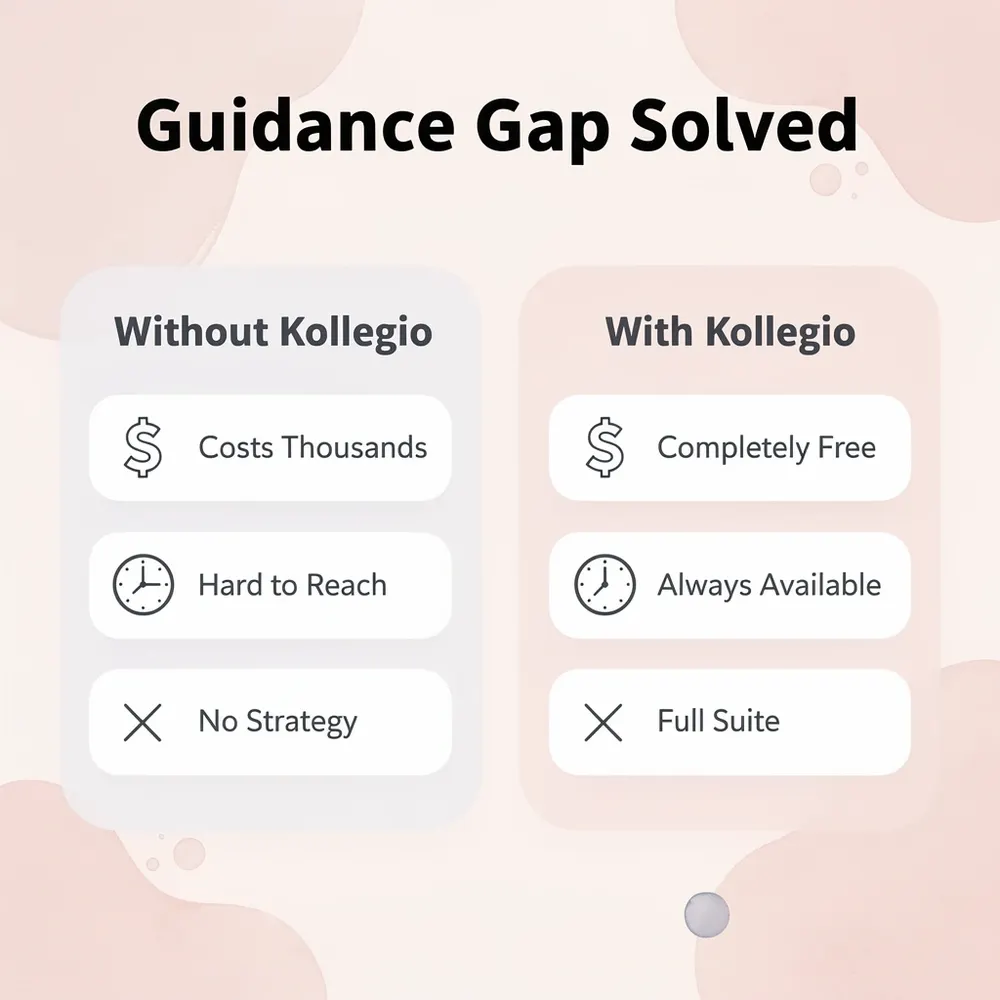
Most students build their college strategy alone, or pay thousands of dollars for private counselors who are hard to reach for most families. Our AI college counselor closes that gap for free, offering a complete suite of tools in one place — so every student works from a full, informed picture.
💡 Tip: You don't need to spend thousands on private counseling to get personalized, high-quality college guidance — Kollegio's AI college counselor delivers it completely free.
Start your first session today and find out exactly where your application stands.
✅ Best Practice: Don't wait until senior year to get clarity. The earlier you use Kollegio's AI college counselor, the more strategic and stress-free your entire application journey becomes.
Related Reading
- What Sat Score Is Required For Ut
- What Sat Score Is Required For Nyu
- What Sat Score Is Required For Ivy League
- What SAT Score Is Required for Texas A&M
- What SAT Score Is Required for Duke
- What Sat Score Is Required For Harvard
- What Sat Score Is Required For Cornell
- What Sat Score Is Required For Princeton
- What Sat Score Is Required For Stanford
- What Act Score Is Needed For Alabama
- What Sat Score Is Required For Ucla
- What Sat Score Is Required For Notre Dame
- What Is The Combined Essay Score For Sat
- What Sat Score Is Required For Columbia
- What Sat Score Is Required For Yale