
Understanding Notre Dame's SAT score requirement is a practical starting point for any student aiming to attend competitive universities. The numbers matter, but so does knowing how to interpret them within the broader context of Notre Dame's admissions process. Applicants who study the actual score ranges and trends are better positioned to set realistic goals and allocate their prep time wisely.
Stop wondering.
Start matching.


Knowing your target score is only part of the equation. Building a strong application also means understanding how your profile compares to admitted students and where you have room to improve. For personalized guidance on Notre Dame's SAT benchmarks and a focused plan to strengthen your candidacy, students can turn to Kollegio's AI college counselor.
Table of Contents
- What SAT Score Is Required for Notre Dame?
- How Competitive Is Notre Dame Admissions?
- Is Your SAT Score Competitive for Notre Dame?
- What Matters Beyond SAT Scores at Notre Dame?
- Should You Retake the SAT for Notre Dame?
- How Kollegio Helps You Understand Your Chances at Notre Dame
- Use Kollegio's AI College Counselor for Free Today!
Summary
- Notre Dame does not publish a required SAT score, but the admitted-student data tell a clear story. According to PrepScholar's analysis, the middle 50% SAT range for enrolled students runs from 1470 to 1540, with an average composite of 1510. Half of the admitted students who submitted scores landed below that average and still earned admission, which means the average is a reference point rather than a verdict.
- Where a score falls within that range changes how it functions in the application. A score below 1470 becomes a liability that the rest of the application needs to compensate for. A score inside the range turns largely neutral, shifting all the evaluative weight to essays, activities, and demonstrated values. A score above 1540 removes testing as a concern entirely, though removing a concern is not the same as creating an advantage.
- Notre Dame's acceptance rate has dropped to a record low of 9% for the Class of 2030, a record that has held for two consecutive years, according to The Observer. That figure reframes what a competitive academic profile actually means at this level. The pool of rejected applicants now regularly includes students with 4.0 GPAs, 1550 SAT scores, and strong extracurricular records. Strong academics function as the entry fee, not the deciding factor.
- Holistic review at Notre Dame means course rigor, essays, recommendations, extracurricular depth, and mission alignment all carry real weight alongside any submitted score. A student who spent three years building a youth mentorship program from 12 participants to over 100 tells a more compelling story than someone who accumulated memberships in 15 clubs. The university is assembling a community, and sustained commitment to something meaningful maps directly onto what Notre Dame's admissions readers are trained to look for.
- Retaking the SAT makes strategic sense only in specific situations. If a score sits well below the competitive range and timed practice tests show consistent improvement of 50 to 80 points above the official result, another attempt is evidence-based. Notre Dame's superscore policy, which considers the highest section scores across all test dates, adds tactical value for students with a clear weakness in one section. However, moving from a 1530 to a 1560 requires roughly the same effort as moving from a 1400 to a 1480, but yields only a fraction of the competitive benefit. If essays still need real work, or the activity record reads like a list rather than a story, that is where the remaining application time belongs.
- Notre Dame received 35,401 applications for the Class of 2029, an 18% increase from the prior year. In a pool that size, treating a competitive SAT score as a green light rather than a baseline is one of the most common and costly misjudgments applicants make. What separates admitted students from waitlisted ones is rarely a single stronger component. It is a profile where every piece reinforces the same coherent story about who the applicant is and why Notre Dame specifically fits them.
- Kollegio's AI college counselor addresses this by evaluating a student's full academic and extracurricular profile against real admissions expectations, helping identify where the application already has momentum and where the narrative needs work before it reaches a reader.
What SAT Score Is Required for Notre Dame?
Notre Dame does not publish a required SAT score and is test-optional through the 2026-27 cycle. For students who submit scores, the numbers show what score you need for a real chance of getting in.
"Notre Dame remains test-optional through the 2026-27 admissions cycle, meaning submitted scores can help — but their absence won't automatically hurt."
🎯 Key Point: Being test-optional doesn't mean scores are irrelevant. A strong SAT score can strengthen your application at Notre Dame.
💡 Tip: If your score falls in the competitive range, submit it. It gives admissions officers one more data point in your favor.

SAT Score Range | Admissions Relevance |
|---|---|
Below 1400 | Likely below competitive threshold — consider withholding |
1400–1499 | Borderline — weigh carefully against other application strengths |
1500–1549 | Competitive — worth submitting to support your application |
1550+ | Strong advantage — well above the typical admitted student range |
⚠️ Warning: Don't assume test-optional means scores don't matter — for a school as selective as Notre Dame, a high SAT score can be a critical differentiator in a competitive applicant pool.
What the score range actually looks like
According to PrepScholar's analysis of Notre Dame admissions data, the 25th percentile SAT score is 1470, and the 75th percentile is 1540. This middle 50% range means half of accepted students scored between those numbers, with a quarter scoring above 1540. A score below 1470 doesn't disqualify you, but your application must be strong in other areas.
Where does your score put you in the distribution?
A 1470 gets you into the conversation. A score at or above the 75th percentile puts you in a strong position. Treating the lower bound as a finish line misses the point. Most students fixate on a single number: the average. PrepScholar reports the average SAT composite at Notre Dame is 1510, meaning half of admitted students scored below that and still got in. The average is a reference point, not a final decision. Knowing where you fall compared to all scores gives you a clearer picture of your position. Our Kollegio AI college counselor compares your specific score against real admissions data so you understand what matters most for your full application.
Why does a holistic review change the math?
Notre Dame's admissions process evaluates class rigor, essays, recommendations, extracurricular activities, and personal qualities alongside any submitted test score. A 1550 with a thin activity record and generic essays is not automatically stronger than a 1490 paired with genuine leadership, intellectual curiosity, and a compelling personal narrative. Admissions officers are building a class, not sorting a spreadsheet.
Does chasing a higher score actually help your application?
The belief that a single score unlocks the door leads students to spend too much time retaking the SAT while neglecting the parts of their applications that make them stand out. Score improvement matters, but only until it stops being the weakest part of your profile.
What does the score range tell you about your real chances?
The score range alone cannot tell you how competitive Notre Dame is at every level of the applicant pool, or what that means for a student whose numbers already clear the bar.
Related Reading
- What ACT Score Is Needed for Harvard
- Average Act Score For Nc State
- Average Sat Score For Unc
- Average Sat Score For Umd
- Average Sat Score For Uc Berkeley
- Average SAT Score for Virginia Tech
- Average Sat Score For Brown
- Average SAT Score for UVA
- Average SAT Score for Michigan
- Average Sat Score For Ohio State
How Competitive Is Notre Dame Admissions?
Notre Dame's acceptance rate has hit a record low of 9% for the Class of 2030, according to The Observer, and has remained the same for two years in a row. Having a strong academic profile is no longer enough to guarantee admission.
"Notre Dame's acceptance rate has hit a record low of 9% for the Class of 2030 — staying at that historic low for two consecutive years." — The Observer, 2026
🎯 Key Point: At 9%, Notre Dame rejects more than 9 out of every 10 applicants — making it one of the most selective universities in the country.
⚠️ Warning: A strong GPA and test scores alone will not get you in. At this acceptance rate, every part of your application must work together to set you apart.
Metric | Detail |
|---|---|
Acceptance Rate | 9% (record low) |
Years at Record Low | 2 consecutive years |
Class | Class of 2030 |
🔑 Takeaway: Notre Dame's admissions landscape has fundamentally shifted — applicants must treat every element of their application as critical, not optional.

What a 9% acceptance rate actually means
The critical difference between a 9% rate and a 15% rate is that the rejected pool now includes thousands of students with 4.0 GPAs, 1550 SAT scores, varsity team captaincies, and strong community service records: credentials that would have earned serious consideration a decade ago. Students with strong credentials who feel worried are not being irrational. The math has moved the goalposts.
Why are strong academics only the starting point?
Strong academics are the entry fee, not the winning ticket. The admitted student profile at Notre Dame is built on academic readiness as a baseline and then evaluated for leadership, service, character, and mission alignment. Two applicants with nearly identical test scores and GPAs can receive completely different outcomes based on how well their other materials fit together and their depth.
How should students move beyond score-matching to assess their full profile?
Most students research score ranges to find where they fit on a competitiveness spectrum, treating admissions like a checklist when Notre Dame explicitly evaluates it as a conversation. Our AI college counselor at Kollegio helps students move past number-matching and assess their full profiles, identifying where they genuinely stand out and where their applications need work.
Why the applicant pool changes everything
At Notre Dame's selectivity level, nearly every applicant is academically ready. Admissions officers ask: Who will contribute something distinct to this campus? That answer rarely lives in a transcript—it lives in how a student describes their initiative, values, and the reason they chose Notre Dame specifically.
How does applying early change your odds at Notre Dame?
The "Why Notre Dame" question matters significantly. Applying Restricted Early Action demonstrates genuine interest, and historically, REA acceptance rates are nearly twice as high as Regular Decision rates. This gap reflects how seriously Notre Dame weighs demonstrated interest and fit alongside academic preparation.
How does understanding the pool reshape what a competitive score looks like?
Once you understand how the pool is structured, whether your specific score is competitive takes on new meaning.
Is Your SAT Score Competitive for Notre Dame?
Scoring within Notre Dame's competitive range confirms academic readiness, not admission. This critical difference costs applicants who mistake range eligibility for likelihood of admission.
🎯 Key Point: Hitting Notre Dame's SAT range proves you can compete academically — it does not mean you will be admitted. Treat your score as a floor, not a finish line.

According to PrepScholar's analysis of Notre Dame SAT scores and GPA, the 25th percentile SAT score is 1470, and the 75th percentile is 1540. A full quarter of enrolled students who submitted scores scored below 1470 — the lowest score is lower than most applicants think, and the highest score matters far less than most hope.
"The 25th percentile SAT score is 1470 and the 75th percentile is 1540 at Notre Dame — a 70-point range that defines competitive, not guaranteed." — PrepScholar
SAT Percentile | Score | What It Means |
|---|---|---|
25th Percentile | 1470 | Bottom of the enrolled range — lower than most expect |
75th Percentile | 1540 | Top of the enrolled range — less decisive than most hope |
Middle 50% Range | 1470–1540 | The competitive window for serious applicants |
⚠️ Warning: Scoring above 1540 does not significantly boost your odds — and scoring below 1470 does not automatically disqualify you. Holistic review means your SAT is one signal among many.
🔑 Takeaway: Notre Dame's narrow 70-point middle-50% range signals an academically homogeneous applicant pool. At this level, non-score factors — essays, recommendations, and demonstrated interest — carry outsized weight in the final decision.
Where your score actually sits in the pool
Your score falls into one of three positions: below the range, inside it, or above it. Below 1470, your testing profile becomes a liability unless the rest of your application compensates with exceptional clarity. Inside the range, your score becomes neutral, shifting all weight to your essays, activities, and demonstrated values. Above 1540, according to C2 Education's 2025 breakdown of competitive SAT scores, you sit above the middle 50% band, removing testing as a concern entirely. But removing a concern is not the same as creating an advantage.
Does a higher score actually outperform a stronger overall profile?
Most students treat score research as a finish line. A 1560 does not outperform a 1490 paired with three years of authentic leadership and essays that show genuine moral reasoning. The score opens a door; what you've built as a person determines whether you walk through it.
Students often spend months chasing a score target without an equally rigorous plan for the rest of their profile. An AI college counselor like Kollegio addresses that gap directly, helping students evaluate their full application picture—from activity impact to essay clarity—with structured feedback that previously required paying thousands for a private coach.
Is Notre Dame actually the right fit for you in the first place?
The question about the score also carries a hidden assumption: that Notre Dame is the right fit in the first place. Fit concerns whether the university's mission, community, and culture match who you are and what you want—not simply whether you can gain admission. A student who applies to Notre Dame because it is prestigious but cannot explain how it specifically aligns with their values will struggle to write compelling essays for admissions officers. Once you understand that scores are only the entry point, the real question becomes what Notre Dame is looking for in the rest of your file.
What Matters Beyond SAT Scores at Notre Dame?
Your transcript tells a story that no test score can. Notre Dame admissions officers examine your academic record to understand how you responded to rigorous coursework. A student who earned a 3.9 GPA while taking a lot of AP courses shows something fundamentally different from one who coasted through easier classes for the same grade. The distinction matters, and Notre Dame's readers are trained to spot it.
"A student who earned a 3.9 GPA while taking a lot of AP courses shows something fundamentally different from one who coasted through easier classes for the same grade — Notre Dame's readers are trained to spot it."
🎯 Key Point: Notre Dame evaluates academic rigor just as heavily as your GPA. A challenging course load with strong grades signals far more than an easy A ever could.
⚠️ Warning: Don't assume a high GPA alone will impress admissions officers. Notre Dame's readers are specifically trained to distinguish genuine academic challenge from grade inflation through easier coursework.
Academic Profile | What It Signals to Notre Dame |
|---|---|
High GPA + Rigorous AP/IB Courses | Intellectual drive and ability to handle college-level work |
High GPA + Standard Coursework | Strong performance, but limited evidence of challenge-seeking |
Moderate GPA + Rigorous Courses | Willingness to take academic risks and push beyond comfort |
Low GPA + Easy Courses | Least competitive academic profile for admissions |

What your course choices reveal about you
The failure point for many strong applicants is not their GPA itself but the gap between their grades and the difficulty of their coursework. Notre Dame evaluates course rigor within the context of what your school offers. If your school provided eight AP courses and you took two, that gap gets noticed. If your school offered limited advanced options and you took every one available, that context works in your favor. Admissions officers ask: "How much did you push yourself?"
Why depth beats a long activity list
A student who spent three years building a youth mentorship program from 12 participants to over 100 tells a more compelling story than someone who joined 15 clubs. Notre Dame seeks sustained commitment to something you genuinely care about, especially when it involves serving others, which aligns directly with the university's mission in ways breadth alone cannot.
Why does a unified profile matter more than individual strong components?
Most students improve each part of their application separately: raising the SAT score, joining another club, and improving the essay. According to The Koppelman Group, Notre Dame admitted 11.3% of applicants during the 2024-2025 cycle. At that level of selectivity, what separates admitted students is rarely a single stronger component. Instead, it's a profile where every piece supports the same story about who you are. Our AI college counselor helps you see your application as a whole picture rather than a checklist, identifying where your profile has momentum and where the narrative breaks down.
How does your essay voice shape what admissions officers actually hear?
Essays let admissions officers hear how you think in ways grades and scores cannot. A strong essay shows your values, demonstrates intellectual curiosity, and reveals self-awareness that signals readiness for a demanding academic and personal environment. At Notre Dame specifically, essays connecting to themes of service, community, and purpose resonate because they reflect what the university seeks in its incoming class.
What does Notre Dame's new video component mean for your application?
According to The Observer, Notre Dame added a one-minute video to its application for the Class of 2030. This reflects the university's evolving approach to understanding applicants. The strongest candidates use every available component, including the video, to present a cohesive picture of themselves rather than treating each part as a separate task. Once you understand that your whole profile is the argument, a sharper question emerges: if your SAT score is already competitive, is spending more time chasing a higher number the best use of your remaining time?
Should You Retake the SAT for Notre Dame?
Take the SAT again if your score is meaningfully below Notre Dame's competitive range and practice tests show consistent improvement. If you're already within striking distance, retaking likely isn't worth the investment.
"Retaking the SAT is only worth the effort if practice tests demonstrate a real, measurable upward trend — not just hope." — College Admissions Insight
🎯 Key Point: A retake makes sense only when your practice scores show consistent gains — not just a one-time bump.
⚠️ Warning: If you're already within Notre Dame's competitive scoring range, investing time in a retake may not be the highest-impact move for your application.
Scenario | Should You Retake? |
|---|---|
Score is significantly below Notre Dame's range | ✅ Yes — retake if practice shows improvement |
Score is within striking distance of the range | ⚠️ Likely not worth the investment |
Practice tests show a consistent upward trend | ✅ Strong case for retaking |
Practice scores are flat or inconsistent | ❌ Retaking may not help |

When does a score gap justify another attempt?
According to Test Ninjas' Notre Dame SAT/ACT data, Notre Dame's SAT 25th-75th percentile range is 1510-1570. If your score falls significantly below that range and your timed practice tests consistently score 50-80 points higher than your official result, that gap warrants a retake. A difference of that size, paired with a targeted preparation plan addressing your weaker section, makes retaking a strategic choice.
How does Notre Dame's superscore policy change the retake calculation?
Notre Dame's superscore policy adds strategic value. The university considers your highest section scores across all test dates, so a focused retake on one weaker section can improve your overall score without requiring perfect performance in every area. A student with a 780 Math score but a 700 Evidence-Based Reading and Writing score needs only to improve that one section.
What kind of prep actually moves the needle on your score?
SAT prep lacking focus typically yields only 20-30 points, which doesn't meaningfully affect admissions decisions. A better approach is to use diagnostic testing: identify which question types cost you points, then create a study plan targeting those specific weaknesses. Tools like Kollegio help students understand their full profiles, enabling them to make choices based on their current standing.
Where the law of diminishing returns bites hardest
Getting a higher score becomes harder as you progress. Moving from a 1400 to a 1480 is achievable with focused work. Moving from a 1530 to a 1560 often requires the same effort but provides minimal competitive advantage. The University of Notre Dame's evaluation criteria confirm the school is test-optional, meaning students who don't submit scores receive full consideration. This matters when deciding whether another month of SAT prep is the best use of your remaining application time.
When should you stop prepping and focus elsewhere?
If your score is already competitive but your essays need work, or your activity list reads as memberships rather than commitment, that's where your next 60 hours should go. An admissions officer isn't running a spreadsheet comparison; they're asking whether you belong in their community. A 20-point score bump rarely answers that question more convincingly than a sharper essay or meaningful leadership arc. Knowing where your score fits within Notre Dame's applicant pool changes how you spend every hour before your deadline.
Related Reading
- What Sat Score Is Required For Uf
- Average Sat Score For Uga
- Average Act Score For Georgia Tech
- Northwestern Average SAT Score
- Average Sat Score For Georgetown
- Rice University Average Sat Score
- Caltech Average Sat Score
- What Is The Combined Essay Score For Sat
- What SAT Score Is Required for Cornell
How Kollegio Helps You Understand Your Chances at Notre Dame
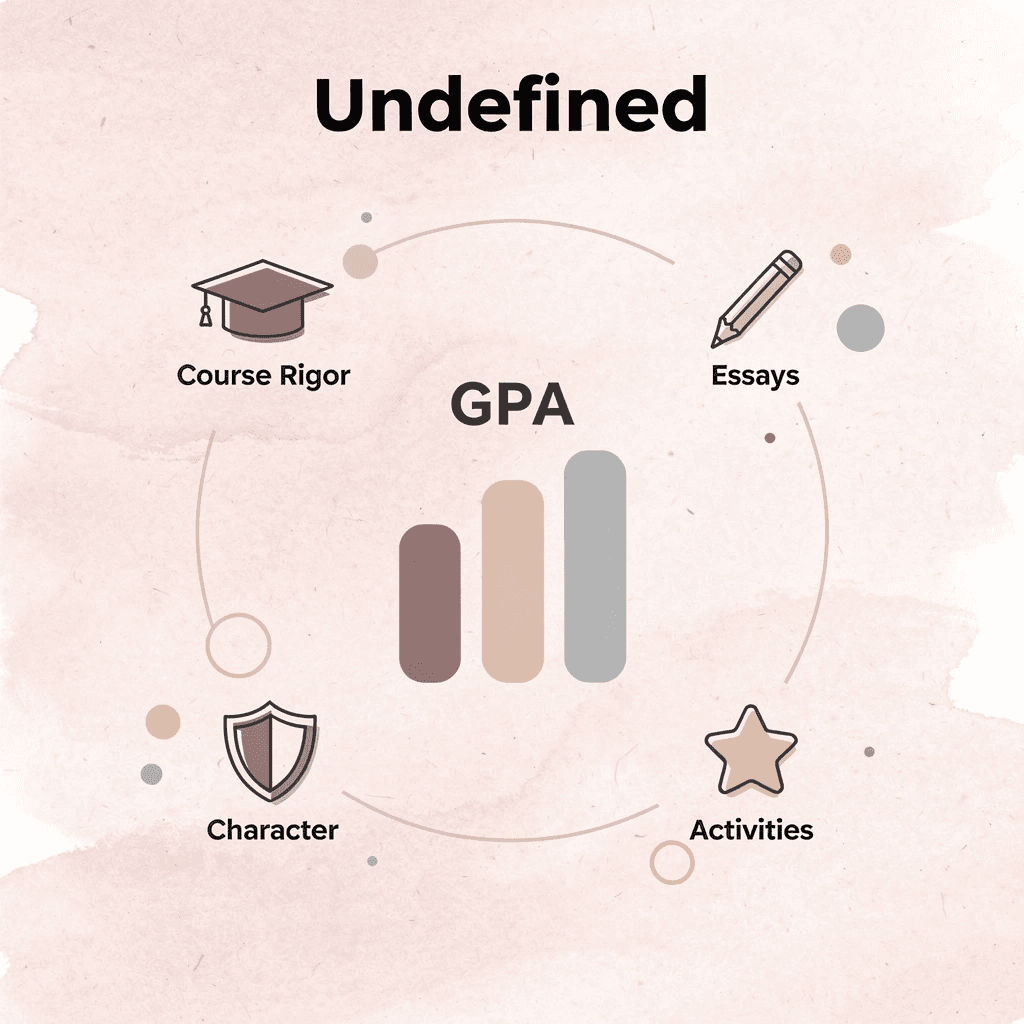
Knowing where your score fits within Notre Dame's admitted class is helpful. But knowing how your whole profile compares—across GPA, course rigor, essays, activities, and character—is what actually makes a difference in your decision-making.
🎯 Key Point: A single test score is never the full picture. Holistic profile comparison is what separates informed applicants from everyone else.
"Knowing how your whole profile compares—across GPA, course rigor, essays, activities, and character—is what actually makes a difference in your decision-making."
Profile Factor | Why It Matters |
|---|---|
GPA | Signals academic consistency over time |
Course Rigor | Shows willingness to challenge yourself |
Essays | Reveals character and fit |
Activities | Demonstrates impact beyond the classroom |
Character | Reflects Notre Dame's mission alignment |
Most students check the published SAT range and stop there. That method is incomplete. According to The College Navigators, Notre Dame received 35,401 applications for the Class of 2029, an 18% increase from the previous year's 29,943. When you're one file in a pool that large, a single number tells you almost nothing about where you stand.
⚠️ Warning: Relying on the published SAT range alone is one of the most common mistakes applicants make. With 35,401+ applicants, context is everything.
🔑 Takeaway: An 18% surge in applications means competition is intensifying year over year. Understanding your full profile—not just one data point—is the only way to make an informed decision about applying to Notre Dame.
Why does a single metric mislead more than it guides?
A competitive SAT score like 1470–1540 gets your application read seriously, but it doesn't make you stand out from thousands of other applicants with the same score. What separates admitted students from waitlisted ones is the story your file tells, and that story is harder to evaluate without a clear framework.
How can students objectively assess their full profile against real admissions expectations?
Most students can research score ranges, but they can't objectively assess how their leadership arc, service record, or essay quality compares with Notre Dame's values. They typically ask a parent, a school counselor, or a friend who applied years ago—advice that rarely matches the current applicant pool. Kollegio closes that gap by functioning as an AI college counselor that evaluates your full academic and extracurricular profile against real admissions expectations, not published score ranges.
What a profile-based view actually changes
Instead of asking "Is my SAT score good enough for Notre Dame?" you start asking "How does my complete profile compare, and where should I focus before my deadline?" According to The College Navigators, Notre Dame's acceptance rate was 9% for the Class of 2029, admitting 3,186 students out of 35,401 applicants. In such a selective pool, admitted students are strong across all areas and strategically aware of their application's strengths and weaknesses.
How does knowing your real chances change your college list?
Kollegio helps you build a college list that reflects your real chances and aligns with your aspirations. A student with a 1490 SAT, a 3.9 GPA, and strong community service leadership might not get into Notre Dame, but could be a great fit at a dozen other schools with comparable academic culture and outcomes. Finding those schools early and understanding why you belong there is smart college planning. The question is whether you're ready to stop guessing and start seeing your application as an admissions officer would.
Related Reading
- What Sat Score Is Required For Ut
- What Sat Score Is Required For Nyu
- What Sat Score Is Required For Ivy League
- What SAT Score Is Required for Texas A&M
- What SAT Score Is Required for Duke
- What Sat Score Is Required For Harvard
- What Sat Score Is Required For Cornell
- What Sat Score Is Required For Princeton
- What Sat Score Is Required For Stanford
- What Act Score Is Needed For Alabama
- What Sat Score Is Required For Ucla
- What Sat Score Is Required For Notre Dame
- What Is The Combined Essay Score For Sat
- What Sat Score Is Required For Columbia
- What Sat Score Is Required For Yale
Use Kollegio's AI College Counselor for Free Today!
To see your application the way an admissions officer would, you need to understand how your GPA trajectory, course rigor, activity depth, and essay voice work together as a single argument for why you belong. That clarity separates students who apply with confidence from those who apply and hope.
"Your application is not a collection of individual parts: it's a unified argument for why you belong at a specific institution." — College Admissions Insight
🎯 Key Point: Admissions officers evaluate your full profile holistically. Your GPA, rigor, activities, and essays must tell one cohesive story, not four separate ones.

Our AI college counselor gives you that clarity for free. It evaluates your complete academic profile, identifies where you're genuinely competitive, and helps you build a college list grounded in real fit rather than name recognition.
What Most Students Do | What Kollegio's AI Does |
|---|---|
Guess at college fit | Evaluates your full academic profile |
Chase brand-name schools | Identifies where you're genuinely competitive |
Apply and hope | Builds a list based on real fit |
Pay for private counseling | Delivers expert-level clarity for free |
💡 Tip: Stop applying to schools based on reputation alone — use data-driven fit to find the colleges where your profile is a genuine match.
✅ Best Practice: Use Kollegio's AI college counselor before you finalize your college list — it's free, fast, and built to give you the confidence that comes from knowing where you stand.