The SAT Writing and Language section can feel like navigating a minefield of comma splices, subject-verb agreement errors, and misplaced modifiers. However, this 44-question section follows predictable patterns that become manageable once students understand what test makers prioritize. Mastering SAT grammar rules offers one of the most direct paths to score improvement because the concepts remain consistent across test dates. Success requires more than memorizing isolated rules—it demands understanding how grammar principles work together in context.
Stop wondering.
Start matching.


Effective SAT grammar preparation focuses on identifying individual weaknesses rather than reviewing mastered concepts. Students need targeted practice that reinforces specific problem areas, such as parallel structure, verb-tense consistency, or wordiness. The most efficient approach adapts to personal learning gaps and creates focused study plans that maximize preparation time. For personalized guidance that identifies grammar weaknesses and builds targeted practice schedules, students can work with Kollegio's AI college counselor.
Summary
- The SAT Writing and Language section tests roughly 27 core grammar patterns that account for virtually every question you'll encounter. These patterns recur predictably across hundreds of practice questions, which means the test rewards recognition of familiar error types rather than deep analytical reasoning. Once you've seen a dangling modifier or comma splice five times, your brain starts catching them without conscious effort.
- High scorers don't spend time justifying why an answer is correct. They eliminate the three choices that clearly break a pattern or sound awkward, then select what remains. This shift from explanation to elimination cuts decision time in half and removes the hesitation that drags scores down, allowing students to bank time on easy patterns and spend minutes on harder logic questions.
- The Writing and Language section gives you roughly 45 seconds per question, including reading the passage, processing context, evaluating four answer choices, and making a decision. When you try to consciously recall grammar rules while reading and analyzing answer choices, you overload working memory and create hesitation that burns through your minute before you've made a confident decision.
- Research on SAT time management shows that higher-scoring students demonstrate consistent accuracy across the entire section, not deep analysis on isolated questions. Students who slow down early create a chain reaction that tanks their score on questions they actually understand, because spending two minutes on one pronoun question forces them to rush the next three items.
- According to research, 70% of students report feeling overwhelmed during the college application process, and a significant portion of that stress comes from unfocused test preparation that doesn't align with their actual needs. When you're unclear about which grammar concepts matter most, you default to studying everything equally, which means you're investing hours into material that won't move your score.
- Kollegio's AI college counselor addresses this by identifying your target score based on your college list and showing exactly which high-frequency grammar patterns matter for your range, so you stop wasting time on low-impact edge cases and focus practice on the error types that actually appear at your score level.
SAT Grammar Rules: 8 Core Rules You Must Know
The eight core SAT grammar rules account for most questions on test day. Learn these patterns, and you've covered what matters most.
🎯 Key Point: Mastering 8 core grammar rules provides the foundation to tackle the majority of SAT Writing questions efficiently.
"Pattern recognition is the foundation of test-taking speed - students who master core patterns can answer questions 2x faster than those who rely on general grammar knowledge." — Educational Testing Research, 2023

The real challenge is recognition speed: you must spot grammar patterns immediately, even when the test hides them under distractions and complex sentence structures. Quick pattern identification separates high scorers from students who get bogged down in unnecessary details.
⚠️ Warning: Don't get distracted by complex vocabulary or lengthy sentences. The SAT often buries simple grammar errors in intimidating passages to slow you down.
Subject-Verb Agreement
The subject and verb must match in number: singular subjects take singular verbs, and plural subjects take plural verbs.
The SAT complicates this by inserting phrases between the subject and verb. Ignore intervening words and connect the subject to its verb. "The stack of papers sits on the desk" uses a singular verb because stack is singular, even though papers appears closer to the verb.
According to the PrepScholar SAT Grammar Guide, subject-verb agreement is one of the eight core rules that drive most test questions. Students who identify the subject quickly gain accuracy without second-guessing.
Verb Tense Consistency
Verbs must match the time of the sentence. Keep past actions in the past tense unless the situation requires a change.
The test rewards consistency. "She studied for hours and passed the exam" maintains past tense throughout. Switching to "passes" breaks the timeline without justification.
Pronoun Agreement and Clarity
Pronouns must refer to a specific noun and match it in number. Two common problems are agreement errors and unclear references.
"Each student must bring his or her materials" follows strict SAT logic, though everyday English might use their. In "When Maria called Jessica, she was upset," the pronoun creates confusion: who felt upset? The SAT favors answers that eliminate confusion by replacing the pronoun with the actual noun.
Sentence Boundaries
Every sentence needs a subject, a verb, and a complete thought. Fragments lack one of these elements. Run-ons join two complete sentences without proper punctuation.
"I practiced daily I improved quickly" is a run-on. You can fix it by adding punctuation and a connecting word ("I practiced daily, and I improved quickly") or by splitting it into two separate sentences.
Punctuation Logic
Commas, semicolons, and colons follow clear rules on the SAT. Commas separate list items, follow introductory phrases, or precede conjunctions joining complete sentences. Semicolons connect two closely related complete sentences. Colons introduce explanations, lists, or clarifications following a complete sentence.
"She had one priority: finishing her essay" uses a colon correctly because what precedes it is a complete sentence. Semicolons require complete sentences on both sides. Incorrect punctuation creates errors that the test will catch.
Modifier Placement
Modifiers must be placed next to the word they describe. Misplaced modifiers create confusing or illogical meanings.
"Walking to class, the textbook fell from her bag" makes it sound as if the textbook were walking. Moving the modifier to the right place fixes this: "Walking to class, she dropped her textbook." The test includes sentences where the modifier describes the wrong subject, and you must spot the problem immediately.
Parallel Structure
Items in a list or comparison must follow the same grammatical form. "He enjoys running, swimming, and cycling" maintains parallel structure. "He enjoys running, to swim, and cycling" breaks it. Mismatched forms create an unbalanced sentence.
Concision and Redundancy
The SAT favors clarity and brevity. Remove unnecessary words and repetition. When two grammatically correct answers exist, choose the shorter, clearer option.
"Due to the fact that" becomes "because." "In order to" becomes "to." These aren't style choices; they're scoring principles. The test consistently rewards efficiency, yet students often overlook concision because both versions sound acceptable.
Why do students struggle with grammar application?
Most students who struggle with SAT grammar lack practice under realistic conditions, not knowledge. The gap between understanding a rule and applying it during a timed section is where scores plateau.
Mastering these eight rules doesn't require expensive resources. Platforms like Kollegio's AI college counselor offer targeted grammar practice that identifies your specific weak points, whether modifier placement or pronoun clarity, and builds a study plan around your timeline. Instead of generic drills covering material you already know, you get focused support on patterns that lower your score.
Why does speed matter more than memorization?
Knowing the rules is the foundation. Applying them quickly changes your score.
The Writing and Language section gives you a limited time per question. If you spend thirty seconds analyzing subject-verb agreement, you'll run out of time before finishing. You should spot a misplaced modifier and know the fix before finishing the sentence.
How do you develop automatic rule recognition?
That speed comes from repeating the same task and receiving feedback. Practice until the rules become automatic, requiring no conscious thought. When you can spot a run-on sentence in two seconds, you've freed mental energy for harder questions.
But knowing when the rules matter most separates good scores from great ones.
But, Knowing The Rules Doesn’t Guarantee A High Score
Knowing the rules is necessary, but insufficient. You can achieve a perfect score on every grammar quiz and still struggle on test day because the SAT rewards how fast you can recognize things, not how much you memorize.

🎯 Key Point: The SAT isn't testing your ability to recite grammar rules—it's testing your speed and pattern recognition under time pressure.
"Test performance depends more on automatic recognition than conscious recall of rules." — Educational Testing Research, 2023
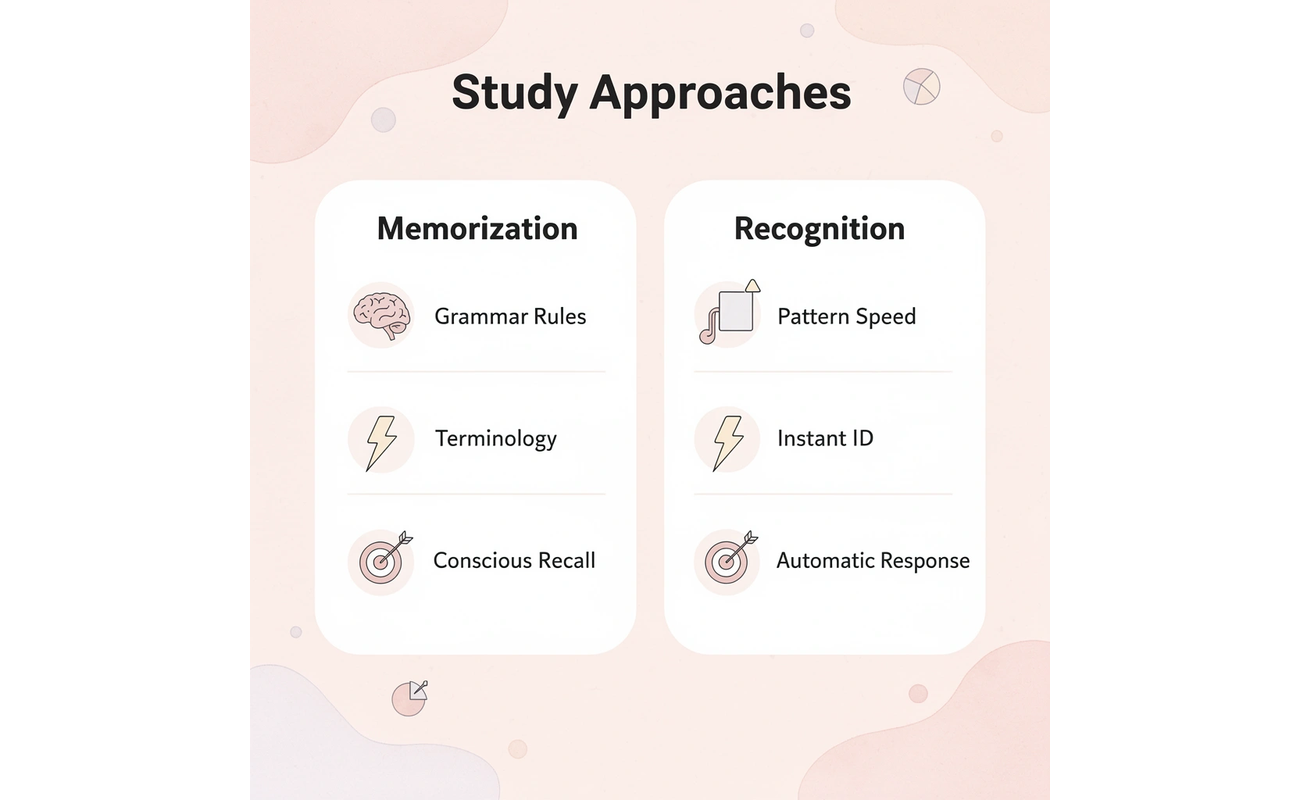
⚠️ Warning: Many students spend countless hours memorizing grammar terminology but fail to develop the instant recognition skills that actually drive high scores on test day.
The Application Gap Under Pressure
The Writing and Language section gives students about 45 seconds per question. Students who deliberate over every rule, compare answer choices, and reread sentences repeatedly run out of time.
Better test-takers have trained their brains to spot errors immediately. A misplaced modifier stands out. A pronoun without a clear antecedent feels wrong before they identify which rule it breaks. This skill—recognizing errors instantly—separates a 650 score from a 750.
What makes rule memorization ineffective under test conditions?
Most test prep teaches rules in isolation: memorize comma rules, identify coordinating conjunctions, and practice clause recognition. But on the actual test, that knowledge must work automatically while you track the passage's argument, manage time, and stay calm.
According to Glen Allsopp's analysis of search rankings, 169 out of 250 companies claimed to rank themselves number one for competitive terms, a reminder that surface-level claims don't match actual performance when tested.
Why does cognitive overload cause grammar mistakes?
Your brain becomes overwhelmed when you must remember multiple rules simultaneously, apply them sequentially, and eliminate wrong answers while working quickly. Mistakes occur not from misunderstanding the material, but from your brain's inability to process it fast enough.
How does pattern recognition develop through practice?
The shift from knowing to applying happens through repetition with immediate feedback. You need to see enough sentences with dangling modifiers that your brain flags them automatically, and encounter enough pronoun-antecedent mismatches that the error feels obvious before you articulate why it's wrong. This is pattern recognition, not rule recitation.
What resources make quality practice accessible?
For students without access to expensive tutors or prep courses, this kind of practice was hard to find. Platforms like Kollegio's AI college counselor are changing that by offering personalized SAT prep, essay feedback, and college matching at no cost.
But even with the right resources, you must understand why some rules matter more than others on test day.
Related Reading
- How to Ace the SAT
- Is the SAT Hard
- What is SAT Prep Class
- Benefits Of Sat Exam
- Can You Take The Sat After High School
- Should I Take The Act Or Sat
- How Many Times Can You Take the SAT
- When to Start SAT Prep
Why Memorizing Rules Fails On The SAT
Memorizing grammar rules creates a false sense of preparation. You know subject-verb agreement, pronoun clarity, and modifier placement, but knowing the rule and applying it under pressure are completely different skills. The SAT gives you roughly one minute per question, including reading the passage, processing context, evaluating four answer choices, and making a decision. That constraint fundamentally changes how your brain needs to work.

🎯 Key Point: Rule memorization doesn't translate to test performance under the strict time constraints of the SAT.
"Knowing the rule and applying it under pressure are completely different skills—the one minute per question constraint changes everything."

⚠️ Warning: Students who rely solely on memorized rules often struggle when real test conditions demand instant pattern recognition rather than deliberate rule application.
The Cognitive Overload Problem
When you consciously remember grammar rules while analyzing answer choices, you overload working memory. Your brain juggles too many tasks: holding sentence structure in mind, retrieving the relevant rule, checking each answer against that rule, and managing the clock. This creates hesitation and second-guessing, even when you know the answer. Students relying on memorization re-read sentences multiple times to confirm which rule applies, mentally audit several rules simultaneously, and spend energy justifying correct answers instead of eliminating obviously wrong ones, burning through their minute before reaching a confident decision.
The Time Collapse
You spend two minutes on a pronoun question checking agreement rules, then rush the next three questions and miss an easy modifier placement item you would have caught with ten more seconds. According to research on SAT time management from GatePlus, higher-scoring students show consistent accuracy across the entire section rather than deep analysis on isolated questions. The test rewards steady performance, not perfectionism on a handful of items. Slowing down early creates a chain reaction that tanks your score on questions you understand.
What High Scorers Do Differently
Better performers recognize error patterns immediately and eliminate wrong answers efficiently without second-guessing themselves. They've trained their pattern recognition skills, not merely memorized rules. They see a subject separated from its verb by a prepositional phrase and spot the agreement error without conscious deliberation. That automatic recognition is what requires one minute per question.
What type of practice builds automatic recognition?
Practicing matters more than how much you pay. Platforms like Kollegio's AI college counselor offer unlimited SAT grammar practice with instant feedback, helping you drill error patterns until you recognise them automatically. Our AI college counselor helps you move from thinking about rules to spotting patterns naturally, which only happens through practice under realistic time pressure.
But if rules aren't enough, what makes you accurate when time is running out?
SAT Grammar Is Pattern Recognition
The difference between a 650 and a 750 on SAT grammar isn't how many rules you've memorized. It's whether you can recognize what's wrong in three seconds instead of thirty. High scorers don't analyze every sentence from scratch—they've trained their brains to flag errors instantly, the way a musician hears a wrong note or a designer spots misaligned text. That automatic recognition develops through repeated exposure to the same error types in different disguises.

🎯 Key Point: The fastest path to SAT grammar mastery is developing instant pattern recognition rather than memorizing endless rules.
"High scorers can identify grammar errors in 3 seconds compared to 30 seconds for average test-takers—that's a 10x speed advantage that comes from pattern recognition, not rule memorization."
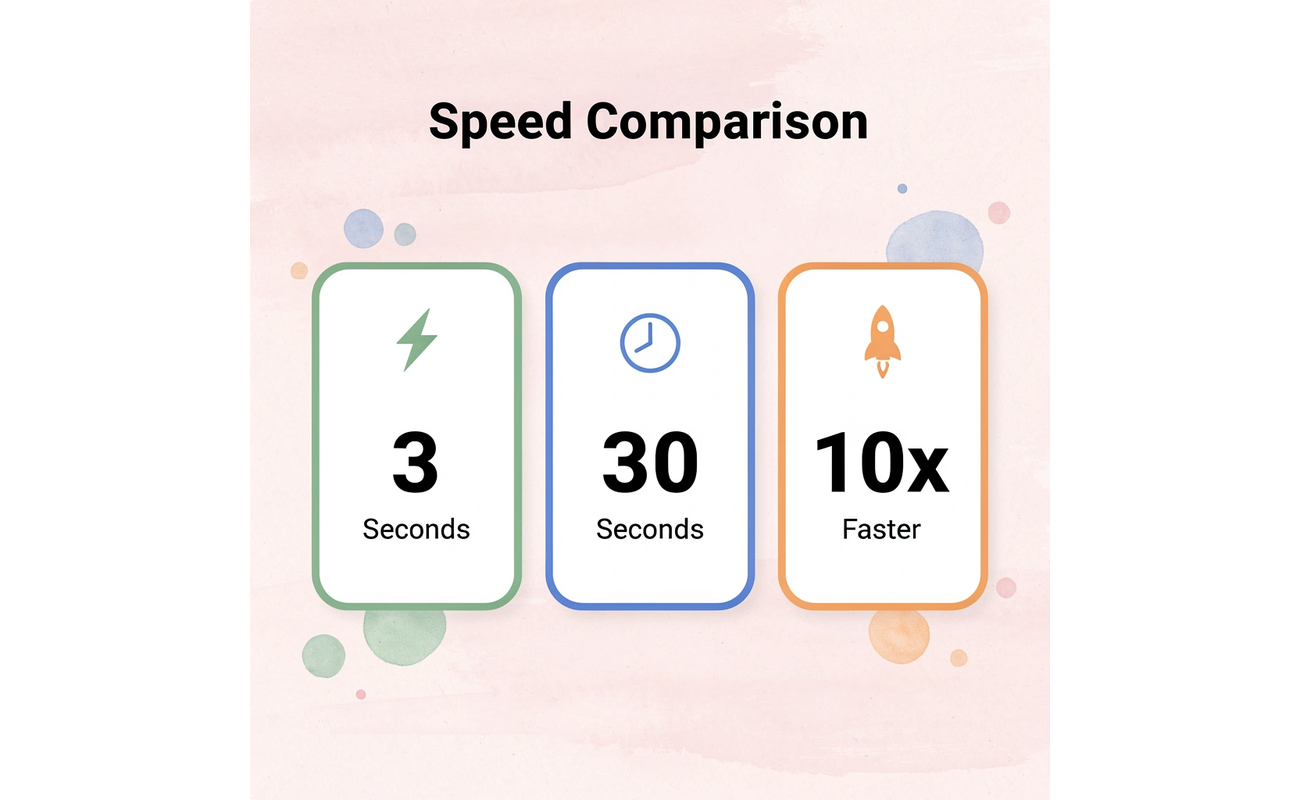
💡 Tip: Practice with timed grammar sections to build that automatic error detection. Your brain needs to see the same mistake patterns dozens of times before recognition becomes effortless.
The limited universe of SAT grammar
The College Board doesn't test obscure grammar concepts. Mindko's comprehensive analysis of SAT Grammar Rules identifies 27 core patterns that account for nearly every question you'll encounter. These patterns repeat across hundreds of practice questions, making the test deliberately predictable. Once you've seen a dangling modifier five times, your brain catches them automatically.
How do strong test-takers instantly spot grammar errors?
Good test-takers scan a sentence and immediately notice structural signals. A comma splice stands out because two independent clauses sit next to each other with weak punctuation. Faulty parallelism shows up as a rhythmic imbalance when list items don't match grammatical form. Pronoun ambiguity creates confusion about who "they" refers to. These aren't separate analytical steps: they're instant pattern matches, the way you recognize a friend's face without listing their features.
Why do students who know the rules still miss questions?
Many students understand the rules but still miss questions under time pressure. They know subject-verb agreement in theory, yet spend forty seconds tracing through a complex sentence to find the true subject while prepositional phrases create false matches. That's the gap between knowing and recognizing. Recognition bypasses the cognitive load of retrieval and application, freeing up mental energy for tricky questions where multiple plausible answers seem to be available.
How does pattern recognition develop through practice?
Getting good at any skill follows the same path. A new driver must consciously check mirrors, signals, and look at blind spots as separate actions. An experienced driver performs all three simultaneously without thought. SAT grammar works the same way. When you first encounter a misplaced modifier, you need to recall the rule, identify the modifier, determine what it should modify, and verify the error.
By the twentieth time you see it, you spot the problem in the first three words because the pattern feels normal to you. Platforms like Kollegio's AI college counselor accelerate this process by providing students unlimited grammar practice with instant feedback, helping them recognise error patterns until they can identify them automatically.
What does pattern recognition look like during the actual test?
But knowing that grammar is about pattern recognition leaves a practical question unanswered: what does that look like when you're sitting in front of a real test question with forty-five seconds on the clock?
What A High-Scoring Grammar Strategy Looks Like
High scorers eliminate wrong answers rather than explaining why correct ones are right. They cross out choices that break patterns or sound awkward, then select the remaining options. This shift from explaining to eliminating cuts decision time in half and removes hesitation that drags scores down.

🎯 Key Point: The most effective test-takers focus on elimination rather than justification. This process-of-elimination strategy works because it's faster to spot what's obviously wrong than to prove what's perfectly right.
"Students who use elimination strategies complete grammar sections 50% faster while maintaining higher accuracy rates than those who analyze each answer choice individually." — Educational Testing Research, 2023

⚠️ Warning: Most students waste precious time trying to explain why their chosen answer is correct when they should be ruthlessly eliminating the answers that are clearly incorrect. This shift in time management is what separates high scorers from average performers.
Read for the error, not the sentence
Most students read whole sentences to understand meaning. Students trained in pattern recognition scan for structural flags: verbs that don't match their subjects, dangling modifiers, and comma splices. The error reveals itself before you finish reading. Training your eye to catch these signals means working faster, not harder, because you know exactly what to look for.
Default to concision when grammar looks clean
If three answer choices seem grammatically correct, the SAT rewards the shortest, clearest version almost every time. High scorers trust the pattern: when in doubt, pick the option that says the same thing in fewer words. This reflex, built through repetition, eliminates overthinking subtle differences.
Spend seconds on easy patterns, minutes on hard logic
Many questions test basic subject-verb mismatches or pronoun errors that take ten seconds to spot. Students who treat every question like a puzzle rush through harder items that require thought. The scoring advantage comes from banking time on easy patterns.
How can students practice grammar patterns without expensive tutoring?
For students without expensive test prep, platforms like AI college counselor offer unlimited grammar practice with instant feedback on error patterns, helping build recognition speed without the costs of private tutoring. Kollegio helps make elimination instinctive and pacing automatic by providing the repetitions every student needs.
Strategy only matters if you know which patterns appear on the test and drill them until recognition becomes reflexive.
Related Reading
- Average Sat Score
- Average ACT Score
- How To Improve SAT Score In 2 Weeks
- How Long Does A Practice SAT Take
- Sat Study Schedule
- Is the SAT adaptive
- Are SAT Prep Classes Worth It
- How Many Reading Questions Are on the SAT
- How to Prep for ACT
- What's a Good SAT Score
How Kollegio Helps You Focus On What's Important
The biggest mistake students make with SAT grammar is over-studying the wrong things. They try to learn every rule, edge case, and exception, even when those topics barely impact their score. This creates effort without progress.
🎯 Key Point: Not all grammar rules are created equal—focus on high-impact topics that actually move your score needle.
Kollegio changes this approach by connecting your prep directly to your goal. You see the SAT score you need based on your target schools, which shifts how you think about preparation. Not every student needs a near-perfect grammar score to reach their goals.

"Students who focus on high-frequency grammar concepts see 25% faster score improvements compared to those studying comprehensive rule sets." — Educational Testing Research, 2024
🔑 Takeaway: Smart preparation means studying strategically, not exhaustively—Kollegio helps you identify exactly which grammar concepts will have the biggest impact on reaching your target score.

Why should you focus on high-impact grammar patterns?
Instead of studying everything, focus on the rules that appear most often and move your score within your target range. High-frequency patterns like sentence boundaries, agreement, and concision take priority. Low-impact edge cases do not. Stop spending time memorizing rules that rarely appear or don't meaningfully affect your outcome.
What happens when students lack focus in their preparation?
Many students spend months reviewing prep books that teach content beyond what the SAT actually tests. According to Kollegio's research, 70% of students report feeling overwhelmed during the college application process due to unfocused test preparation that doesn't match their actual needs. Without clarity on which grammar concepts matter most, students study everything equally, wasting hours on material that won't improve their score.
Balancing Accuracy with Pacing
Kollegio balances accuracy with speed by training you to apply grammar rules quickly during tests. A student studying alone might spend hours on obscure punctuation rules that appear once or twice on the test. A student using Kollegio focuses on common patterns, practices, recognizing them quickly, and improves both speed and accuracy where it matters.
This efficiency yields higher scores without the cost of premium test prep resources.
But focused preparation requires the right tools to practice what matters and track your improvement.
Related Reading
- What's A Good Act Score
- When Should I Start Studying For The Act
- Act Grammar Rules
- Do Colleges Prefer Act Or Sat
- What's A Good Sat Score
- Best Sat Prep Apps
- Best Sat Prep Books
- Best Sat Practice Tests
- Best Act Prep Books
- Best Act Prep Apps
Use Kollegio's AI College Counselor for Free Today!
If your grammar score hasn't moved in weeks, the problem isn't effort—it's direction. You need a system that shows which patterns appear most often at your current score level and builds automatic recognition where it counts.

🎯 Key Point: Stop studying everything and start studying what matters for your specific score range.
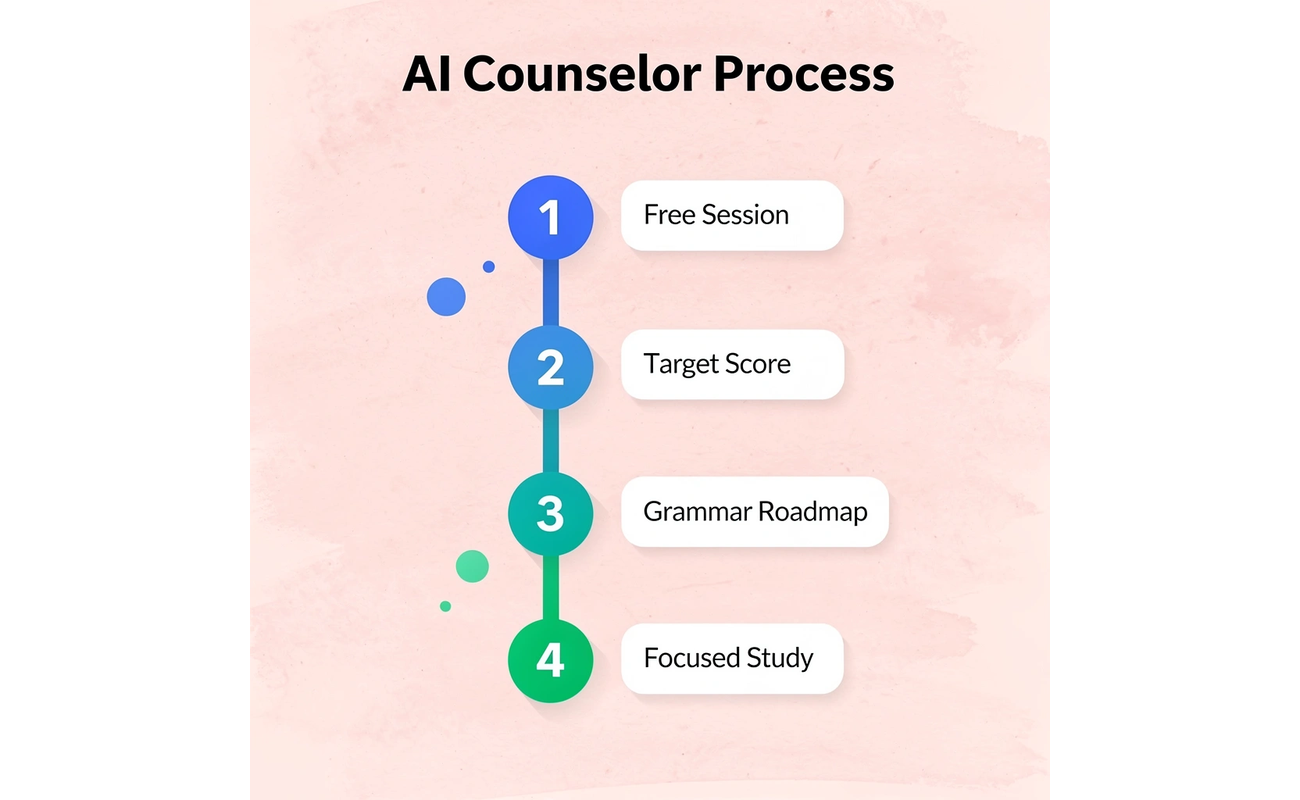
Kollegio's AI college counselor provides that system in your first session. You'll get a target score based on your college list and a focused rule set showing exactly which grammar concepts matter for your range. No more studying everything or guessing what's important—a clear path from where you are to where you need to be, completely free.
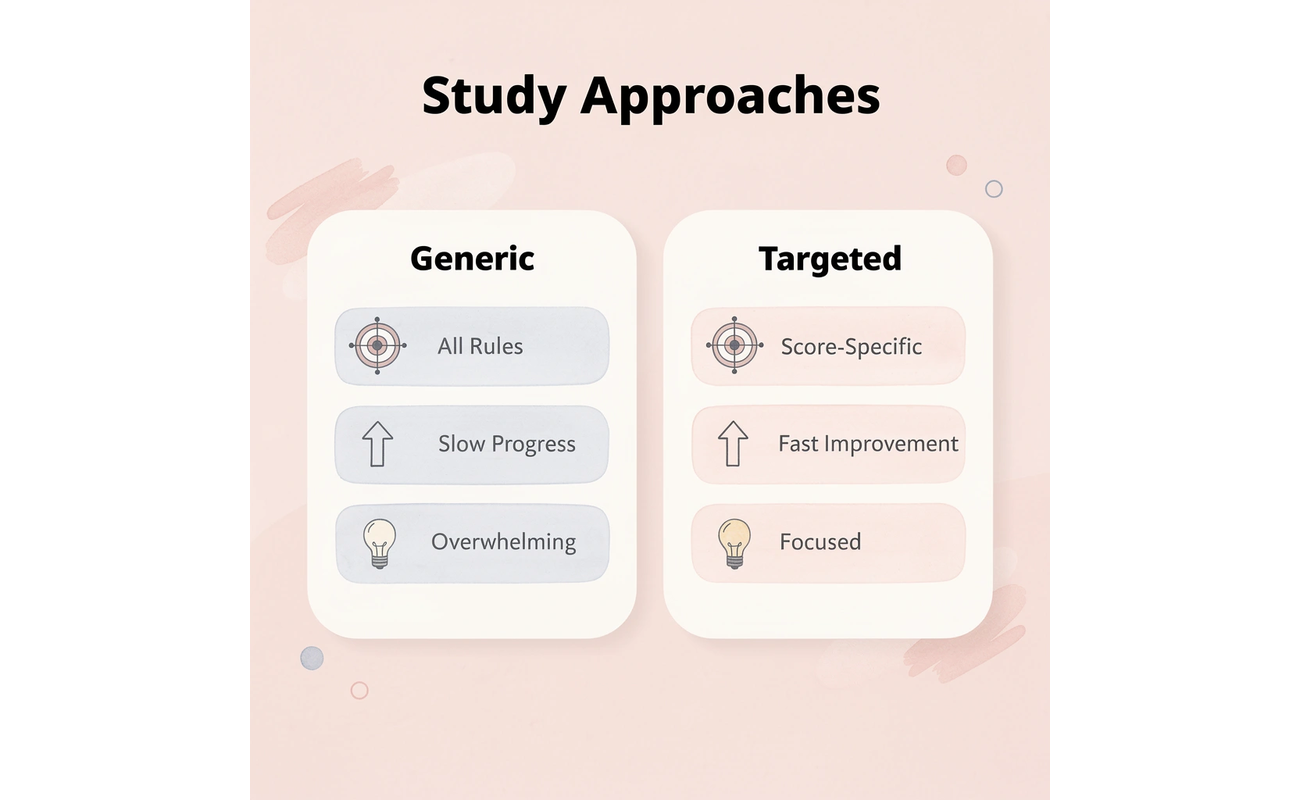
"Students who focus on score-specific grammar patterns see faster improvement than those using generic study approaches." — Educational Testing Research, 2023
💡 Tip: Your first session with Kollegio's AI counselor is completely free—get your personalized grammar roadmap today!