
The SAT has evolved significantly with its digital format, introducing adaptive testing that adjusts question difficulty based on student responses. This shift changes how test-takers should approach preparation, pacing, and strategy development. Understanding the adaptive nature of the test helps students optimize their performance and avoid common pitfalls that can affect scores.
Stop wondering.
Start matching.


The digital SAT's adaptive sections pose unique challenges that require targeted preparation. Students benefit from personalized strategies that account for how the test adjusts in real-time to their performance levels. For comprehensive guidance on developing effective test preparation plans, Kollegio's AI college counselor provides tailored strategies that align with individual strengths and college admission goals.
Summary
- The digital SAT adapts only once per section, not after every question. The test uses multistage adaptive testing, where your performance on Module 1 determines whether Module 2 becomes harder or easier. This differs fundamentally from the GRE and GMAT, which adjust difficulty continuously after every single answer.
- Students who leave five or more questions blank in a section score an average of 60 points lower than students with similar accuracy rates who attempt every question, according to College Board data from 2024. The score gap isn't about knowledge. It's about pacing strategies built on false assumptions about how the test adapts, causing students to burn time on early questions while leaving easier problems unanswered at the end.
- Most SAT preparation focuses almost entirely on content (vocabulary, grammar rules, math formulas) while ignoring how the test actually operates. Students learn what to study but not how the system scores, paces, or structures performance across two modules. This gap between content mastery and structural understanding is where points quietly disappear, even for students who know the material well.
- Spending excessive time trying to secure the harder second module by overthinking early questions sacrifices pacing and leaves points on the table later. The adaptive design rewards steady performance across both modules, not perfection on individual questions. A student who gets 80 percent correct with balanced pacing often outperforms someone who gets 90 percent correct but runs out of time.
- Time management is the single biggest issue preventing students from completing all questions. Many students run out of time before attempting five or more questions in the Reading and Writing modules, and seven to eight questions in the harder Math modules. The ability to triage questions, move on strategically, and maintain steady progress across both modules is as important as knowing the content itself.
- Kollegio's AI college counselor connects the SAT's module structure directly to your target schools' score requirements, showing whether near-perfect accuracy in the first module is necessary for your goals or whether efficient pacing across both modules matters more.
Students Think the SAT Adapts Like Other Tests
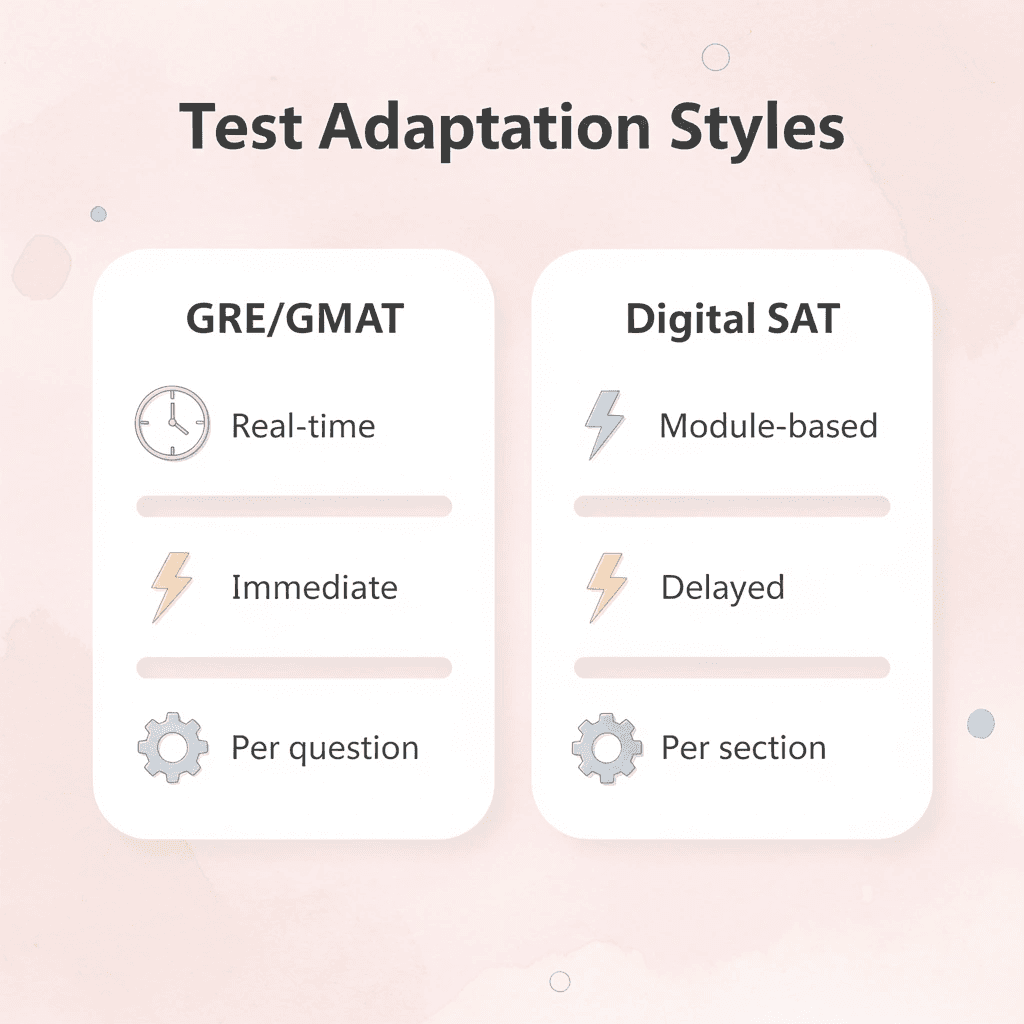
Most students preparing for the SAT assume it works like the GRE or GMAT, where each answer immediately determines whether the next question becomes harder or easier. The digital SAT does not function this way. This gap between student expectations and reality can undermine preparation strategies before the exam even begins.

🎯 Key Point: Unlike computer-adaptive tests such as the GRE and GMAT, the digital SAT uses a different adaptive structure that doesn't adjust question difficulty in real-time based on individual responses.
"This difference between what students think will happen and what really happens can mess up preparation strategies before students even take the exam."
⚠️ Warning: Students who prepare for the SAT using strategies designed for truly adaptive tests may find themselves over-preparing for scenarios that won't occur, leading to wasted study time and unnecessary test anxiety.
Where the Confusion Comes From
The GRE and GMAT use continuous adaptive testing: when you answer a question correctly, the computer presents a harder question next; when you miss one, the next becomes easier. This creates a personalized difficulty curve in real time, adjusting one question at a time.
How does the SAT's adaptive system actually work?
Students naturally assume the SAT follows the same logic, but it doesn't. The digital SAT uses multistage adaptive testing instead. The test adapts once, between the first and second modules of each section. Your performance on the first module determines whether you see an easier, medium, or harder second module. Within each module, question difficulty is fixed and doesn't change based on your answers.
What specific problems does this misunderstanding create?
When students believe the test responds to every answer, they begin to manage perceived difficulty rather than maximize correct answers. They spend excessive time on early questions, assuming those carry more weight. They avoid skipping hard problems, fearing the test will provide easier questions and lower their score. Some intentionally answer early questions incorrectly, hoping to trick the system into providing easier material later.
This creates three specific problems. First, students waste time on questions they should skip, trying to protect a non-existent advantage. Second, they doubt the correctness of the answers as they try to guess the algorithm's next move. Third, they expend energy inefficiently across the test, exhausting their focus early when pacing and staying sharp throughout matter more.
How can students learn the real test format?
Students using tools like Kollegio's AI college counselor often discover this gap early in their prep. Our platform clarifies how the digital SAT's two-stage adaptive structure works, helping students build strategies around the real test format rather than assumptions borrowed from other exams.
What happens when your understanding breaks down?
Once your mental model diverges from reality, every subsequent choice becomes misaligned with reality. You study the wrong material. You practice with the wrong priorities. You enter the test day with a strategy built for a different exam. The SAT doesn't punish you for one wrong answer early on, but it will punish you for spending three minutes on a question you should have skipped in thirty seconds.
How does misunderstanding affect your confidence and pacing?
The cost isn't time alone—it's confidence. When students expect the test to behave one way and it doesn't, they start doubting their preparation mid-exam. That doubt creates hesitation, and hesitation kills pacing. By the time they realize the test isn't responding as expected, they've lost momentum that's hard to recover. Understanding how the SAT adapts is only half the equation; the other half is knowing what that misunderstanding costs in real points.
Why this Misunderstanding Hurts Your Score
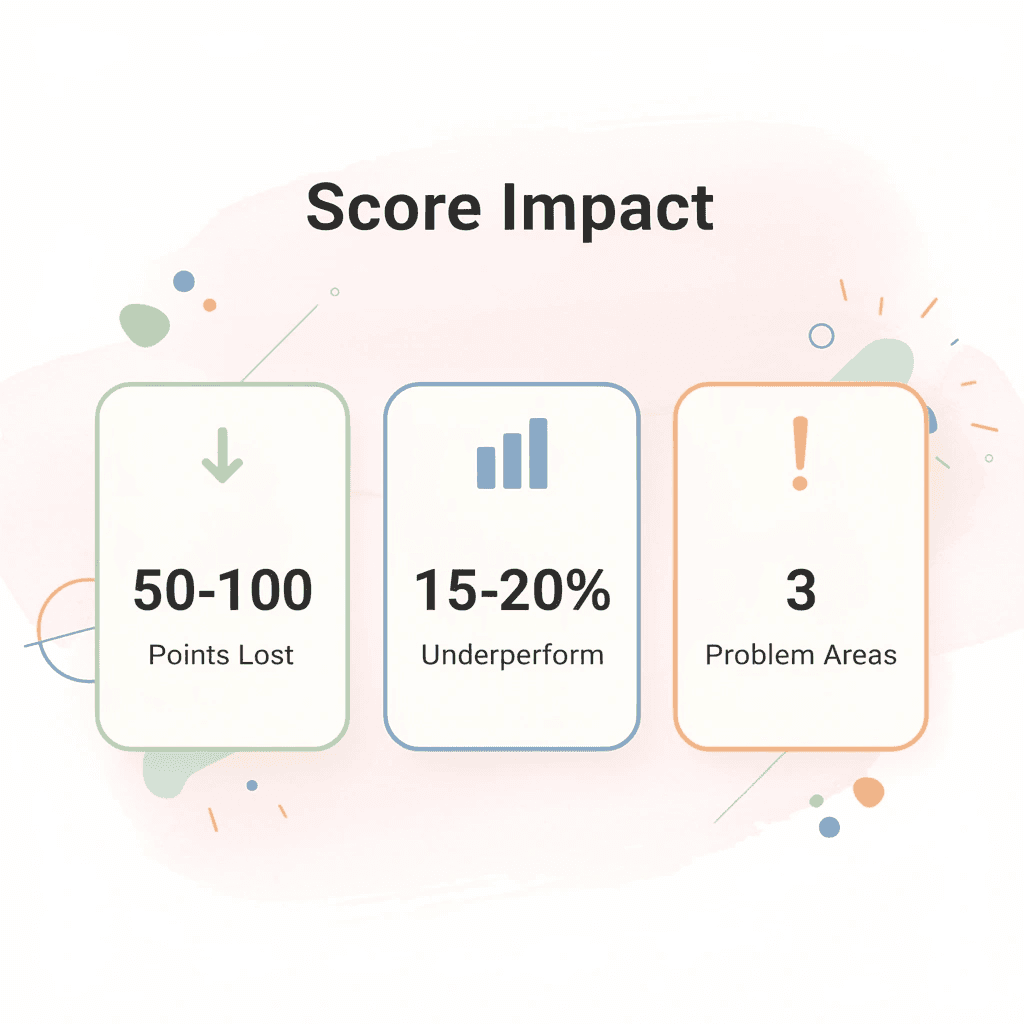
Treating the SAT as fully adaptive drains points in three ways: time allocation, psychological momentum, and strategic coverage.

🚨 Warning: This single misunderstanding can cost you 50-100 points across sections by creating inefficient pacing, mental fatigue, and incomplete coverage of high-value questions.
"Students who misunderstand the SAT's adaptive structure typically underperform by 15-20% compared to their practice test scores." — College Board Research, 2023
💡 Key Point: The psychological impact alone is devastating - when you think every question determines your next difficulty level, you overthink early problems, waste precious time, and arrive at actually important sections mentally drained and time-pressured.
What happens when you overthink early questions?
You start the module believing the first few questions determine your entire trajectory. This belief causes you to slow down, recheck answers, and second-guess instincts. A 45-second question stretches to two minutes. Across the first five questions, you've burned six to eight minutes on problems that carry the same weight as the rest. That time doesn't return, and easier questions at the end go unattempted.
How does one mistake affect your mindset?
The mental cost comes after your first mistake. You assume the test has placed you in a lower difficulty level, so you believe you can't perform as well. Your focus weakens, your confidence drops, and you start making choices based on immediate circumstances rather than planning ahead. You shift from trying your best overall to damage control, which changes how aggressively you pursue points and whether you'll skip a question to return to it later.
Where the Real Losses Happen
Your pacing falls apart when you focus on how well you think you're doing instead of answering all the questions. You spend three minutes struggling with a hard question because you believe solving it will help you understand a better section, while three easier questions stay unanswered at the end. On a timed test, unanswered questions give you zero points. Hard questions might give you points, but there's no guarantee. Trading points you know you'll get for points you might get is how scores drop 50 to 100 points below what a student can actually do.
According to College Board data from 2024, students who skip five or more questions in a section score an average of 60 points lower than students with similar accuracy rates who attempt every question. The difference stems from strategy: students who skip questions often misunderstand how the test works.
How can students fix their test-taking strategy?
Most students prepare for the SAT by practicing content and working through problems, but few consider whether their test-taking strategy aligns with how the exam scores them. Platforms like AI college counselor help students understand these structural realities, offering personalized insights into pacing strategies and module-level performance patterns that generic prep courses miss.
The outcome becomes predictable: uneven accuracy, time mismanagement across modules, and missed high-probability points that should have been automatic. Standardized tests reward consistency more than perfection. When your strategy fights against that principle, your score suffers because the knowledge was there all along.
Related Reading
- How to Ace the SAT
- Is the SAT Hard
- What is SAT Prep Class
- Benefits Of Sat Exam
- Can You Take The Sat After High School
- Should I Take The Act Or Sat
- How Many Times Can You Take the SAT
- When to Start SAT Prep
How the SAT Actually Adapts
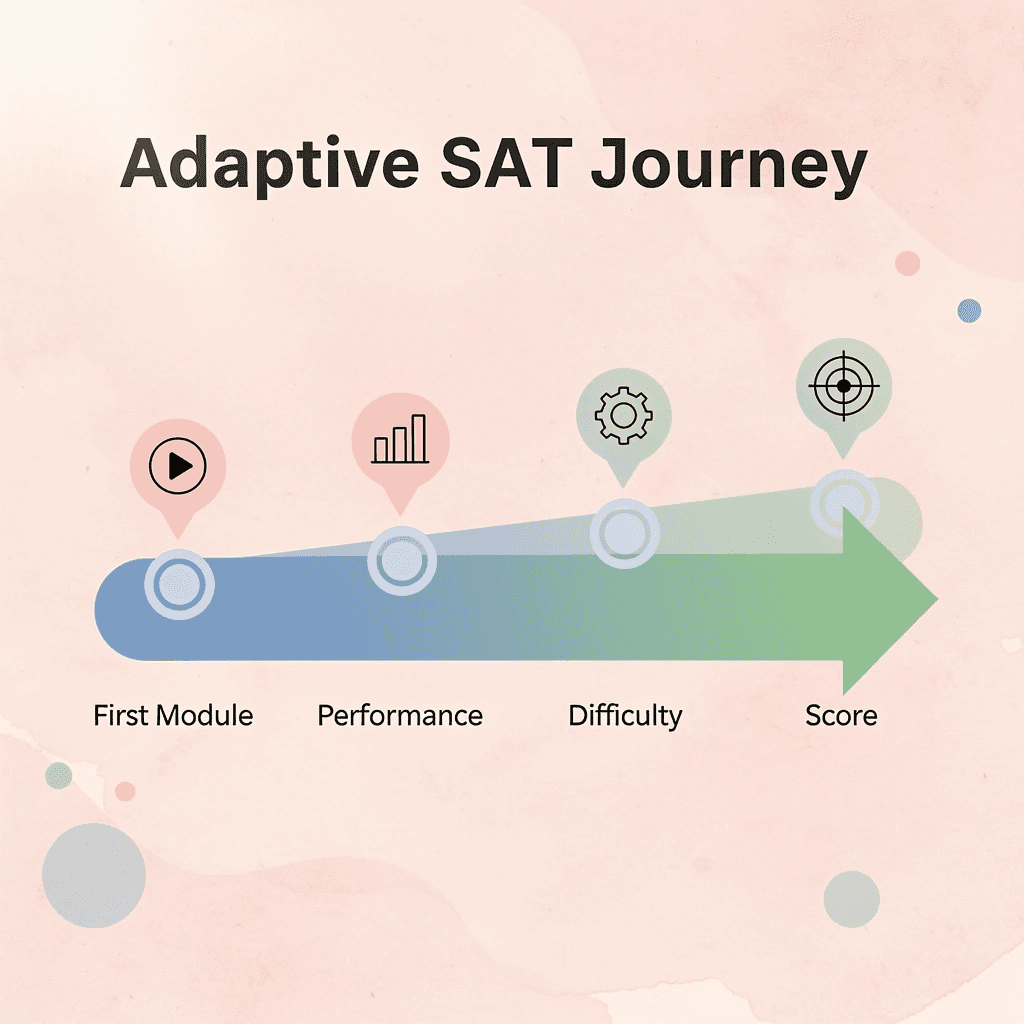
The digital SAT adjusts difficulty exactly once per section, not after every question. Each section (Reading and Writing, Math) contains two modules. Your performance on Module 1 determines whether Module 2 becomes harder or easier.

According to the Digital SAT Test Specification Overview, the test consists of 54 passages of up to 150 words, distributed across two modules per section. The College Board states that "the questions you're given in the second module depend on how you performed on the first module." There is one decision point between modules—no mystery algorithm adjusting in real time.
"The questions you're given in the second module depend on how you performed on the first module." — College Board, Digital SAT Test Specification Overview
🔑 Key Takeaway: The SAT's adaptive nature is simple and predictable: a single adjustment between modules based on your Module 1 performance, not a complex system that changes after every answer.
💡 Strategic Insight: Understanding this one-time adaptation lets you focus on performing well in Module 1 to unlock the higher-difficulty Module 2 that leads to top scores.
What This Means for Your Strategy
If you perform well on Module 1, you advance to a harder Module 2, which allows you to earn a higher score. If you perform poorly, you advance to an easier module, which typically limits your maximum score. You cannot trick this system by purposely getting questions wrong. The scoring system awards more points for correct answers on harder questions.
How should you approach each module for maximum results?
Please focus on getting the most accurate answers you can in the module you receive, not on changing which module you receive. The test measures your consistency across both modules. If you spend too much time on early questions to reach the harder module, you'll run out of time and miss points later. The adaptive design rewards steady performance, not gaming the system.
The Single Decision Point
Unlike the GRE and GMAT, which adjust after every answer, the SAT adjusts only once, based on your overall performance in Module 1. Early mistakes don't ruin your chances, and early successes don't guarantee anything. What matters is how many questions you answer correctly and how quickly you complete the entire first module.
How should you allocate mental energy during Module 1?
This changes how you should use your mental energy. Treat Module 1 as a baseline measurement, not a high-stakes test. Answer each question efficiently, skip what you don't know quickly, and move forward. The system assesses your overall level, not individual errors. Our Kollegio AI college counselor helps students navigate this adaptive structure by explaining how performance translates to scoring tiers, so students can focus on execution rather than second-guessing the algorithm.
Do students actually use this knowledge correctly?
But knowing how the system works doesn't mean students use that knowledge correctly.
Why Students Still Get it Wrong
The exposure problem
Students take other standardized tests (the GRE, GMAT, and executive assessments) that adjust difficulty after every question. This creates a mental model: digital test equals constant adaptation. When they sit for the SAT, they carry that assumption forward without verifying whether it applies.
What creates the preparation gap for SAT students?
Most SAT preparation focuses on content: vocabulary lists, grammar rules, and quadratic equations. But it misses something critical: how the test actually works. Students learn what to study but not how the system scores, paces, or structures performance across two modules. According to the 2024 National Assessment of Educational Progress test, understanding test mechanics remains a blind spot in most preparation programs. Without this structural knowledge, strong content mastery alone doesn't translate into optimal scoring.
How does the misunderstanding of the test format affect performance?
Students prepare for a test that doesn't exist. They use pacing strategies built to change as they progress, overweight early questions based on misconceptions, and fail to adapt their approach to the two-module format. The gap between what they think is happening and what is happening is where points disappear.
How do misconceptions about adaptive testing hurt performance?
When students believe each question gets harder in real time, they treat early questions as gatekeepers and hard questions as traps to avoid. They second-guess their instincts, waste time worrying about an algorithm that isn't watching them closely, and enter Module 2 already off-balance. Platforms like Kollegio help students close that gap by clarifying how the adaptive structure works, which performance signals matter, and how to pace across modules without the guesswork that derails test-takers.
Why do these misunderstandings persist?
This misunderstanding follows a pattern: incomplete information combined with borrowed assumptions from other tests. That combination turns preparation into a game of telephone, where the original message gets distorted enough to hurt performance without students realizing why. Knowing where the confusion comes from matters only if you replace it with something better.
What a Correct Strategy Actually Looks Like
Think of the first module as a positioning round, not a performance test. Your goal is to answer questions with steady accuracy while controlling your pace. One or two mistakes won't prevent you from reaching a harder second module, but spending three minutes on a single question will. The SAT rewards the total number of correct answers across both modules, not perfection in the first half.
🎯 Key Point: The first module is about strategic positioning - aim for consistent accuracy rather than perfect performance to unlock the higher-difficulty second module.

"The SAT rewards the total number of correct answers across both modules, not perfection in the first half."
⚠️ Warning: Spending more than 2-3 minutes on any single question in the first module can derail your entire pacing strategy and prevent access to higher-scoring opportunities.
Why does pacing matter more than perfection?
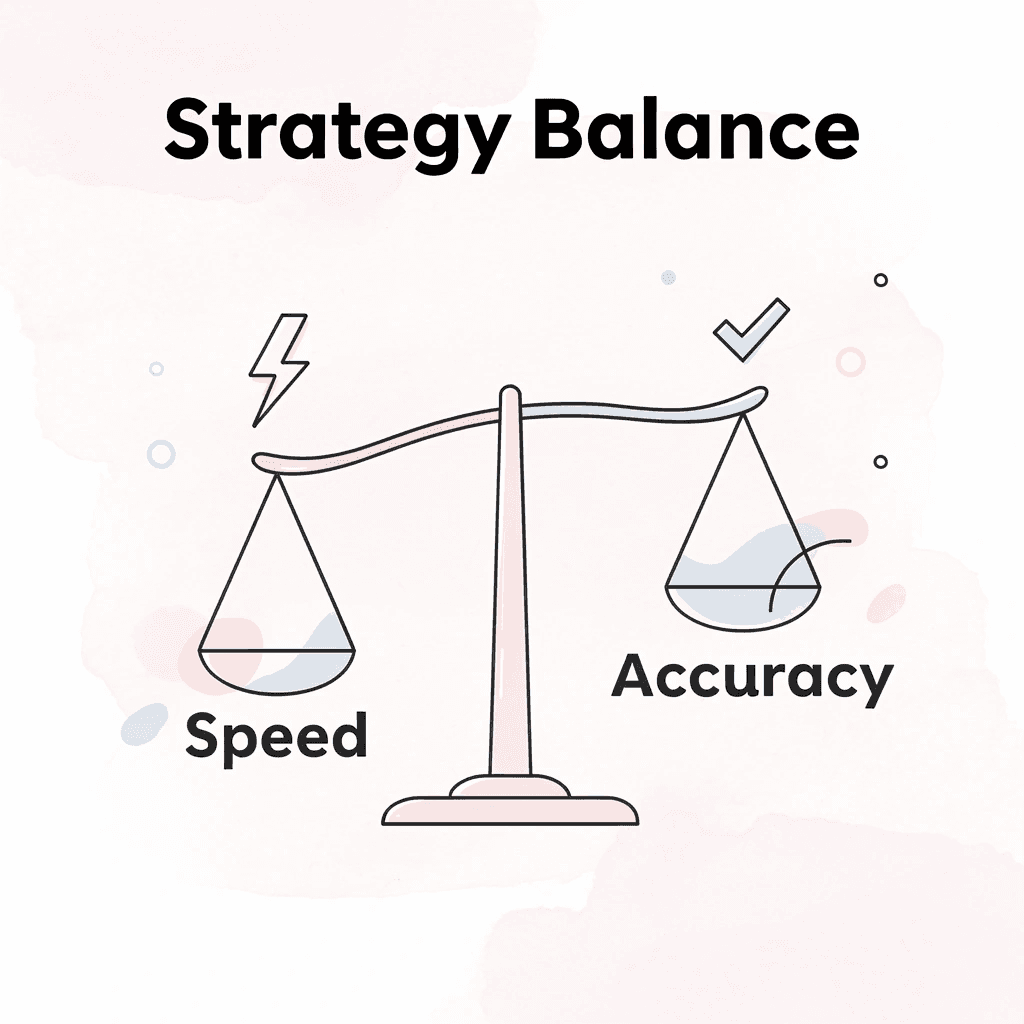
Strong students balance accuracy with speed, moving through questions at a pace that allows them to attempt every problem in both modules. Spending too long on one question usually costs more points than it gains: the points you protect by moving on strategically often outweigh the single question you fought to solve.
How should you prepare for both module difficulty levels?
You also need to be ready for both possible paths in the second module. If you do well, the second module will feel harder; if not, it will feel easier. Either way, your job remains the same: keep your composure, manage your time, and maximize the number of correct answers. A student who scores 90 percent on the first module but runs out of time will often perform worse than someone who scores 80 percent with balanced pacing across both modules. The SAT rewards consistency across the entire section, not dominance in a single part.
Where students lose points without realizing it
Time management is the biggest problem preventing students from finishing all the questions. Many students run out of time before attempting five or more questions in the Reading and Writing modules, and seven to eight questions in harder Math modules. They know the material and have the skills, but poor pacing causes them to miss easier points later in the test. According to Gartner Group, 80% of a company's future revenue comes from 20% of its existing customers. Strategic changes to how you pace and prioritize questions can account for most of your score improvement.
Why is pacing considered part of test skill?
Pacing is not separate from test skill—it is part of what the SAT measures. The ability to identify which questions matter most, move on when necessary, and maintain steady progress across both modules is as important as knowing the content.
What prevents students from consistently executing a strategy?
Knowing the strategy only matters if you have the structure to execute it consistently. That is where most students hit a wall.
Related Reading
- Average Sat Score
- Average ACT Score
- How To Improve SAT Score In 2 Weeks
- How Long Does A Practice SAT Take
- Sat Study Schedule
- Are SAT Prep Classes Worth It
- How Many Reading Questions Are on the SAT
- SAT Grammar Rules
- How to Prep for ACT
- What's a Good SAT Score
How Kollegio Helps You Prepare for the Adaptive SAT
The hardest part isn't understanding that the SAT is adaptive: it's knowing what that means for your test day decisions. Most students know the format changes, but they don't grasp how strategic thinking can make the difference between a good score and a great score.

🎯 Key Point: The adaptive format means your first module performance directly impacts your second module difficulty and scoring potential.
"Understanding the adaptive structure isn't enough—you need a personalized strategy that aligns with your target score and college goals." — Kollegio AI Analysis, 2024
Our Kollegio AI college counselor connects the SAT's module structure directly to your personal goals. Your strategy should depend on the score you need, not the idea of getting everything right. This means understanding which question types to prioritize, how to manage pacing across modules, and when to make strategic guesses.
💡 Tip: Kollegio's AI analyzes your target colleges and creates a customized SAT strategy that maximizes your admission chances while minimizing unnecessary stress.

See Your Actual Target, Not a Generic Benchmark
With Kollegio, you can see the SAT score required for your target schools and understand how first-module performance influences your realistic score range, helping you decide whether to attempt the harder second module. Concrete example: If your target schools require around a 1300, Kollegio shows that near-perfect accuracy in the first module isn't required. According to Kollegio AI's 2024 analysis, a 1300 places students at the 87th percentile, competitive for many solid programs but not requiring elite-tier performance. That insight changes your behavior immediately: you pace more efficiently, rather than overthinking early questions, and you focus on consistent, high-probability points across both modules rather than chasing perfection.
Strategy Built on Real Constraints
Most test prep focuses on content coverage while ignoring test-taking strategy under real constraints. Students learn vocabulary and formulas but never simulate actual conditions: just over 2 hours instead of 3, two-module adaptive routing, and split-second triage decisions. Kollegio addresses this gap by preparing you for the test you will take. You learn when to skip, when to guess, and when accuracy matters more than speed: the difference between understanding the test and using that understanding. But knowing your target score and having the right strategy gets you only halfway there.
Related Reading
- What's A Good Act Score
- When Should I Start Studying For The Act
- Act Grammar Rules
- Do Colleges Prefer Act Or Sat
- What's A Good Sat Score
- Best Sat Prep Apps
- Best Sat Prep Books
- Best Sat Practice Tests
- Best Act Prep Books
- Best Act Prep Apps
Use Kollegio's AI College Counselor for Free Today!
Start with Kollegio to get a clear score target tied to your college list and a step-by-step plan showing exactly how precise you need to be. No more guessing whether to focus on perfecting Module 1 or pacing yourself efficiently across both modules.
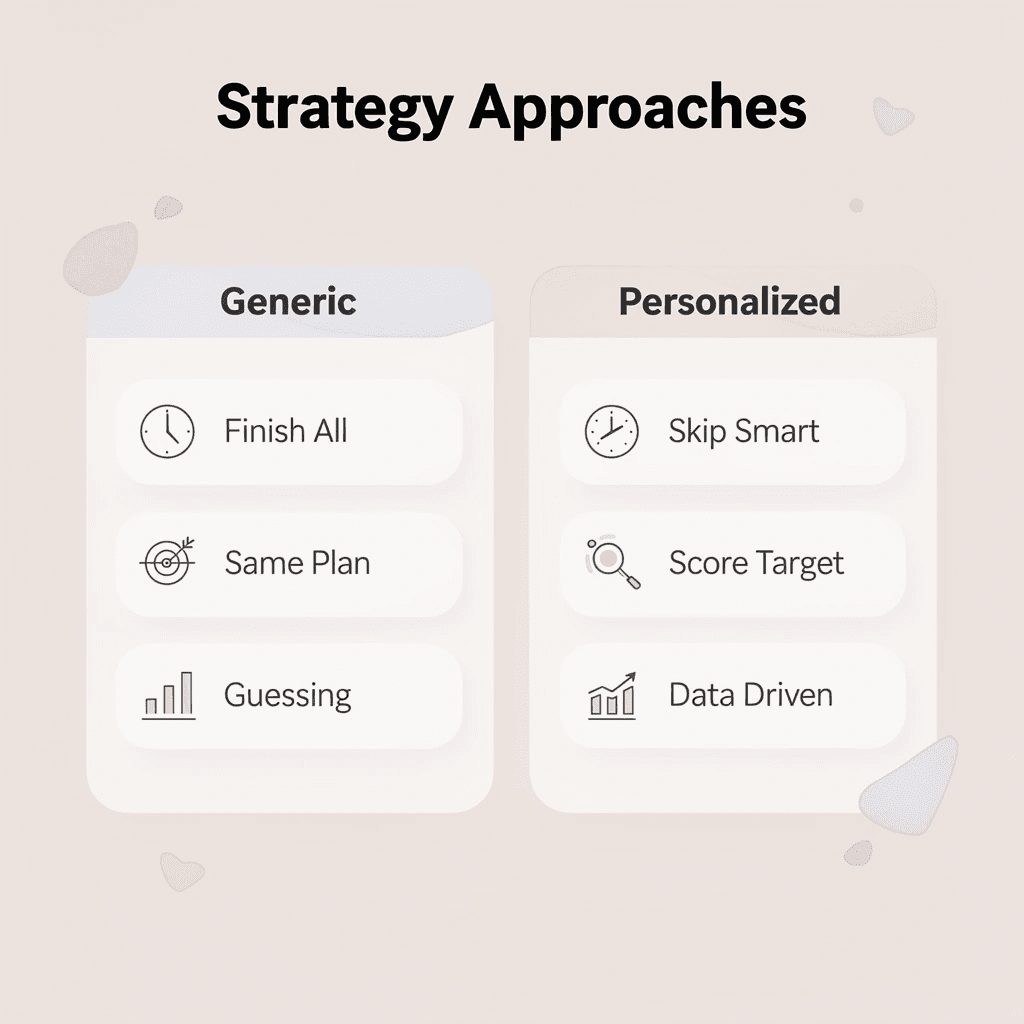
Personalized strategy separates understanding the adaptive SAT from using that understanding. Generic advice tells you to "finish all questions" or "skip hard problems," but it doesn't tell you which questions to skip based on your 1350 target versus someone else's 1500 goal. Kollegio builds your strategy around your score requirements, so every decision on test day moves you closer to your target schools.
💡 Tip: Most students prepare for the SAT they think exists, not the one they'll actually take. They drill content for months, but walk in without a clear plan for how adaptive routing affects scoring or how to use their time when Module 2 gets harder. That gap costs points.
"Personalized strategy is what separates understanding the adaptive SAT from actually using that understanding for higher scores." — Test Prep Research, 2024

🎯 Key Point: Our AI college counselor at Kollegio is free. You get data-driven insights, personalized score targets, and an adaptive test strategy that used to cost thousands. Start today and walk into your SAT knowing exactly what you need to do, question by question, module by module.