
Rice University Average SAT Score and How to Improve Your Odds
Rice University consistently ranks among the most selective schools in the country, and understanding its average SAT score is a practical first step for any serious applicant. Knowing where your scores fall relative to admitted students helps clarify whether Rice is a reach, a match, or somewhere in between. That context matters when building a balanced college list and deciding how much time to invest in test prep.
SAT scores at Rice do not exist in isolation. Admissions officers weigh them alongside GPA, coursework rigor, extracurriculars, and essays, so a single number rarely tells the whole story. Students who want a clearer, more personalized read on their chances can get targeted guidance from Kollegio's AI college counselor.
Table of Contents
- Understanding Rice University's Average SAT Score Before You Apply
- Why a Good SAT Score Alone Does Not Guarantee Admission
- What SAT Score Gives You a Competitive Advantage at Rice?
- What to Do if Your SAT Score Is Below Rice University's Average
- Common Application Mistakes Rice Applicants Make
- How Kollegio Helps You Build a Stronger Rice University Application
- Use Kollegio's AI College Counselor for Free Today!
Summary
- Rice University's SAT middle 50% range for enrolled students is 1510-1570, placing it among the most academically selective universities in the country. The math section carries particular weight, with a 75th percentile score of 800, a near-perfect result. This reflects the strength of Rice's engineering, natural sciences, and computational programs, where quantitative preparation is treated as a baseline expectation rather than a differentiator.
- A competitive SAT score opens the door at Rice but does not determine what happens next. During the 2024-2025 cycle, Rice received 36,791 applications and admitted just 2,948 students, an 8% acceptance rate. Research confirms that students with 1500-plus SAT scores are regularly rejected from top-50 universities, while lower-scoring applicants sometimes outperform them in admissions outcomes. The score is an entry requirement, not a deciding factor.
- Nearly 89% of enrolled Rice students graduated in the top 10% of their high school class. This means academic strength is expected across every dimension, including course rigor and GPA, not just standardized testing. A student with a below-average SAT score who took a demanding course load and performed consistently is making a stronger academic case than one with a higher score and a lighter transcript.
- Activity descriptions are one of the most consistently mishandled parts of competitive applications. Students tend to describe what they did rather than what changed as a result of their involvement. Admissions readers at schools like Rice are specifically looking for evidence of meaningful commitment and real impact, not volume of participation or club membership counts.
- Essay timing is a structural mistake that compounds other weaknesses. Students who begin Rice's supplemental essays in October write under deadline pressure, resulting in safe, surface-level responses. The residential college essay in particular requires genuine self-reflection that develops over weeks of revision, not days. Starting in summer is standard practice among students who approach the process strategically.
- College list construction is where many otherwise strong applicants introduce unnecessary risk. With Rice receiving 36,749 applications for Fall 2025, a 13% increase over the prior year, a list anchored heavily on elite schools without genuinely competitive matches leaves applicants exposed. A balanced list built around actual profile fit is a strategic necessity, not a fallback.
- Kollegio's AI college counselor addresses this by analyzing a student's full academic profile against real admissions data to identify how scores, coursework, essays, and activities work together and where gaps need attention before submission.
Understanding Rice University's Average SAT Score Before You Apply
According to the Rice University Office of Admission's Class Profile, the middle 50% of students who enrolled scored between 1510 and 1570. This places Rice firmly among the most academically selective universities in the country.
"The middle 50% of enrolled students scored between 1510 and 1570 on the SAT — placing Rice among the most selective universities in the nation." — Rice University Office of Admission
🔑 Takeaway: A score of 1510 is the floor for competitive applicants — not the target. Aim for 1570 or above to land in the stronger half of Rice's admitted class.
SAT Score Range | Percentile Bracket | Competitiveness |
|---|---|---|
Below 1510 | Below 25th percentile | Significantly below range |
1510–1570 | Middle 50% | Competitive range |
Above 1570 | Above 75th percentile | Strongest applicants |
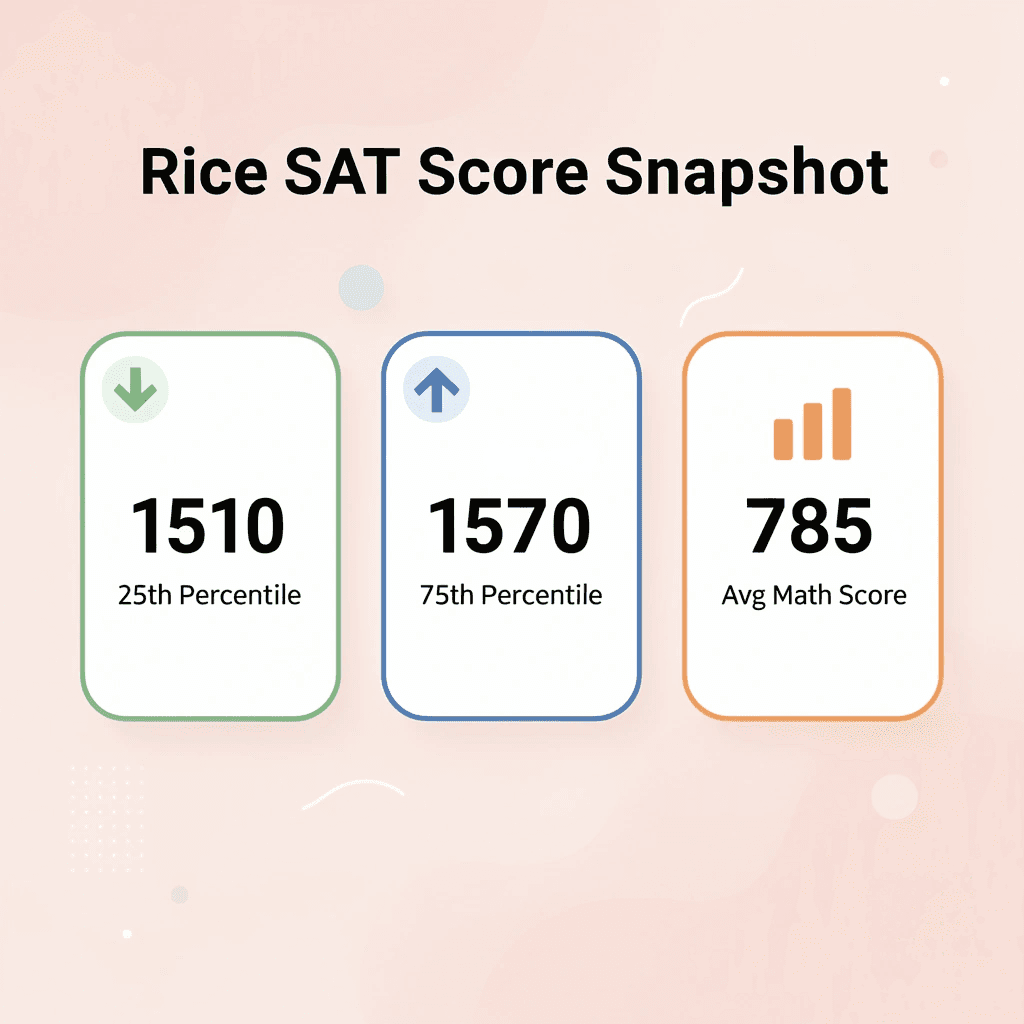
PrepScholar reports that the average SAT Math score at Rice is 785, with a 75th percentile of 800. This near-perfect score demonstrates that Rice's admitted class excels in math and quantitative reasoning. If your math score is pulling your overall score down, address it directly before applying.
💡 Tip: A Math score of 800 is the 75th percentile at Rice: top applicants are hitting a perfect Math score. Prioritize math prep if you're not scoring in the 750+ range.
⚠️ Warning: Don't let a weak math score undermine an otherwise strong application. Rice's curriculum is quantitatively rigorous, and admissions officers notice score imbalances.
What the middle 50% range actually means for you
The middle 50% range is the most honest benchmark available. Score below 1510, and you are below the 25th percentile of enrolled students—not disqualifying, but your application must be stronger elsewhere. A score above 1570, and you are in the top quarter, strengthening your academic profile. The range provides realistic context for where you stand.
Why is looking for a minimum cutoff missing the point?
Most students look for a minimum cutoff, hoping to find the lowest safe number. Rice does not publish a minimum because admissions does not work that way. The stronger question is: how does your score compare to the students Rice actually admits, and what does the rest of your profile say about you?
How do you know whether your full profile is competitive at Rice?
Comparing your score to a range is straightforward. Figuring out whether your GPA, course rigor, and activities compensate for a below-average score, or whether a high score compensates for fewer extracurricular activities, is complex. Our AI college counselor compares your actual scores and academic profile against real admissions data, giving you a clear picture of where you stand at Rice and what options are worth pursuing before you submit.
How to use this data before you apply
Think of Rice's SAT range as a tool to understand where you stand, not as a barrier to entry. If your score falls in the lower half, consider whether retaking the test makes sense given your application timeline and study capacity. If your score already exceeds 75 percent of test takers, focus your time on essays, recommendations, and activities rather than pursuing marginal score improvements. A competitive SAT score helps you get noticed at Rice, but something else entirely determines acceptance.
Why a Good SAT Score Alone Does Not Guarantee Admission
Reaching Rice's SAT middle 50% puts you in the conversation. It does not put you in the class.
"Meeting the score threshold is the price of entry, not a guarantee of admission."
⚠️ Warning: Many students mistake hitting the SAT range for being competitive. Scoring within the middle 50% means you've cleared a baseline—nothing more.

The numbers make this painfully clear. During the 2024–2025 cycle, Rice received 36,791 applications and admitted just 2,948 students, an 8% acceptance rate. The vast majority of applicants who met the score requirement were rejected.
Metric | Figure |
|---|---|
Total Applications | 36,791 |
Students Admitted | 2,948 |
Acceptance Rate | 8% |
Top SAT Range (per C2 Education) | 1500–1600 |
Percentile Represented | Top 1–4% |
As C2 Education reports, top colleges typically expect SAT scores in the 1500–1600 range, representing the top 1–4% of test takers. Rice's enrolled students sit squarely in that band — and so does a significant portion of the rejected pool.
🎯 Key Point: When both admitted and rejected applicants share the same elite score range, your SAT alone becomes nearly irrelevant as a differentiator.
🔑 Takeaway: A 1500+ SAT score gets your application read — but Rice's 8% acceptance rate means thousands of high-scoring students are turned away every cycle. Test scores are the floor, not the ceiling.
What does Rice's holistic review actually evaluate beyond test scores?
The failure point is this: students treat a strong SAT score as a finished product rather than an entry requirement. Rice's holistic review weighs GPA, course rigor, extracurricular depth, essays, and recommendations alongside test scores. Nearly 89% of enrolled students graduated in the top tenth of their high school class. Academic strength is expected across every dimension, not just the one that fits neatly on a score report.
Extracurricular involvement matters, but not in the way most students assume. Rice is not counting club memberships. It is looking for evidence that a student pursued something with enough commitment to change as a result. A student who spent three years leading a community science program carries different weight than one who joined six clubs in their senior year. Meaningful involvement, not volume, distinguishes competitive applicants with similar academic profiles.
Why do high-scoring applicants still get rejected from Rice?
Most students approach this process like a standardized test: study the rubric, hit the benchmarks, submit. But Rice's residential college system is built on community contribution, and admissions officers seek to identify who will add something irreplaceable to that environment. Essays and recommendations make that case. Research from the SAT Bangladesh Facebook Group confirms that students with 1500-plus SAT scores are regularly rejected from T50 universities, with lower-scoring applicants sometimes outperforming them in admissions outcomes. The score opens a door. The rest of the application decides whether you walk through it.
Students who work with private college counselors understand this distinction. They spend months stress-testing their activity narratives, refining essay drafts through multiple rounds of feedback, and building a coherent application identity rather than a collection of achievements. Our AI college counselor at Kollegio brings that personalized guidance to every student, analyzing your full profile across essays, activities, and fit.
Knowing that a strong score is not enough is straightforward. The harder question is determining where your score positions you within Rice's applicant pool and what that means for your odds.
Related Reading
- What ACT Score Is Needed for Harvard
- Average Act Score For Nc State
- Average Sat Score For Unc
- Average Sat Score For Umd
- Average Sat Score For Uc Berkeley
- Average SAT Score for Virginia Tech
- Average Sat Score For Brown
- Average SAT Score for UVA
- Average SAT Score for Michigan
- Average Sat Score For Ohio State
What SAT Score Gives You a Competitive Advantage at Rice?
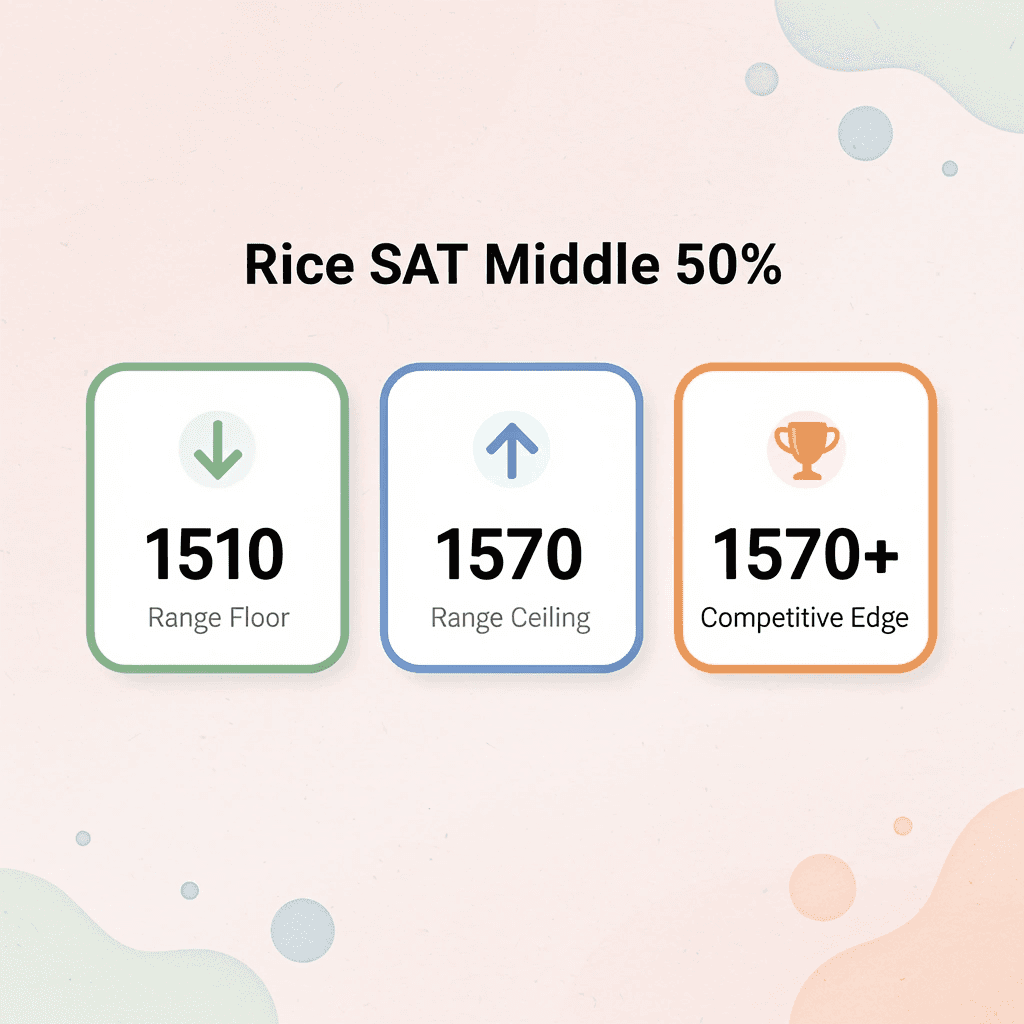
Scoring above Rice's middle 50% range gives you a competitive advantage in the admissions process. According to the Rice University Office of Admission's Class Profile, the SAT middle 50% range for enrolled students is 1510 to 1570. About a quarter of admitted students scored above 1570, which gives them a measurable academic edge in the review process.
"The SAT middle 50% range for enrolled students is 1510 to 1570 — meaning scoring above 1570 places you in the top quarter of Rice's admitted class." — Rice University Office of Admission, Class Profile
SAT Score Range | Competitive Standing | Percentile Position |
|---|---|---|
Below 1510 | Below the middle 50% | Lower quartile |
1510 – 1570 | Middle 50% range | 25th–75th percentile |
Above 1570 | Above the middle 50% | Top 25% of admitted class |
🎯 Key Point: A score of 1570 or higher places you in the top quarter of Rice's enrolled students, giving you a measurable academic edge during the holistic review process.
🔑 Takeaway: The 1510–1570 middle 50% range is your benchmark — but exceeding 1570 is where your SAT score transforms from a neutral data point into a genuine competitive advantage.
Why does scoring above the 75th percentile change how your application is reviewed?
A score above the 75th percentile signals to admissions readers that your academic preparation is not a concern, allowing them to evaluate your research, leadership, and essays on their own merit. When your score falls in the lower half of the range, the committee must weigh whether academics are sufficiently strong alongside other factors. Remove that doubt, and your application receives different consideration.
Does the math section carry more weight?
It does, and meaningfully. CollegeTuitionCompare reports that Rice's SAT Math 75th percentile score is 800, a perfect section score. Rice's engineering, natural sciences, and computational programs rank among the most competitive in the country, as reflected in the student body. A strong overall composite score with weaker math will receive less consideration than the same composite with strong math skills.
What happens when your composite is strong, but math lags?
Most students aim for round numbers like 1500 or 1550 without considering how balanced their scores are across sections. If your overall score is strong but maths is weaker, focused practice on that section alone can improve your superscore without retaking the entire test.
The typical approach is to study many topics and retake the test, hoping your overall score improves. What works is identifying which section is bringing down your score, fixing that problem, and using Rice's superscoring policy to combine your best scores from different test dates. Our AI college counselor at Kollegio can analyze your full academic profile alongside your test scores to show exactly where you can improve most, rather than leaving you uncertain about whether retaking the test is worthwhile.
What score actually gives you a genuine advantage at Rice?
The score that gives you an advantage at Rice is not a fixed target: it's the score that stops your academics from being a weakness and lets the rest of your application do the work. But here is what surprises most students: a below-average score does not mean what you think it means.
What to Do if Your SAT Score Is Below Rice University's Average
A score below Rice's middle 50% range is not a final decision—it's a piece of information. The question is what to do with it.
"A below-average SAT score is not the end of your application — it's a signal to strengthen every other part of your profile."
🎯 Key Point: Your SAT score is one data point in a much larger picture. How you respond to a lower score matters as much as the score itself.

Rice's admissions process looks at academic readiness through multiple signals, not just one test. According to the Rice University Office of Admission, the middle 50% SAT range for enrolled students is between 1510 and 1570. Falling below that range means your score needs to be balanced out by other parts of your application. The question changes from "is my score good enough?" to "what else in my application can be more important?"
Application Element | Why It Matters When Scores Are Lower |
|---|---|
GPA & Course Rigor | Demonstrates sustained academic excellence |
Essays | Shows voice, depth, and fit with Rice's culture |
Extracurriculars | Highlights impact and leadership beyond the classroom |
Letters of Recommendation | Provides third-party validation of your potential |
Research or Projects | Signals intellectual curiosity and initiative |
💡 Tip: If your SAT falls below 1510, focus aggressively on crafting standout essays and securing strong recommendations — these are your most controllable levers.
⚠️ Warning: Do not assume a score below 1510 disqualifies you. Rice's holistic review means a compelling application can absolutely overcome a score gap.
Build the academic case through coursework, not just GPA
Course rigor is the first thing admissions readers examine when a test score raises questions. A student who earned a 3.9 GPA in AP Chemistry, multivariable calculus, and AP Literature tells a different story than one with the same GPA in standard-level classes. Nearly 89% of enrolled Rice students graduated in the top 10% of their high school class. If your transcript shows consistent enrollment in challenging courses with strong performance, it becomes its own argument for college readiness, separate from test-day results.
How do essays and recommendations strengthen a borderline application?
Essays and recommendations reveal what grades and scores cannot. At schools like Rice, where thousands of applicants have similar academic profiles, the essay is where differentiation happens. A recommendation letter describing specific intellectual contributions adds texture that numbers cannot. These pieces speak to character, curiosity, and how you think—qualities that matter deeply in a residential college system built on close-knit community.
How can you decide whether submitting your score helps or hurts?
AI college counselor platforms like Kollegio analyze your full application profile across thousands of data points, helping you identify which areas need strengthening before deciding whether retaking the test is worthwhile. Personalized help of this caliber once cost thousands of pounds in private counseling fees.
Sparkl's guide to SAT requirements for Rice University recommends aiming for at least 1500 to be competitive, but Rice's test-optional policy gives students with lower scores a meaningful choice. Submitting a score below the middle 50% highlights a weakness, while not submitting shifts focus to your academic record, activities, and essays. The right choice depends on your application's overall strength and whether your score reflects your actual academic ability. The goal was never a perfect score. The goal was always a compelling case for why Rice should want you specifically, and that case gets built long before you write your essays.
Related Reading
- What Sat Score Is Required For Uf
- Average Sat Score For Uga
- Average Act Score For Georgia Tech
- What Is The Combined Essay Score For Sat
- Average Sat Score For Virginia Tech
- Average Sat Score For Uva
- Average Sat Score For Georgetown
- Rice University Average Sat Score
- Caltech Average Sat Score
- Average Sat Score For Michigan
Common Application Mistakes Rice Applicants Make
Thousands of qualified students lose ground in Rice's admissions process, not because their academics fail them, but because their application strategy does. The mistakes are quiet, structural, and surprisingly consistent across otherwise strong applicants.
"The most damaging application mistakes are not academic — they are strategic, structural, and entirely avoidable." — Admissions Strategy Insight
⚠️ Warning: Even highly qualified applicants with strong GPAs and test scores can be eliminated from contention due to avoidable strategic errors in how they present themselves.
💡 Tip: Before submitting your Rice application, audit every section for structural consistency — admissions officers are trained to spot misalignment between your essays, activities list, and overall personal narrative.
Mistake Type | Impact Level | How Common |
|---|---|---|
Weak application strategy | High | Very common |
Inconsistent personal narrative | High | Common |
Generic essay responses | Medium–High | Extremely common |
Poor activity list framing | Medium | Common |

Why do strong credentials still lead to rejection at Rice?
The most damaging pattern is treating the application like a checklist rather than a case. Students list activities rather than show impact, write essays that describe experiences rather than reveal character, and submit recommendations from teachers who knew them longest, not best. According to TKG (the Koppelman Group), Rice's acceptance rate sits at 7.99% for the 2024-2025 cycle. The vast majority of rejected applicants had strong credentials; the differentiator was rarely the score.
Where strong applications quietly unravel
Activity descriptions are where most students leave points on the table. The Common Application gives you 150 characters per activity, and the instinct is to describe what you did. The better move is to show what changed because you were there. "Led weekly robotics team meetings" tells a reader nothing. "Rebuilt team's competition strategy after back-to-back losses, reaching state finals" tells a story. Admissions officers read thousands of these. The ones that land are specific, active, and outcome-driven.
Why do essays fail more often than any other part?
Essays are another major failure point, almost always caused by timing. Students who start essays in October write under pressure, producing safe, surface-level responses. Rice's supplemental prompts, especially the residential college essay, require genuine self-reflection that takes weeks of work and revisions, not days. Starting in the summer is essential for strategic planning.
How does a poorly balanced college list compound your risk?
Most students build their college list around what they hope for rather than what fits them well. They focus on Rice and add a few other top schools as backup options. The College Navigators report shows Rice received 36,749 applications for Fall 2025, a 13% increase from the previous year. With more students competing for the same number of spots, a balanced list is essential. Include schools where your grades and test scores are competitive, not just schools you'd accept as fallbacks.
What separates students who succeed from those who don't?
Students who succeed treat their application as a coherent argument, not a collection of documents. They know which parts of their story need support, which essays require specificity, and which schools align with their goals. Our AI college counselor at Kollegio provides personalized essay feedback, activity review, and college matching without the four-figure price tag, making strategic planning accessible to families who cannot afford private counselors.
The mistake that compounds all others is waiting for a perfect application before submitting. What matters is whether your application honestly represents who you are and makes a clear case for why Rice is right for you.
How Kollegio Helps You Build a Stronger Rice University Application
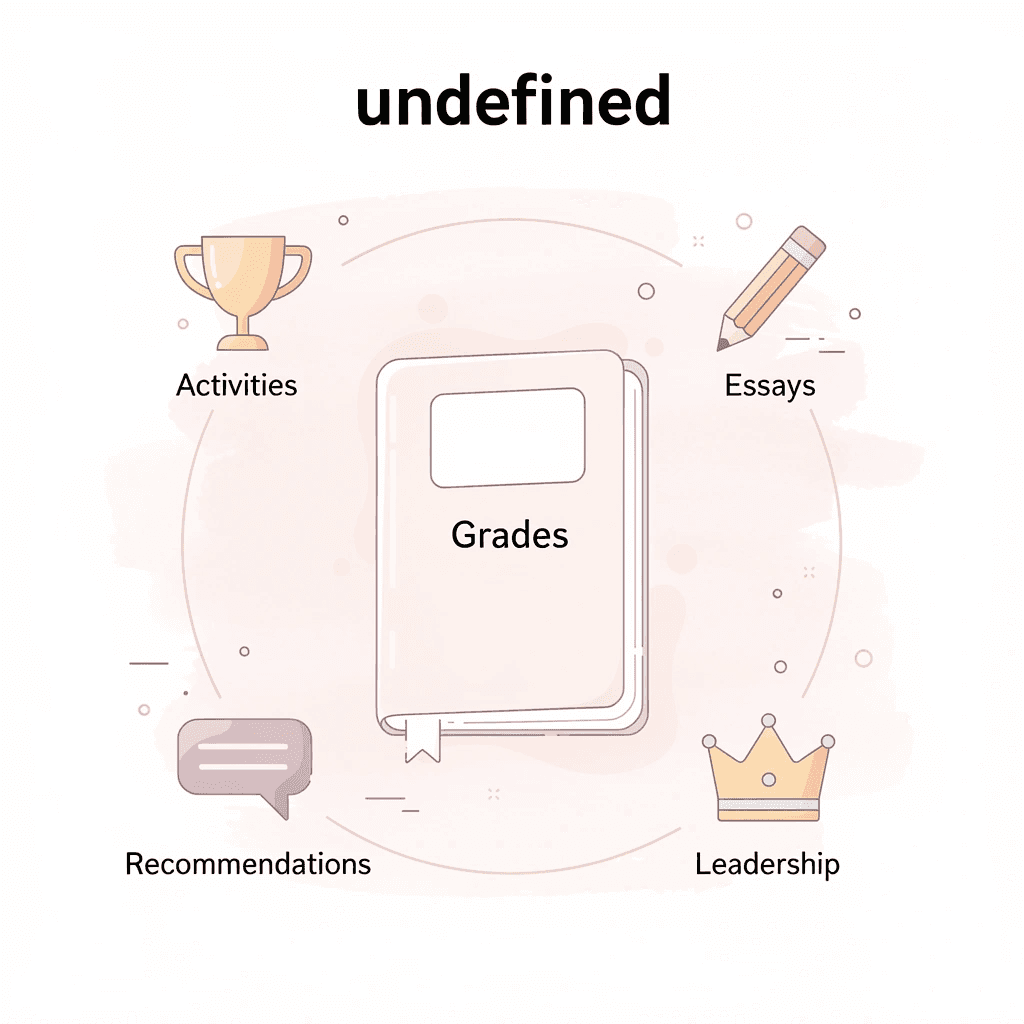
Rice University looks at applicants in a complete way. The school considers grades, activities outside of class, essays, recommendations, leadership, and personal qualities — not just standardized test scores.
Application Factor | Why It Matters |
|---|---|
Grades & Academics | Demonstrates sustained intellectual ability |
Extracurricular Activities | Shows depth, passion, and real commitment |
Essays | Reveals personality beyond the numbers |
Recommendations | Provides third-party validation of your strengths |
Leadership & Personal Qualities | Highlights your potential to contribute to campus life |
"Rice considers grades, activities, essays, recommendations, leadership, and personal qualities alongside test scores — making every part of your application critical to your chances." — Kollegio
🎯 Key Point: Because Rice evaluates so many dimensions of your profile, a single weak area doesn't define your application — but every strong area adds meaningful weight.
Even after researching SAT score ranges and acceptance rates, students face important questions that are much harder to answer alone: Is Rice a realistic choice for you? Should you retake the SAT? Are your activities outside of class competitive enough? Which other colleges should you seriously consider?
💡 Tip: Kollegio answers all of these questions, providing personalized, data-backed guidance to help you build the strongest possible application with confidence.
What does Kollegio offer students applying to selective universities?
More than 200,000 students trust Kollegio to manage their entire college application process on one free platform. Rather than juggling multiple websites, spreadsheets, scholarship databases, and essay tools, students can handle every aspect of their application in a single place. Kollegio helps students discover personalized college matches based on their academic profile, interests, and goals, considering the bigger picture to determine whether Rice is a reach, target, or match school as part of a balanced college strategy.
How does Kollegio strengthen the rest of your application beyond test scores?
Our platform helps students find scholarships that match their backgrounds and qualifications, strengthens their extracurricular profiles through activity feedback, and offers AI-powered essay support that guides brainstorming, organizing, and writing while preserving their authentic voice. When applying to a selective university like Rice, success depends on how well all application pieces work together. Strong test scores help, but a thoughtful college list, compelling activities, well-developed essays, and a clear application strategy create a competitive profile.
Use Kollegio's AI College Counselor for Free Today!
Kollegio's AI college counselor gives you a free personalized assessment showing exactly where Rice fits on your list alongside reach, target, and match schools calibrated to your scores, academics, and activities.
"A free personalized assessment that calibrates your reach, target, and match schools to your specific profile — that's the clarity every applicant needs." — Kollegio AI
🎯 Key Point: Kollegio's AI college counselor doesn't just list schools — it strategically places Rice University in the context of your full, balanced college list based on your real academic profile.
School Category | What It Means | How Kollegio Helps |
|---|---|---|
Reach Schools | Competitive beyond your stats | Identifies realistic reach targets |
Target Schools | Strong match for your profile | Calibrates to your scores & activities |
Match Schools | High likelihood of admission | Ensures a balanced, strategic list |

Your first session with our AI college counselor provides clarity that used to cost thousands: a balanced college list, a sharper application strategy, and a plan built around your specific strengths.
💡 Tip: Try Kollegio's free first session before spending thousands on traditional college counseling. You'll gain actionable insights immediately.
✅ Best Practice: Use your free personalized assessment to establish a college list strategy early, so every essay, activity, and application decision aligns with a clear, targeted plan.
Related Reading
- What Sat Score Is Required For Yale
- What Sat Score Is Required For Notre Dame
- What Sat Score Is Required For Mit
- What Sat Score Is Required For Cornell
- What Sat Score Is Required For Ucla
- What Sat Score Is Required For Nyu
- What Sat Score Is Required For Princeton
- What Sat Score Is Required For Harvard
- What Sat Score Is Required For Ivy League
- What Sat Score Is Required For Stanford
- What Act Score Is Needed For Alabama
- What Sat Score Is Required For Texas A&m
- What Sat Score Is Required For Duke
- What Sat Score Is Required For Ut
- What Sat Score Is Required For Columbia
Author
Trailblazer Marketing