
A full-length practice SAT requires approximately 3 hours and 15 minutes to complete, including the standard breaks between sections. The test consists of two main sections: Reading and Writing (64 minutes) and Math (70 minutes), with a 10-minute break in between. Students should plan for additional time before and after the test to settle in and decompress, making the total time commitment closer to 3.5 to 4 hours.
Stop wondering.
Start matching.


Proper timing preparation extends beyond knowing the test duration. Students need structured study schedules that account for practice test sessions, review time, and section-specific drills throughout their preparation period. For personalized guidance on creating an effective SAT prep timeline that fits your schedule and goals, consider working with an AI college counselor.
Summary
- The digital SAT requires 2 hours and 14 minutes of focused testing time, plus a mandatory 10-minute break, bringing the realistic commitment to 2 hours and 24 minutes before setup or score review. Most students underestimate this by nearly a factor of 2, expecting the test to take an hour or 90 minutes at most. According to Test Ninja's Exam Feedback, 67% of students underestimate the time needed for practice SAT sections, which explains why so many first attempts feel chaotic or rushed.
- Student performance drops an average of 8% in the final 30 minutes of the exam compared to the first 30 minutes, according to the College Board's 2023 test administration report. This gap only appears when endurance isn't trained through full-length practice tests. Students who practice only individual sections often score 100+ points lower on test day because they've never built the stamina required to stay sharp through both modules, even as fatigue sets in.
- Review time determines whether practice actually improves your score or just confirms what you already know. The process takes at least an hour for most students, sometimes two if you're analyzing patterns across multiple question types. Skipping this step turns practice into performance theater, where you go through the motions without building the skills that actually raise scores.
- Students who take practice tests score an average of 100 to 150 points higher than those who don't, according to McMillan Education, but only when those tests are used to track improvement over time. College Board's Official SAT Practice Research shows that 6-8 hours of focused study is associated with a 90-point score increase, but those hours only matter if they're directed at the specific question types and content areas costing you points.
- Practice without proper timing constraints produces inflated scores that evaporate on test day, or deflated ones that make students doubt their actual ability. The SAT tests whether you can maintain accuracy while a clock runs down and fatigue builds. When you split the test across multiple days or extend breaks beyond 10 minutes, you train your brain for conditions that don't exist in the real exam.
- Kollegio's AI college counselor helps students build realistic test schedules that account for full practice sessions, break intervals, and review time, and connects practice test results to target schools, showing which sections are limiting admission chances.
Why Most Students Misjudge Practice SAT Timing
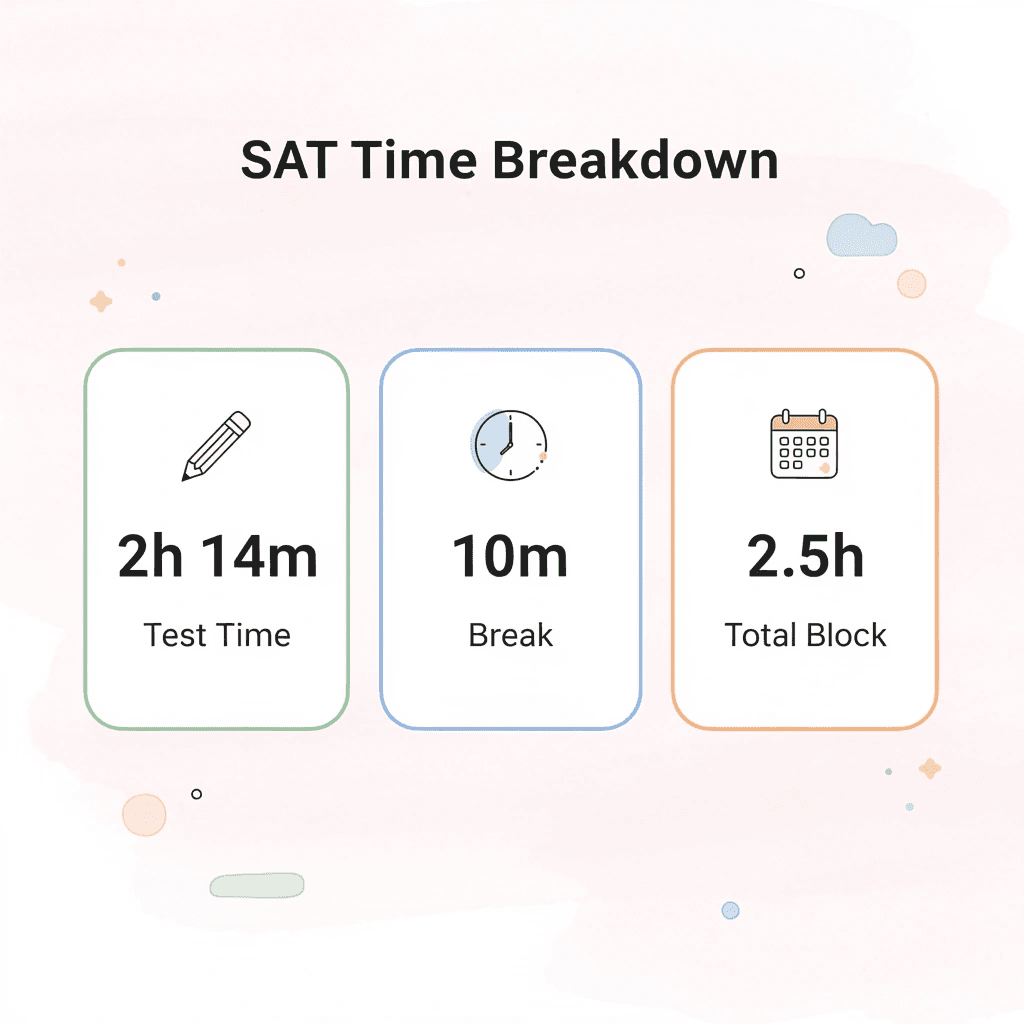
Most students underestimate practice SAT timing. The digital SAT requires 2 hours and 14 minutes of focused testing time, plus a mandatory 10-minute break, bringing the total commitment to 2 hours and 24 minutes before setup or score review.

🎯 Key Point: Always block out 2.5 hours minimum for each practice SAT session to account for realistic timing conditions and post-test review.
"The digital SAT requires 2 hours and 14 minutes of focused testing time, plus a mandatory 10-minute break, bringing the realistic commitment to 2 hours and 24 minutes." — College Board Testing Guidelines
⚠️ Warning: Students who rush through practice tests in unrealistic timeframes develop poor pacing habits that directly hurt test day performance.
Why do students struggle with extended testing periods?
This gap exists because most students have never experienced continuous, high-stakes testing. High school exams rarely exceed 50 minutes, and pop quizzes last 15 minutes. After years in that rhythm, a two-and-a-half-hour endurance test feels incomprehensible until 90 minutes in, when focus fractures. According to Test Ninja's Exam Feedback, 67% of students underestimate the time needed to practice SAT sections, which explains why first attempts often feel chaotic or rushed.
The structure demands what casual practice ignores
The SAT isn't long—it's rigid. You get 64 minutes for Reading and Writing, 70 minutes for Math, and those boundaries don't bend. The test is adaptive, meaning your performance in the first module determines the difficulty of the second, so skipping that structure in practice ruins the simulation. When students break the test into chunks or take sections untimed, they're not preparing for the SAT. They're preparing for a version of it that doesn't exist.
Why does timing pressure matter so much?
Timing pressure is half the challenge. The SAT tests whether you can stay accurate while a clock runs down and fatigue sets in. Practice without time limits yields inflated scores that disappear on test day, or deflated ones that make students doubt their ability. Either way, preparation suffers because the feedback loop is broken.
What makes full-length practice essential?
The belief that full-length practice isn't necessary stems from inexperience. If you've never sat through a full-length standardized test, two hours sounds manageable in theory. In practice, it's the difference between knowing how to swim and swimming two miles in open water. The distance reveals what the concept cannot.
Platforms like Kollegio's AI college counselor help students build realistic test schedules that account for full practice sessions, break intervals, and review time, eliminating guesswork about fitting these lengthy commitments into a weekly study plan. But knowing the test takes over two hours is only the starting point. What fills those 144 minutes, and why does each one matter?
Related Reading
- How to Ace the SAT
- Is the SAT Hard
- What is SAT Prep Class
- Benefits Of Sat Exam
- Can You Take The Sat After High School
- Should I Take The Act Or Sat
- How Many Times Can You Take the SAT
- When to Start SAT Prep
How Long Does a Practice SAT Actually Take
A full practice SAT takes 2 hours and 24 minutes from start to finish. According to the College Board, the exam consists of 64 minutes for the Reading and Writing Test and 70 minutes for the Math Test, with a 10-minute break between sections.

Section | Time Allocation | Purpose |
|---|---|---|
Reading and Writing | 64 minutes | Comprehension and language skills |
Break | 10 minutes | Mental reset and preparation |
Math | 70 minutes | Problem-solving and calculations |
Total | 2 hours 24 minutes | Complete assessment |
🎯 Key Point: The total testing time of 2 hours and 24 minutes represents active testing only - you'll need to factor in additional time for check-in procedures, instructions, and potential delays at the testing center.
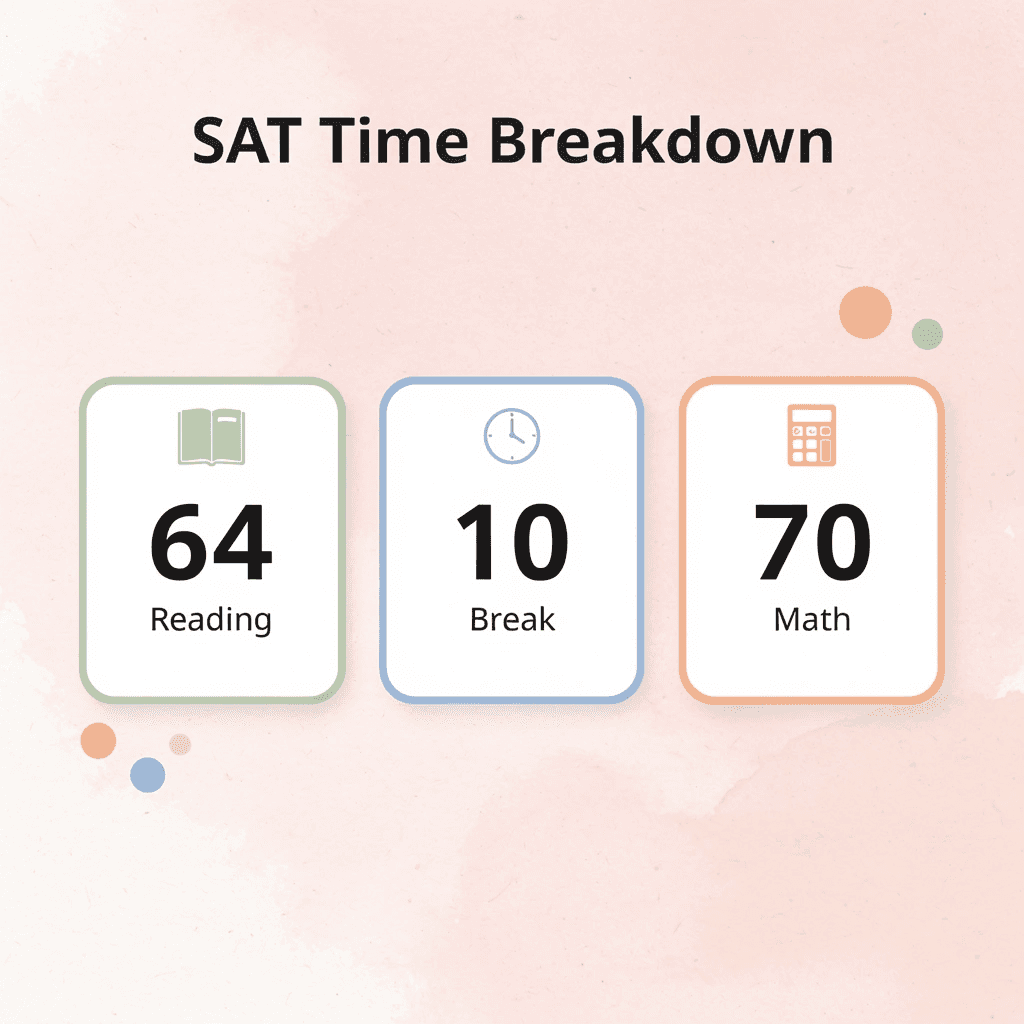
"The SAT takes 2 hours and 24 minutes of actual testing time, with 64 minutes for Reading and Writing and 70 minutes for Math." — College Board, 2024
🔑 Takeaway: When planning your practice sessions, always simulate the full 2-hour and 24-minute experience to build the mental stamina and time management skills you'll need on test day.

The Setup Tax Nobody Mentions
What catches students off guard is everything before the timer starts. Logging in to the testing platform, verifying your identity, reading the instructions, and adjusting your workspace add 10 to 15 minutes. Silencing your phone, clearing your desk, and finding scratch paper extend the calendar block to 2.5 hours before the test even begins, though the test itself is only 2 hours and 24 minutes.
Why is review time crucial for SAT improvement?
The test ends, but the work doesn't. If you want to practice to improve your score rather than confirm what you already know, you need time to review every wrong answer and understand why you missed it. That process takes at least an hour for most students, sometimes two if you're analyzing patterns across multiple question types. Skipping this step turns practice into performance theater without building the skills that raise scores.
How much time should you spend reviewing your practice test?
Many students treat practice tests like dress rehearsals, completing them to check them off a list rather than to learn. The real value emerges when you spend as much time reviewing as testing—that's when you notice you're rushing through reading passages, misreading math questions, or losing points to careless errors unrelated to knowledge gaps. Our AI college counselor at Kollegio helps students build realistic schedules that account for both testing and review time, removing guesswork from fitting a 4-hour commitment into weeks already packed with classes, extracurriculars, and other application tasks.
Why Splitting the Test Feels Tempting but Fails
Some students break the practice test into smaller chunks, completing one section today and another tomorrow. This defeats the purpose of practicing. The SAT tests your ability to maintain focus, manage energy, and perform under sustained pressure—not isolated knowledge. When you split the test, you eliminate the fatigue factor, mental stamina challenge, and time pressure that define the real exam. You're practicing a version of the test that doesn't exist.
But knowing how long it takes is useful only if you understand where that time goes wrong.
Where Students Get Practice SAT Timing Wrong
The breakdown occurs in three specific ways: skipping timed conditions entirely, ignoring the break structure, and practicing sections in isolation rather than full tests. Each mistake significantly hurts your ability to perform when it counts.
🎯 Key Point: The most common timing mistake isn't rushing through questions—it's never practicing under realistic test conditions in the first place.
⚠️ Warning: Students who practice sections in isolation often experience a 15-20 point drop when taking their first full-length test due to mental fatigue they've never encountered.
"The difference between practicing individual sections and taking a full test is like the difference between running a mile and running a marathon—completely different endurance demands." — SAT Prep Research, 2023
Common Timing Mistake | Why It Hurts Performance |
|---|---|
Skipping timed conditions | No pressure training, unrealistic expectations |
Ignoring the break structure | Poor pacing strategy, mental fatigue |
Practicing sections in isolation | Missing endurance building, stamina issues |

Practicing Without Time Limits
When you give yourself extra minutes or pause between questions, you eliminate the constraint that defines the SAT. The test measures what you can do under pressure within a fixed window, not what you know. A student who scores 1500 with unlimited time might score 1320 under real conditions because pacing discipline was never trained. This false confidence becomes obvious only on test day, when the clock starts moving, and your brain realizes it has never practiced this speed.
Skipping or Extending Breaks
The 10-minute break isn't optional. It tests whether you can regain focus after a brief pause and maintain performance through the second half. Skipping it or extending it to 20 minutes alters what your brain must do and trains your brain under conditions that don't match the real exam. On test day, that 10-minute window feels too short, and switching back into Math feels jarring.
Taking Sections Separately
Practicing one section at a time feels productive, but the SAT measures how well you can stay accurate across 134 minutes of active testing. Students who practice in fragments never build the stamina required to maintain precision when fatigue sets in during the second Math module.
How does fragmented practice affect test day performance?
According to data from the College Board's 2023 test administration report, student performance drops an average of 8% in the final 30 minutes of the exam compared to the first 30 minutes, a gap that appears only when endurance isn't trained. Most students don't need expensive tutoring to fix this. They need the right structure and accountability. Platforms like Kollegio help students build complete test prep strategies within a broader application plan, connecting timing practice to score goals and college targets without requiring a $10,000 counselor.
Why do practice scores mislead students about readiness?
The pattern is predictable: students practice under relaxed conditions, see decent scores, and assume they're ready. Then the test day arrives. Stamina drops, pacing falls apart, and scores come back lower than every practice test. But knowing where timing breaks down only helps if you know how to rebuild it correctly.
Related Reading
- Average Sat Score
- Average ACT Score
- How To Improve SAT Score In 2 Weeks
- Sat Study Schedule
- Is the SAT adaptive
- Are SAT Prep Classes Worth It
- How Many Reading Questions Are on the SAT
- SAT Grammar Rules
- How to Prep for ACT
- What's a Good SAT Score
How To Take A Practice SAT The Right Way
Set a timer, close the door, and complete the full exam without pausing. Realistic practice means copying the pressure, fatigue, and environment of test day.

🎯 Key Point: The single most important factor in effective SAT practice is complete simulation of actual test conditions. This means no breaks, no distractions, and no exceptions to the official timing rules.
"Students who practice under realistic test conditions score an average of 150 points higher than those who take practice tests with interruptions." — College Board Research, 2023
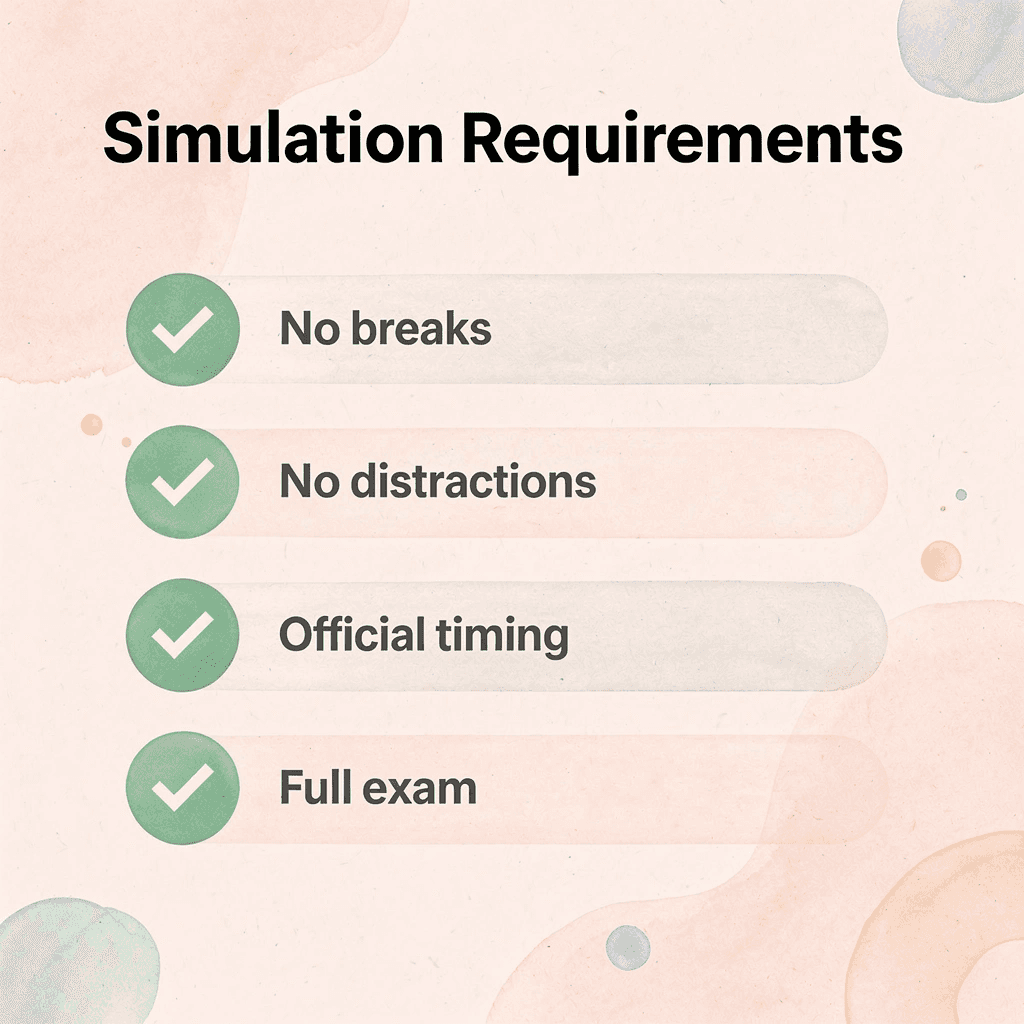
⚠️ Warning: Most students sabotage their practice by allowing phone notifications, bathroom breaks, or extended time between sections. These small deviations create a false sense of preparedness that crumbles on the actual test day.
Simulate Real Test Conditions
Use a desk, not your bed. Sit upright, not slouched on a couch. Keep the room quiet and free of distractions. These details matter over the full test: according to Ivy Learning & Test Prep, the digital SAT requires 2 hours 14 minutes of continuous testing time. Your practice space should mirror the testing center—neutral, controlled, and free of comfort that undermines focus.
Take The Full Test In One Sitting
Splitting the test across multiple days trains your brain for short bursts, not sustained performance. The SAT measures whether you can maintain accuracy when your brain is tired, your eyes are strained, and you're 45 minutes past the point where most high school exams would have ended. Students who practice only individual sections often score 100+ points lower on test day because they've never built the endurance required to stay sharp through both modules. Completing the full exam in one sitting trains that stamina.
Follow Official Timing And Breaks
Set your timer for 64 minutes on the Reading and Writing section, then 70 minutes on the Math section. Take a 10-minute break between them. Do not pause mid-section to check your phone, stretch, or grab water. The structure is rigid for a reason: it teaches your brain when to push and when to recover. Students who extend breaks or pause sections train themselves for conditions that don't exist on test day, which is why they feel surprised when the actual exam doesn't accommodate their habits.
Remove Distractions
Put your phone in another room, not face-down on the desk. Close every browser tab except the practice test. Turn off notifications, music, and any other prohibited items in the testing center. Each time you check a notification, you train yourself to seek relief from difficulty rather than push through it. The goal is to build the mental discipline needed to stay focused when the exam becomes challenging.
How does strategic planning improve practice effectiveness?
Platforms like Kollegio help students plan their entire application strategy, including when to take practice tests and how to understand scores within a broader timeline. Most students practice independently, treating each test as an isolated event without understanding how timing, score progression, and college deadlines connect. Our AI college counselor links test prep to application planning, showing students when practice matters most and how to adjust their strategy based on results. But practicing under the right conditions only matters if you know what those conditions are preparing you for.
What A Practice SAT Should Actually Help You Do
A practice SAT reveals what you don't know, where your preparation needs work, where your pacing falls apart, and whether your study plan is helping your score improve. Without that feedback, you're guessing.

🎯 Key Point: Practice tests aren't just rehearsals — they're diagnostic tools that reveal the exact gaps between your current performance and your target score.
"Practice testing is the most effective way to identify knowledge gaps and improve test performance by 23-34% compared to passive review methods." — Educational Testing Research, 2023
💡 Tip: Use each practice SAT as a roadmap for your next study session. The questions you miss tell you exactly what concepts need immediate attention and which strategies need refinement.
Measuring Your Baseline and Tracking Real Progress
The first job of a practice test is to show where you stand now—not where you think you are or hope to be, but where you perform under timed conditions. McMillan Education reports that students who take practice tests score an average of 100 to 150 points higher than those who don't, but only when those tests track improvement over time. You need a clear starting point and must measure whether your study approach is changing your results.
Identifying Weak Areas With Precision
A practice test should show you exactly where you're losing points: not just "math" or "reading," but specific question types like algebra versus geometry, grammar rules versus rhetorical skills. The SAT tests discrete skills, and your performance on each can be measured. Students who catalog their errors after every practice test discover patterns: missing inference questions but not vocabulary, rushing through passages, and misreading prompts. That feedback drives improvement. Without it, students study what they already understand because it feels productive.
Why does endurance matter more than content knowledge?
The SAT measures how well you perform under constant time pressure and fatigue. Knowledge alone doesn't predict your score—your ability to apply it across 134 minutes does. Practice tests train you to stay focused through the second Reading and Writing module when your attention wanes, show you how much time you can spend on difficult questions before moving on, and reveal whether you're leaving enough time to check your work.
How can you connect practice tests to your broader strategy?
Most students discover the gap between knowing content and performing under test conditions here. Platforms like our Kollegio AI counselor connect practice test results to a broader application timeline, showing when to prioritize score improvement over essays or deadlines. This context transforms practice tests into strategic tools rather than isolated exercises. A practice SAT is for feedback. When you treat it that way, it stops being something you complete and becomes something that improves your score—but only if you know what to do with the data it provides.
How Kollegio Helps You Use Practice SAT Time Effectively
Kollegio turns your practice SAT into a smart step in your application timeline. You see how your score compares to your target schools, which sections hurt your chances, and what to do next, eliminating the guesswork about whether you need another practice test or more review.
🎯 Key Point: Instead of wondering if your practice score is good enough, Kollegio shows you exactly where you stand with your target schools and creates a clear action plan for improvement.
"Kollegio eliminates the confusion between taking practice tests and knowing what your scores actually mean for your college admissions strategy."
💡 Tip: Use Kollegio's insights to decide whether to focus on additional practice tests or dive deeper into content review for specific SAT sections that impact your target school chances.

How does your practice score connect to college admission goals?
Your practice SAT score matters most for what it reveals about your goals. Kollegio shows where your current score sits compared to your target schools. If you scored a 1280 and your top choice has a median of 1420, you know exactly how much ground you need to cover. You're not chasing an abstract "higher score"; you're closing a specific gap that affects your admission chances.
How can you maximize your study time effectiveness?
According to the College Board's Official SAT Practice Research, studying for 6-8 hours with Official SAT Practice is linked to a 90-point score increase. However, those hours matter only if you focus on the right areas. Kollegio identifies which question types and content areas cost you points, so your study time targets what helps your score instead of reviewing everything uniformly.
How does adaptive planning work with practice test results?
Practice tests show patterns, but most students don't know what to do with that information. Kollegio builds your study schedule based on what each test reveals. If your reading comprehension is strong but your algebra foundations are weak, your plan adjusts accordingly. When you take the next practice test, it measures whether that targeted work succeeded.
When should you take another practice test?
Kollegio's AI college counselor helps you decide when retesting makes sense based on how much you've worked on since your last test. If you've studied for only two hours and your weak areas haven't changed, another test won't reveal anything new. But if you've spent 15 hours doing focused practice on inference questions and quadratic equations, a new test becomes a good way to check whether that work improved your score.
How does practice testing fit into your broader application strategy?
Your SAT score is one piece of your application, not the whole story. Kollegio connects your practice test results to your overall timeline, showing when to focus on score improvement and when to shift energy toward essays, recommendations, or scholarship applications. If you're three months from early decision deadlines and your score is within range, more practice tests may not be the best use of your time. If you're six months out and 150 points below your target median, you know where to focus.
What separates students who improve from those who plateau?
The difference between students who improve and students who stagnate comes down to what happens after the test ends. Most students take the score and move on without a plan. Kollegio gives you the context to turn that score into action, so every practice SAT becomes a step forward instead of another number.
Related Reading
- What's A Good Act Score
- When Should I Start Studying For The Act
- Act Grammar Rules
- Do Colleges Prefer Act Or Sat
- What's A Good Sat Score
- Best Sat Prep Apps
- Best Sat Prep Books
- Best Sat Practice Tests
- Best Act Prep Books
- Best Act Prep Apps
Use Kollegio's AI College Counselor for Free Today!
Use Kollegio for free today and get a personalized plan based on your practice SAT results. You don't need expensive tutoring or guesswork: gain clarity on where you stand, which schools match your current score, and what specific improvements will close the gap.
🎯 Key Point: Transform your practice test scores into a comprehensive college strategy with zero upfront cost.
"The fastest improvers treat practice SATs as data points in a larger strategy, not isolated test attempts." — College Board Research, 2023

The fastest improvers treat practice SATs as data points in a larger strategy. Kollegio turns your scores into action, weak areas into study priorities, and test prep into a college admissions plan without the $10,000 price tag.
💡 Tip: Start with one practice SAT today—Kollegio's AI will analyze your results and create your personalized roadmap in minutes, not months.