
Average SAT Score for UMD and How to Gauge Your Chances
The University of Maryland attracts thousands of hopeful students each year, making it crucial to understand its SAT expectations when building a strategic college list. Just as students research what ACT score is needed for Harvard when aiming for elite schools, knowing UMD's average SAT requirements helps gauge where you stand competitively. UMD's admission statistics reveal specific score ranges and GPA requirements that define successful applicants. These benchmarks provide the clarity needed to assess your chances and prepare accordingly.
Beyond general statistics, understanding how your overall academic profile compares to UMD's standards requires a personalized analysis. Your SAT scores represent just one piece of the admission puzzle, alongside GPA, course rigor, and extracurricular activities. Getting actionable guidance to strengthen your entire candidacy helps you make informed decisions about where to apply and how to improve your competitiveness. For a comprehensive analysis of your specific profile against UMD's admission data, consider using an AI college counselor that evaluates all aspects of your application.
Table of Contents
- Your SAT Score Feels Hard to Interpret Without Context
- What Is the Average SAT Score for UMD?
- Why Students With Similar Scores Can Have Different Admissions Results
- How to Know Whether Your SAT Score Is Competitive for UMD
- The Bigger Mistake: Building a College List Around One Number
- How Kollegio Helps You Understand Your Real Admissions Chances
- Use Kollegio's AI College Counselor for Free Today!
Summary
- UMD's middle 50 percent SAT range spans from 1410 to 1520, with an average of 1470 among admitted students. This range shows where half of admitted students fall, not a cutoff that determines your fate. Scoring within this window means you've cleared the academic threshold, but it doesn't guarantee admission. Scoring below it doesn't disqualify you if other parts of your application demonstrate readiness and fit.
- Two students with identical SAT scores of 1420 can receive opposite admissions decisions based on the context surrounding those scores. One might have pushed through AP Calculus BC, AP Physics, and honors English while leading a community organization. The other took standard courses and participated in clubs without leadership roles. Admissions officers evaluate academic rigor, extracurricular depth, essays, and recommendations alongside test scores, which is why similar numbers produce different outcomes.
- Students from the bottom income quintile were 13.1 percentage points less likely to be admitted when they didn't submit test scores, according to Dartmouth College researchers. This finding highlights how holistic factors like demonstrated leadership, course rigor, and compelling essays become even more critical when scores alone don't tell the full story. The absence of a test score shifts the burden of proof to other elements of the application.
- The most damaging admissions mistake isn't having a low SAT score. It's building an entire college list around that single number, then eliminating schools prematurely or applying only to reaches based on false confidence. A 1380 might lead someone to skip UMD entirely, while a 1500 can lead to the assumption that admission is nearly guaranteed. Neither reflects how decisions actually get made when admissions officers weigh dozens of factors simultaneously.
- Fall 2025 enrollment increased just 1 percent across institutions, intensifying competition and making holistic evaluation even more critical for admissions officers trying to build diverse, well-rounded classes. Students who understand this create balanced lists in which reach, match, and target schools are aligned with their overall strengths rather than with a single test result. The effective approach evaluates academic rigor, grades, leadership, and personal story together.
- Kollegio's AI college counselor analyzes your SAT score, GPA, coursework rigor, extracurricular involvement, and intended major together to show how your complete profile stacks up against UMD's admitted student data.
Your SAT Score Feels Hard to Interpret Without Context
A raw SAT score tells you almost nothing about your chances of getting admitted. A 1300 might place you in the middle 50% at one university and below the 25th percentile at another. Without knowing where your score falls within the specific range of admitted students at UMD, you cannot determine whether you're competitive.

"Without knowing where your score falls within the specific range of admitted students, you're basically guessing whether you're competitive." — College Admissions Reality
🔑 Key Takeaway: Your SAT score only becomes meaningful when compared to the specific admission statistics of your target university.

⚠️ Warning: A "good" score at one school can be a below-average score at another - always check school-specific percentiles before making assumptions about your competitiveness.
Why do national percentiles mislead students about their chances?
According to UWorld College Prep Blog (2025), SAT scores range from 200–800 points per section. A single score carries different weight depending on the college. Students often compare their scores to classmates, browse chance-me threads, or focus on national percentiles that may not apply to their target school. These comparisons rarely answer what matters most: whether this score will strengthen my application at this specific institution.
How do national averages create false expectations?
National SAT benchmarks can create false confidence or unnecessary panic because they ignore how selective different schools are. A score in the 75th percentile nationally may fall below the typical range for students admitted to competitive universities.
Students with strong grades and rigorous coursework sometimes remove schools from consideration, assuming their SAT score alone disqualifies them. Others build unrealistic expectations, believing a high score guarantees admission while overlooking that admissions officers evaluate applications holistically, weighing academic performance, essays, recommendations, and demonstrated interest alongside test scores.
What costly decisions result from score misinterpretation?
This confusion leads to expensive mistakes. Students apply to schools where admissions data show they are unlikely to gain admission, spending time and money on mismatched applications.
Others never apply to universities where they could have been accepted because they don't understand what their score means. One student's 1350 might represent the 60th percentile among UMD's admitted class, making them a solid match, while another dismisses the same score because a friend with a 1420 also applied.
What colleges actually evaluate
Admissions officers assess whether your academic profile, including your SAT score, indicates you'll succeed at their institution. Your score is evaluated alongside your high school's difficulty level, GPA trend, course choices, and extracurricular activities. Two students with identical SAT scores may receive different decisions based on these additional factors.
How can students move beyond score guessing?
Platforms like Kollegio's AI college counselor help students move past guessing by comparing their full academic profile against admission data from recently admitted students. Instead of wondering whether a 1310 is "good enough," students see exactly where that score places them within UMD's admitted range and how their GPA, course rigor, and extracurriculars compare, transforming uncertainty into clear information about whether to apply and how to strengthen weaker areas.
Knowing your score's position within UMD's admitted student range is only the starting point.
Related Reading
- What ACT Score Is Needed for Harvard
- Average Act Score For Nc State
- Average Sat Score For Unc
- Average Sat Score For Uc Berkeley
- Average Sat Score For Ohio State
- Average Sat Score For Brown
What Is the Average SAT Score for UMD?
PrepScholar reports an average SAT score of 1470 for admitted students at the University of Maryland, College Park. UMD's middle 50 percent range spans from a 25th percentile score of 1410 to a 75th percentile of 1520. These numbers indicate where your score falls among admitted students, though the average alone doesn't determine your competitiveness.
🎯 Key Point: UMD's middle 50% range (1410-1520) matters more than the average—it shows where most admitted students scored.
"UMD's middle 50 percent range goes from a 25th percentile score of 1410 to a 75th percentile of 1520." — PrepScholar, 2024
💡 Tip: Scores within the 25th-75th percentile range are academically competitive. Scores below the 25th percentile make admission significantly more challenging.

What does the middle 50 percent range tell us about admissions?
The middle 50 percent range shows how scores spread among accepted students rather than relying on a single average. Scoring at or above 1470 puts you in the top half academically. Scoring closer to 1410 keeps you competitive, though other application components need to be stronger. Students below 1410 aren't automatically excluded; they typically compensate with exceptional leadership, unique experiences, or strong academic achievement.
How should students interpret scoring within or outside this range?
The range is a window, not a wall. Scoring within it clears the academic threshold but doesn't guarantee admission. Scoring below it shifts the burden to other application components. Successful applicants outside this range recognise that admissions officers build a class, not collect high scores.
Why holistic review changes the equation
UMD evaluates applications holistically, meaning your SAT score is one piece of information among many. Your GPA, coursework rigor, extracurricular involvement, essays, and letters of recommendation all influence the decision. A student with a 1450 SAT who took five AP courses, led a community project, and wrote a compelling essay about overcoming adversity may be more attractive than a student with a 1500 who took standard coursework and submitted generic essays. The score opens the door; the rest of your application determines whether you walk through it.
How do admissions officers actually make decisions?
Students often misread their chances by assuming the average SAT score is a threshold: hitting it guarantees admission, falling short makes acceptance unlikely. Neither reflects how decisions actually get made. Admissions officers aren't checking boxes; they're asking whether you'll contribute to campus, thrive academically, and bring something distinct to the incoming class.
What tools help students understand their full profile?
Most students spend weeks worrying about whether their SAT score is high enough. Platforms like AI college counselor help students move past that worry by showing how their full profiles stack up against admitted-student data, not just test scores. Instead of guessing whether a 1420 is competitive, students see exactly where that score places them and which application components need the most attention.
Your admission decision depends on how your entire application fits together. Two students with identical scores can receive opposite outcomes based on the surrounding context.
Why Students With Similar Scores Can Have Different Admissions Results
Two students with a 1420 SAT score can receive opposite decisions from UMD because admissions officers evaluate the full academic story, not a single number. One student might have taken AP Calculus BC, AP Physics, and honors English while maintaining a strong GPA, while the other took standard-level courses. The test score appears identical, but the academic preparation reveals a different story about readiness for college-level work.

🎯 Key Point: Identical test scores don't guarantee identical admissions outcomes - course rigor and academic context matter just as much as the numbers.
"Admissions officers evaluate the full academic story, not just standardized test scores, when making decisions about college readiness." — College Admissions Research, 2024

⚠️ Warning: Students who focus only on test score improvement without considering course rigor may find themselves at a disadvantage compared to peers with similar scores but stronger academic preparation.
How does course rigor impact admissions with similar test scores?
Admissions officers assess whether students challenged themselves during high school. A 1400 SAT score paired with AP, IB, or honors classes demonstrates intellectual curiosity and resilience, whereas the same score with mostly standard courses raises questions about whether the student sought academic challenges. UMD prioritizes students who will succeed in rigorous programs, not those who simply perform well on standardized tests.
How does your intended major affect score evaluation?
Your intended major significantly affects evaluation. Computer science, engineering, and business programs attract exceptionally strong applicants, making a 1410 competitive for some majors but below the typical range for others. Highly selective programs face tougher competition within UMD's overall middle 50 percent range.
Why does leadership matter more than participation?
Being involved in activities outside of class matters, but doing one thing well is better than doing many things without depth. A student with a 1390 who started a community organization, led a research project, or built something important demonstrates they take action and make a real difference. Another student with a 1420 who joined five clubs but didn't lead anything or show results has a weaker application.
According to Dartmouth College researchers, students from families with the lowest incomes were 13.1 percentage points less likely to gain admission when they didn't submit test scores. This underscores why demonstrating leadership matters when test scores alone cannot convey the full picture.
How do essays and recommendations provide crucial context?
Essays and recommendation letters provide context that numbers alone cannot. A strong essay demonstrates character, resilience, intellectual curiosity, or a unique perspective. A good recommendation from a teacher who observed growth, leadership, or perseverance strengthens the credibility of the academic record. Generic essays and weak recommendations fail to distinguish an application.
When students with similar SAT scores achieve different results, the difference lies in the factors surrounding that score: class rigor, student involvement, writing quality, and recommendation strength. Platforms like AI college counselors help students understand how these elements work together by examining their full profile and identifying areas for improvement.
Most students focus on whether their score is high enough, overlooking that admissions officers ask a different question: who they are and what they will contribute.
How to Know Whether Your SAT Score Is Competitive for UMD
UMD's middle 50 percent SAT range is approximately 1410 to 1520. Your competitiveness depends not on whether your score exceeds the average, but on how your score compares to all other applicants and how the rest of your application demonstrates you're a good fit.
"UMD's middle 50 percent SAT range is approximately 1410 to 1520, meaning 25% of admitted students scored below 1410 and 25% scored above 1520." — UMD Institutional Research, 2024
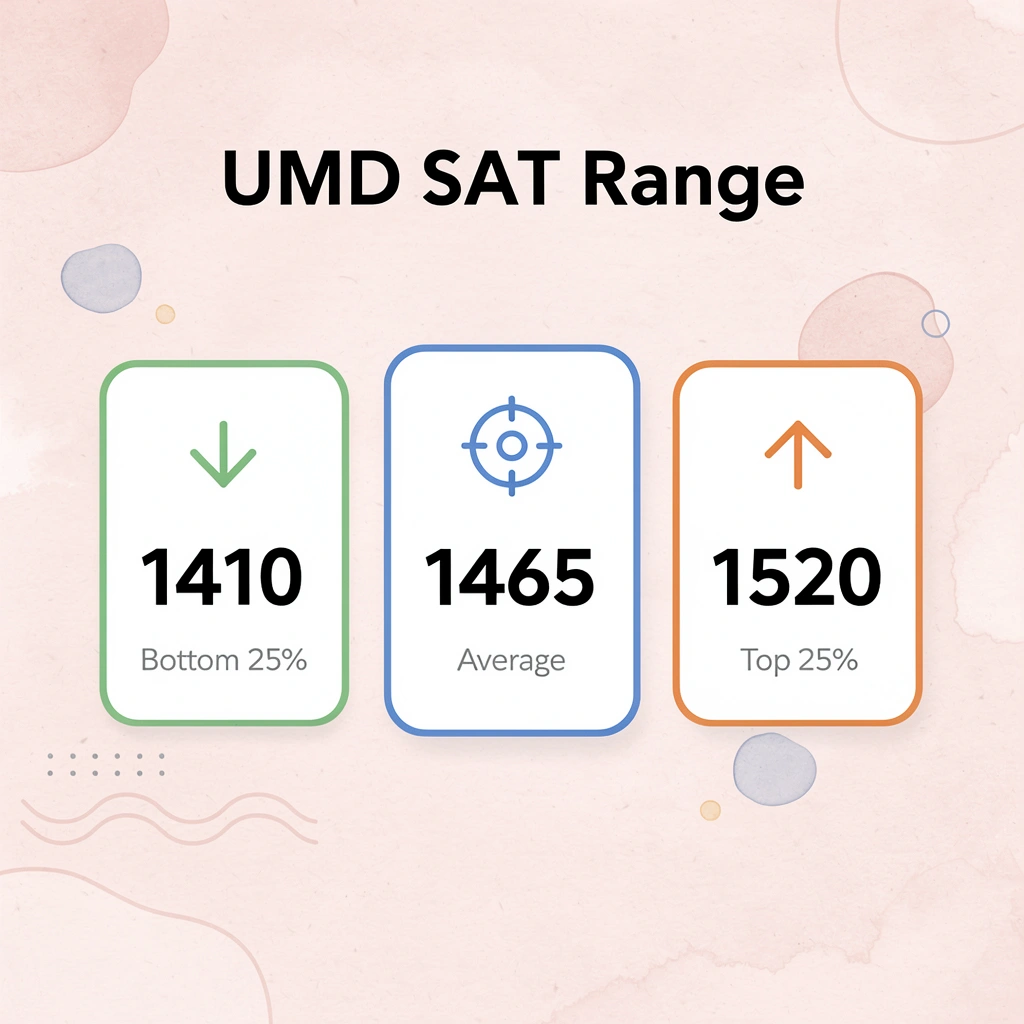
A helpful way to determine where you stand is to place your score into one of four categories.
🎯 Key Point: Your competitiveness isn't just about beating the average—it's about understanding where you fit within the entire applicant pool and demonstrating strong fit through your complete application.

⚠️ Warning: Don't assume that scoring above the middle 50% guarantees admission. Holistic review means your essays, extracurriculars, and grades matter just as much as your test scores.
If Your Score Is Above the 75th Percentile
Students with SAT scores above the 75th percentile, SAT scores of 1520, demonstrate strong academic readiness and compare well with most admitted applicants. However, high scores do not guarantee admission. UMD evaluates academic rigor, grades, extracurricular involvement, essays, and intended major. A strong SAT score cannot compensate for weak academic performance or limited engagement outside the classroom.
If Your Score Falls Within the Middle 50 Percent Range
Students scoring between the 25th percentile SAT score of 1410 and 1520 fall within the range of half of admitted students. Admissions outcomes depend heavily on the rest of your application: GPA competitiveness, rigorous coursework, meaningful activities or leadership, and essay depth.
This range is where most admissions decisions happen. Your score opens the door, but your classroom performance and extracurricular involvement determine whether you walk through it.
If Your Score Is Near the 25th Percentile
Students with SAT scores around 1410 may still be competitive. Colleges regularly admit students within and below the 25th percentile, so don't assume rejection. Focus on strong grades in challenging courses, AP or IB coursework, leadership roles, compelling essays, and positive recommendations. A student with a 1400 SAT score, a 4.0 GPA, several AP courses, and significant leadership experience may present a stronger overall application than a student with a higher SAT score but weaker academic and extracurricular credentials.
If Your Score Falls Below the Reported Range
A score below 1410 does not automatically rule UMD out of consideration, but it may pose challenges. Exceptional academic achievement, significant accomplishments outside the classroom, or unique personal experiences can help you stand out.
How can you build a competitive college application strategy?
Build a balanced college list with strong match and target options that fit your academic profile. Our AI college counselor at Kollegio analyzes your profile, identifies realistic targets versus reaches, and surfaces opportunities where your strengths align with what colleges seek.
How should you think about SAT competitiveness?
SAT competitiveness is not a simple yes-or-no question. A score shows your academic level but does not determine the final result. Instead of asking "Is my SAT score high enough?" ask "How does my SAT score fit into my overall application?" This shift moves you from uncertainty to a realistic assessment of your chances of admission.
But knowing where your score fits is only half the equation.
The Bigger Mistake: Building a College List Around One Number
The most damaging admissions mistake isn't having a low SAT score. It's building an entire college list around that single number and making every decision based on whether you fall above or below a school's reported range.

🎯 Key Point: Students who do this end up with unbalanced lists that misrepresent where they're actually competitive. A 1380 SAT might lead someone to eliminate UMD entirely because it falls below the 1410 threshold, while a 1500 SAT creates false confidence that admission is nearly guaranteed. Neither assumption reflects how admissions actually works.
"Building a college list around test scores alone creates dangerous blind spots that lead to both missed opportunities and unrealistic expectations." — College Admissions Reality Check

⚠️ Warning: This numbers-only approach ignores the holistic nature of modern admissions, where test scores are just one factor among academic rigor, extracurriculars, essays, and demonstrated interest.
What are the most common mistakes when building college lists?
Students often make critical mistakes when creating their college application lists. One significant mistake is misunderstanding how test scores affect admissions decisions. These errors can substantially affect their chances of acceptance and limit their options.
Why shouldn't you apply only to reach schools?
The first mistake is applying only to reach schools. Students with strong test scores often fill their lists with highly selective universities, believing their SAT makes them competitive everywhere. Once you enter that competitive range, you're surrounded by applicants with similar scores; grades, grades, course rigor, leadership depth, essays, and institutional priorities become the distinguishing factors.
Should you eliminate schools if your scores fall outside their ranges?
The second mistake is removing schools too quickly. When scores fall slightly below a college's middle 50 percent range, students underestimate how much the rest of their application matters. Strong grades in challenging courses, meaningful extracurricular involvement, and compelling personal narratives can make you far more competitive than your SAT score suggests.
According to Higher Ed Dive, fall 2025 enrollment increased by 1 percent across institutions, intensifying competition and making holistic evaluation critical for admissions officers as they build diverse, well-rounded classes.
How do identical test scores create different admission outcomes?
Consider two students with identical SAT scores of 1400, slightly below UMD's reported middle 50 percent range. Student A has a 4.4 weighted GPA, completed eight AP courses, served as student body president, and founded a community service project involving hundreds of volunteers. Student B has a 3.7 weighted GPA, took mostly standard-level courses, joined a few clubs without leadership roles, and demonstrated limited impact in extracurriculars.
Both students have the same SAT score, but their admissions profiles look completely different. Student A shows strong evidence of readiness for college-level work and leadership skills. Student B may find it hard to stand out in a group where most applicants show both strong scores and meaningful achievements outside the classroom.
What makes an effective college application strategy?
The most effective college lists aren't built around SAT scores. They're built around a realistic assessment of your entire applicant profile: academic rigor, grades, leadership, and personal story. Students who understand this create balanced lists in which reach, match, and target schools are aligned with their overall strengths rather than with a single test result.
Related Reading
- Average Sat Score For Virginia Tech
- Northwestern Average Sat Score
- What Is The Combined Essay Score For Sat
- Average Sat Score For Uva
- What Sat Score Is Required For Uf
- Rice University Average Sat Score
- Average Sat Score For Uga
- Average Sat Score For Michigan
- Average Act Score For Georgia Tech
- Average Sat Score For Georgetown
- Caltech Average Sat Score
How Kollegio Helps You Understand Your Real Admissions Chances
Knowing UMD's middle 50 percent SAT range tells you where other students scored, but not whether your specific combination of grades, course rigor, activities, and background makes you truly competitive. Most students get stuck in this critical gap between published statistics and personalized assessment, building college lists based on incomplete information rather than a realistic evaluation of their full profile.

🎯 Key Point: Raw admission statistics only show part of the picture - your individual competitiveness depends on how all elements of your application work together in the admissions context.
"Most students get stuck in this gap between published statistics and personalized assessment, building college lists based on incomplete information rather than realistic evaluation."

🔑 Takeaway: Kollegio's personalized assessment goes beyond basic SAT ranges and GPA averages to evaluate your complete academic profile, extracurricular involvement, and unique background - giving you a realistic picture of your actual admission chances rather than generic statistical ranges.
Why is relying on single metrics problematic for college admissions?
Students asking whether a 1380 SAT is strong enough for UMD are trying to solve a multifaceted problem with a single data point. A student with a 1400 SAT, 3.7 GPA, and leadership in two meaningful activities faces entirely different odds than another with identical test and GPA scores but minimal extracurricular depth.
What mistakes do students make when building college lists?
Without understanding those differences, every application decision feels like a gamble. According to Kollegio, which serves ~300K+ students and families, the most common mistake in building college lists is treating single numbers as predictive, even though admissions offices evaluate dozens of factors simultaneously. Students either eliminate schools too early or overestimate their competitiveness by comparing themselves to incomplete benchmarks rather than complete profiles.
How does profile-based assessment change college admissions evaluation?
Platforms like Kollegio's AI college counselor evaluate your competitiveness by considering your SAT score, GPA, coursework rigor, extracurricular involvement, leadership experience, and intended major. A 1420 with six AP courses, founding a community organization, and demonstrating interest in engineering tells a different story than a 1420 with standard coursework and passive club membership. Our assessment shows which schools align with your actual profile, rather than relying on a single number.
This approach solves the classification problem students struggle with most: determining whether UMD should be a reach, match, or target school based on your credentials. You're working from data that reflects how admissions committees actually evaluate applications, including factors like intended major competitiveness and demographic background that significantly affect your odds but rarely appear in published statistics.
What additional benefits does a comprehensive assessment provide?
Beyond admissions probability, this assessment reveals scholarship opportunities matched to your profile and interests, provides AI-powered feedback on essays and activity descriptions, and organizes the entire application process in one place. It identifies where your application is strong, where it needs development, and which schools represent realistic opportunities rather than aspirational reaches or safety schools that lack sufficient challenge.
But knowing your real chances matters only if you're willing to act on that information instead of the story you've been telling yourself.
Use Kollegio's AI College Counselor for Free Today!
Create a free Kollegio account today. After entering your SAT score, GPA, coursework, and activities, you'll receive a personalized assessment of your competitiveness for UMD and a balanced list of target, match, and reach schools. Rather than guessing what a 1400 or 1500 SAT score means for your chances, you'll leave your first session with a clearer understanding of where you stand and a college list built around your complete application.

🎯 Key Point: Get instant clarity on your college competitiveness with personalized data, not generic advice.
"Strategic guidance that traditionally costs thousands is now accessible through AI-powered college counseling platforms." — College Admissions Industry Report, 2024
The platform shows where your profile needs to get stronger—through additional AP courses, deeper involvement in existing activities, or essay revisions that clarify your narrative. You receive strategic guidance that traditionally costs thousands, helping you distinguish between schools where you're genuinely competitive and schools where you're a statistical outlier.

💡 Tip: Focus on strengthening your weakest profile areas first—this creates the biggest impact on your overall competitiveness across all target schools.
Related Reading
- What Act Score Is Needed For Alabama
- What Sat Score Is Required For Nyu
- What Sat Score Is Required For Texas A&m
- What Sat Score Is Required For Ut
- What Sat Score Is Required For Cornell
- What Sat Score Is Required For Stanford
- What Sat Score Is Required For Mit
- What Sat Score Is Required For Columbia
- What Sat Score Is Required For Harvard
- What Sat Score Is Required For Notre Dame
- What Sat Score Is Required For Ucla
- What Sat Score Is Required For Duke
- What Sat Score Is Required For Ivy League
- What Sat Score Is Required For Yale
- What Sat Score Is Required For Princeton
Author
Trailblazer Marketing