
What SAT Score Is Required for UT to Improve Admission Odds?
For students applying to the University of Texas at Austin, knowing the right SAT score to target is one of the most practical steps toward building a competitive application. UT Austin draws tens of thousands of applicants each year, and understanding where your score falls within the admitted-student range helps you set realistic expectations. The middle 50% SAT range, how scores interact with GPA, and what admissions officers actually weigh all matter more than a single cutoff number.
Context is everything when interpreting test score data, especially for a school as selective and large as UT Austin. A score that looks strong on paper may carry more or less weight depending on your intended major, class rank, and overall academic profile. For personalized guidance that accounts for all of those factors, students can turn to an AI college counselor to get a clearer picture of where they stand and what to do next.
Table of Contents
- Why Students Struggle to Know What SAT Score UT Actually Wants
- Does UT Have a Minimum SAT Score Requirement?
- What SAT Score Is Competitive for UT Admissions?
- When a Higher SAT Score Can Strengthen Your Application
- What Matters Beyond SAT Scores at UT?
- How Kollegio Helps You Understand Your UT Admission Chances
- Use Kollegio's AI College Counselor for Free Today!
Summary
- The middle 50% SAT range for admitted UT Austin students spans 1230 to 1490, a 260-point spread that misleads more applicants than it helps. A student at 1240 and a student at 1480 both fall within that range, but their competitive positions are completely different. Treating a range like a fixed threshold misses how admissions actually work.
- UT Austin reinstated a standardized test requirement for fall 2025 applicants, ending the test-optional window it had maintained for several years. While no absolute cutoff is published, PrepScholar's analysis of admissions data identifies 1240 as roughly the point where a score becomes difficult to overcome, even with a strong overall application. Submitting a score satisfies the requirement. Submitting a competitive score is an entirely separate standard.
- The score that looks strong against UT's university-wide pool can look average inside a specific major's applicant pool. The Texas Admissions notes that scores of 1500 or above are recommended for highly selective programs like Computer Science and Engineering, compared to a general benchmark of 1400 for competitive applicants overall. Students who benchmark against the wrong group often apply with false confidence or unnecessary anxiety.
- A score above 1400 carries particular value when it resolves an interpretive gap in a student's profile rather than simply adding another strong number. For applicants from schools with limited AP offerings, a high SAT score provides admissions readers with a standardized reference point that a transcript alone cannot always supply. According to C2 Education, a 1400 places students at approximately the 95th percentile nationally, which creates measurable separation in a dense applicant pool.
- At UT Austin, roughly 75% of the freshman class is admitted automatically under the Top 6% rule, according to the Koppelman Group's 2025 admissions statistics. The remaining students admitted through holistic review undergo a process in which GPA rigor, essay quality, depth of extracurricular commitment, and alignment with a specific major all carry real weight. A strong SAT score opens the conversation. The rest of the application determines the outcome.
- Applicants who earn admission to UT's most competitive programs rarely win on a single metric. The strongest applications connect academics, essays, activities, and major-specific preparation into a coherent story about who the student is and what they intend to do. Without a clear picture of how all those pieces interact, students tend to over-invest in areas that matter least for their specific target programs.
- Kollegio's AI college counselor addresses this by compiling a student's full academic profile and comparing it against thousands of data points tied to their intended major and target programs, so the decision about where to focus effort becomes a calculated one rather than a guess.
Why Students Struggle to Know What SAT Score UT Actually Wants
Students looking for a clear SAT target for UT Austin rarely find one because the data gets presented in ways that appear precise but require context to be meaningful.
"The way SAT data is reported can make students over-estimate their chances or unnecessarily rule themselves out — all from the same number." — AdmitStudio, 2025
🎯 Key Point: A score that looks "good enough" on the surface may tell a different story once you understand where it actually falls in the distribution.

According to AdmitStudio's UT Austin SAT Analysis, the middle 50% SAT range for admitted students spans 1230 to 1490 — a 260-point spread. A student scoring 1240 and one scoring 1480 both fall inside this range, yet their competitive positions differ dramatically. When websites report "the average" without explaining where it sits within the full distribution, students either overestimate their chances or unnecessarily rule themselves out.
Score | Position in the Middle 50% | Competitive Standing |
|---|---|---|
1240 | Bottom of range | Weaker relative position |
1360 | Midpoint | Moderate standing |
1480 | Top of the range | Stronger relative position |
⚠️ Warning: Falling inside the middle 50% range does not mean all scores are equal — a 260-point gap separates the bottom from the top.
🔑 Takeaway: The 1230–1490 range is a starting point, not a finish line. Understanding where your score lands within that spread is what actually determines your competitive position at UT Austin.
Why does the same number mean different things to different students?
The failure point is a misreading of what "middle 50%" means. It doesn't mean a score of 1230 is competitive. It means roughly a quarter of admitted students scored below 1230, and another quarter scored above 1490. Your position within that range, combined with your GPA, course rigor, and the specific program you're applying to, determines how much weight your SAT score carries.
Why do different sources give you different score numbers?
Most students search across multiple sites, comparing numbers and piecing together a picture from scattered data. The problem: each source uses different metrics, cycle years, and definitions of "required." Students land on a number that feels authoritative but reflects an incomplete understanding of how UT evaluates applicants. Our AI college counselor at Kollegio addresses this directly, drawing on thousands of data points to show students where their full profile ranks relative to admitted students, rather than isolated score averages.
How does automatic admission change what the score data actually shows?
NextAdmit reports that UT Austin automatically admits the top 6% of Texas high school graduates regardless of SAT score. This policy alters the applicant pool in ways that complicate fair comparisons of scores. Since many admitted students entered through automatic admission, published SAT data reflect only the more selective portion of the class, not the full cohort.
Why is asking whether your score is good enough the wrong question?
The real problem isn't a lack of data. Students ask a yes-or-no question ("Is my score good enough?") when the honest answer depends on probability and their specific profile. A score doesn't get you in or keep you out by itself; it's one signal among several, and its weight changes depending on who else is applying, which major they're targeting, and what the rest of their application reveals about them. What you haven't seen yet is whether UT sets a floor on that score, and the answer might surprise you.
Does UT Have a Minimum SAT Score Requirement?
UT Austin requires SAT or ACT scores for all freshman applicants. According to KUT Radio, Austin's NPR Station, students applying for the fall 2025 semester must submit standardized test scores, ending the test-optional period the university maintained for several years and marking a critical policy shift for prospective applicants.
"Students who want to get admitted for the fall 2025 semester must submit standardized test scores." — KUT Radio, Austin's NPR Station, 2024
🚨 Warning: If you're applying to UT Austin for fall 2025 or beyond, submitting without SAT or ACT scores is no longer an option. This is a non-negotiable admission requirement.
🔑 Takeaway: The test-optional era at UT Austin is over. Every freshman applicant must include standardized test scores in a complete application, making your SAT or ACT performance more critical than ever.

What happens if your SAT score falls below 1240?
PrepScholar's analysis of UT Austin admissions data reports that while there is no absolute SAT requirement, a score below 1240 makes it difficult to be considered. Think of 1240 not as a welcome mat but as the threshold where the door begins to open, and only if the rest of your application is strong.
What the "no minimum" policy actually means
Not having a published cutoff score does not mean there are no consequences for a low score. UT's holistic review process examines your full profile, but a test score significantly below the range of admitted students creates a gap that grades, essays, and extracurricular activities rarely close on their own. In practice, it requires the rest of your application to compensate.
Why does treating admissions like a checklist fall short?
Most students seek a single target number, treating admissions as a checklist when it is more of a human judgment call that involves reviewing thousands of files. Our AI college counselor synthesizes thousands of data points across your full profile, not just your test score, to show where you stand and which application components deserve the most attention before you apply.
Why are " required " and " competitive " two different standards
Turning in a score meets the requirement. Turning in a competitive score improves your chances. A student who turns in a 1240 has technically met the submission requirement, but their score sits at the edge of what UT's admitted class usually looks like. This means the rest of their file needs to be strong, not adequate. UT's minimum works more like a signal than a gate, telling you whether you're in the conversation. Whether your score helps your case or works against it depends on something most applicants never check.
Related Reading
- What ACT Score Is Needed for Harvard
- Average Act Score For Nc State
- Average Sat Score For Unc
- Average Sat Score For Umd
- Average Sat Score For Uc Berkeley
- Average SAT Score for Virginia Tech
- Average Sat Score For Brown
- Average SAT Score for UVA
- Average SAT Score for Michigan
- Average Sat Score For Ohio State
What SAT Score Is Competitive for UT Admissions?
The calculation most applicants miss isn't whether their score clears a threshold, but where it lands relative to enrolled students and what that signals to admissions readers. Understanding your position within the admitted class—not a simple cutoff—is what separates a strategic application from a hopeful one.
🎯 Key Point: UT Austin doesn't publish a hard SAT cutoff; what matters is where your score falls within the enrolled class distribution.
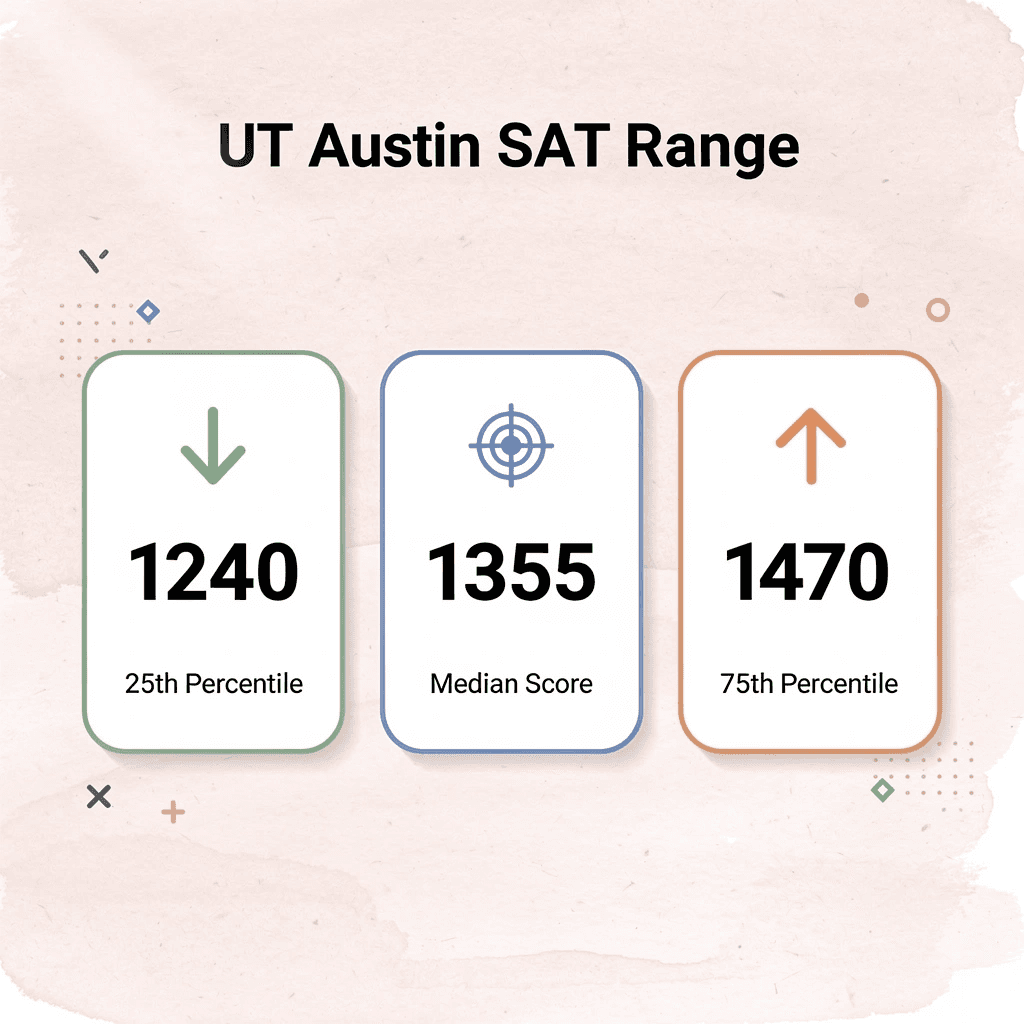
According to PrepScholar's analysis of UT Austin admissions data, the 25th percentile SAT score is 1240, and the 75th percentile is 1470. Below 1240, you're outside the range where most admitted students land. Above 1470, you're doing better than three-quarters of the enrolled class. Everything in between is a sliding scale, not a pass-or-fail gate.
"The 25th percentile SAT score is 1240 and the 75th percentile is 1470 — meaning a full 50% of enrolled students score somewhere in that range." — PrepScholar, UT Austin Admissions Data
SAT Score Range | What It Signals |
|---|---|
Below 1240 | Outside the range of most admitted students |
1240 – 1470 | Competitive sliding scale — not a pass/fail gate |
Above 1470 | Stronger than 75% of the enrolled class |
💡 Tip: If your score falls below 1240, prioritize strengthening other application components — essays, extracurriculars, and GPA — to compensate.
🔑 Takeaway: A score of 1470+ puts you in an elite position relative to your peers, while anything below 1240 signals a meaningful admissions risk that deserves a strategic response.
How does your score change the conversation by major
The sliding scale steepens depending on your intended major. The Texas Admissions notes that a 1400 or higher is recommended for competitive UT Austin admissions, with scores of 1500 or higher needed for highly selective programs like Computer Science and Engineering. A score that appears strong among university-wide applicants can look average within a competitive major's applicant pool.
Why does your intended major shift how admissions reads your score?
A 1380 means something different for a student applying to Liberal Arts than for someone targeting McCombs or Cockrell. Students who understand this difference apply with greater precision than those who treat the middle 50% range as a universal verdict. An AI college counselor like Kollegio combines your full profile, intended major, and thousands of data points to show exactly where you stand.
What a score below 1350 actually means
A score below 1350 changes how your application is reviewed. Admissions readers at UT assess academic preparation, and a below-range score means other parts of your file must be stronger. Strong grades in AP or dual-enrollment coursework, a clear upward GPA trend, and essays revealing real intellectual engagement become more important when your test score falls in the lower half of the admitted range. UT's holistic review doesn't balance weaknesses; it assesses whether your strengths stand on their own. Applicants with strong academic records often assume their overall profile compensates for a lower score without recognizing how competitive the applicant pool is. A higher SAT score doesn't improve your odds in a straight line.
Related Reading
- What Sat Score Is Required For Uf
- Average Sat Score For Uga
- Average Act Score For Georgia Tech
- Northwestern Average SAT Score
- Average Sat Score For Georgetown
- Rice University Average Sat Score
- Caltech Average Sat Score
- What Is The Combined Essay Score For Sat
- What SAT Score Is Required for Cornell
When a Higher SAT Score Can Strengthen Your Application
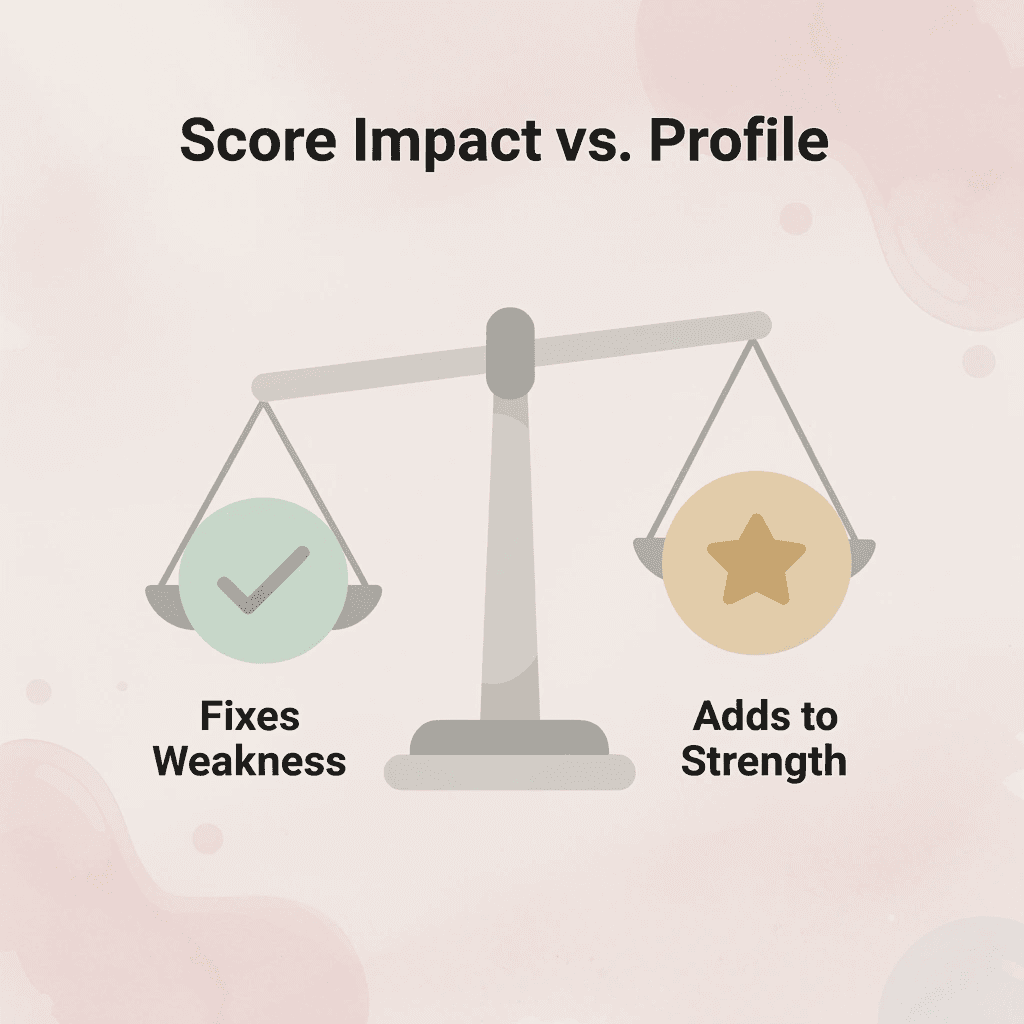
A higher SAT score helps your application the most when it fixes a specific problem in your profile — not when it just adds another great number to an already strong one.
"A higher SAT score delivers the greatest impact when it directly addresses a weakness in your application — transforming a liability into a strength."
Scenario | Impact of a Higher SAT Score |
|---|---|
GPA is below the target range | Offsets academic concern, signals true ability |
Profile already well-rounded | Minimal added value — diminishing returns |
Applying to score-sensitive schools | Critical differentiator in competitive pools |
Scholarship eligibility at stake | Can unlock funding tied to score thresholds |
💡 Tip: Before retaking the SAT, ask yourself why — if your score is already competitive for your target schools, your time may be better spent elsewhere.
🎯 Key Point: A higher SAT score is a strategic tool. Use it to close a gap, not to chase perfection on an already strong application.
When does a GPA alone leave admissions officers guessing?
The failure point is usually a mismatch between what a student's transcript suggests and what their test score confirms. A student with a 3.7 GPA from a school with limited AP offerings presents an interpretive challenge for admissions officers: is that GPA the product of genuine academic strength or a reflection of a less demanding environment? A strong SAT score of 1400 or above answers that question directly. According to C2 Education, a score of 1400 or higher places students at approximately the 95th percentile nationally, providing admissions readers with a standardized reference point that a transcript alone cannot provide. The score thus serves as a clarifying signal.
How does a high score create separation in competitive programs?
The same logic applies to students applying to high-demand programs such as engineering or computer science, where the applicant pool is exceptionally strong. When hundreds of applicants arrive with near-identical GPAs and course loads, a score in the upper quartile of UT's admitted range creates measurable separation. It doesn't guarantee admission, but it removes a reason to hesitate.
Why is guessing whether to retake the SAT a costly mistake?
Most students take the SAT once, check the score against a general university average, and decide whether to retake based on gut feeling. This approach rarely accounts for major-specific competitiveness, how the score interacts with GPA trends, or whether a modest gain would shift their positioning within the applicant pool. An AI college counselor like Kollegio evaluates your full profile across thousands of data points, making the retake decision calculated rather than guesswork-based.
Is chasing a higher score always worth it?
The constraint is real: time spent drilling practice tests is time not spent strengthening application components that can't be replicated by a single exam. Retaking makes sense when your current score falls below UT's 25th percentile for your intended major, when timed practice tests consistently show you're leaving points on the table, or when an unusual circumstance disrupted a previous test date. It makes less sense when you're already within the middle range, and your essays still need serious work.
C2 Education reports that top institutions like MIT and Harvard show middle 50% SAT ranges of 1510–1580 and 1500–1580, respectively. Once you're within a program's competitive range, additional score gains deliver diminishing returns compared to a compelling essay or leadership record that tells a story no test score can. A test score, however strong, answers only one question about who you are.
What Matters Beyond SAT Scores at UT?
A test score answers one question. Your application needs to answer a dozen more. At UT Austin, roughly 75% of the freshman class gets admission through automatic acceptance via the Top 6% rule, according to the Koppelman Group's University of Texas Admissions Statistics 2025. For the remaining 24% admitted through holistic review, every single piece of the application carries real weight. A strong SAT score is a starting point — not a finish line.
"For the 24% of UT Austin admits who go through holistic review, every piece of the application carries real weight — a strong SAT score is a starting point, not a finish line." — Koppelman Group, University of Texas Admissions Statistics 2025
🎯 Key Point: If you fall outside the Top 6% automatic admission path, your essays, extracurriculars, leadership, and context become the deciding factors — not your SAT alone.
🔑 Takeaway: UT Austin's admissions are a two-track system. Understanding which track you're on determines exactly how much your SAT score matters — and what else you must bring to the table.
Admission Path | % of Freshman Class | Primary Factor |
|---|---|---|
Top 6% Auto-Admit | ~75% | Class rank |
Holistic Review | ~24% | Full application review |
⚠️ Warning: Assuming a high SAT score alone will carry your application through holistic review is one of the most common — and most costly — mistakes applicants make.

What actually moves the needle in holistic review
Students admitted to UT's most competitive programs build profiles where academics, essays, activities, and major-specific preparation all point in the same direction, telling a coherent story about who they are and what they intend to do.
How do academics and coursework shape your application?
Academic performance is the foundation. Admissions officers examine GPA, class rank, and course rigor through AP, IB, dual enrollment, or honors coursework. A student with a 3.8 GPA in five AP classes presents a stronger profile than one with the same GPA in standard courses. Sustained excellence in challenging classes over three or four years demonstrates discipline under pressure.
What role do essays play in holistic review?
Essays are where the application becomes a person. Two students with nearly identical transcripts and scores can diverge based on writing that reveals intellectual curiosity, purpose, or genuine growth. Admissions officers seek evidence that applicants know who they are and why UT fits their story. The strongest essays explain what accomplishments cost and what they built, not just what was achieved.
How do extracurriculars and major fit factor into decisions?
Most students treat extracurriculars like a checklist. UT reviewers care more about the depth of your commitment and impact than the number of activities you pursued. A student who spent two years building a tutoring program demonstrates initiative and follow-through, which matters far more to reviewers than a long list of one-semester activities. Leadership is about what you do over time, not the title you hold.
Many applicants miss a critical point: demonstrating fit for their intended major. UT admits students to specific colleges and programs, each with its own competitive applicant pool. A student applying to computer science or to McCombs must demonstrate preparation and genuine interest in the field through relevant coursework, projects, and experiences.
How can students identify gaps before it's too late?
Most students build their profiles alone, piecing together advice from busy school counselors and family members navigating the process for the first time. Without understanding how the pieces connect, students invest excessive time and effort in the wrong areas. Our AI college counselor maps a student's full profile against thousands of data points, identifying strengths, gaps, and connections to target programs without the $10,000 price tag of traditional guidance.
How Kollegio Helps You Understand Your UT Admission Chances
After reviewing SAT score ranges, admissions requirements, and the factors that matter beyond testing, many students ask: "How do I know where I stand?" The challenge isn't finding admissions statistics — it's understanding how your unique academic profile compares to admitted students and identifying areas that deserve attention before you apply.
"The challenge isn't finding admissions statistics — it's understanding how your unique academic profile compares to admitted students and identifying areas that deserve attention before you apply."
🎯 Key Point: Raw stats alone don't suffice. What matters is understanding how your specific profile compares to admitted students at UT.
💡 Tip: Use Kollegio's personalized analysis tools to move beyond generic data and get a clear, honest picture of your UT admission chances based on your academics, scores, and background.

What does Kollegio offer students navigating the admissions process?
Kollegio is a free AI-powered platform trusted by more than 200,000 students that consolidates the entire college application process into one place. Rather than gathering information from multiple websites, students can develop a comprehensive admissions strategy tailored to their individual goals, academic record, and college preferences.
Kollegio's personalized college matching system analyzes your GPA, SAT score, coursework, activities, and other factors to show how you align with colleges you're considering, including UT Austin. The platform provides AI-powered admissions insights that help students identify strengths and potential weaknesses: for example, discovering that your SAT score is competitive but your extracurricular profile could be strengthened.
How does Kollegio help with scholarships, essays, and activities?
For students worried about cost, Kollegio includes a scholarship finder that matches users with opportunities based on their academic background, interests, and qualifications. Essay preparation support helps students brainstorm ideas, organize thoughts, and strengthen their writing while maintaining their authentic voice. Activity feedback helps students present their extracurricular involvement, highlighting leadership, impact, and growth.
How does Kollegio bring your entire application together in one place?
Kollegio brings everything together in a single dashboard where students can manage college lists, track applications, explore scholarships, receive admissions insights, and refine application materials without juggling multiple tools. Understanding your admission chances requires evaluating your complete application profile, identifying gaps, and creating a plan to strengthen your candidacy before application deadlines.
Use Kollegio's AI College Counselor for Free Today!
Most students piece together college advice from Reddit threads, old blogs, and regular college websites, missing how their SAT score, GPA, intended major, and essays must work together as one unified case for admission.
"Students who approach college applications without a unified strategy—treating SAT scores, GPA, major choice, and essays as separate pieces—are leaving their admission outcomes to chance." — Kollegio
⚠️ Warning: Relying on scattered, generic advice means your application tells no coherent story. Admissions officers notice immediately.

Our AI college counselor closes that gap for free. See exactly how your SAT score compares to program-specific expectations, identify precisely which parts of your profile carry the most weight, and get essay feedback that connects your unique story to what your target programs value—no guesswork, no $10,000 retainer.
🎯 Key Point: Kollegio's AI college counselor gives you the same strategic edge as a high-end private counselor—completely free of charge.
💡 Tip: Start by uploading your full academic profile so the AI can identify your strongest assets and flag the exact gaps holding your application back.
What You Get | Traditional Advice | Kollegio AI Counselor |
|---|---|---|
SAT Score Benchmarking | Generic national averages | Program-specific comparisons |
Profile Strength Analysis | Guesswork | Data-driven insights |
Essay Feedback | Generic tips | Tied to your target schools |
Cost | $0–$10,000+ | Free |
Related Reading
- What SAT Score Is Required for Duke
- What Sat Score Is Required For Mit
- What Sat Score Is Required For Ucla
- What Sat Score Is Required For Princeton
- What Sat Score Is Required For Nyu
- What Is The Combined Essay Score For Sat
- What Sat Score Is Required For Columbia
- What Sat Score Is Required For Yale
- What Act Score Is Needed For Alabama
- What Sat Score Is Required For Stanford
- What Sat Score Is Required For Notre Dame
- What Sat Score Is Required For Texas A&m
- What Sat Score Is Required For Harvard
- What Sat Score Is Required For Cornell
- What Sat Score Is Required For Ivy League

Author
Senan KhawajaSenan Khawaja is the Co-Founder and CEO of Kollegio, an AI-native college counseling and institutional recruiting platform serving roughly 250,000 students across 190 countries. A Stanford graduate, repeat founder, and Forbes 30 Under 30 honoree with World Bank experience, Senan launched Kollegio to democratize elite college counseling—addressing the 400:1 student-to-counselor ratio in public schools. Under his leadership, Kollegio has secured 22+ institutional partners with a 100% renewal rate and backing from Reach Capital, JFF Ventures, and ECMC Group. He was also selected for OpenAI's inaugural ChatGPT Futures Class of 2026. Senan is based in New York City.