
The University of Florida receives tens of thousands of applications each year, and SAT scores remain one of the clearest signals admissions officers use to evaluate academic readiness. Knowing where UF sets its expectations and how admitted students actually score helps applicants build a strategy grounded in real data rather than guesswork. Just as students researching what ACT score is needed for Harvard benefit from understanding concrete benchmarks, UF applicants gain an edge by knowing exactly what competitive scores look like for this flagship institution.
Stop wondering.
Start matching.


Navigating testing requirements alongside the rest of a college application is demanding, and generic advice rarely accounts for an individual student's full profile. Personalized support makes a measurable difference, which is why students and families are increasingly turning to Kollegio's AI college counselor to get clear, accurate answers about UF's admissions expectations and a smarter path forward.
Table of Contents
- Why Students Obsess Over Finding UF's "Required" SAT Score
- What SAT Score Is Required for UF?
- Why UF Admissions Are About More Than SAT Scores
- What Your SAT Score Actually Means for Your Chances
- The Application Factors Many UF Applicants Underestimate
- How Kollegio Helps You Understand Where You Stand
- Use Kollegio's AI College Counselor for Free Today!
Summary
- UF doesn't require a minimum SAT score for admission. The middle 50% of admitted students for the Class of 2029 scored between 1380 and 1510, which means 25% of accepted students scored below 1380 and still received offers. This range reflects admissions reality: your score demonstrates academic readiness, but it doesn't determine your decision because UF evaluates complete profiles rather than isolated metrics.
- With over 73,000 applications and a 24% acceptance rate, thousands of applicants meet UF's academic benchmarks each year. Once your SAT score shows you can handle college-level work, admissions officers shift attention to what distinguishes you from other academically qualified candidates. Two students with identical 1450 scores rarely have identical applications, and the one who demonstrates depth through rigorous coursework, sustained leadership, and compelling essays typically outperforms the one whose application lacks substance beyond test performance.
- Course rigor matters more than many students expect because it signals whether you chose academic challenge when it was available. A 3.8 GPA in standard classes often appears weaker than a 3.7 GPA in AP, IB, AICE, and honors coursework. Admissions officers compare your transcript to what your school offered, so avoiding rigor to protect your average raises concerns about college readiness, while choosing harder classes demonstrates intellectual ambition even if it occasionally means B grades.
- Over 2 million students in the class of 2025 took the SAT, yet most focus exclusively on raising scores while neglecting factors that admissions officers actually weigh heavily. Students spend months retaking tests to gain 20 or 30 points while underestimating the extent to which course selection, extracurricular depth, GPA trends, and essay quality shape their competitiveness. A 1420 SAT, paired with four years of deepening commitment to specific activities and essays that reveal genuine insight, often beats a 1480 SAT with superficial involvement and generic writing.
- Leadership doesn't require formal titles or a quantity of activities. Admissions officers distinguish between students who joined ten clubs superficially and students who committed deeply to two or three areas over multiple years, creating measurable impact through initiative and sustained engagement. A student who spent four years in debate, eventually coaching younger members and organizing tournaments, demonstrates more than a student who held five officer titles but showed no meaningful involvement, because depth predicts how students will engage on campus.
- Kollegio's AI college counselor evaluates your complete profile to show how admissions officers will view your application, analyzing patterns across your transcript, identifying strengths and gaps in your activities, and providing personalized college matching that classifies schools accurately as reach, target, or likely based on your full profile rather than a single SAT number.
Why Students Obsess Over Finding UF's "Required" SAT Score
Students look for a number that separates competitive from uncompetitive applicants: a cutoff that offers certainty in an inherently uncertain process. This search for a magic threshold is understandable. Admissions anxiety is real, and a single score provides a concrete anchor in an otherwise ambiguous system.
"Students fixate on cutoff scores because they want a clear signal in a process designed to resist simple answers." — College Admissions Research
💡 Tip: Instead of hunting for a hard cutoff, focus on understanding the full range of scores among admitted students—that context is far more useful than any single number.

The real problem is that this number doesn't exist, and treating admissions like a pass/fail test creates serious blind spots that can derail an otherwise strong application strategy. When students reduce the process to a binary threshold, they risk ignoring the holistic factors — essays, activities, and context — that drive decisions.
⚠️ Warning: Obsessing over a single SAT cutoff is one of the most common mistakes applicants make. It creates a false sense of security and causes students to underinvest in other critical parts of their application.
🎯 Key Point: UF admissions is not a pass/fail system. There is no magic number that guarantees acceptance or rejection.
Why do students fixate on a single required score?
When facing a 24.2% acceptance rate, students seek clarity. A specific SAT requirement feels like a map in unfamiliar territory. This binary thinking- hit the number and you're safe, miss it and look elsewhere- makes planning feel manageable.
Does a cutoff score actually determine who gets admitted?
But selective admissions don't operate on simple yes-or-no logic. Universities don't sort applications by test score and accept everyone above a cutoff. A student scoring 1380 might be admitted, while another with a 1460 might be rejected, because admissions officers evaluate complete profiles, not isolated metrics.
What deeper anxiety is really driving the search for a number?
The obsession with finding a required score reflects deeper concerns: fear of wasting time and effort, fear of rejection, and pressure to make perfect choices about the future. Students don't want to know if they're competitive. They want to know if they're safe.
Why do online forums give such contradictory SAT advice?
Online forums offer conflicting advice: one post claims a 1300 is competitive, another insists anything below 1450 is unrealistic. Students read about peers with lower scores getting accepted, then hear stories of students with near-perfect scores being denied. The result leaves students stuck and uncertain.
What does a 25th percentile score actually mean?
Part of the confusion stems from a misunderstanding of score ranges. When students see that PrepScholar reports a 25th percentile SAT score of 1330, many assume it's a minimum requirement. They miss the point: 25% of admitted students scored below that number. The university accepted them because other application components compensated for lower test scores.
A score below the middle won't hurt your chances if your GPA, course difficulty, essays, and extracurricular activities tell a strong story. Conversely, scoring above the 75th percentile doesn't guarantee admission if the rest of your application lacks depth or distinction.
Why This Mindset Creates Risk
Focusing too much on a single number can hurt your application strategy. Some students don't apply because their score falls below what they think is required, even though they have other strengths that could make them competitive. Others assume a high SAT score alone will suffice, ignoring essays, recommendations, and demonstrated interest that admissions officers consider essential.
What happens when students treat test scores as the only variable?
The danger lies in treating test scores as the sole measure of merit, even though universities evaluate applicants across multiple dimensions. Students who present a complete academic profile, connect their experiences to their intended field of study, and articulate alignment with the university's values gain an advantage no single test score can provide. Our Kollegio AI college counselor helps students view their applications through admissions officers' eyes, identifying strengths and opportunities for strategic improvement.
What students need is an understanding of what UF requires and what the university values beyond test performance.
What SAT Score Is Required for UF?
The University of Florida does not publish a minimum SAT score requirement. Instead, UF provides admissions profile data: for the Class of 2029, the middle 50% SAT range for admitted students was 1380 to 1510. This means 25% scored below 1380 and 25% scored above 1510. UF explicitly notes these ranges are not minimum requirements, and being within the range does not guarantee admission. Students are admitted both above and below this range every year.
"For the Class of 2029, the middle 50% SAT range for admitted UF students was 1380 to 1510 — but UF confirms this is not a minimum cutoff, and students are admitted above and below this range every year."
🔑 Takeaway: The 1380–1510 range is a benchmark, not a barrier — UF evaluates applicants holistically, so a score outside this range does not automatically disqualify you.
⚠️ Warning: Do not treat the middle 50% range as a minimum requirement. UF has no official SAT cutoff, and relying solely on your score to predict admission is a critical mistake.

SAT Section Breakdown
According to PrepScholar, admitted students typically score between 1330 and 1470, with Evidence-Based Reading & Writing scores ranging from 650 to 720 and Math scores from 650 to 750.
Understanding UF's selectivity
The University of Florida received more than 73,000 applications and admitted roughly 17,800 students, resulting in an acceptance rate of about 24%. Many applicants assume they need to score at or above the top end of the SAT range, but this assumption is incorrect.
Does a lower SAT score mean automatic rejection at UF?
The admissions profile shows what successful applicants typically score, not what admissions officers require. A student with a 1400 SAT score may be admitted with exceptional coursework, leadership experience, and a strong overall application, while a student with a 1500 SAT score may be denied if other application components are less compelling.
Admissions data show where successful applicants typically score, not where admissions decisions begin or end. Understanding this distinction helps applicants avoid costly assumptions about their chances at UF.
Related Reading
- What ACT Score Is Needed for Harvard
- Average Act Score For Nc State
- Average Sat Score For Unc
- Average Sat Score For Umd
- Average Sat Score For Uc Berkeley
- Average SAT Score for Virginia Tech
- Average Sat Score For Brown
- Average SAT Score for UVA
- Average SAT Score for Michigan
- Average Sat Score For Ohio State
Why UF Admissions Are About More Than SAT Scores
UF doesn't publish a minimum SAT score. The middle 50% of admitted students for the Class of 2029 scored between 1380 and 1510, but this range doesn't determine competitiveness. A 1400 can secure admission if your coursework, leadership, and essays demonstrate a compelling story. A 1490 can fall short if your profile feels generic or unfocused.
Why Students Obsess Over Finding UF's "Required" SAT Score
Looking for a specific SAT cutoff score makes sense because you want to know where you stand. But selective admissions don't work that way. UF looks at your complete profile, not just one test score, which is why you'll find students with 1350 SATs getting admitted while others with 1480s get rejected. The focus on finding a required score creates confusion because it assumes admissions works like a pass-or-fail test, when in reality it involves dozens of variables evaluated holistically across tens of thousands of applications.
What SAT Score Is Required for UF?
UF doesn't require a minimum SAT score for admission. For the Class of 2029, the middle 50% of admitted students scored between 1380 and 1510, with Evidence-Based Reading and Writing ranging from 650 to 720 and Math from 650 to 750. Thus, 25% of admitted students scored below 1380, and 25% scored above 1510.
With over 73,000 applications and a 24% acceptance rate, your SAT score is one of many factors admissions officers consider. A score at the 25th percentile (around 1380) won't disqualify you if your grades, course rigor, leadership, and essays demonstrate readiness for UF. Conversely, a 75th percentile score (around 1510) doesn't guarantee admission without a strong overall application. Admissions officers evaluate how all parts of your profile work together to show what you could contribute to campus.
Why UF Admissions Are About More Than SAT Scores
UF evaluates applications holistically, weighing academic performance, course rigor, extracurricular involvement, leadership, essays, and personal context alongside test scores. Admitted students demonstrate sustained academic effort through challenging coursework, such as AP, IB, honors, or dual-enrollment classes, and meaningful engagement beyond the classroom.
A student with a 1420 SAT who founded a community organization, led a research project, or demonstrated four years of deepening commitment in a specific area often outcompetes a 1480 scorer whose activities list reads like resume padding. UF wants students who will contribute to campus culture, engage deeply in their fields, and sustain effort over time. Your SAT score shows you can handle college-level work, but your grades, coursework choices, leadership roles, and essays reveal who you are and what you'll bring to UF's community.
What Your SAT Score Actually Means for Your Chances
Your SAT score shows you are ready for college-level work, but it doesn't determine admission. What distinguishes applicants within UF's score range is how hard they've pushed themselves in school, what they've done outside the classroom, and how well they've conveyed their story in essays. A 1390 SAT paired with challenging classes, steady leadership, and strong essays can outperform a 1480 SAT with few activities and basic writing.
The situation around your score matters more than many students realize. Over 2 million students in the class of 2025 took the SAT, and thousands scored within UF's middle 50% range. Your score places you in a large group of academically capable students, but UF admits students who stand out for deep involvement, genuine curiosity about learning, and proven impact. Students scoring below the 25th percentile (around 1380) have been admitted because their overall profiles showed exceptional strength in areas UF values. The score opens the door to serious consideration, but everything else determines whether you walk through it.
The Application Factors Many UF Applicants Underestimate
How hard your classes are matters more than many students realize. Choosing regular classes when your school offers AP, IB, AICE, or dual enrollment suggests you avoided academic challenge. UF wants students who choose the harder path, even if it means earning occasional B grades, because that choice demonstrates readiness for college-level work and intellectual ambition. Admissions officers compare your transcript to what your school offered, so taking the most rigorous courses available matters more than a perfect GPA in easy classes.
Your GPA trend tells a story about how you bounce back and grow. A student who started with a 3.4 freshman year and finished with a 3.9 senior year demonstrates improvement and adaptability. A declining trend raises questions about sustained effort and college readiness. UF reviews your transcript semester by semester, looking for patterns that reveal how you respond to challenge and whether you build momentum or lose focus under pressure.
Leadership is not about titles or how many activities you join. Admissions officers distinguish between students who joined ten clubs without real involvement and those who committed deeply to two or three areas over multiple years. A student who spent four years in debate, eventually coaching younger members and organizing tournaments, demonstrates more leadership than one who held five officer titles but showed no meaningful involvement. UF values depth because it predicts how students will engage on campus: those who make a difference are the ones who show up consistently, take ownership, and create measurable impact.
How Kollegio Helps You Understand Where You Stand
Kollegio evaluates your complete profile beyond test scores, assessing your academic trajectory, course rigor, extracurricular depth, and essay quality. The platform analyses patterns across your transcript, identifies strengths and gaps in your activities, and provides personalized college matching that classifies schools as reach, target, or likely based on your full profile rather than a single SAT score. Students discover whether their 1420 SAT positions them competitively at UF due to strong leadership and rigorous coursework, or whether their 1480 SAT leaves them less competitive due to weak extracurriculars and declining grades.
Our AI college counselor surfaces opportunities students typically miss without expensive private counseling. It identifies scholarships that match your background, suggests essay angles that differentiate your story, and highlights strategies to strengthen weak areas. A student with a 1400 SAT might learn that their community college coursework and sustained volunteer work make them more competitive than their score suggests, while a 1490 scorer might discover that their generic activities and lack of academic challenge put them at risk despite strong testing.
More than 200,000 students use Kollegio to navigate admissions with AI support that helps them evaluate options, strengthen applications, and make informed decisions without expensive private counseling. Our platform doesn't replace your voice or write your essays. It helps you tell your authentic story more effectively, identify schools where your profile fits, and understand what "competitive" means for your specific combination of scores, grades, coursework, activities, and accomplishments. Admissions officers need to understand the impact and significance behind each activity, not a list of titles.
Why UF Admissions Are About More Than SAT Scores
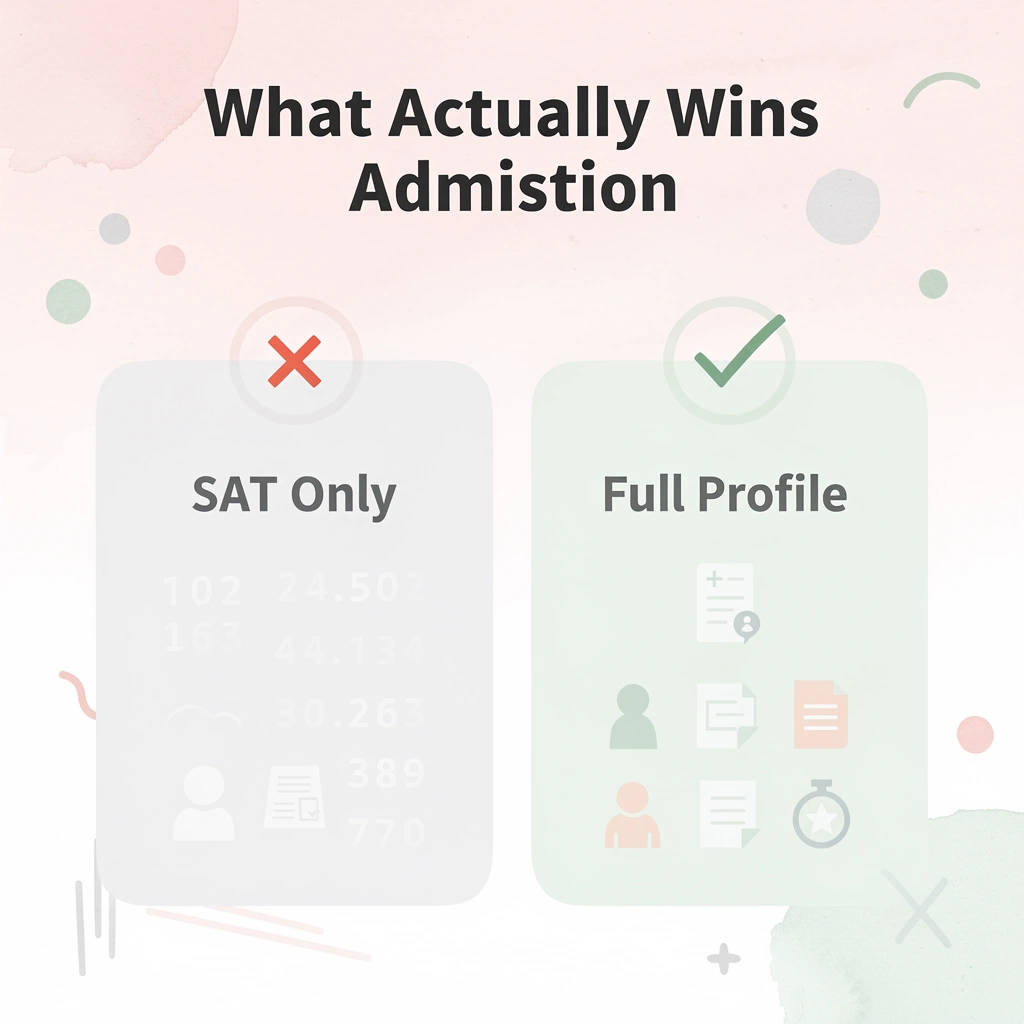
A competitive SAT score matters at UF, but it cannot carry an application by itself. Admissions officers do a holistic review that weighs academic performance, course rigor, extracurricular involvement, leadership, essays, and personal context. The strongest candidates build complete profiles in which every part reinforces their readiness and potential contributions to the university community.
"The strongest candidates build complete profiles where every part reinforces their readiness and potential contribution to the university community."
🎯 Key Point: UF's admissions process is holistic — a high SAT score alone is never enough to guarantee acceptance. Every element of your application must work together.
💡 Tip: Think of your application as a complete story, not a checklist. Academic rigor, leadership, and personal essays are just as critical as your test scores when competing for a spot at UF.

How the holistic review actually works
UF does not rank applicants by SAT score and admit from the top down. Instead, admissions officers read each application to understand who the student is, what they have accomplished, and how they might contribute to campus life. According to PrepScholar, the 25th percentile SAT score is 1330, while the 75th percentile is 1470. Some students score below this range but stand out through rigorous coursework, meaningful leadership, or compelling personal stories. Others score above the 75th percentile yet face rejection because their applications lack depth or fail to demonstrate genuine engagement.
What do your GPA and course rigor tell admissions officers?
Your GPA demonstrates that you work hard, stay focused, and understand diverse subjects. The difficulty of your classes matters, too: admissions officers want to see that you challenged yourself by taking AP, IB, honors, dual-enrollment, or college-level classes. A student with strong grades in rigorous classes outshines one with identical grades in easier classes.
How do extracurriculars factor into the evaluation?
Extracurricular involvement shows how you spend time outside the classroom. Admissions officers value depth of involvement and impact over the number of activities you join. Leadership doesn't require a formal title; you can demonstrate it by organizing events, mentoring peers, launching projects, solving community problems, or creating positive change within organizations.
Why essays carry more weight than most students realize
Two applicants with identical academic profiles can leave markedly different impressions through their essays. Essays reveal your reasons for applying, your values, how you overcome challenges, your goals, and your worldview—dimensions that grades and test scores cannot capture. Admissions officers also consider students' backgrounds, weighing the opportunities available at your school, hardships you faced, and circumstances that shaped your learning.
How can students access personalized guidance for building a holistic profile?
For years, students who could afford private counselors received personalized guidance on building complete profiles while others navigated the process alone. Platforms like AI college counselor now provide personalized college matching, essay feedback, scholarship discovery, and application planning to all students regardless of financial resources. These tools help students identify how their unique experiences, achievements, and goals align with what selective universities seek.
What does your specific SAT score actually mean for your admission chances?
But knowing that UF evaluates complete profiles leaves one important question unanswered: what does your specific SAT score mean for your chances of admission?
Related Reading
- What Sat Score Is Required For Uf
- Average Sat Score For Uga
- Average Act Score For Georgia Tech
- Northwestern Average Sat Score
- What SAT Score Is Required for Cornell
- What SAT Score Is Required for Harvard
- What Is The Combined Essay Score For Sat
- Average Sat Score For Virginia Tech
- Average Sat Score For Uva
- Average Sat Score For Georgetown
- Rice University Average Sat Score
- Caltech Average Sat Score
- Average Sat Score For Michigan
What Your SAT Score Actually Means for Your Chances
Your SAT score tells admissions officers whether you can handle UF's academic workload — not whether you should be admitted. Once your score shows you are academically ready, the decision shifts to factors that make you different from thousands of other applicants who are also academically qualified.
"Your SAT score is the entry ticket — it proves you can handle the coursework. What gets you in the door is everything else that makes you uniquely you." — College Admissions Insight
🎯 Key Point: A strong SAT score clears the academic bar — but it rarely wins the admission decision on its own.
💡 Tip: Once you've hit UF's competitive score range, redirect your energy toward essays, extracurriculars, and leadership — those are the real differentiators at this stage.

If Your Score Falls Below UF's Middle 50%
A score below UF's typical range (25th percentile around 1380) does not disqualify you. Every admission cycle includes students who scored below this threshold and still received offers. The difference lay in the strength of their overall application.
What can strengthen your application when your score is lower?
Students with lower scores can remain competitive by demonstrating exceptional performance in other areas. A rigorous course load with strong grades demonstrates academic ability beyond a single test. Leadership roles, sustained extracurricular involvement, and essays revealing genuine insight into your values and character can offset a weaker score. Admissions officers assess whether your overall application suggests you will contribute meaningfully to campus.
The better question is whether the rest of your application compensates for that weakness. If your GPA, coursework, activities, and essays are strong, your score becomes one piece of information among many rather than something that automatically disqualifies you.
If your score sits within UF's middle 50%
A score of 1380–1510 puts you in the middle 50% of UF students, meaning you have similar academic skills to many admitted students. However, this doesn't guarantee admission. More than 2 million students in the high school class of 2025 took the SAT at least once, and thousands of UF applicants meet or exceed the university's academic benchmarks annually.
What do admissions officers focus on once your score shows readiness?
Once your score shows you are ready, admissions officers examine what makes you different. Two applicants with the same 1450 score rarely have identical applications. One might have taken the hardest courses available while maintaining a strong GPA; the other might have avoided challenging classes to protect their average. One might lead a community organization that demonstrates genuine passion; the other might list activities without depth. One might write essays that reveal self-awareness and intellectual curiosity; the other might submit generic responses.
Application quality matters more than small score differences. A student with a 1420 and a compelling story often outperforms one with a 1480 whose application lacks substance. Your score opens the door; what you bring through it determines whether you stay.
If Your Score Exceeds UF's Typical Range
A score above the 75th percentile strengthens your academic profile and demonstrates solid preparation. However, high scores cannot compensate for weaknesses elsewhere in your application.
Does a high SAT score guarantee admission to UF?
Top universities reject applicants with great test scores every year. A 1550 score means little if your classes lack rigor, your grades are inconsistent, or your extracurricular activities lack substance. Admissions officers want students who push themselves, help their communities, demonstrate leadership, and bring new ideas that enhance campus life, not students who merely excel on tests.
Strong scores show you are ready for college classes. They do not prove character, initiative, or potential to contribute. The strongest applications combine academic success with evidence of how you have used your abilities to make a difference beyond yourself.
How does your SAT score fit within your complete application?
Students often focus too much on SAT scores as the primary factor in college admissions while neglecting essays, course rigor, and depth in extracurricular activities. Platforms like AI college counselor help students assess their whole profile, showing where SAT scores fit into a broader application strategy and identifying opportunities to strengthen areas that admissions officers prioritize.
Your SAT score is one piece of information in the complete picture. Admissions officers review students, not numbers. The question is whether your whole application demonstrates the academic ability, personal qualities, and potential contribution that UF seeks.
Application Factors: Many UF Applicants Underestimate
Students who focus only on raising their SAT scores often miss what makes an application truly competitive. Admissions officers build classes based on readiness, curiosity, and potential to contribute — not test performance alone.
"Admissions officers build classes based on readiness, curiosity, and potential to contribute — not test performance alone."
🚨 Warning: Pouring all your energy into test prep while neglecting other application factors is one of the most common — and costly — mistakes UF applicants make.
💡 Tip: Shift your focus from just chasing a higher SAT score to building an application that signals genuine curiosity, real-world readiness, and a clear potential to contribute to UF's community.
Course Rigor
The classes you choose matter as much as the grades you earn in them. According to the University of Florida Office of Admissions, course rigor is one of the strongest signs of college readiness. A student with a 3.8 GPA in standard-level courses may appear less prepared than a student with a 3.7 GPA who took AP, IB, AICE, dual-enrollment, and honors classes when available. Challenging yourself in school demonstrates curiosity about learning and a willingness to work hard beyond what feels easy.
GPA Trends
Your cumulative GPA tells one story. Your transcript tells another. Admissions officers examine how your academic performance has changed over time, not just your final grades. A student who struggled initially but showed steady improvement demonstrates resilience and adaptability—qualities essential for college-level coursework. Strong test scores paired with declining grades can raise questions about consistency, motivation, and long-term academic habits.
Leadership and Extracurricular Depth
Admissions officers value sustained engagement, growth, and measurable impact in a few areas over superficial participation across many clubs. Leadership doesn't require a formal title; it can involve organizing events, mentoring peers, managing projects, launching initiatives, or solving problems within your school or community. Depth outweighs breadth.
How do essays and community impact strengthen your application?
Standardized tests show academic performance; essays show who you are. When thousands of applicants have similar credentials, essays become one of the few chances to demonstrate your personality, values, motivations, and experiences that grades and test scores cannot convey. Community impact doesn't require starting a nonprofit or achieving national recognition. It can involve volunteering, mentoring younger students, supporting local initiatives, or addressing neighborhood challenges. These experiences help admissions officers understand how you may contribute to campus life.
How can a strong profile support both admissions and financial aid?
The same qualities that strengthen admissions applications—leadership, service, academic achievement, and personal accomplishments—also strengthen scholarship applications. Students who focus only on test scores miss opportunities to build a profile that supports both admissions and financial aid. Platforms like AI college counselors help students align their strengths with scholarship opportunities, essay prompts, and application strategies without the expense of private counseling. Kollegio makes it easy to identify these connections and develop a stronger overall application strategy.
But understanding these factors still leaves one question unanswered: how do you know where you stand?
How Kollegio Helps You Understand Where You Stand
Most students compare themselves to UF's middle 50% SAT range and general admissions statistics, then calculate their chances with incomplete information. This leads to either false confidence or unnecessary panic—neither helps you make better decisions.
"Relying on a single metric like SAT range gives you at best a partial picture—and at worst, a completely misleading one." — Kollegio
🎯 Key Point: Middle 50% ranges and general admit rates are surface-level data points. Without understanding your full profile, these numbers can send you in the wrong direction entirely.

Admissions officers evaluate academic trajectory, course rigor, extracurricular depth, essay quality, and how these pieces fit together as a complete picture. Our AI college counselor helps you assess your complete profile rather than fixating on a single metric, providing personalized insights based on your actual strengths and experiences.
💡 Tip: Instead of asking "Is my SAT high enough?" ask "How does my full profile stack up?" That's the question admissions officers are answering.
🔑 Takeaway: No single stat defines your admissions outcome. The students who make the best decisions understand their complete academic story — and that's what Kollegio is built to help you do.
Personalized College Matches
Students often misclassify schools as reach, target, or likely options because they rely on outdated information or misjudge their own strengths. A student with a 1420 SAT might consider UF a reach school, given their rigorous coursework and leadership experience, while another with a 1480 might assume acceptance despite lacking substantial extracurricular activities.
Kollegio creates college matches based on your grades, interests, and goals, finding schools where your profile fits well. This prevents wasted applications on unsuitable schools and helps you discover institutions you might have missed, enabling you to build a smart list that reflects your competitiveness.
Scholarship Finder
According to Kollegio's research on scholarship accessibility, students with a GPA of 3.5 or higher receive private scholarships at a rate of 17%, yet many never apply because they don't know where to look. Scholarship searches require scrolling through hundreds of mismatched opportunities across multiple websites, causing most students to give up or apply to common competitions with thousands of other applicants.
Kollegio filters scholarships based on your academic achievements, interests, experiences, and goals, removing opportunities that don't align. Since 91% of Gen Z students need scholarships to pay for college, finding the right opportunities quickly can make a significant financial difference.
How does Kollegio help with essay brainstorming and application support?
Many applicants struggle to decide what story to tell or share their experiences without sounding like everyone else. Kollegio provides AI-powered essay support to help students brainstorm ideas, organize their thoughts, and strengthen their writing, while ensuring the final essay remains authentically theirs. Structured guidance helps you tell a stronger personal story instead of staring at a blank page.
How does Kollegio support the activities section and broader admissions decisions?
The platform helps students evaluate and improve the way they present their extracurricular involvement, leadership experiences, and accomplishments in their activities section. Admissions officers need to understand the impact and significance behind each activity, not a list of titles. More than 200,000 students use Kollegio to navigate the admissions process with AI support that strengthens applications and enables more informed decisions without expensive private counseling.
So where does that leave you if you're still wondering whether your SAT score is good enough for UF?
Use Kollegio's AI College Counselor for Free Today!
Wondering whether your SAT score is competitive for UF? Use Kollegio to evaluate your full applicant profile, discover colleges that match your academic strengths, and uncover scholarships that fit your background. Our AI college counselor provides personalized college matches in your first session and helps you understand how UF fits into your admissions strategy.
Related Reading
- What SAT Score Is Required for Duke
- What Sat Score Is Required For Mit
- What Act Score Is Needed For Alabama
- What Sat Score Is Required For Columbia
- What Sat Score Is Required For Notre Dame
- What Sat Score Is Required For Nyu
- What Sat Score Is Required For Princeton
- What Sat Score Is Required For Ivy League
- What Sat Score Is Required For Ut
- What Sat Score Is Required For Texas A&m
- What Sat Score Is Required For Harvard
- What Sat Score Is Required For Ucla
- What Sat Score Is Required For Yale
- What Sat Score Is Required For Cornell
- What Sat Score Is Required For Stanford