
What SAT Score Is Required for MIT? Tips to Improve Your Chances
MIT admits fewer than 4% of applicants, and SAT scores play a meaningful role in that process. Understanding exactly where you need to score can shape how you spend the next several months preparing. Knowing what SAT score is required for MIT, alongside questions like what ACT score is needed for Harvard, helps students set realistic benchmarks early and avoid costly surprises later.
Getting the right guidance at the right time makes a measurable difference in outcomes. The sections ahead break down MIT's SAT expectations, what the numbers mean in context, and concrete steps to strengthen your preparation. For a personalized look at your target score and a focused plan to reach it, Kollegio's AI college counselor can identify gaps in your preparation and help you close them with confidence.
Table of Contents
- Why So Many Students Stress About MIT SAT Scores
- The Hidden Risk of Focusing Only on SAT Scores
- What SAT Score Is Required for MIT?
- How Competitive Is Your SAT Score for MIT?
- What MIT Looks for Beyond Test Scores
- How Kollegio Helps Students Build Stronger MIT Applications
- Use Kollegio's AI College Counselor for Free Today!
Summary
- MIT's middle 50% SAT score range for admitted students sits between 1510 and 1580, with the Math section alone ranging from 780 to 800. That compression means near-perfect quantitative ability functions as a floor for a meaningful portion of the admitted class, not a ceiling. Once a student's score lands within that band, the number stops being a differentiator, and the rest of the application takes over.
- The overall acceptance rate for MIT's Class of 2028 is approximately 3.9%, meaning thousands of applicants with scores in or above the middle 50% range still receive rejections. Being statistically competitive is not the same as being admissions-competitive. The score establishes credibility. Everything else determines the outcome.
- More than 80% of U.S. four-year colleges and universities did not require ACT or SAT scores for fall 2025 admissions, according to FairTest. That shift reflects something admissions offices have recognized for years: a test score captures part of a student's profile, not the whole picture. At schools like MIT, the distinction between qualifying and compelling lives is almost entirely outside the score.
- Students who spend months pushing from a 1540 to a 1560 are trading time they could spend on research projects, essays, and activities that actually separate applicants in a hyper-competitive pool. That opportunity cost is rarely visible in the moment because test prep offers clear structure and measurable feedback while essays and research feel harder to evaluate. The result is chronic over-investment in the one area where most competitive applicants are already strong.
- MIT evaluates applicants across five criteria beyond test scores, including character, collaboration, and contribution to community. Admissions readers are looking for consistency across recommendations, essays, and activity descriptions, not a checklist of impressive credentials. A student whose entire file points toward the same person, someone who makes the people and projects around them better, reads very differently from one who appears to have assembled a profile strategically.
- A student with a 1530 SAT, published research, and essays that reveal a specific intellectual obsession presents a stronger case than a student with a 1580 who spent those same months retaking the test. The score is the entry ticket. The story is what gets you through the door.
- Kollegio's AI college counselor addresses this by evaluating a student's full profile across academic, extracurricular, and essay dimensions, helping identify where the application is genuinely strong and where targeted effort will have the most impact given a student's specific score range and background.
Why So Many Students Stress About MIT SAT Scores
Students stress about MIT SAT scores because the numbers feel like a final judgment. A single test result becomes a way to measure worthiness, and when the goal seems impossibly high, worry fills every gap in understanding.
"A single test result becomes a way to measure worthiness: when the goal seems impossibly high, worry fills every gap in understanding."
🎯 Key Point: The stress isn't about the score itself but what students believe it represents about them as a person.

According to UnivAdmitHelp's analysis of MIT's academic expectations, the middle 50% SAT score range for admitted MIT students falls between 1510 and 1580. A 1500 is not automatically disqualifying, and a 1580 does not guarantee admission. Once you're inside that range, the score stops being the thing that sets you apart.
⚠️ Warning: Chasing a perfect SAT score as your sole strategy is a critical mistake — once inside the 1510–1580 range, other factors carry far more weight.
🔑 Takeaway: The score is a threshold, not a ticket. Crossing into the middle 50% range means your application moves into a space where holistic factors — not raw numbers — determine your outcome.
Where does the pressure to score higher actually come from?
The real pressure comes from a broken feedback loop. Students compare scores on forums, see rejection stories from applicants with 1550s and near-perfect GPAs, and conclude that no score is ever safe enough. A student who earns a 1530 after months of preparation doesn't feel accomplished—they feel exposed. This emotional response is understandable, but it distracts from the actual question admissions officers ask about a candidate.
International students, first-generation applicants, and students from under-resourced schools describe the same spiral: self-doubt about whether their profile is "enough," compounded by conflicting advice and a lack of a clear way to benchmark their full application against real outcomes. Most students fixate on the one number they can control while neglecting the research projects, essays, and activities that would separate them in a pool where the acceptance rate dropped to 4.55% in the 2024-2025 cycle. That's the trap.
How can students get clarity instead of chasing a perfect score?
Tools like our AI college counselor exist for this moment. Instead of leaving students to guess whether their SAT score is competitive, our platform evaluates their full profiles together, identifying where their applications are genuinely strong and where focused effort will make the biggest difference. That clarity is what a $10,000 private counselor provides; Kollegio makes it available to every student, regardless of zip code or financial situation.
What most students don't realize until it's too late is that score anxiety is a symptom of something bigger.
Related Reading
- What ACT Score Is Needed for Harvard
- Average Act Score For Nc State
- Average Sat Score For Unc
- Average Sat Score For Umd
- Average Sat Score For Uc Berkeley
- Average SAT Score for Virginia Tech
- Average Sat Score For Brown
- Average SAT Score for UVA
- Average SAT Score for Michigan
- Average Sat Score For Ohio State
The Hidden Risk of Focusing Only on SAT Scores
Score anxiety masks a deeper problem: tunnel vision, where one number crowds out everything that actually determines whether MIT says yes.
"A single SAT score is one data point — yet it consumes disproportionate mental energy that could be invested in portfolio-building, essays, and extracurriculars that move the needle far more."
⚠️ Warning: Fixating on score improvements at the expense of your holistic application is one of the most common and most costly mistakes competitive applicants make.

Chasing small SAT gains past a certain point is extremely expensive in opportunity cost. A student pushing from a 1540 to a 1560 over six weeks has given up time building a research project, deepening a robotics portfolio, or drafting an essay that makes an admissions reader stop scrolling. That trade rarely pays off.
🎯 Key Point: Once your SAT score clears a school's competitive threshold, every additional hour spent on test prep is an hour not spent on the differentiating factors that admissions officers actually remember.
🔑 Takeaway: The real return on investment at 1540+ comes from holistic application strength — not 20-point score increments that admissions committees rarely weigh heavily.
Why extra test prep can quietly backfire
At MIT, Harvard, and Caltech, students with nearly identical academic profiles are separated by what they built outside the classroom, not by test scores. According to FairTest, the National Center for Fair and Open Testing, more than 80% of U.S. four-year colleges and universities will not require ACT or SAT scores for fall 2025 admissions. Admissions offices recognise that test scores tell part of the story, not all of it.
What does over-investing in test prep actually cost you?
Most students focus on test prep because it has a clear structure, measurable outcomes, and satisfying feedback loops. Essays and research projects feel messier and harder to grade. The hidden cost is spending too much time on areas where they're already doing well while neglecting what makes them stand out. Our AI college counselor at Kollegio addresses this by analyzing a student's full profile to identify where extra effort yields the greatest impact.
What MIT is actually evaluating
The failure point is usually a misreading of what "qualified" means at MIT. Thousands of applicants each year meet the academic threshold. According to the College Board Newsroom's SAT Suite of Assessments Annual Report, average SAT scores for the class of 2025 are 521 in Reading and Writing and 508 in Math. MIT's admitted students score far above those averages. When every applicant can handle the coursework, admissions officers seek intellectual initiative, creative problem-solving, and evidence that a student will contribute something original to campus.
Why does your story matter more than your score?
A student with a 1530 SAT, a published research paper, a meaningful leadership role, and a personal essay demonstrating intellectual curiosity will present a stronger case than a student with a 1580 who spent those months retaking the test. The score is the entry ticket. The story is what gets you through the door.
That distinction between qualifying and compelling is what most score-focused students miss until it's too late.
What SAT Score Is Required for MIT?
MIT does not publish a minimum SAT score requirement. According to MIT Admissions Statistics, the middle 50% of admitted students scored between 1510 and 1580 on the SAT, with the Math section ranging from 780 to 800. These numbers show where the competitive band sits — not where the door locks.
"The middle 50% of admitted MIT students scored between 1510 and 1580 on the SAT, with Math scores ranging from 780 to 800 — signaling an extraordinarily high baseline for quantitative ability." — MIT Admissions Statistics
🎯 Key Point: The 1510–1580 range represents the competitive band — not a hard cutoff. Scoring within or above this window puts you in the conversation; scoring below doesn't automatically close the door.
⚠️ Warning: Don't treat 1510 as a "safe" floor. Most admitted students cluster toward the upper end of this range, meaning the real competition is concentrated at 1560 and above.
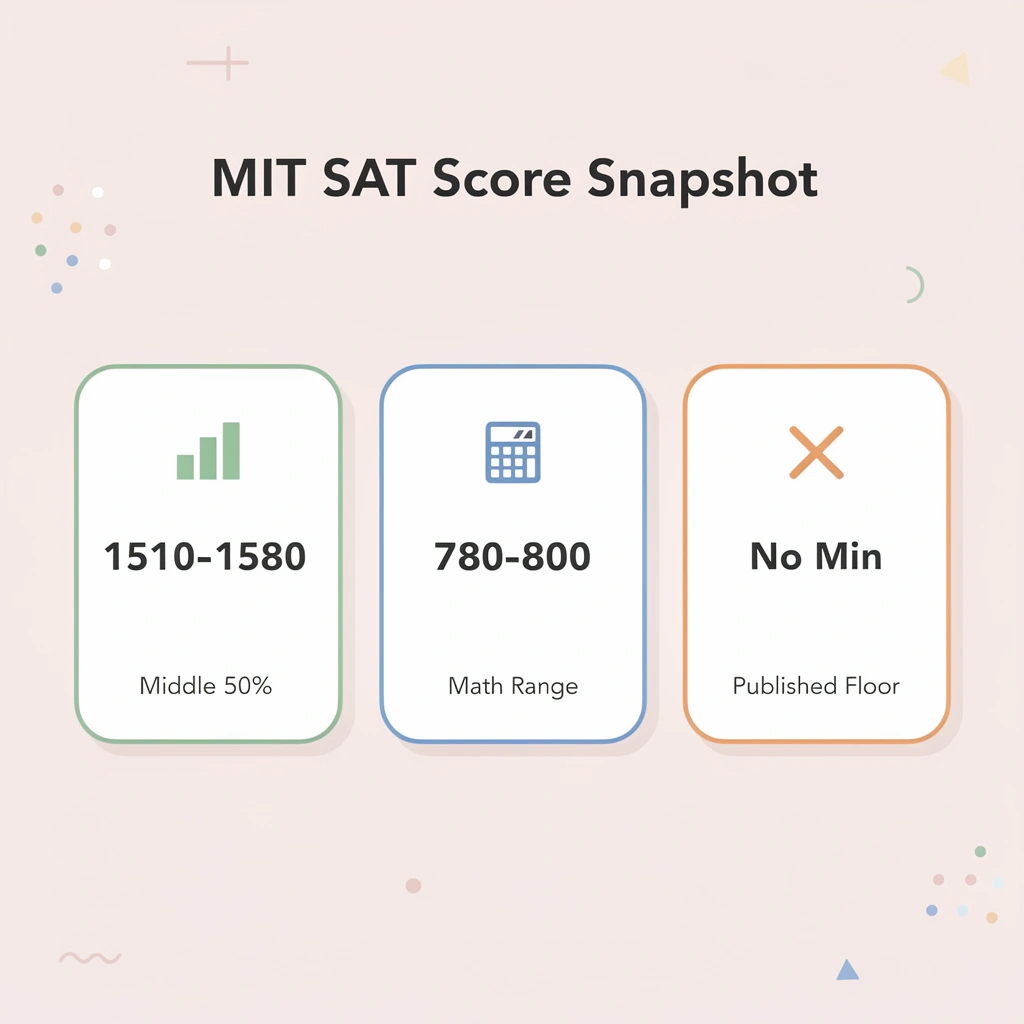
The Math range is particularly significant: a 780 to 800 spread means near-perfect quantitative ability is the floor for a meaningful portion of the admitted class. This signals the academic environment MIT is building: one where the baseline is already extraordinary.
🔑 Takeaway: A Math score below 780 places you outside the middle 50% of admitted students. For a school where quantitative mastery is central to its identity, this is a critical signal about the academic threshold MIT expects.
What does the score range actually filter?
The middle 50% range serves as a credibility check, not a ranking system. Once a student passes that threshold, the score stops doing most of the work. What matters instead is the rest of the file: the two-year research project, the essay revealing how a student thinks, the teacher's recommendation describing someone who asks novel questions.
Why does a competitive score still lead to rejection?
That pattern appears consistently among applicants who score within range yet receive shocking rejections. A 1550 with strong extracurriculars and genuine academic drive is common in MIT's applicant pool. The confusion stems from treating a competitive score as a differentiator when, at this level, it functions as a qualifier. The differentiators exist elsewhere.
How does evaluating your full profile change the picture?
Most students build their college list around a single benchmark score and compare it against published ranges. At MIT, this approach breaks down because the score gets you into consideration, but your research depth, intellectual trajectory, and personal narrative move the needle. Our AI college counselor evaluates your full profile across all those dimensions, not just the number, helping you understand where you genuinely stand and which schools fit the whole picture.
Does a higher score help at all?
Getting a score above the middle 50% range offers no meaningful advantage in MIT admissions. The applicant pool includes thousands of students with perfect or near-perfect scores, many of whom are rejected. According to MIT Admissions Statistics, the SAT Evidence-Based Reading and Writing section shows a middle 50% range of 730 to 780. Chasing a higher score instead of conducting research or writing is a trade most applicants would regret.
Your SAT score is one of the least personal things in your application. It does not show how you think, what you build, or why MIT's environment would bring out something in you that no other place could. The question shifts from "Is my score high enough?" to something far more worth your time: what will you do there?
How Competitive Is Your SAT Score for MIT?
Your SAT score for MIT is a positioning tool, not a verdict. Scores within the middle 50% show that you belong in the academic conversation. What happens after that is determined by everything the score cannot measure.
"Your SAT score for MIT is a positioning tool, not a verdict — it shows you belong in the conversation, but it does not write the ending."
🎯 Key Point: Hitting the middle 50% range means you've cleared the academic threshold. That's the starting line, not the finish line.
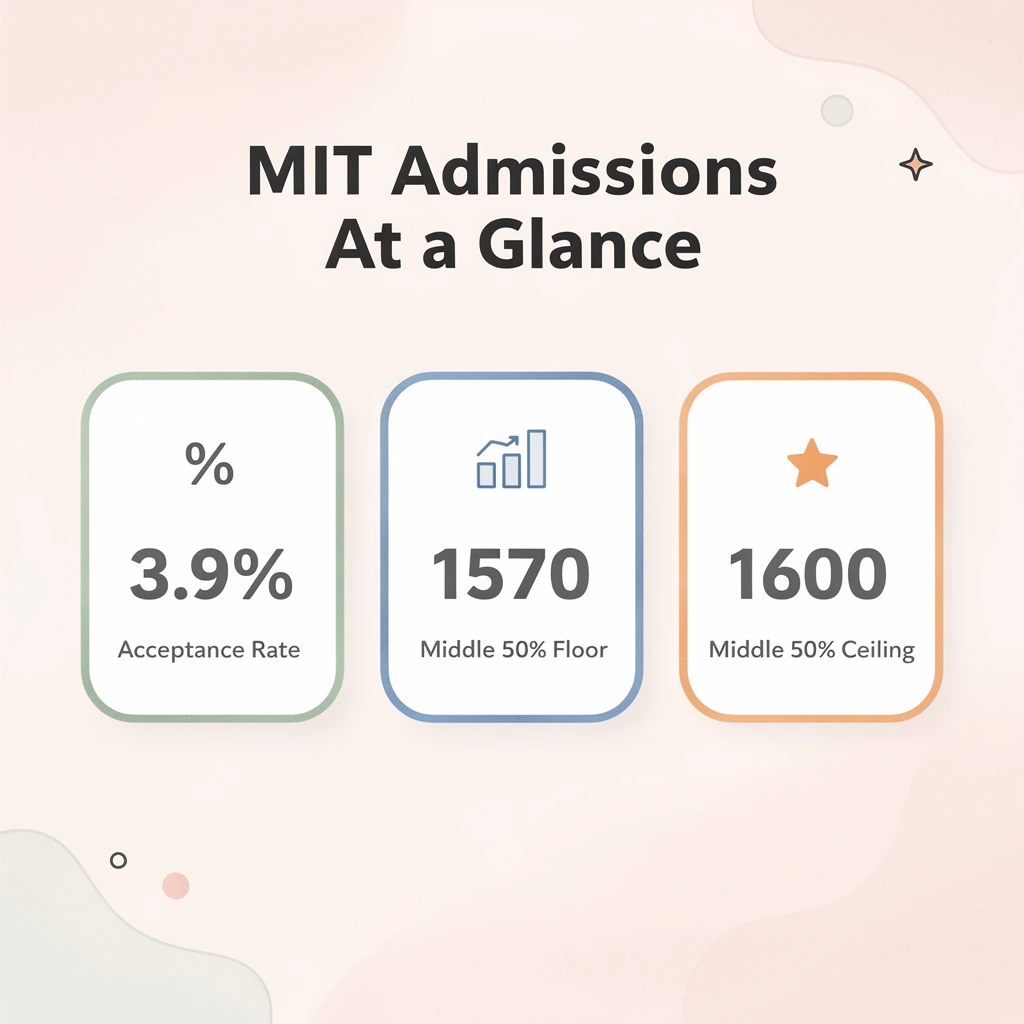
Being statistically competitive is not the same as being admissions-competitive. According to MIT Admissions Statistics, the overall acceptance rate for the Class of 2028 is approximately 3.9%. Thousands of applicants each cycle have scores within or above the middle 50% range and still receive denials. The score gets you considered. It does not get you admitted.
⚠️ Warning: A perfect SAT score does not make you a lock — with a 3.9% acceptance rate, thousands of top-scoring applicants are turned away every single cycle.
🔑 Takeaway: The score opens the door. Everything else — your story, your impact, your character — is what walks you through it.
Where your score actually positions you
A score below 1450 creates a significant problem in mathematics, which sits at the center of MIT's academic identity. It does not disqualify you, but it requires admissions officers to work harder to justify your academic readiness. Scores between 1450 and 1510 place you in a competitive gray zone where the application must carry more weight. Within the middle 50%, you have cleared the credibility threshold. Above 1570, you are among many applicants at that level, and the score itself no longer creates separation.
Does a higher score within a competitive range actually improve your odds?
A repeated pattern among applicants is the assumption that a higher score within an already competitive range produces meaningfully better odds. It rarely does. MIT Admissions Statistics show the SAT Math middle 50% range runs from 780 to 800, meaning the vast majority of admitted students cluster near the ceiling. At that compression level, the difference between a 1550 and a 1580 is noise, not a differentiator.
Most students respond by doubling down on test prep because it feels controllable. Retaking the SAT provides a target, timeline, and measurable goal, whereas research projects, essays, and letters of recommendation feel messier. This familiarity makes over-investing in marginal score gains costly. Our AI college counselor at Kollegio can shift that focus productively by mapping your actual profile gaps and identifying which application components will move the needle most, given your score range and background.
What does the context surrounding your score actually signal to MIT?
How competitive your score is depends less on the number itself and more on what surrounds it. A 1530 supported by published research, a national competition placement, and essays revealing a specific intellectual obsession reads differently from a 1530 with no distinguishing context. Score ranges describe a population, not you.
Once you understand what the score can and cannot do, a harder question surfaces: what does MIT look for in the parts of your application that numbers cannot capture?
Related Reading
- What Sat Score Is Required For Uf
- Average Sat Score For Uga
- Average Act Score For Georgia Tech
- Northwestern Average SAT Score
- Average Sat Score For Georgetown
- Rice University Average Sat Score
- Caltech Average Sat Score
- What Is The Combined Essay Score For Sat
- What SAT Score Is Required for Cornell
What MIT Looks for Beyond Test Scores
MIT looks at five key things when reviewing applications beyond test scores, according to MIT Admissions: character, collaboration, and contribution to the community. These holistic factors are what truly help separate the strongest applicants from each other — making them essential to understand for any serious candidate.
"MIT looks at five key things when reviewing applications beyond test scores: character, collaboration, and contribution to community." — MIT Admissions
🎯 Key Point: A perfect test score alone will not get you into MIT — character, collaboration, and community contribution carry significant weight in the admissions process.
🔑 Takeaway: Understanding what MIT values beyond academics is critical — applicants who demonstrate genuine community impact and collaborative spirit stand out in one of the world's most competitive applicant pools.

What does "academic excellence" actually mean here?
The failure point is usually a misreading of what MIT means by academic strength. It is not a GPA number. It is evidence that a student sought out difficulty, remained curious as the material grew challenging, and built genuine depth in mathematics and science rather than merely collecting course credits. A student who took every available AP course and still found ways to advance—through independent study, community college coursework, or self-directed research—signals that learning is a habit, not a performance.
Why does problem-solving matter more than competition results?
MIT is not a place that gives out credentials. It is a place where people build things, break things, and figure out why. Admissions officers look for evidence of initiative, not achievement alone. A student who entered a robotics competition and placed well shows something. A student who identified a gap, built a prototype to address it, and iterated through failure shows something different and often more compelling. Scale matters less than the quality of thinking behind the work.
Why do assembled applications fall flat with admissions officers?
Most students work backward from activities to match what they think MIT wants, creating applications that feel constructed rather than authentic. Admissions officers read thousands of files annually and quickly discern the difference. The students who stand out pursued something specific because it genuinely interested them, not because it looked good on a list.
How can students surface the real story behind their experience?
AI college counselor platforms like Kollegio help students identify which parts of their experience best demonstrate these qualities. Our platform provides feedback that reveals their authentic story rather than a polished version of what students think admissions officers want to hear. For students who cannot afford expensive private counselors, this honest, specific feedback often makes the difference between an application that feels generic and one that feels true.
How do character and collaboration actually show up on paper?
With over 26,000 students applying to MIT each year for roughly 1,100 freshman spots, admitted applicants rarely check every box. They show a pattern: recommendations, essays, and activity descriptions consistently point toward someone who makes the people and projects around them better. A student whose teacher writes about how they stayed after class to help peers understand a concept, whose essay describes a team project that succeeded because of their listening, and whose activity list shows years of sustained group work has made their character clear. It is shown, not stated.
Knowing this changes the question you should ask yourself.
How Kollegio Helps Students Build Stronger MIT Applications
Once students understand MIT's SAT expectations, the next challenge is building an application that stands out beyond the numbers. Many applicants know their test scores and grades but struggle to figure out how competitive their overall profile is compared to other applicants. They may be unsure whether their academic achievements, extracurricular activities, leadership experiences, or application strategy is strong enough to make an impact.
"Knowing your numbers is only the beginning — the real differentiator is understanding how your complete profile stacks up against the most competitive applicants in the pool." — Kollegio Admissions Insight
🎯 Key Point: A strong MIT application goes far beyond test scores — it requires a holistic understanding of how your academic achievements, extracurricular activities, and leadership experiences work together as a unified profile.
💡 Tip: Use Kollegio to benchmark your overall application strength — not just your SAT score — so you can identify exactly where your profile needs the most improvement before you apply.
[IMAGE: https://im.runware.ai/image/os/a04d20/ws/3/ii/302098ad-75f5-4a8f-ab16-da44d7d0964f.webp] Alt: Scene of an application launching upward, representing a standout MIT application
How does Kollegio help students evaluate their academic profile?
Kollegio provides students with personalized college guidance to evaluate their academic profiles and make informed decisions throughout the admissions process. Rather than focusing solely on test scores, our AI college counselor helps students understand how different application components affect their chances of admission.
The platform helps students find universities that match their academic background, interests, and goals. Through university matching and admissions insights, students can see how their profile compares with what schools like MIT and other highly selective universities seek.
How does Kollegio support planning and application strategy?
Kollegio offers planning tools that help students stay organized throughout the admissions journey by tracking deadlines, preparing materials, and developing a clear strategy, rather than navigating by guesswork.
Application strategy is especially important for competitive schools. Students often focus heavily on increasing test scores while overlooking other areas that strengthen their candidacy. Kollegio helps students identify strengths and gaps before submission, enabling them to present a more compelling overall profile.
Students can also explore scholarship opportunities aligned with their achievements and goals, addressing both admissions and affordability.
Why do SAT scores represent only one part of the MIT admissions picture?
Kollegio recognizes that SAT scores provide only one piece of the admissions picture. Universities like MIT evaluate applicants based on academic achievement, intellectual potential, extracurricular involvement, personal qualities, and overall fit. A strong SAT score demonstrates academic readiness, but understanding how all application components work together separates strong applicants from exceptional ones.
Use Kollegio's AI College Counselor for Free Today!
Most students understand score thresholds and how colleges evaluate applications holistically, but translating that knowledge into a sharper, clearer application is difficult without support.
"Turning knowledge into a competitive application is one of the hardest parts of the college process — and most students are doing it completely alone." — Kollegio
🎯 Key Point: Understanding admissions differs from knowing how to stand out. That gap is where most students fall behind.

Our AI college counselor gives you clear, actionable information about your profile that normally costs thousands of dollars. It compares your academic profile against real admissions data from thousands of colleges, finds schools where you have a real chance of getting in, and helps you improve your application in ways that go beyond your test scores. Over 300,000 students and families have used it — completely free.
💡 Tip: Don't spend thousands of dollars on traditional counseling before trying a free AI-powered alternative that uses real admissions data.
✅ Best Practice: Use Kollegio's AI college counselor early in your application process — the sooner you compare your profile, the more time you have to meaningfully improve it.
Related Reading
- What Sat Score Is Required For Ut
- What Sat Score Is Required For Nyu
- What Sat Score Is Required For Ivy League
- What SAT Score Is Required for Texas A&M
- What SAT Score Is Required for Duke
- What Sat Score Is Required For Harvard
- What Sat Score Is Required For Cornell
- What Sat Score Is Required For Princeton
- What Sat Score Is Required For Stanford
- What Act Score Is Needed For Alabama
- What Sat Score Is Required For Ucla
- What Sat Score Is Required For Notre Dame
- What Is The Combined Essay Score For Sat
- What Sat Score Is Required For Columbia
- What Sat Score Is Required For Yale
Author
Trailblazer Marketing