
What SAT Score Is Required for Harvard? Your Chances Explained
Harvard's admitted students typically score between 1500 and 1580 on the SAT, with most top applicants landing at or near 1600. For those wondering what ACT score is needed for Harvard, the competitive range mirrors that standard, with admitted students generally scoring between 34 and 36. A strong test score alone does not guarantee admission, but falling below these benchmarks makes an already difficult process significantly harder.
Understanding where your score stands is only the first step. Closing the gap requires a focused plan built around real admissions data, not guesswork. Students who want personalized guidance on their SAT prep, application strategy, and overall competitiveness can get targeted support from Kollegio's AI college counselor.
Table of Contents
- Why Getting Into Harvard Is About More Than a Test Score
- What SAT Score Is Required for Harvard?
- What SAT Score Is Competitive for Harvard?
- Why a High SAT Score Alone Won't Get You Into Harvard
- How to Build a More Competitive Harvard Application
- How Kollegio Helps You Build a Stronger Harvard Application
- Use Kollegio's AI College Counselor for Free Today!
Summary
- Most admitted Harvard students score between 1500 and 1580 on the SAT, which represents the middle 50% of enrolled students who submitted scores. A score below 1500 is a meaningful disadvantage in a pool where academic credentials are uniformly strong. However, this range is descriptive, not prescriptive. It tells you what scores looked like among enrolled students, not what score guarantees admission.
- Harvard receives tens of thousands of applications each cycle and admits a small fraction of them. For the Class of 2029, the university received 47,893 applications and admitted 2,003 students. Many of the nearly 46,000 rejected applicants had scores at or above 1500. The score establishes academic readiness but does not explain why any individual student was admitted or denied.
- Over 50% of Harvard applicants submit perfect or near-perfect SAT scores and are still rejected, according to CollegeVine. This means the moment an application enters the review process, the test score has already stopped doing meaningful work. What carries an application forward is everything else, including essays, course rigor, recommendation letters, and demonstrated intellectual curiosity over time.
- Admissions officers look at whether students sought out the hardest available coursework and succeeded in it. A student with a 1520 who took five AP courses and conducted independent research can be read as a more compelling academic candidate than a student with a 1580 in a lighter curriculum. The score is one data point inside a larger argument that the full application is making.
- Depth of engagement consistently appears in admitted student profiles more often than breadth of credentials. A student who spent years on one meaningful pursuit and can write about it with specificity and self-awareness tends to stand out more than a student who collected a long list of activities without a clear through-line. Harvard's admissions process is designed to build a class community, not rank applicants by measurable inputs.
- Harvard has publicly stated that there is no minimum required SAT or ACT score for admission, which signals that the institution treats testing as one signal among many rather than a threshold to clear. Students who spend the majority of their preparation time optimizing their score while neglecting their essays and activity framing often arrive at the application deadline with a profile that looks strong on paper but feels anonymous in review.
- Kollegio's AI college counselor addresses this by evaluating a student's full profile across scores, essays, activities, and fit, helping identify where the application is strong and where the story needs more development before submission.
Why Getting Into Harvard Is About More Than a Test Score
Harvard turns away students with perfect SAT scores every year. This fact should reshape how you approach the admissions process.

According to Harvard College Admissions Statistics, more than 54,000 students applied for admission to Harvard's Class of 2028, and the university admitted approximately 1,937 of them. The majority of rejected applicants had extraordinary academic credentials: SAT scores in the 1550-1600 range, rigorous AP coursework, and impressive extracurricular records. They still didn't get in.
What a test score actually signals
A strong SAT score tells Harvard you can handle rigorous academic work, but not who you are, what you care about, or what you would add to a residential campus of 1,600 freshmen. Admissions officers are building a community, not a class of high scorers. Course rigor, intellectual curiosity, essay voice, demonstrated leadership, teacher recommendations, and character carry significant weight alongside test performance.
Why do so many strong applicants still get rejected?
The pattern among rejected applicants is consistent: students stack impressive credentials, hoping volume creates differentiation, but most top applicants already have similar credentials. What separates admits from rejects at Harvard is often a clear, specific, human identity that emerges through writing and choices made over years, not months, before the deadline.
Most students focus entirely on measurable inputs—GPA, scores, clubs—because those feel controllable. This approach produces polished but hollow applications. Kollegio's AI college counselor evaluates your full profile across essays, activities, and fit, helping you understand where your numbers stand and where your story needs strengthening before submission.
Does building a resume for Harvard actually work?
Harvard's admissions process is designed to resist gaming. A student who spends two years building a resume for Harvard often looks exactly like thousands of others who did the same. A student who spent two years doing something they genuinely love and can write about with specificity and energy stands out in a way no score optimization can replicate.
The SAT score still matters, though not in the way most applicants think it does.
Related Reading
- What ACT Score Is Needed for Harvard
- Average Act Score For Nc State
- Average Sat Score For Unc
- Average Sat Score For Umd
- Average Sat Score For Uc Berkeley
- Average SAT Score for Virginia Tech
- Average Sat Score For Brown
- Average SAT Score for UVA
- Average SAT Score for Michigan
- Average Sat Score For Ohio State
What SAT Score Is Required for Harvard?
Harvard College FAQ states clearly: there is no minimum required SAT score for Harvard College admission. What exists instead is a competitive range, a distinction that fundamentally changes how you should approach preparation.
"There is no minimum required SAT or ACT score for Harvard College admission — what matters is a competitive range, not a hard cutoff." — Harvard College FAQ
🎯 Key Point: Harvard does not use a minimum SAT threshold. Chasing a single "magic number" is the wrong strategy; understanding the competitive landscape is what matters.

Most applicants treat a score range like a requirement — and that's a critical mistake. When PrepScholar reports that the 25th percentile SAT score among admitted Harvard students is 1500 and the 75th percentile is 1580, students interpret those numbers as a threshold to clear. Those numbers describe who got in. They do not explain why.
⚠️ Warning: Hitting 1500 does not guarantee admission — it simply places you within the competitive range. Scores alone are never the deciding factor.
💡 Tip: Aim for the 75th percentile (1580+) to ensure your SAT score is a strength in your application, not a liability.
Why do strong SAT scores still lead to rejection at Harvard?
A pattern emerges among rejected applicants with strong scores: shock. Students with a 1550 SAT, top class rank, and a full list of AP courses find themselves turned away while peers with similar profiles receive acceptances. When your numbers look right on paper, rejection feels random. But thousands of applicants each cycle meet Harvard's academic standards. The score gets you into the conversation, not across the finish line.
Most students respond by improving what is easiest to measure: retaking the SAT, taking more AP courses, or adding another club. But that approach costs them hours they could spend developing the parts of their application that make them stand out. Our AI college counselor at Kollegio helps students shift that focus, using thousands of data points to evaluate the full profile—essays, activities, and fit—so decisions about where to invest time are based on real signal rather than score worry.
What does Harvard's admissions process actually reward?
Harvard's admissions process is designed to build a class, not find the highest test scorers. A student with a 1520 who has spent three years doing something specific, unusual, and meaningful often seems more compelling than a student with a 1580 who has spent those years collecting credentials. The score shows academic readiness; everything else shows who you are.
What SAT Score Is Competitive for Harvard?
A competitive SAT score at Harvard falls between 1500 and 1580, the middle 50% of enrolled students who submitted scores. According to BestColleges, you need a score of 1500 or higher to be truly competitive. Anything below that range puts you at a meaningful disadvantage in a pool where academic credentials are uniformly exceptional.
"You need a score of 1500 or higher to be competitive at Harvard — where the middle 50% of admitted students scored between 1500 and 1580." — BestColleges
🔑 Takeaway: The 1500 threshold is not a suggestion — it's the baseline for serious consideration in Harvard's applicant pool.
⚠️ Warning: Scoring below 1500 doesn't just lower your odds — it places you outside the middle 50% entirely, making every other part of your application work that much harder.

What the middle 50% range actually tells you
The critical difference most students miss is that this range describes what happened, not what should happen. It tells you what scores looked like among enrolled students, not what score gets you in. A 1500 does not unlock admission; it signals that your academic preparation is strong enough for admissions officers to keep reading. The score is a floor, not a finish line.
Why do students with strong scores still get rejected?
That gap between "competitive" and "admitted" is where many strong applicants get surprised. Students with scores in the middle 50% range, rigorous coursework, and compelling extracurriculars still face rejection at a 4.2% acceptance rate, because the applicant pool is sorted by factors beyond academics once the academic bar is cleared. The score earns you a fair read. What happens after depends on elements that a number cannot capture.
How does focusing only on the SAT create a blind spot?
Most applicants treat the SAT as their primary tool and build their applications around it. As the applicant pool grows more complex, this approach creates a blind spot. Our AI college counselor helps students shift from single-metric thinking to a full-profile view, using personalized matching and essay feedback to surface the non-score elements that differentiate competitive applicants.
How Harvard reads scores alongside everything else
Harvard considers SAT scores as one component within a broader evaluation that includes GPA, course difficulty, and academic performance over several years. According to PrepScholar, the 25th percentile SAT score at Harvard is 1500, and the 75th percentile is 1580. A perfect 1600 demonstrates strong preparation but does not distinguish you from the thousands of other applicants with near-perfect scores.
For the Class of 2029, Harvard received 47,893 applications and admitted 2,003 students. Many of the 45,890 denied applicants almost certainly had scores at or above 1500. The score was not the reason they were rejected; it was an insufficient reason to admit them.
Related Reading
- What Sat Score Is Required For Uf
- Average Sat Score For Uga
- Average Act Score For Georgia Tech
- Northwestern Average SAT Score
- Average Sat Score For Georgetown
- Rice University Average Sat Score
- Caltech Average Sat Score
- What Is The Combined Essay Score For Sat
- What SAT Score Is Required for Cornell
- What SAT Score Is Required for Stanford
Why a High SAT Score Alone Won't Get You Into Harvard
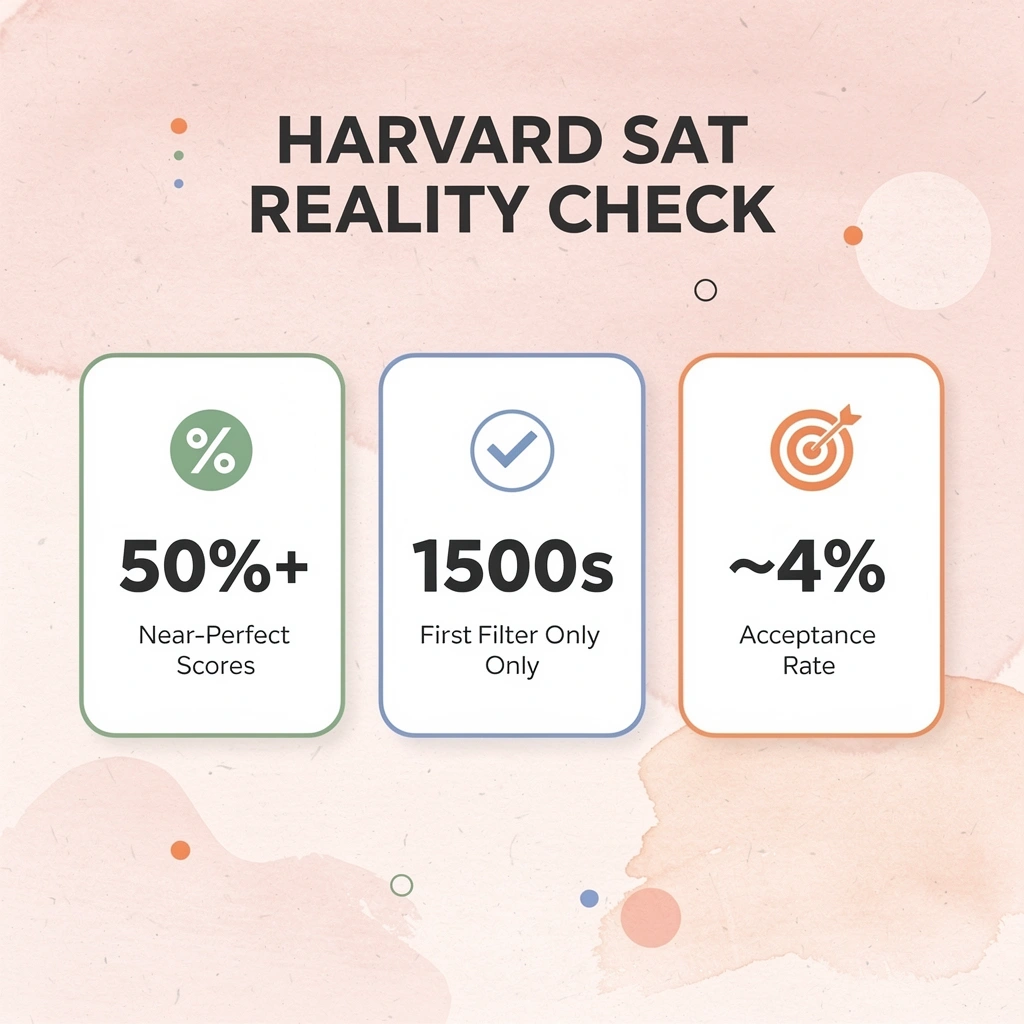
A score in the 1500s gets you past the first filter — and that's where its power ends. According to the CollegeVine Blog, over 50% of applicants to Harvard have perfect or near-perfect SAT scores yet are still rejected. Once your application enters review, your test score stops doing meaningful work — everything else carries the application forward.
"Over 50% of applicants to Harvard have perfect or near-perfect SAT scores — and are still rejected." — CollegeVine Blog
🔑 Takeaway: A high SAT score is not a golden ticket — it's the price of admission to the conversation. Once you clear the score threshold, admissions decisions hinge on everything else in your application.
⚠️ Warning: Don't fall into the trap of treating test prep as your primary strategy. Spending hundreds of hours chasing a perfect 1600 delivers diminishing returns once you've hit the competitive range.
What admissions officers are actually reading for
Here is where things often go wrong: students spend months preparing for the SAT and weeks improving their GPA, only to submit essays that read like resume summaries. Harvard's admissions readers are trained to look for specific details, not lists of achievements. They want to understand how you think, what you care about when no one is grading you, and whether your presence would genuinely change what it feels like to have a classroom conversation. A 1580 does not answer any of those questions.
Does course difficulty matter more than your score?
Academic rigor matters, but not in the way most students expect. Admissions officers assess whether you sought the hardest available coursework and succeeded in it. A student who earned a 1520 while taking five AP courses and conducting independent research presents differently from one who earned a 1580 in a lighter curriculum. The score is one data point in the larger argument your application makes about who you are.
Why do strong applications still feel anonymous to readers?
Most students approach the application by stacking credentials, assuming impressive inputs produce better outcomes. The hidden cost is a profile that looks strong on paper but feels anonymous in review. Readers see thousands of applications with near-identical academic profiles. What stops them is the application that reveals a person, not a performance. Our AI college counselor at Kollegio fills this gap by offering essay feedback, activity framing, and personalized profile analysis that help students surface what is genuinely distinctive about them at no cost.
What actually separates admitted students
Admitted students share one pattern: depth over breadth. A student who spent three years building a tutoring program for underserved middle schoolers, wrote about how that experience shaped their thinking, and received a letter of recommendation from someone who witnessed that growth firsthand, stands out. Harvard's admissions process weighs personal qualities that standardized tests cannot capture: intellectual curiosity, resilience, and self-awareness that signal a student will push their peers to think harder. According to Harvard College Admissions, Harvard has no minimum required SAT or ACT score for admission, signaling that testing is one signal among many, not a threshold to clear.
Why do recommendation letters matter so much?
Recommendation letters add something special to your application that nothing else can do. A teacher describing how you changed a class discussion, or a mentor explaining how you dealt with failure, gives admissions officers a genuine picture of who you are. This context goes beyond grades and test scores, making your application feel complete rather than carefully constructed.
How can students without private counselors find a clear path forward?
Knowing what Harvard looks for is only useful if you know how to work toward it—and most students, especially those without access to expensive private counselors, lack a clear path forward. Our AI college counselor at Kollegio helps bridge this gap by providing personalized guidance that makes elite college preparation accessible to everyone.
How to Build a More Competitive Harvard Application
Students can make their Harvard applications stronger by focusing on the things that matter most in holistic review: academic excellence, personal growth, and meaningful impact.
"Harvard's holistic review process evaluates academic excellence, personal character, and real-world impact — not just grades and test scores." — Harvard Admissions
🎯 Key Point: A competitive Harvard application is built on three core pillars — academic excellence, personal growth, and meaningful impact — all weighted equally in holistic review.
💡 Tip: Don't focus solely on GPA and test scores. Harvard's admissions process is designed to identify students who demonstrate authentic leadership, intellectual curiosity, and a track record of impact beyond the classroom.

How can you strengthen your academic profile for Harvard?
Academic performance remains one of the most important parts of a Harvard application. Students should earn strong grades while taking the most challenging courses available. Admissions officers examine course rigor to assess whether a student has consistently challenged themselves academically.
Strong GPAs, advanced coursework, and academic consistency over several years carry more weight than a single test score. Harvard seeks evidence that students can succeed in a demanding academic environment.
What kind of extracurricular activities does Harvard value?
Harvard values depth over quantity in extracurricular activities. Rather than joining every club available, focus on activities that genuinely interest you and allow meaningful contributions. Long-term commitment, leadership responsibilities, and measurable impact distinguish your application from other highly qualified candidates.
Why does a clear personal story matter in your application?
Strong applicants have a clear story connecting their interests, experiences, and future goals. Help admissions officers understand what motivates you and how your experiences have shaped your growth. Your academic choices, extracurricular activities, essays, and recommendations should work together to provide a clear picture of who you are.
How should you approach writing your Harvard essays?
Essays have qualities that cannot be shown through grades and test scores alone. The best essays are real, thoughtful, and personal. Focus on genuine experiences, lessons you have learned, and perspectives that reveal who you are rather than what you think admissions officers want to hear.
What makes a strong recommendation letter for Harvard?
Spend time building positive relationships with teachers who know you well and can speak meaningfully about your academic performance, intellectual engagement, and classroom contributions. The most effective recommendations include specific examples demonstrating curiosity, leadership, resilience, and personal growth.
How should you build a smart college application strategy?
Harvard is extremely selective, so admission is never guaranteed regardless of grades. A balanced application strategy should include reach, target, and safety schools aligned with your academic profile, interests, and goals. Starting early, tracking application requirements, preparing essays in advance, and researching universities reduce stress and improve application quality.
How Kollegio Helps You Build a Stronger Harvard Application
Getting into Harvard requires far more than a competitive SAT score. Students must understand how their academic profile compares to other applicants, identify areas for improvement, and build a strategic application that stands out. Every element of your candidacy — from GPA and extracurriculars to essays and recommendations — plays a critical role in the decision.
💡 Tip: Don't rely on guesswork when building your Harvard application. Data-driven insight into your academic profile can be the difference between a rejection and an acceptance letter.
"Harvard's acceptance rate hovers around 3–4%, making strategic preparation and a truly differentiated application profile more essential than ever." — Harvard Admissions Data
Our AI college counselor helps students navigate every stage of this process — turning a reactive approach into a proactive, strategic plan.

Kollegio provides personalized college guidance throughout the application process. Instead of relying on guesswork, students gain a data-backed understanding of their academic standing and what steps will strengthen their candidacy.
🎯 Key Point: Personalized guidance is essential for schools like Harvard. Kollegio replaces uncertainty with actionable clarity at every stage.
⚠️ Warning: Students who apply to Harvard without a clear strategic framework often underestimate how their profile compares to the applicant pool. Kollegio's AI is designed to prevent this costly mistake.
How does Kollegio help students assess their academic profile?
The platform offers personalized university matching that helps students find colleges aligned with their academic background, interests, and goals. For students considering highly selective universities such as Harvard, it provides insight into how competitive their profile is relative to admissions standards.
Kollegio provides admissions insights into what universities want beyond grades and test scores, helping applicants make informed decisions about coursework, extracurricular activities, essays, and overall application strategy.
Students can analyze their academic profiles to identify strengths and gaps, and focus their efforts where they can make the biggest impact before submitting applications.
What support does Kollegio offer beyond academic planning?
Kollegio offers support with essays and extracurricular activities, helping students communicate their experiences, achievements, and personal story—areas that play a major role in holistic admissions decisions.
The platform helps students explore scholarship opportunities and develop an organized application plan, from creating a balanced college list to tracking deadlines.
Use Kollegio's AI College Counselor for Free Today!
Our AI college counselor builds your personalized admissions strategy using thousands of data points—your SAT score, GPA, essays, activities, and fit—so you understand exactly where your profile stands and what to strengthen before applying to highly selective universities like Harvard.
"Understanding your full admissions profile—from SAT scores to extracurriculars to essay strength—is the single most important step before applying to highly selective universities." — Kollegio AI
🎯 Key Point: Kollegio's AI counselor doesn't guess—it analyzes thousands of real data points to give you a precise, actionable picture of your admissions chances.

Start with Kollegio for free today and get personalized college matches, essay guidance, and a clearer picture of your competitive application profile.
💡 Tip: Use Kollegio's AI tools to identify your strongest schools, sharpen your essays, and enter application season with confidence.
✅ Best Practice: Don't wait until senior year. The earlier you understand your admissions profile, the more time you have to strengthen it where it matters most.
Related Reading
- What Act Score Is Needed For Alabama
- What Sat Score Is Required For Ut
- What Sat Score Is Required For Yale
- What Sat Score Is Required For Columbia
- What Is The Combined Essay Score For Sat
- What Sat Score Is Required For Texas A&m
- What Sat Score Is Required For Duke
- What Sat Score Is Required For Princeton
- What Sat Score Is Required For Nyu
- What Sat Score Is Required For Mit
- What Sat Score Is Required For Ivy League
- What Sat Score Is Required For Ucla
- What Sat Score Is Required For Cornell
- What Sat Score Is Required For Notre Dame
- What Sat Score Is Required For Stanford
Author
Trailblazer Marketing