
Is Business Administration a Good Major for Your Future?
You're standing at a crossroads, trying to pick from dozens of college majors, and business administration keeps popping up everywhere. Maybe your parents suggested it, or you've heard it's practical and versatile, but you're wondering if it's actually worth your time and tuition money. This guide breaks down the career prospects, earning potential, skill development, and real-world value of a business administration degree so you can make an informed decision about your future.
Finding the right major doesn't have to feel like guessing in the dark. Kollegio's AI college counselor can provide personalized insights into business administration programs, helping you compare degree options, understand job market trends, and determine whether this path aligns with your strengths and career goals. Think of it as having an experienced guide who knows the ins and outs of higher education, ready to answer your specific questions about whether business administration is the right fit for you.
Summary
- Business Administration attracts over 380,000 degree recipients annually, according to NMSU Global Campus, making it one of the most popular majors in the United States. That scale reflects confidence in its versatility, but it also intensifies competition, with graduates with identical credentials competing on internships, technical skills, and professional networks rather than on transcripts alone.
- Paid internships dramatically outperform unpaid ones in career outcomes. NACE data show that 50% to 60% of paid interns at for-profit firms receive full-time job offers, and they command median starting salaries of $62,500, compared with $42,500 for unpaid interns. This gap indicates that relevant work experience during college matters more than coursework in hiring decisions.
- The breadth that makes Business Administration feel safe becomes a strategic liability without intentional specialization. Students who complete general course mixes without building depth in finance, marketing, analytics, or operations graduate with foundational knowledge but lack the demonstrable expertise employers seek when filling specialized roles. The degree provides tools, not a predetermined professional identity.
- Nearly one in five master's degrees conferred in the U.S. is in business, according to Fortune, creating a crowded space where standing out requires more than completing the degree. When applicant pools contain hundreds of candidates with similar academic backgrounds, hiring decisions shift to factors beyond transcripts, including leadership experience, technical certifications, industry exposure, and interpersonal skills that coursework alone doesn't capture.
- Financial literacy extends beyond finance majors into every business function. Research published by the American Accounting Association in 2016 found that accounting education significantly improves students' ability to interpret financial information and make informed business judgments. This capability is essential across roles because every business decision involves resource allocation, budget evaluation, and return-on-investment calculations, regardless of department.
- Kollegio's AI college counselor helps students compare business specializations by analyzing their specific strengths, constraints, and career interests to identify realistic concentration paths and internship opportunities that align with their goals, rather than offering generic advice to keep options open.
Why So Many Students Choose Business Administration and Still Feel Unsure

The Default Choice That Doesn't Provide Default Answers
Business Administration attracts students because it feels like a safe bet. It promises career flexibility, industry relevance, and practical skills that translate into real jobs. But that same versatility creates a paradox: the broader the degree, the harder it becomes to visualize what you're actually preparing for.
According to NMSU Global Campus, business administration is one of the most popular majors, with over 380,000 degrees awarded annually. That scale reflects how widely the degree is viewed as a reliable path forward. Yet popularity doesn't equal clarity. Many students choose it without understanding what the curriculum actually involves or where it leads beyond vague notions of "office jobs" or "management roles."
The curriculum itself covers finance, marketing, operations, human resources, economics, and organizational behavior. This breadth builds adaptable skills, but it also means students spend four years sampling disciplines rather than mastering one. Unlike nursing students who know they'll become nurses, or engineering students who know they'll design systems, business majors graduate with a toolkit but no clear blueprint for how to use it.
When Flexibility Feels Like Ambiguity
Career outcomes mirror this uncertainty. A business degree can lead to corporate strategy, sales, consulting, entrepreneurship, supply chain management, or financial analysis. For students seeking a defined destination, this range feels overwhelming rather than allowing. They wonder: Am I preparing for everything or nothing in particular?
Competition intensifies the doubt. Because so many graduates enter the job market with the same credentials, internships, leadership roles, and networking often determine who stands out. The degree alone doesn't guarantee differentiation. Students may worry that they're not doing enough to distinguish themselves from thousands of peers with identical transcripts.
Specialization decisions add another layer of pressure. Should you concentrate on finance, marketing, analytics, or management? Is a general business degree too broad to compete with more technical majors? Would data science or supply chain offer better job security? These questions feel high-stakes when you're 19 and unsure what you'll care about at 25.
The Gap Between Promise and Starting Point
Income expectations contribute to the confusion. While many business careers are lucrative, entry-level salaries vary widely by role, industry, and location. Students hear stories about six-figure consulting jobs and executive compensation, only to discover that most graduates start in coordinator or analyst roles, earning far less. The gap between promise and reality can feel jarring.
Internship competitiveness is another concern. Employers prioritize practical experience, meaning students must build credentials during college, not after. Securing those opportunities requires strategic planning, networking, and often geographic flexibility. For students balancing coursework, part-time jobs, and personal responsibilities, this expectation can feel daunting.
Some students face additional barriers that further complicate the timeline. Health challenges, family obligations, or financial constraints can delay enrollment or create attendance gaps. When you're trying to coordinate prerequisite math courses, manage unpredictable life circumstances, and plan around semester start dates, the path to a business degree can feel exhausting before it even begins. The frustration isn't about lack of ambition. It's about the gap between knowing what you're capable of and being unable to execute on that potential right now.
Traditional college counseling often reinforces the confusion rather than resolving it. Generic advice about "following your passion" or "keeping your options open" doesn't help when you're trying to decide between marketing and finance, or whether to pursue internships at startups versus Fortune 500 companies. What students need isn't more platitudes. They need personalized guidance that accounts for their specific interests, constraints, and career goals. Kollegio's AI college counselor provides tailored support, helping students compare specializations, understand job market trends, and map out realistic paths based on their unique circumstances rather than one-size-fits-all recommendations.
What the Numbers Don't Tell You
According to Fortune, 19% of all master's degrees conferred in the U.S. are in business. That statistic reflects confidence in the field's value, but it also reveals how crowded the space has become. When nearly one in five graduate students chooses business, standing out requires more than just completing the degree.
Ultimately, Business Administration offers possibilities rather than guarantees. Its strength is flexibility. Its weakness is also flexibility. Without a clear plan for specialization, experience, and career direction, students may feel adrift despite choosing the most popular major in the country.
Selecting Business Administration answers "What field should I enter?" but not "What will I actually do within it?" That second question is what keeps students uncertain even after declaring the major.
But there's something even more unsettling than choosing a broad degree: discovering the specific ways that breadth can work against you if you're not strategic.
Related Reading
- College Majors
- Common App
- Early Action Vs Early Decision
- First Generation College Student
- Weighted Vs Unweighted Gpa
- What Should I Major In
- How Many Colleges Should I Apply To
- Passion Project Ideas
The Hidden Challenges of a Broad Business Degree

When Breadth Becomes a Disadvantage
The flexibility that defines Business Administration creates real structural problems for students upon entering the job market. Because the degree is offered at nearly every institution and enrolls massive numbers of students, graduates compete against enormous applicant pools with nearly identical credentials. That scale transforms what should be an advantage into a challenge for differentiation.
Employers can afford to be selective. When hundreds of candidates hold the same degree from similar programs, hiring decisions shift toward factors beyond transcripts. Leadership experience, technical certifications, industry exposure, and interpersonal skills serve as the primary sorting mechanisms. The degree gets you considered. Everything else determines whether you get hired.
The Experience Trap
Competition intensifies before graduation. According to NACE's position statement on internships, paid internships strongly correlate with full-time job offers: 50% to 60% of paid interns at for-profit firms receive offers. That's significantly higher than that of unpaid interns, who earn a median starting salary of $42,500, compared with $62,500 for their paid counterparts.
The implication is clear: experience matters more than coursework. Students who graduate without internships, project portfolios, or demonstrable skills face steeper odds regardless of GPA. The degree alone doesn't signal readiness. It signals potential that still needs proof.
Securing those opportunities requires planning that many students don't realize they need until it's too late. Internship applications open months before summer. Recruiting timelines favor students who understand the process early. Those who wait until junior year to start building experience often discover that competitive roles have already been filled by peers who started freshman year.
The Quality Variance Problem
Not all business programs produce equivalent outcomes. Unlike fields with standardized curricula enforced by accreditation bodies, business education varies dramatically in rigor, faculty expertise, industry connections, and career support. A top-ranked program with dedicated recruiting pipelines can generate fundamentally different opportunities than a lesser-known school with limited employer engagement.
Students often underestimate the extent to which institutional reputation shapes access. Consulting firms, investment banks, and competitive corporate programs recruit heavily from target schools. If your university isn't on that list, breaking into those fields requires exceptional networking, skills, or alternative pathways that most 20-year-olds don't yet know how to navigate.
Program structure matters too. Some schools offer deep specializations in analytics, supply chain, or entrepreneurship. Others provide only general coursework with minimal elective options. The difference shapes what students can claim expertise in and which roles they're prepared to pursue after graduation.
Choosing a Concentration Without a Map
Business majors face pressure to specialize, but the decision feels opaque. Finance, marketing, management, analytics, operations, and entrepreneurship lead to vastly different career trajectories. Choosing too early risks locking into a path before understanding what the work actually involves. Choosing too late limits access to relevant internships and coursework sequences.
The stakes feel high because specialization decisions compound over time. A finance concentration opens doors to banking and corporate finance but may limit opportunities in marketing agency roles. An analytics focus builds technical skills but requires comfort with data tools that not every student expects. Students worry about making irreversible choices based on incomplete information.
Traditional advising often fails here. Generic guidance on "following your interests" doesn't help when you're unsure what those interests are or how they translate into specific roles. What students need is personalized exploration that connects their strengths, constraints, and goals to realistic career paths. Kollegio's AI college counselor provides tailored guidance, helping students compare specializations, understand job market trends, and map out paths based on their unique circumstances rather than one-size-fits-all recommendations.
The Differentiation Crisis
According to data from the National Center for Education Statistics, business degrees consistently rank among the most awarded bachelor's degrees in the United States. That volume creates a differentiation crisis. When thousands of graduates enter the market each year with similar academic backgrounds, standing out requires intentional effort beyond attending class.
Extracurriculars become essential. Leadership roles in student organizations, case competitions, consulting projects, and entrepreneurial ventures signal initiative and applied skills. Technical certifications in Excel, SQL, Tableau, or financial modeling add measurable competencies. Networking through industry events, informational interviews, and alumni connections builds relationships that often matter more than resumes.
The challenge is that many students don't realize this until late in their college experience. They assume strong grades will be enough, only to discover during senior year recruiting that employers expect a portfolio of experiences they haven't built.
Graduating Without Direction
The genuine risk is finishing the degree without clarity about what comes next. Students who take a general course mix without pursuing internships, building specialized skills, or exploring career options may graduate unsure which roles they're qualified for. The diploma exists, but the professional identity doesn't.
Two students with identical majors can face dramatically different outcomes. One who pursued finance internships, earned a CFA Level I certification, and networked with alumni enters the job market with clear positioning. Another who completed coursework but little else may struggle to articulate what they're prepared to do beyond vague references to "business roles."
The degree functions as a platform, not a ticket. It provides foundational knowledge in accounting, strategy, marketing, and operations. But translating that foundation into a distinctive professional profile requires intentional planning that many students don't receive guidance on until it's too late.
Without that planning, the very flexibility that makes Business Administration appealing becomes a liability in a crowded, competitive field.
But even students who plan strategically face a deeper problem: the assumption that the degree itself guarantees success.
The Myth That Business Administration Guarantees Career Success

The degree creates opportunity, not certainty. Business Administration provides foundational knowledge of how organizations operate, but that foundation must be built deliberately in college to translate into employment. Without strategic planning, the credential alone rarely produces the outcomes students expect.
This misconception persists because business degrees are marketed as practical and career-ready. Parents recommend them when students feel uncertain about their direction. High schools frame them as safer choices than the liberal arts or emerging fields. The visibility of successful executives with business backgrounds reinforces the belief that the degree itself drives success, even though those individuals typically spent years building specialized expertise, industry connections, and leadership skills beyond their undergraduate education.
The Salary Mirage
Entry-level compensation varies dramatically based on factors beyond the degree title. Geography matters. A marketing coordinator in San Francisco earns substantially more than the same role in smaller markets, but the cost of living often erases that advantage. Industry matters. Finance and consulting pay higher starting salaries than retail management or nonprofit administration, even when candidates hold identical degrees.
According to AACSB, business school employment rates and salaries remain strong, but this aggregate data masks significant variation. The figures include graduates with internship experience, technical certifications, and strong professional networks, as well as those without any of these advantages. Median statistics don't show that some business majors start at $45,000 while others command $75,000, based solely on how they spent their college years.
Students often discover this disparity too late. They compare their offers to published averages and feel confused about why their outcomes differ. The degree provided access to interviews. Everything else determined the offer amount.
What Employers Actually Evaluate
Relevant work experience consistently ranks among the most decisive hiring factors. Internships demonstrate that candidates understand professional environments, can apply classroom concepts to real problems, and require less onboarding than peers without practical exposure. A finance major who completed two internships at financial institutions signals readiness in ways a higher GPA without experience cannot.
Technical skills set applicants apart in competitive applicant pools. Proficiency in Excel, SQL, Tableau, or financial modeling software provides measurable capabilities that transcend theoretical knowledge. Employers can test these skills during interviews. They can assign projects that require their immediate attention. Candidates who invested time building technical competencies gain leverage that coursework alone doesn't provide.
Leadership experience outside the classroom signals initiative and interpersonal skills. Running a student organization, organizing campus events, or leading project teams demonstrates collaboration, problem-solving, and responsibility. These experiences become interview stories that illustrate how candidates handle challenges, manage conflict, and drive results.
The Specialization Decision
General business knowledge is too broad to signal expertise in any particular domain. A student who took one course each in marketing, finance, operations, and strategy may understand the basics but lacks the depth employers seek in specialized roles. The breadth that feels safe during freshman year becomes a liability when competing against candidates who have focused their studies.
Choosing a focus area requires understanding what each business function entails. Marketing isn't just creativity and social media. It includes data analysis, consumer psychology, campaign measurement, and strategic positioning. Finance isn't just spreadsheets and stock markets. It involves risk assessment, capital allocation, regulatory compliance, and financial modeling. Students who select concentrations based on vague impressions rather than informed exploration often regret those choices later.
Traditional advising struggles to provide the personalized guidance this decision requires. Generic conversations about interests don't connect individual strengths to realistic career trajectories. Students need to understand how their analytical abilities, communication preferences, and work style align with different business functions. They need to see how concentration choices affect internship opportunities, graduate school options, and long-term career paths. Kollegio's AI college counselor helps students map these connections by analyzing their specific circumstances, comparing specialization outcomes, and identifying paths that align with their goals, rather than offering one-size-fits-all recommendations that ignore individual context.
The Networking Gap
Professional relationships often determine who gets hired when multiple qualified candidates apply. Alumni connections open doors to informational interviews. Industry events create visibility with recruiters. Professors with corporate ties facilitate introductions. Students who graduate without building these networks face steeper odds regardless of academic performance.
Networking feels uncomfortable to many students. It requires initiating conversations with strangers, asking for help, and maintaining relationships over time. The discomfort leads some to avoid it entirely, assuming strong grades will compensate. They discovered during senior year recruiting that employers filled positions through referrals before posting them publicly.
The students who treat networking as essential rather than optional gain compound advantages. Early connections lead to internship opportunities. Internships create additional connections. By graduation, they've built a professional network that generates job leads, provides industry insights, and offers mentorship that accelerates career development.
When Preparation Meets Reality
Graduates without internships, specialized skills, or professional networks often struggle during their first job search. They apply to dozens of positions and receive few responses. When they do land interviews, they lack concrete examples of applied skills or relevant experience. The degree confirms they completed coursework. It doesn't demonstrate they're ready to contribute immediately.
The gap between expectation and outcome creates frustration. Students believed that earning the degree would be enough. They followed the prescribed path: declared the major, completed requirements, and maintained decent grades. Yet employers want evidence of capabilities that the transcript doesn't capture.
This realization typically arrives too late to change trajectory. Seniors can't retroactively build three years of internship experience. They can't quickly develop technical skills that require sustained practice. They can't manufacture professional networks overnight. The planning they needed occurred during their freshman and sophomore years, when the urgency felt distant and the path forward seemed obvious.
Business Administration provides tools, not guarantees. The students who succeed understand this distinction early and build strategically throughout college. Those who rely on the degree alone often discover that success requires far more than showing up and passing classes.
But knowing what the degree doesn't guarantee raises a different question: what does it actually prepare you to do?
Related Reading
- Best College Majors
- Easiest College Majors
- Hardest College Majors
- College Majors List A–z
- Is Computer Science A Good Major
What Business Administration Actually Prepares You For

Business Administration teaches you how organizations make decisions under constraints. It builds literacy in the systems that drive companies: how money moves, how teams coordinate, how markets respond, and how strategy translates into execution. You won't graduate ready to run a company, but you will understand how companies run.
The value lies in transferability. Unlike degrees that train you for one specific profession, this major develops capabilities that apply across industries and roles. That flexibility matters in a career landscape where most people change jobs multiple times and many pivot entirely between sectors. The question isn't whether you'll use what you learn. It's whether you'll use it strategically.
How Organizations Actually Function
Every business operates through interconnected systems: finance allocates resources, marketing generates demand, operations deliver products, and management coordinates effort. Business programs map these systems so students understand how decisions in one area ripple through others.
You learn why companies choose certain strategies over alternatives. Why do some prioritize growth while others focus on profitability? How organizational structure shapes communication patterns. Why culture affects execution as much as planning does. These aren't abstract concepts. They're the mechanics that determine whether initiatives succeed or fail.
That systems-level perspective becomes useful the moment you enter a workplace. You recognize why projects stall when departments don't align. You anticipate how budget cuts will affect timelines. You understand why leadership emphasizes certain metrics over others. Colleagues who lack this framework often struggle to see beyond their immediate tasks.
Financial Literacy That Extends Beyond Accounting
Understanding financial statements isn't just for finance majors. Every business decision involves money, whether you're in marketing, operations, or human resources. Business programs teach you how to read balance sheets, interpret cash flow, and evaluate return on investment.
This literacy changes how you approach problems. When proposing a new initiative, you can articulate costs, project revenue impact, and calculate payback periods. When reviewing budgets, you recognize where resources are allocated and why certain expenses receive priority. When assessing company health, you can distinguish between profitable growth and unsustainable expansion.
According to research published by the American Accounting Association in 2016, accounting education significantly improves students' ability to interpret financial information and make informed business judgments. That capability matters regardless of your eventual role. Managers who can't interpret financial data make worse decisions. Entrepreneurs who don't understand unit economics often fail despite strong products.
Strategic Thinking Under Uncertainty
Business education emphasizes decision-making when outcomes are unclear. You analyze case studies where companies faced ambiguous situations with incomplete information. You learn frameworks for evaluating options, assessing risk, and choosing paths forward despite uncertainty.
This training matters because real business problems rarely have obvious solutions. Markets shift unexpectedly. Competitors launch disruptive products. Regulations change. Technology creates new possibilities. The ability to structure ambiguous problems, weigh trade-offs, and commit to decisions sets effective leaders apart from those who freeze when conditions aren't perfect.
You practice this through projects that simulate real constraints. Limited budgets force prioritization. Competing stakeholder interests require negotiation. Time pressure demands efficiency. These exercises build comfort with imperfect information and high-stakes choices.
Communication That Bridges Technical and Non-Technical Audiences
Business roles require translating complex ideas into clear recommendations. You present findings to executives who need bottom-line implications, not exhaustive analysis. You explain technical processes to clients who care about outcomes, not methodology. You write memos that persuade stakeholders to approve initiatives.
Programs develop these skills through presentations, group projects, and written assignments. You learn to structure arguments logically, support claims with evidence, and adapt your messaging to the audience. You practice defending recommendations under questioning. You refine the ability to distill complexity into actionable insights.
This capability becomes essential as you advance. Individual contributors execute tasks. Leaders must articulate vision, align teams, and secure resources. The quality of your communication often determines whether ideas gain traction or die in meetings.
Data Interpretation Without Technical Depth
Modern business increasingly relies on analytics, but most roles don't require advanced statistical expertise. What matters is understanding what data reveals, recognizing patterns, and asking the right questions when numbers seem counterintuitive.
Business programs introduce quantitative methods without requiring the mathematical rigor of data science degrees. You learn to interpret dashboards, evaluate A/B test results, and assess whether correlations suggest causation. You develop healthy skepticism about metrics that look impressive but measure the wrong things.
This middle-ground competency proves valuable across functions. Marketing teams need to evaluate campaign performance. Operations managers must identify process bottlenecks. Sales leaders track conversion rates and pipeline health. You don't need to build the models, but you do need to understand what they're telling you.
Where Traditional Guidance Falls Short
Choosing concentrations within Business Administration requires understanding how different specializations connect to actual career paths. Generic advice about "following your passion" doesn't help when you're comparing finance, marketing, and supply chain without clear visibility into what those roles involve day-to-day.
Students need personalized exploration that maps their specific strengths, work preferences, and constraints to realistic outcomes. Traditional advising often provides one-size-fits-all recommendations that ignore individual context. Kollegio's AI college counselor helps students compare specializations by analyzing their unique circumstances, connecting concentration choices to internship opportunities, and identifying paths that align with their goals rather than offering generic platitudes about keeping options open.
The Adaptability Advantage
Business Administration prepares you to enter multiple fields rather than locking you into one. Graduates pursue corporate strategy, sales, consulting, operations, financial analysis, human resources, and entrepreneurship. Some transition into graduate programs. Others launch startups. Many change industries multiple times over their careers.
This flexibility becomes an asset when career paths evolve unpredictably. The skills you develop, understanding organizational dynamics, interpreting financial information, communicating across functions, and making strategic decisions, remain relevant regardless of sector. You're not trained for one specific job that might become obsolete. You're equipped to navigate changing environments.
The challenge is that this breadth requires intentional direction. Without specialization, internships, and strategic skill development, the flexibility becomes vagueness. Employers don't hire potential. They hire demonstrated capability. The degree provides the foundation. What you build on it determines whether that foundation supports a career or just sits unused.
But not everyone should build on this particular foundation in the first place.
Who Business Administration Is and Is Not a Good Fit For

This major rewards students who thrive in environments where the path forward isn't predetermined. If you need to know exactly what your career will look like before you start, Business Administration will feel uncomfortable. If you're energized by exploring options, building versatile skills, and shaping your direction as you learn, it becomes a powerful platform.
Fit matters more than prestige here. A student at a mid-tier program who pursues internships, builds technical skills, and networks strategically will outperform a peer at a top school who assumes the degree alone will carry them. The curriculum provides raw materials. What you construct with those materials determines outcomes.
Students Who Gain Traction in Business Programs
The major suits people who want to understand how organizations work without committing to a single technical specialty. If you're curious about why companies make certain strategic choices, how teams coordinate across functions, or what drives profitability, the breadth makes sense. You're not learning one narrow skill. You're building literacy in the systems that power every industry.
Students who enjoy applied problem-solving over theoretical abstraction tend to engage more deeply. Business coursework emphasizes case studies, simulations, and projects that mirror real decisions. You analyze why a product launch failed, how a supply chain could improve efficiency, or whether a company should enter a new market. If you prefer concrete scenarios over pure theory, the learning style aligns with how you think.
Collaboration matters in most business roles. Group projects, presentations, and team-based assignments dominate the curriculum because the work itself requires collaboration. If you're comfortable negotiating different perspectives, facilitating discussions, or building consensus, you'll find the environment familiar. Many students discover they enjoy this aspect more than they expected. Working through disagreements about strategy or splitting responsibilities teaches skills that transcripts don't capture, but employers value immediately.
Leadership interest signals a strong fit. Business programs expose you to organizational behavior, management principles, and strategic decision-making. If you want to shape the direction rather than execute predefined tasks, the curriculum develops the relevant capabilities. You learn how leaders allocate resources, motivate teams, and navigate competing priorities. That perspective becomes useful whether you're managing a department, launching a startup, or coordinating cross-functional projects.
Students Who Often Struggle With the Structure
The major frustrates students seeking deeply technical or specialized careers that require intensive domain training. If your goal is software engineering, data science, biomedical research, or clinical practice, Business Administration won't provide the depth you need. You'll spend time on finance and marketing when you should be building programming skills or scientific expertise. The breadth becomes a distraction rather than an asset.
Students who prefer independent, analytical work over constant collaboration may find the environment draining. Business roles typically involve meetings, presentations, stakeholder management, and team coordination. If you're most productive working alone on complex problems without frequent interruption, many business careers will feel exhausting. The work itself centers on influencing people and managing relationships, not solitary analysis.
Another mismatch emerges for students who want a clearly defined professional identity from day one. Degrees that lead directly to licensure or specific occupations provide more structured pathways. Accounting students know they're becoming accountants. Nursing students know they're entering the healthcare field. Business Administration students graduate with options, but not a predetermined title. That ambiguity feels liberating to some and paralyzing to others.
Some students face practical constraints that make the timeline feel impossible. When you're coordinating prerequisite courses, managing health challenges, or balancing family obligations, the gap between knowing what you're capable of and executing on that potential can be frustrating. The degree requires sustained momentum that life circumstances sometimes don't allow. That friction isn't about ability. It's about the mismatch between program structure and individual reality.
Traditional advising often makes this worse by offering generic encouragement instead of personalized pathways. Telling someone to "keep options open" doesn't help when they're trying to decide between finance and marketing, or whether to pursue internships at startups versus established companies. Kollegio's AI college counselor addresses this by analyzing your specific interests, constraints, and goals to map realistic specialization paths. Instead of one-size-fits-all platitudes, you get tailored guidance that accounts for your circumstances, helping you compare concentrations, understand job market trends, and identify internship opportunities that align with where you actually want to go.
Interest Develops Through Exposure
You don't need prior business experience to succeed in these programs. Many students enter with a minimal background in economics, management, or organizational strategy. The curriculum assumes you're starting with foundational concepts and builds on them.
Exposure to different disciplines often clarifies interests over time. A student unsure about career direction might discover they enjoy financial analysis during an accounting course, or realize they're drawn to consumer behavior after studying marketing psychology. Internships accelerate this process by showing what different roles actually involve day-to-day. What sounds appealing in a course description sometimes feels tedious in practice, and vice versa.
Extracurricular activities provide low-risk exploration. Joining a consulting club, participating in case competitions, or working on entrepreneurial ventures lets you test interests without committing to a specialization. These experiences also build the portfolio employers evaluate when deciding who to hire.
The Real Question Isn't Difficulty
Business Administration isn't harder or easier than other majors in any meaningful way. The challenge lies in turning a general curriculum into demonstrable expertise that employers recognize. That transformation requires intentional planning throughout college, not just during senior year when recruiting begins.
Students who treat the degree as a starting point rather than a finish line tend to build stronger outcomes. They pursue internships early, develop technical skills beyond coursework, and network with professionals in fields they're exploring. They use electives strategically to build depth in areas that interest them rather than filling requirements with whatever fits their schedule.
The students who struggle most are those who assume completing coursework will be sufficient. They focus on grades without building experience, avoid networking because it feels uncomfortable, and delay specialization decisions until choices narrow. By graduation, they hold a degree but lack the specific capabilities or professional relationships that convert credentials into offers.
Choosing Business Administration means accepting responsibility for shaping your own path. The degree provides tools and access. How you use them determines whether you're prepared for the work you want to do or just holding a diploma that doesn't open the doors you expected.
But knowing whether the major fits your strengths only matters if you can actually figure out which specialization, internships, and skills to pursue while you're still in school.
How Kollegio Helps You Decide If Business Administration Is Right for You
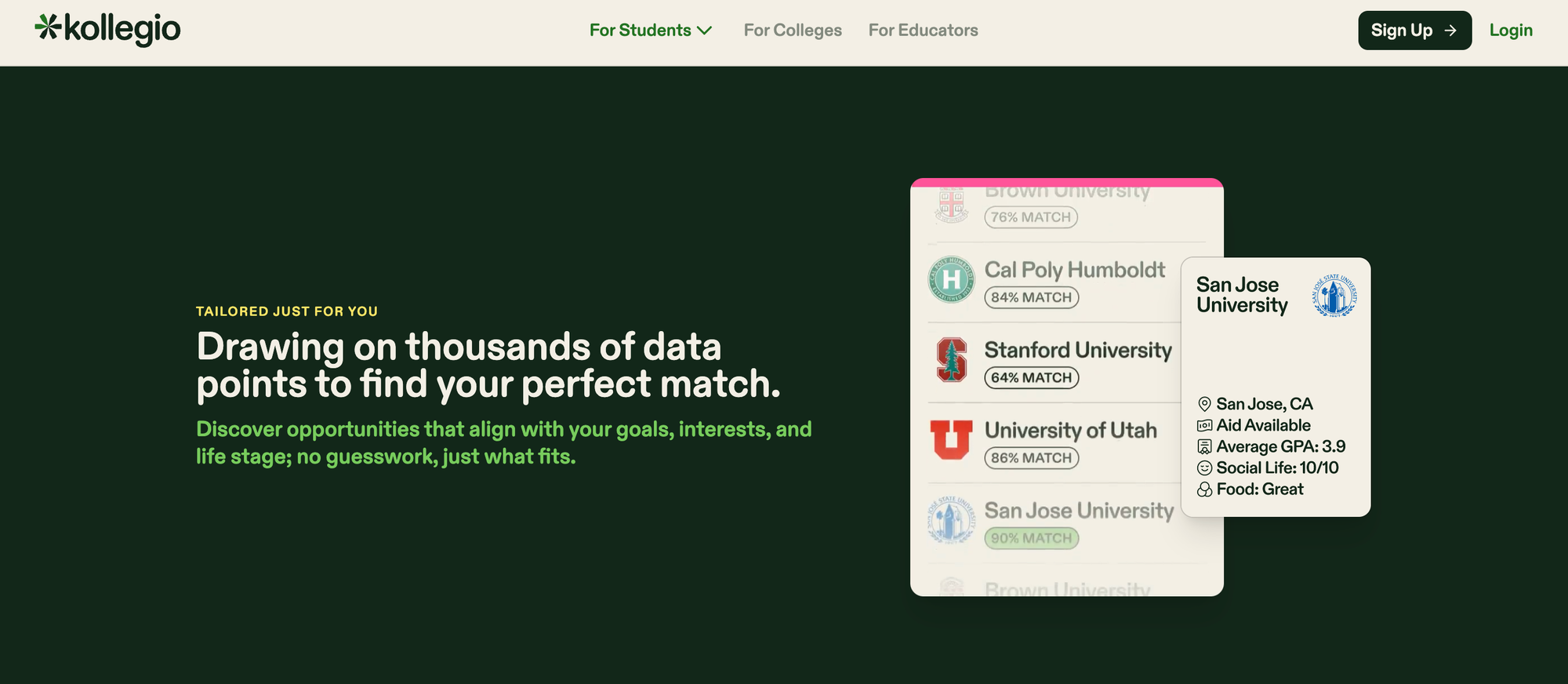
After weighing the benefits, challenges, and fit of a Business Administration degree, many students still face a difficult question: how do you translate general information into a decision that is right for you? Advice from family, teachers, or the internet often reflects broad trends rather than individual circumstances.
Kollegio is designed to bridge that gap by personalizing the decision process.
Trusted by more than 200,000 students, the free AI platform brings the entire college planning journey into one place. Instead of researching majors, schools, scholarships, and application strategies across dozens of disconnected websites, students receive guidance tailored to their academic background, interests, activities, and goals.
This personalization is especially valuable for a broad major like Business Administration, where outcomes vary widely depending on the school, program strengths, internships, and specialization options. Kollegio helps students evaluate not only whether the major aligns with their profile, but also where they are most likely to thrive within it.
Matching Your Profile to Real Programs
Business programs vary significantly in structure, industry connections, and depth of specialization. A finance concentration at one school might emphasize investment banking pipelines, while another focuses on corporate financial planning. Marketing programs vary between data analytics tracks and creative brand strategy paths.
Kollegio analyzes your academic performance, extracurricular involvement, geographic preferences, and career interests to identify programs where you're competitive and likely to find the resources you need. The platform doesn't just suggest schools. It explains why specific programs align with your circumstances and what opportunities each offers.
Students receive customized college matches that reflect their competitiveness and preferences, along with scholarship opportunities that fit their achievements and circumstances. This clarity helps you identify which business schools offer the specializations, internship networks, and career support that align with your goals, rather than applying blindly based on rankings.
Exploring Specializations Before Committing
Choosing between finance, marketing, operations, analytics, or management can feel high-stakes when you're unsure what each path entails day-to-day. Generic descriptions don't reveal whether you'll enjoy financial modeling more than consumer research, or whether supply chain optimization matches your problem-solving style better than human resources strategy.
Kollegio's AI functions like a high-end counselor available at any time. It supports brainstorming, planning, and decision-making, but does not write applications for you, ensuring that essays and materials still reflect your own voice. This balance helps students build stronger applications while maintaining integrity.
The platform helps you map how different concentrations connect to specific career trajectories, what technical skills each requires, and which internship opportunities become accessible through each path. You can explore tradeoffs between specializations without committing prematurely or waiting until choices narrow.
Building Your Experience Strategy Early
Internship planning determines outcomes as much as coursework selection. Students who start building relevant experience in their freshman year enter senior recruiting with portfolios that demonstrate their capabilities. Those who wait discover that competitive roles are filled months earlier.
Kollegio provides activity feedback that helps you evaluate which extracurriculars, leadership roles, and projects strengthen your profile for specific business concentrations. The platform identifies gaps in your experience and suggests concrete steps to address them, tailored to your timeline and constraints.
Essay guidance helps students present their experiences effectively without sacrificing authenticity. When you're explaining why you chose a particular internship or how a leadership role shaped your interest in entrepreneurship, the feedback ensures your narrative sounds genuine while highlighting the competencies employers value.
Reducing Uncertainty Through Organized Planning
Perhaps most importantly, the platform provides clarity. By organizing information into a coherent plan, Kollegio reduces the uncertainty that often surrounds major selection and college admissions. Students can see how different choices, including pursuing Business Administration, connect to real schools, opportunities, and outcomes.
You're not navigating this decision alone with fragmented advice from people who don't understand your specific situation. The AI analyzes patterns across hundreds of thousands of student profiles to show what paths students similar to you have successfully pursued, what obstacles they encountered, and what strategies helped them stand out.
This isn't about following a template. It's about understanding how your unique combination of strengths, interests, and constraints maps to realistic options within a major as broad as Business Administration.
But having the right tools matters only if you're willing to use them before decisions become irreversible.
Related Reading
- How To Prepare For College
- Is Marketing A Good Major
- Is Economics A Good Major
- Is Finance A Good Major
- Is Political Science A Good Major
- Is Business A Good Major
- Is Business Administration A Good Major
- Is Accounting A Good Major
Use Kollegio's AI College Counselor for Free Today!
If you want confidence that your major choice and college strategy truly fit your goals, use Kollegio for free today. Get personalized matches, relevant scholarships, and 24/7 guidance designed to help you move forward with clarity instead of guesswork.
The difference between students who thrive in Business Administration and those who struggle often comes down to planning that happens before senior year, not during it. Kollegio's AI college counselor helps you identify which specializations align with your strengths, which programs offer the resources you need, and which internships will build the experience employers actually evaluate.
You're not navigating this alone with fragmented advice from people who don't know your situation. You're getting tailored support that accounts for your circumstances and helps you build a path that makes sense for where you want to go.

Author
Senan KhawajaSenan Khawaja is the Co-Founder and CEO of Kollegio, an AI-native college counseling and institutional recruiting platform serving roughly 250,000 students across 190 countries. A Stanford graduate, repeat founder, and Forbes 30 Under 30 honoree with World Bank experience, Senan launched Kollegio to democratize elite college counseling—addressing the 400:1 student-to-counselor ratio in public schools. Under his leadership, Kollegio has secured 22+ institutional partners with a 100% renewal rate and backing from Reach Capital, JFF Ventures, and ECMC Group. He was also selected for OpenAI's inaugural ChatGPT Futures Class of 2026. Senan is based in New York City.