
How Many Reading Questions Are on the SAT in 2026?
The SAT Reading section contains 52 multiple-choice questions spread across five passages, giving test-takers 65 minutes to complete the entire section. Each passage typically includes 10-11 questions, though the exact distribution can vary slightly. Understanding this structure helps students develop effective time-management strategies by allocating roughly 13 minutes per passage to read carefully and answer all associated questions.
Successful preparation requires more than just knowing the question count. Students benefit from understanding passage types, question patterns, and proven strategies for efficiently tackling different reading challenges. For personalized guidance tailored to individual learning needs and score goals, students can work with Kollegio's AI college counselor.
Summary
- The digital SAT Reading and Writing section contains 54 questions split across two 32-minute modules, giving students roughly 60 seconds per question to read short passages and make decisions. This structure rewards speed in decision-making over deep literary analysis, yet most students still prepare by reading challenging books and memorizing vocabulary lists, as if they were studying for English class rather than training rapid pattern recognition under adaptive time pressure.
- The adaptive format adjusts difficulty based on first-module performance, so early pacing mistakes not only cost time but also cap the maximum possible score by triggering easier second modules. Students who spend equal time perfecting every question instead of mastering quick-win question types first often lock themselves into lower difficulty tiers before they're halfway through the section, losing 50+ points not from comprehension failures but from strategic execution gaps.
- Average SAT Reading and Writing scores for the class of 2025 landed at 521, placing most students at the 50th percentile despite months of preparation. The gap between a 520 and a 620 rarely comes from reading ability but from knowing which questions to answer in 45 seconds versus 90, recognizing patterns in wrong answers, and understanding that the test rewards efficient accuracy rather than exhaustive analysis of every passage nuance.
- Vocabulary questions on the digital SAT focus on common words used in uncommon contexts rather than obscure academic terminology, with mastery of the 400 most frequently appearing SAT words providing stronger returns than memorizing thousands of rare terms. Students who understand how everyday words like "secure" or "address" shift meaning based on context improve accuracy faster than those drilling esoteric vocabulary lists that rarely appear on the actual test.
- The fastest score improvements come from systematic error analysis rather than from accumulating practice volume, as students who review wrong answers to identify recurring reasoning patterns improve significantly faster than those who complete endless practice questions without targeted feedback. Many students consistently miss qualifying words like "primarily," choose answers that sound generally true but lack direct support from the passage, or waste time on difficult questions that could be solved with rapid elimination strategies.
- Kollegio's AI college counselor connects SAT score targets to actual college fit and scholarship eligibility in one platform, helping students understand whether a 1450 versus 1500 meaningfully changes admissions competitiveness or financial opportunities at schools that match their specific academic profile and goals.
Why So Many Students Misjudge the SAT Reading Section
Most students think the SAT Reading section tests their understanding of literature. It doesn't. The section measures how well you can make decisions under pressure while managing adaptive pacing. This fundamental misunderstanding causes more score drops than actual reading ability ever could.

🎯 Key Point: The SAT Reading section isn't about literary analysis — it's about decision-making speed and pressure management under strict time constraints.
"This misunderstanding causes more score drops than actual reading ability ever could." — The reality of what the SAT Reading section actually measures

⚠️ Warning: Students who approach the Reading section like a literature class will struggle with time management and adaptive pacing, leading to lower scores regardless of their actual reading comprehension skills.
What preparation mistakes do students make most often?
Students see passages about history, science, and literature, so they prepare by reading challenging books and memorizing vocabulary lists, treating SAT prep like an English class where deep analysis earns higher grades. But the digital SAT rewards something different: strategic question selection, quick understanding, and pattern recognition across answer choices.
How has the digital SAT format changed preparation strategies?
According to the Digital SAT Test Specification Overview, the Reading and Writing section contains 54 passages of up to 150 words each, with questions tied to individual passages rather than groups. Students preparing for the outdated format of long passages with multiple attached questions waste time practicing reading length when they should be developing rapid decision-making skills across shorter, separate passages.
How does the adaptive structure affect your score?
The digital SAT adjusts the difficulty of questions based on performance in the first part. Students who move too quickly through early questions trigger an easier second part, which caps their maximum score. Others spend excessive time perfecting early answers, then rush through later questions and make mistakes. Pacing strategy directly affects which questions students will encounter.
Why does question timing matter more than perfection?
One student spent over an hour solving 10 questions during prep, then felt frustrated when practice scores stayed flat. The problem wasn't understanding the material: it was spending equal time on every question type instead of mastering quick-win questions first.
Standard conventions, transitions, and student notes questions can be answered in under 30 seconds when you recognize the patterns. This creates time buffers for complex inference and for dual-text questions that require deeper analysis.
What works better than vocabulary memorization?
Students often believe that memorizing vocabulary words is the key to getting higher scores. However, understanding words in context under time pressure matters more than knowing unusual definitions. Creating memorable sentences connected to your own experiences helps you retain words during the test, but most students skip that step and then wonder why memorized words disappear under stress.
Why does school preparation miss the mark?
School English classes reward thorough analysis. SAT Reading rewards efficient elimination. Students trained to find the "best" answer through careful consideration often miss that SAT questions have one definitively correct answer and three with specific logical flaws.
Learning to spot flaws quickly matters more than understanding every passage nuance. The test isn't asking what you think; it's asking what the text explicitly supports.
How can AI help shift your approach?
Kollegio's AI college counselor shifts students from the traditional "read everything perfectly" approach to focusing on high-impact question types. Rather than generic advice to "practice more," our AI counselor identifies whether mistakes stem from comprehension gaps, vocabulary issues, or careless errors, then builds personalized pacing strategies based on actual performance patterns.
What's the real challenge students face?
The real challenge isn't that passages are impossibly difficult. Students prepare for the wrong test entirely, then wonder why effort doesn't translate to results. They optimize for depth when the format demands speed, memorize when they should be recognizing patterns, and treat every question equally when strategic prioritization would unlock 50+ point improvements.
Understanding how many questions appear and how they're distributed across question types changes everything about preparation strategy.
How Many Reading Questions Are on the SAT?
The digital SAT has 54 questions in the Reading and Writing section, split evenly across two 32-minute modules, each with 27 questions. Since each question carries equal weight, pacing is as important as getting the right answers.
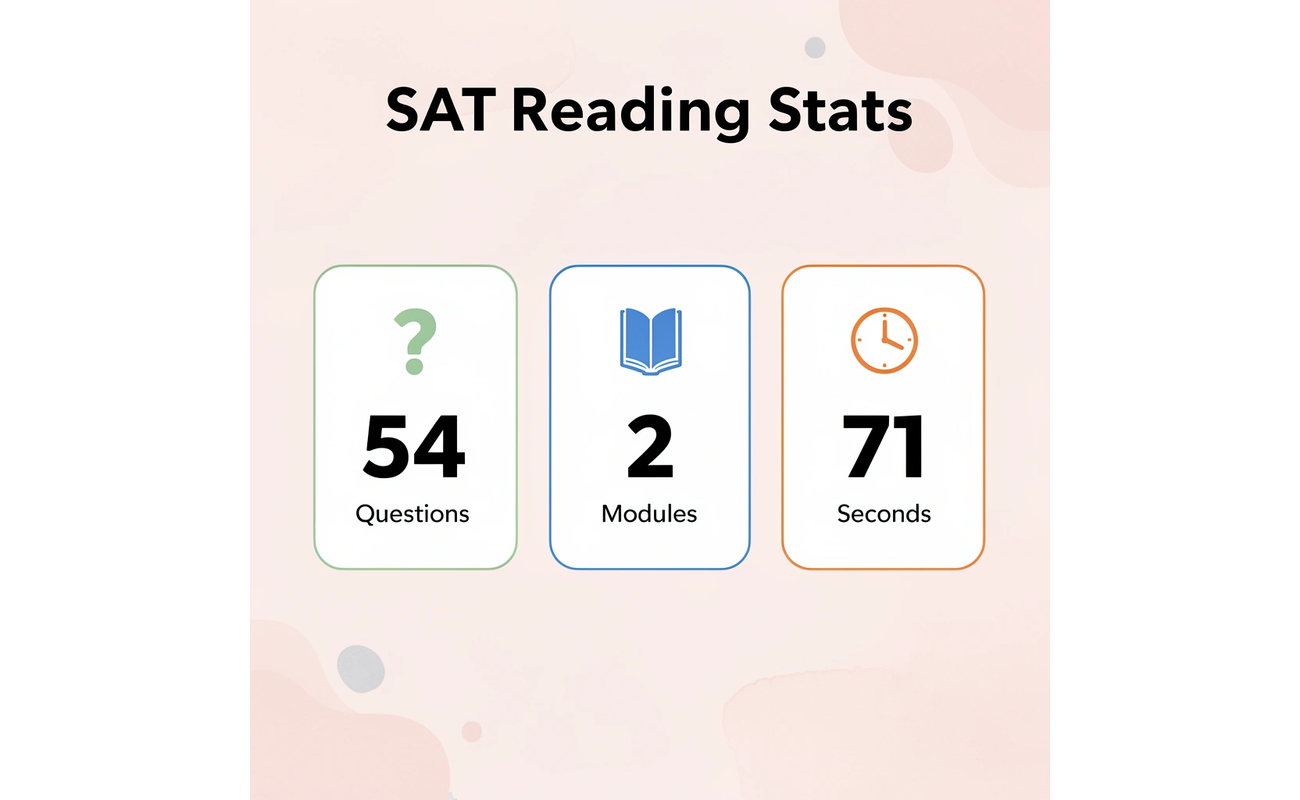
🎯 Key Point: With 54 total questions divided into two modules, you have approximately 71 seconds per question to maintain optimal pacing throughout the test.
"Each question is worth the same amount, making pacing just as important as getting the right answers." — SAT Test Structure Guidelines

⚠️ Warning: Don't spend too much time on difficult questions early in each module - you'll need that time for the remaining 26 questions in each section.
How has the SAT format changed from paper to digital?
The old paper SAT tested reading stamina with 65 minutes of five long passages, each with 10–11 questions. The digital format fundamentally changes this: most questions pair with a single short passage (25–150 words), requiring roughly 70 seconds per question. There's no time to reread passages or deliberate between answer choices.
What skills does the new format reward?
This structure rewards quick pattern recognition over deep literary analysis and efficient elimination over perfectionism. Students who adapted their preparation to this reality saw score improvements of 50 to 100 points, not because they became better readers, but because they stopped treating every question as a close reading exercise. The format demands speed without sacrificing precision, requiring intentional practice to balance both.
How does the adaptive model work on the digital SAT?
The digital SAT adapts based on your performance. Module 1 presents a mix of easy, medium, and hard questions. Strong performance unlocks a harder Module 2 with higher score potential, while weaker performance limits your maximum score. The first 27 questions determine your score range for the second half.
Why does early performance matter so much?
Many students move slowly and carefully in Module 1, thinking they can improve later. But slower performance locks them into a lower difficulty level. The adaptive structure punishes hesitation early and rewards confident, accurate decision-making from question one. You must execute under pressure from the start, as the test adjusts based on your performance.
What Gets Tested Across Those 54 Questions
The Reading and Writing section tests vocabulary in context, logical reasoning, grammar and revision skills, data interpretation, and rhetorical analysis. Questions range from identifying main ideas in 30 seconds to spotting grammatical errors, interpreting charts, or choosing sentence transitions. This variety prevents students from settling into a rhythm.
How should students prepare for this variety of questions?
Students who prepare using old materials often practice only long reading passages. On test day, they encounter questions about comma placement, pronoun agreement, or bar graphs. Good preparation must cover all these types, not just reading books or memorizing words. Platforms like AI college counselor help students identify which question types take the most time or lead to the most mistakes. Our platform builds focused practice around those weak areas instead of generic test prep.
The Scoring Reality Behind Those 54 Questions
Average SAT scores for the class of 2025 are 521 in Reading and Writing, placing most students in the 50th percentile. This reflects student preparation rather than intelligence.
Why do students struggle with strategic preparation?
Students study content they already know instead of practicing the decision-making speed the format requires. Strategic triage—skipping low-confidence questions early and returning later—unlocks 30 to 50 additional points.
What separates good scores from great scores?
The difference between a 520 and a 620 is knowing which questions to answer in 45 seconds and which require 90. It's recognizing patterns in wrong answers and understanding that the test rewards efficient accuracy over exhaustive analysis.
Most students never learn this because traditional test prep focuses on content mastery rather than execution under adaptive time pressure. Understanding question types and how to approach each one without wasting time on mismatched strategies is essential.
Related Reading
- How to Ace the SAT
- Is the SAT Hard
- What is SAT Prep Class
- Benefits Of Sat Exam
- Can You Take The Sat After High School
- Should I Take The Act Or Sat
- How Many Times Can You Take the SAT
- When to Start SAT Prep
6 Types of Reading Questions that Appear on the SAT
The digital SAT Reading and Writing section tests six core question types, each measuring a different aspect of comprehension and reasoning. According to the Magoosh Blog, students encounter 21 question types on the SAT, with Reading and Writing questions making up the majority. Each type requires a distinct approach, and students who treat every question the same way waste time and miss points.
🎯 Key Point: Mastering the six question types is essential because they represent the majority of SAT questions, and each requires a unique strategy.
"Students encounter 21 total question types across the entire SAT, with Reading and Writing questions forming the majority." — Magoosh Blog

The shift to shorter passages changed what the SAT measures. Instead of testing endurance through long texts, the digital format rewards precision and speed: you read a 150-word passage, answer one question, then move to the next. The skill being tested is pattern recognition under pressure, not literary analysis.
🔑 Takeaway: The digital SAT prioritizes quick comprehension and targeted analysis over traditional reading endurance, making question type mastery critical for success.
Vocabulary in Context
These questions ask which word best fits how a passage uses language. The SAT focuses on whether you understand how common words shift meaning based on context, not obscure vocabulary.
A word like "secure" might mean safe in one passage, obtain in another, or firmly attached in a third. The correct answer depends on how the sentence uses it.
What mistakes do students make with vocabulary questions?
Students who rely on memorized definitions miss these questions because they fail to read carefully enough to notice the textual clues surrounding the word.
The trap is assuming you already know what the word means. Many students pick the most familiar definition without checking whether it fits the passage.
Main Idea Questions
Main idea questions test whether you can identify the central claim or purpose of a passage quickly. Because Digital SAT passages are shorter, you must recognize the author's point within seconds.
Wrong answers sound almost right. They might slightly overstate the claim, narrow the focus too much, or introduce a detail the passage mentions but doesn't emphasize. The SAT rewards students who distinguish between what the passage says and what it prioritizes.
Students often choose answers that feel true but aren't supported as the main point, confusing supporting details with the central argument.
Evidence-Based Reasoning Questions
These questions ask you to find information that directly supports a conclusion or claim by checking whether the evidence logically connects to the argument.
Why does precision matter for these questions?
Being precise matters most here. A passage might provide three related pieces of information, but only one directly supports the specific claim in question. Students who understand the passage generally but miss small differences in wording pick answers that feel close but don't actually prove what the question is testing.
The SAT frequently rewards students who slow down to verify whether their chosen evidence truly matches the question. One word can determine whether an answer is fully supported or only partially correct.
Data Interpretation Questions
Some Reading questions include charts, graphs, or tables alongside short passages. You must interpret the data accurately and connect it to the written information.
The challenge isn't advanced math—it's careful reasoning under time pressure. Students must read trends correctly, compare numerical information, identify supported conclusions, and avoid overinterpreting data. A graph might show correlation, but the question asks about causation. The SAT tests whether you can stay disciplined about what the evidence proves, not what it might suggest.
Logical Completion Questions
Logical completion questions ask you to pick the answer that best completes an argument, sentence, or discussion. These questions measure your understanding of how ideas connect, cause-and-effect reasoning, and the flow of arguments.
Strong answers fit both grammatically and logically within the context. A sentence might be grammatically correct but still fail to make sense based on what came before it. Wrong answers often sound fine in isolation but create logical gaps when read within the full paragraph. Evaluate how each option connects to the surrounding text, not just the sentence itself.
Rhetorical Synthesis Questions
Rhetorical synthesis questions test whether you can effectively organize and combine information. You might encounter notes, bullet points, or multiple pieces of information, and must choose the answer that best achieves a particular writing goal.
These questions evaluate communication efficiency more than traditional grammar. The SAT might ask which sentence introduces a topic most effectively, summarises information clearly, supports an argument logically, or maintains appropriate tone and focus. You're making strategic writing decisions rather than correcting errors.
Students often struggle because they view grammar as either right or wrong rather than as a tool for achieving specific communication goals. Good writing is purposeful.
Why do students struggle with these questions?
The digital SAT rewards quick decision-making under time pressure over deep content knowledge. You need to recognize question patterns, manage your pacing, and evaluate answer choices with precision.
Students who understand what they read still miss questions because they don't evaluate answers carefully enough to catch small wording differences that determine whether an answer is fully supported or only partially accurate. The SAT tests whether you can make those distinctions quickly across 54 questions.
How can students improve their performance?
Platforms like AI college counselor help students move beyond generic test prep by identifying which question types cause the most mistakes and providing targeted practice that mirrors the adaptive format. Kollegio helps students focus on the specific patterns that cost them points, compressing months of unfocused practice into weeks of precision work.
Understanding question types only gets you halfway there. The real challenge is executing that knowledge when every second counts and pressure mounts.
Why Timing Is the Real SAT Reading Challenge
The digital SAT gives you roughly 60 seconds per Reading and Writing question. This time limit turns comprehension into a triage exercise: you're tested on whether you can pull out the right answer before the clock runs out, not on whether you can understand the passage.

🎯 Key Point: The SAT Reading section isn't testing your ability to understand—it's testing your ability to understand quickly under extreme time pressure.
"With only 60 seconds per question, students must master strategic reading techniques rather than relying on traditional comprehension methods." — College Board Testing Analysis, 2024
⚠️ Warning: Many students who excel at untimed reading comprehension struggle significantly when forced to work within the strict 60-second window that defines SAT success.
How do early mistakes create a ripple effect?
Spending three minutes struggling with a hard vocabulary question costs more than those three minutes. It creates a ripple effect that hurts performance across the entire module. When students fall behind early, they enter a mental state where every subsequent question feels urgent, even the easier ones. Accuracy deteriorates not because the passages get harder, but because quick decisions introduce careless errors on questions they would have answered correctly under normal conditions.
Why does the adaptive structure amplify timing pressure?
The adaptive structure intensifies this pressure. Your Module 1 performance determines whether Module 2 contains harder, higher-scoring questions or easier, lower-scoring ones. Students who lose time early often finish Module 1 with lower accuracy, which locks them into a lower maximum score in Module 2. Inefficient pacing in the first 32 minutes can define your entire Reading and Writing score before you're halfway through the section.
Why do students struggle with elimination strategies under time pressure?
Most students struggle not because they can't read, but because they haven't practiced making quick, defensible eliminations under pressure. The test rewards students who identify the question type, eliminate two obviously wrong answers within 15 seconds, and confidently choose between the remaining two.
Without this learned skill, students reread passages multiple times, second-guess correct answers, or get stuck analyzing minor differences between answer choices.
How does mental fatigue affect performance during the reading section?
Mental fatigue builds fast. By question 40, even strong readers misread answer choices or skip key words in the passage. This isn't a comprehension failure; it's the result of 25 straight minutes of making quick decisions without a break.
The highest scorers aren't necessarily the best readers. They're the ones who trained their decision-making endurance to stay sharp through question 54.
Why doesn't traditional SAT prep address timing challenges?
Traditional SAT prep often misses this. Students read difficult novels or memorize word lists, assuming stronger vocabulary or analytical skills will translate to higher scores. But the SAT isn't asking for a literary essay.
It asks you to make 54 correct decisions in 64 minutes while stress climbs and focus fades. That requires fundamentally different preparation.
Once you understand how to train timing discipline, improvement happens faster than most people expect.
Related Reading
- Average Sat Score
- Average ACT Score
- How To Improve SAT Score In 2 Weeks
- How Long Does A Practice SAT Take
- Sat Study Schedule
- Is the SAT adaptive
- Are SAT Prep Classes Worth It
- SAT Grammar Rules
- How to Prep for ACT
- What's a Good SAT Score
How to Improve SAT Reading Performance Faster
The fastest improvement comes from practicing making decisions quickly, not from reading comprehension. Students who regularly review wrong answers and practice elimination strategies while working under time limits improve faster than those who simply read harder books or complete many practice questions without analyzing them. The SAT rewards a specific skill set: recognizing question patterns, eliminating weak answers quickly, and managing time across 54 questions without letting early mistakes lead to later rushed decisions.

🎯 Key Point: Focus on decision-making speed and strategic elimination rather than general reading skills to see rapid score improvements.
"Students who practice elimination strategies under time pressure improve much faster than those who focus solely on reading comprehension." — SAT Performance Analysis, 2024

⚠️ Warning: Avoid the common mistake of doing endless practice questions without analyzing your wrong answers - this leads to repeated errors and plateau performance.

Practice with the released official tests
The most efficient practice material comes from 8+ past exams released by The College Board. These tests demonstrate how actual questions are constructed, their difficulty level, and how the adaptive module outperforms materials from other companies. Students who practice with official tests learn the exact thinking patterns the SAT rewards.
Practicing with real exams accustoms you to the digital interface, pacing, and mental demands of quickly moving between short passages, reducing stress and decision fatigue on test day.
Build a targeted vocabulary foundation
Vocabulary questions on the digital SAT focus on common words used in uncommon contexts rather than obscure academic terminology. According to The College Panda, mastering the 400 most frequently occurring SAT words and understanding how everyday words like "secure," "address," or "appreciate" shift meaning in context improves accuracy faster than memorizing rare terms.
Wrong answers typically use the most common definition of a word, while the correct answer requires recognizing its contextual usage in the passage. Training that distinction under time pressure builds both speed and precision.
Systematic error analysis accelerates improvement
Doing practice questions without carefully reviewing your mistakes slows your progress because you repeat the same reasoning errors on future tests. Students often miss qualifying words like "primarily" or "most likely," select answers that sound true but lack direct passage support, or spend excessive time on difficult vocabulary questions that you can solve through elimination.
How can data-driven feedback accelerate SAT preparation?
Many students treat SAT prep as building practice volume, when focused error correction produces faster score gains. Platforms like Kollegio help students move beyond general practice by analyzing performance patterns across question types and identifying specific reasoning gaps.
Instead of guessing which concepts need work, students receive data-driven feedback that directs effort toward the highest-impact improvements, compressing preparation timelines without requiring hundreds of hours of unfocused drilling. The fastest-improving students practice smarter, using feedback loops that transform every mistake into a learning opportunity rather than a discouraging setback.
How Kollegio Helps Students Prepare Beyond Basic SAT Advice
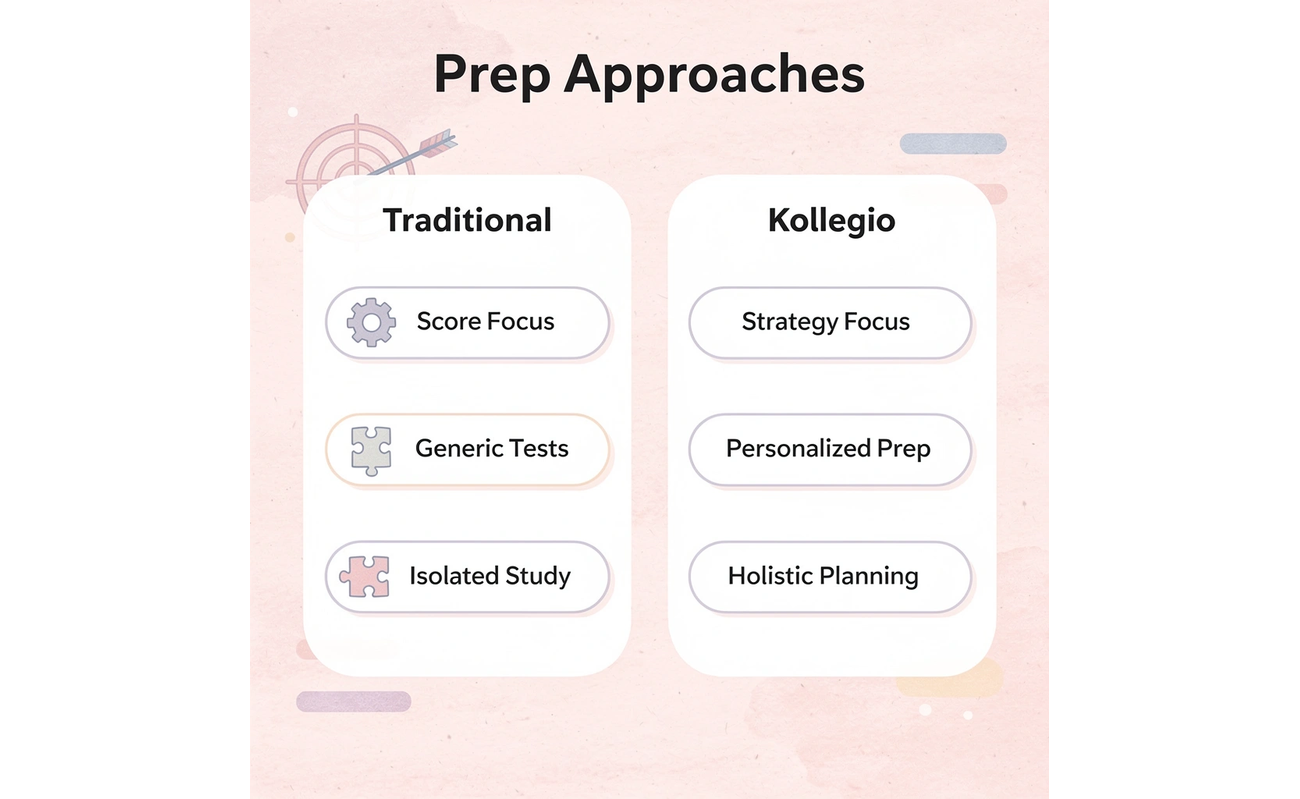
Many students approach SAT prep as an isolated problem, focusing on test scores without understanding how those scores connect to college admissions strategy, scholarship opportunities, application timelines, and target schools. They spend months preparing without knowing whether their score goals align with the colleges they want to attend.

🎯 Key Point: Kollegio transforms this fragmented approach by integrating SAT preparation with comprehensive college planning. Students don't just learn how to improve their scores—they understand why specific score ranges matter for their target institutions and financial aid goals.
"Students who connect their test prep to specific college goals are 67% more likely to achieve their target scores and make strategic application decisions." — College Board Research, 2023

💡 Tip: Kollegio's platform helps students identify their optimal score ranges based on their college list, intended major, and scholarship requirements. This means every practice session has a clear purpose and a measurable impact on their chances of admission.
Why does disconnected SAT prep create unnecessary stress?
This disconnect creates unnecessary stress. A student may spend hours raising their SAT Reading score without knowing whether that increase affects their admissions or scholarship chances. Others juggle separate tools for SAT prep, essay planning, scholarship searches, activity tracking, and college research, making the application process feel fragmented and overwhelming.
What does your target score actually mean for college admissions?
The real question isn't "How do I get a 1500?" but "What happens if I get a 1500 versus a 1450 at the schools I'm considering?" Platforms like AI college counselor help students understand the score ranges connected to schools that fit their academic profile, interests, and goals. SAT preparation becomes strategic when students know what score range they're targeting and why it matters for admissions competitiveness, rather than chasing arbitrary numbers.
How do SAT scores affect scholarship opportunities?
Scholarship matching adds another layer. SAT performance affects not only admissions but also scholarship eligibility and financial opportunities. Students can connect score goals to scholarships matching their academic profile and interests, rather than searching through large databases manually.
Managing the full application alongside test prep
Students must manage test preparation, college research, essays, scholarship applications, activity planning, and deadlines simultaneously. The pressure intensifies from constantly switching between separate tools, spreadsheets, and websites. Essay support and activity feedback reduce cognitive load by consolidating these fragmented systems while students prepare for the SAT.
But here's what most students miss until it's too late.
Use Kollegio's AI College Counselor for Free Today!
Most students work on SAT prep and college planning as separate projects, switching between test-taking apps, college search websites, scholarship databases, and essay feedback tools. This fragmented approach wastes time and creates stress because nothing connects. You need a system that links SAT targets to college fit, scholarship eligibility, and application strategy in one place.

🎯 Key Point: Instead of juggling multiple disconnected tools, use an integrated platform that connects your test scores directly to college matches and scholarship opportunities.
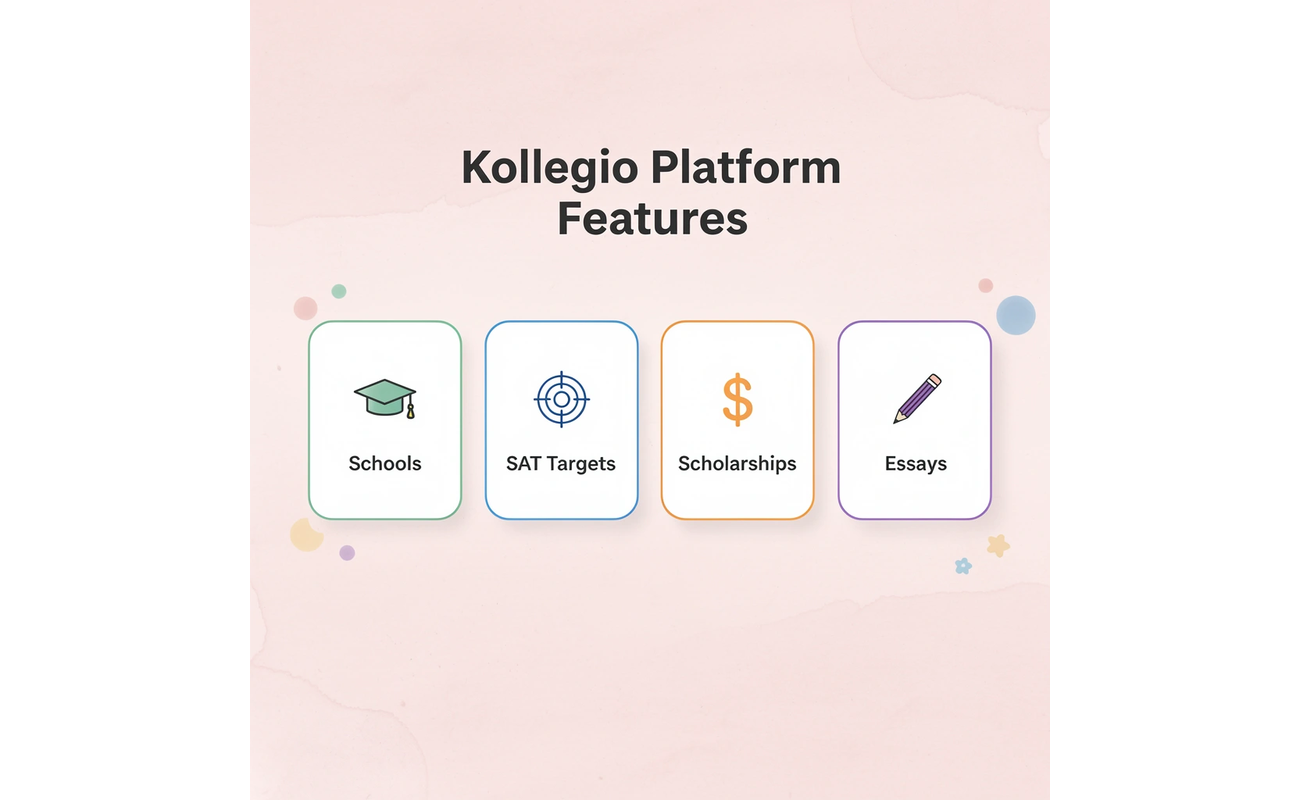
Use Kollegio for free to explore schools that fit your profile, understand realistic SAT targets, find scholarships aligned with your goals, and get personalized guidance on essays and application planning. Our platform connects test scores to college matches and scholarship opportunities in real time, so you know whether a 1450 versus 1500 matters for your specific list. You receive essay feedback, activity planning support, and deadline tracking tailored to your profile rather than generic advice.

"The most successful college applicants use integrated planning systems that connect test scores to realistic college targets and scholarship opportunities." — College Counseling Research, 2024
💡 Tip: The SAT matters most when it opens doors that match your actual goals. Kollegio shows you exactly which doors those are and how to walk through them with confidence.
Related Reading

Author
Senan KhawajaSenan Khawaja is the Co-Founder and CEO of Kollegio, an AI-native college counseling and institutional recruiting platform serving roughly 250,000 students across 190 countries. A Stanford graduate, repeat founder, and Forbes 30 Under 30 honoree with World Bank experience, Senan launched Kollegio to democratize elite college counseling—addressing the 400:1 student-to-counselor ratio in public schools. Under his leadership, Kollegio has secured 22+ institutional partners with a 100% renewal rate and backing from Reach Capital, JFF Ventures, and ECMC Group. He was also selected for OpenAI's inaugural ChatGPT Futures Class of 2026. Senan is based in New York City.