You're staring at your laptop screen, cursor blinking in the activities section of your Common App, and suddenly, you're questioning every club you've joined since freshman year. The Common App is your gateway to hundreds of colleges, but it's also where you'll declare potential college majors, craft your personal statement, list your extracurriculars, and somehow distill four years of high school into a handful of text boxes. This article outlines how to navigate each section of the application without second-guessing every word or losing sleep over which college majors to select.
Stop wondering.
Start matching.


Kollegio's AI college counselor offers support tailored to your specific situation, whether you're undecided about a major, polishing your activity descriptions, or determining which colleges align with your academic goals.
Summary
- The Common Application centralizes college admissions by allowing students to submit a single standardized form to more than 1,000 institutions, rather than submitting separate applications to each school. According to Common Application data, more than 2 million students use the platform annually.
- The platform divides applications into eight sections (Profile, Family, Education, Testing, Activities, Writing, Courses & Grades, and a Colleges tab), but students often misunderstand that equal space doesn't mean equal importance. The Profile and Family sections take 20 minutes to complete, while the Activities and Writing sections can take weeks.
- Test-optional policies continue to reshape how students approach standardized testing. Common App data from February 2025 show that approximately 1.2 million applicants submitted test scores in the last cycle, though policies vary widely across institutions.
- The Activities section provides 10 slots and 150 characters per description, but the format requires prioritization that most students struggle with. Admissions officers want to see depth and commitment in a few areas, not surface-level participation across a dozen activities.
- Essays remain one of the few places where every student has an equal opportunity to stand out, yet 44% of applicants submit generic drafts according to EdWeek data from 2025. Students avoid vulnerability and choose topics they think sound impressive rather than stories that actually matter to them.
- Scholarship applications follow separate timelines outside the Common App, with deadlines that don't align with the college admissions cycle. Students who treat scholarship searches as an afterthought miss opportunities that could reduce their financial burden.
Kollegio's AI college counselor addresses this gap by reviewing activity descriptions, essay drafts, and supplemental responses before students submit, pointing out where narratives lose focus or where stronger examples would clarify their points.
What the Common App Is and Why So Many Colleges Use It
The Common App is a single online platform that lets you apply to hundreds of colleges using one standardized form. Instead of creating separate applications for each school, you complete your personal information, academic history, activities, and essays once, then submit them to multiple institutions.
According to the Common Application, more than 2 million students annually use the platform to apply to colleges and universities in the United States and internationally.
Reducing Institutional Friction
Colleges adopted this system because the old model created unnecessary friction for everyone involved. Before the Common App, students spent weeks duplicating the same information across different applications, often making small errors that varied from one submission to the next. Admissions offices, meanwhile, received applications in dozens of different formats, making it harder to compare candidates fairly.
The Common App standardized the core components, allowing colleges to focus on evaluating students rather than deciphering inconsistent paperwork.
The Structure Simplifies What Used to Be Chaos
When students describe feeling lost navigating the Common App, they're often reacting to the structure itself. The platform divides your application into clearly labeled sections:
- Profile
- Family
- Education
- Testing
- Activities
- Writing
- Courses & Grades
Each section requires specific details, and the system won't allow you to submit until all required fields are complete.
Navigating Application Constraints
Rigidity feels restrictive at first, especially if your academic background doesn't fit neatly into predetermined categories. International students, for example, sometimes struggle when their grading systems don't match the dropdown options, or when they've taken more courses than the platform's 15-subject limit allows.
Standardizing Non-Traditional Paths
The truth is, the Common App wasn't designed to accommodate every possible educational path perfectly. It was built to establish a baseline that works for most students while providing colleges with enough context to understand your profile. If your transcript doesn't translate cleanly into the required format, admissions officers will notice. They regularly review:
- International records
- Homeschool curricula
- Non-traditional grading systems
The Common App collects what it can in a standardized way, and your school counselor or transcript fills in the rest.
Why Do So Many Colleges Use It
The platform solves a logistics problem at scale. Before centralized applications, colleges managed their own systems, which meant maintaining separate technology, training staff on different workflows, and troubleshooting unique technical issues. Smaller schools, in particular, struggled with the cost and complexity.
The Common App shifted that burden to a shared infrastructure, allowing colleges to focus their resources on reviewing applications rather than on building and maintaining their own portals.
Efficiency Through Centralization
For students, the advantage is obvious. You manage:
- One profile
- One essay
- One activity list
- One set of recommenders
Foundation for Institutional Nuance
When you add a new school, most of your work is already done. Some colleges require supplemental essays or additional materials, but the foundation stays consistent. This doesn't mean every application looks identical. Colleges still review your materials individually and weigh different factors based on their priorities.
The Common App simply removes the repetitive data entry that used to consume hours of time without adding any real value to your candidacy.
What Students Misunderstand About "One Application, Many Colleges"
The phrase makes it sound effortless, but the Common App is a tool, not a shortcut. You still need to research each school's requirements, write thoughtful supplemental essays, and tailor your approach to different institutional priorities. The platform organizes your materials in one place, but it doesn't make strategic decisions for you.
Institutional Priority Variance
Students sometimes assume that because they use the same core application, colleges will view their profiles the same way. That's not how it works. A liberal arts college might prioritize your essay and extracurricular depth, while a research university focuses more on test scores and academic rigor.
The Common App presents the same information to everyone, but each school interprets it through its own lens.
Synthesizing Your Narrative Arc
This is where many students feel stuck. They know their interests span multiple areas, but the Common App's structured format makes it hard to communicate a cohesive narrative when your activities list includes robotics, debate, and volunteer work that don't obviously connect. The application doesn't guide you through the storytelling process. It collects data points and expects you to make sense of them through your essays and activity descriptions.
If you're not sure how to frame your profile, the platform won't tell you. It just asks you to fill in the boxes.
Optimizing Your Competitive Edge
Platforms like Kollegio's AI college counselor help students translate their experiences into the Common App's framework without losing the nuance that makes their profile distinct. Instead of guessing whether your activities section communicates focus or looks scattered, you get feedback on how admissions officers might interpret what you've written.
The AI reviews your essays and activity descriptions, suggesting ways to clarify your narrative so the standardized format works for you instead of against you.
The Common App Doesn't Replace Judgment
Students often treat the platform like a form to complete rather than a story to tell. They list activities chronologically, write generic descriptions, and assume the admissions office will connect the dots. But the Common App is only as effective as the thought you put into it.
The Power of Strategic Emphasis
Two students with identical credentials can submit wildly different applications depending on how they describe their experiences and what they choose to emphasize. The structure is neutral. It doesn't favor one type of student over another, but it also doesn't compensate for vague or unfocused writing.
Reflection as a Competitive Asset
This is why starting early matters, not because the Common App is complicated, but because good applications require reflection. You need time to figure out which activities actually shaped your interests, which essays reveal something meaningful about who you are, and how to present your academic history in a way that makes sense to someone who's never met you. The Common App gives you the framework. You provide the substance.
Related Reading
- College Majors
- Early Action Vs Early Decision
- First Generation College Student
- Weighted Vs Unweighted Gpa
- What Should I Major In
- How Many Colleges Should I Apply To
- Passion Project Ideas
How the Common App Is Structured (What Students See Inside)
Profile
This section collects your legal name, contact information, citizenship status, and demographic details. It's administrative. Fill it out accurately, double-check for typos, and move on. Colleges use this information to process your application and contact you if any information is missing. It doesn't tell them anything about who you are as a student or person.
Navigating Demographic Disclosures
One area where students sometimes hesitate is the demographic questions about race, ethnicity, and family background. These are optional, and your decision to answer or skip them won't hurt your chances. Some students worry that providing this information will trigger bias. Others wonder if leaving it blank sends a signal.
The truth is simpler: admissions offices use demographic data to understand their applicant pool and track institutional diversity goals. Individual reviewers focus on your:
- Academic record
- Essays
- Activities
Answer what feels comfortable, skip what doesn't.
Family
The Family section asks about your parents' education levels, occupations, and whether you have siblings in college. Like the Profile section, this is contextual background, not evaluative material. Admissions officers want to understand your family circumstances because they affect how they interpret the rest of your application.
If you're a first-generation college student, this section makes that clear. If your parents both have graduate degrees, that context matters too. Neither scenario helps nor hurts you directly. It just gives colleges a fuller picture of the resources and support systems you've had access to.
Contextualizing Achievement and Opportunity
Students sometimes feel self-conscious about their parents' education or employment, especially if it doesn't match the profile they imagine colleges prefer. That instinct misunderstands how admissions works. Colleges aren't looking for a specific family background. They're trying to evaluate what you've done with the opportunities available to you.
Education
This is where you enter your high school information, graduation date, and any college coursework you've completed while still in high school. You'll also report your GPA if your school calculates one, though the Common App doesn't verify this number. Your official transcript does that.
The Education section can feel tricky for students whose academic paths don't fit neatly into standard categories. Homeschooled students, international applicants, and anyone who switched schools mid-year often run into formatting issues.
Navigating Systemic Discrepancies
The platform tries to accommodate different systems, but it's built around a U.S. high school model. If your situation doesn't translate cleanly, use the additional information section to explain. Admissions officers review thousands of non-traditional transcripts every year. They know the Common App has limits.
Testing
The Testing section is where you self-report SAT, ACT, AP, IB, and other standardized test scores. According to Common Application data from February 2025, approximately 1.2 million students submitted applications in the last cycle, and test-optional policies continue to influence how applicants approach testing.
Strategic Score Reporting
You control what you report here. If a college is test-optional and your scores don't strengthen your application, leave them out. If you took the SAT three times and only want to submit your highest score, you can do that (unless the college requires all scores, which some still do). The confusion comes from the fact that test policies vary widely across schools.
Navigating Institutional Testing Variances
Some colleges don't consider scores at all. Others require them. Many fall somewhere in between, using scores when submitted but not penalizing students who don't provide them. The Common App doesn't enforce these policies. It collects the information and allows each college to decide how to use it.
Activities
The Activities section gives you ten slots to describe what you've done outside the classroom. Each entry includes:
- A character-limited description
- Hours per week
- Weeks per year
- Your role or title
This is one of the most important parts of your application, and it's also one of the hardest to get right.
Prioritizing Depth Over Breadth
Students struggle here because the format forces prioritization. You can't list everything you've ever done, and even if you could, that wouldn't help. Admissions officers want to see depth, not breadth. They're looking for commitment, leadership, and impact in a few areas, not surface-level participation in a dozen activities.
Engineering High-Impact Descriptions
The challenge is figuring out which experiences matter most and how to describe them in 150 characters or fewer. This is where vague descriptions like "volunteered at local hospital" or "member of debate team" fail. Those phrases don't communicate what you actually did or why it mattered. Stronger descriptions:
- Specify your role
- Quantify your contributions
- Highlight the skills you developed
"Coordinated volunteer schedules for 40+ students, ensuring 24/7 coverage in the pediatric wing" tells a clearer story than "hospital volunteer." The Activities section isn't a resume. It's a narrative about how you spend your time and what that reveals about your priorities.
Maximizing Impact Within Constraints
Many students find that tools like Kollegio's AI college counselor help translate their experiences into the Common App's constrained format without losing the substance. Instead of guessing whether your activity descriptions sound impressive or generic, you get feedback on how admissions officers might interpret what you've written. The AI reviews your entries and suggests ways to make your role and impact clearer, so the limited space works in your favor rather than against you.
Writing
The Writing section includes your main personal essay, which you'll share with most colleges, and any supplemental essays required by individual schools. The personal essay has a 650-word limit and seven prompt options, though the prompts are broad enough that most students can write about whatever they want.
Scaling Supplemental Demands
This section expands or collapses depending on how many colleges you're applying to and what they require. Some schools request a single short supplement. Others ask for five. A student applying to ten colleges might write anywhere from two to twenty essays, depending on which schools they choose. The personal essay stays the same across all of them, but everything else is school-specific.
The Vulnerability Factor in Essays
The mistake students make here is treating the personal essay like an English class assignment. They write about a topic they think sounds impressive, use formal language that doesn't sound like them, and avoid anything that feels too personal or vulnerable. The result is an essay that could have been written by anyone.
Admissions officers read thousands of these. The essays that stand out are the ones that sound like a real person talking about something that actually matters to them. That's harder to write than it sounds, which is why this section takes time.
Courses and Grades
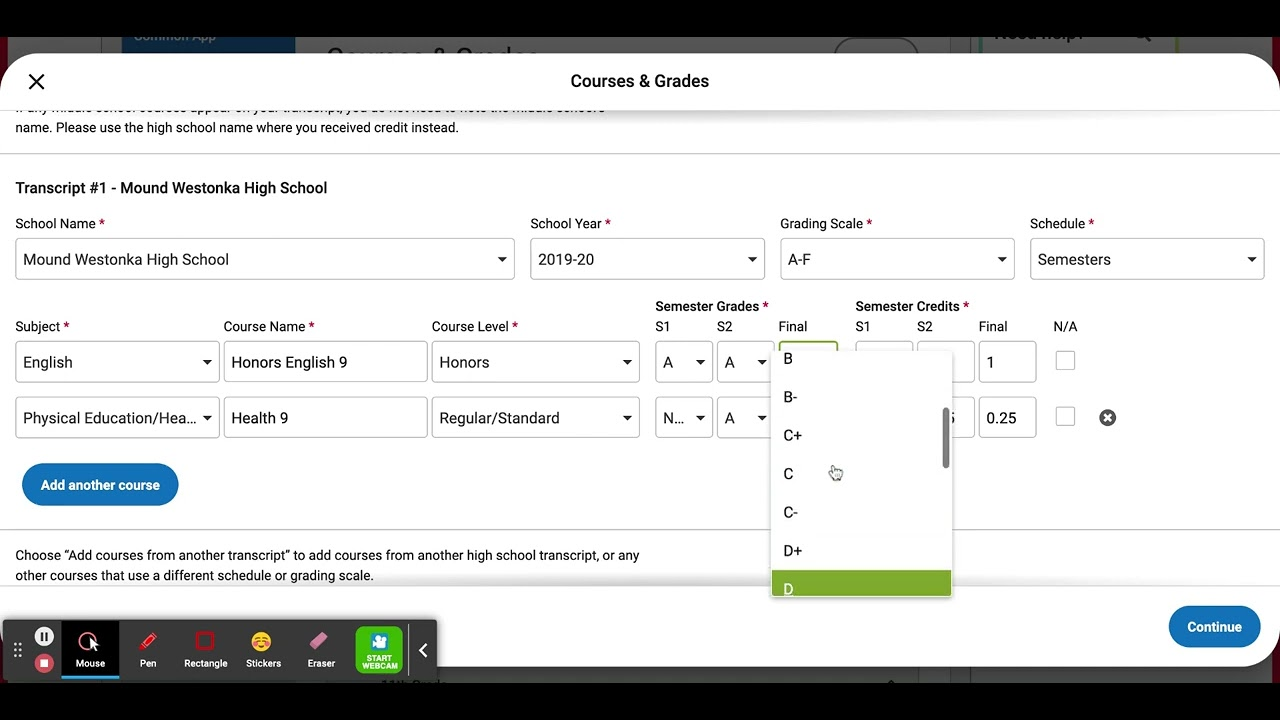
This section asks you to list the courses you've taken each year of high school, along with the grades you earned. It's tedious, and for students with complicated transcripts, it can be confusing. The good news is that your official transcript will verify everything you enter here, so minor discrepancies won't derail your application.
Evaluating Academic Momentum
The purpose of this section is to give admissions officers a quick view of your academic trajectory without waiting for your counselor to upload your transcript. They want to see whether you challenged yourself with rigorous courses, how your grades trended over time, and whether your performance aligns with the story you're telling in the rest of your application.
If your grades dropped in junior year, they'll notice. If you took six AP classes senior year after taking none before, they'll notice that too. This section doesn't exist in isolation. It's part of the larger picture.
Colleges Tab
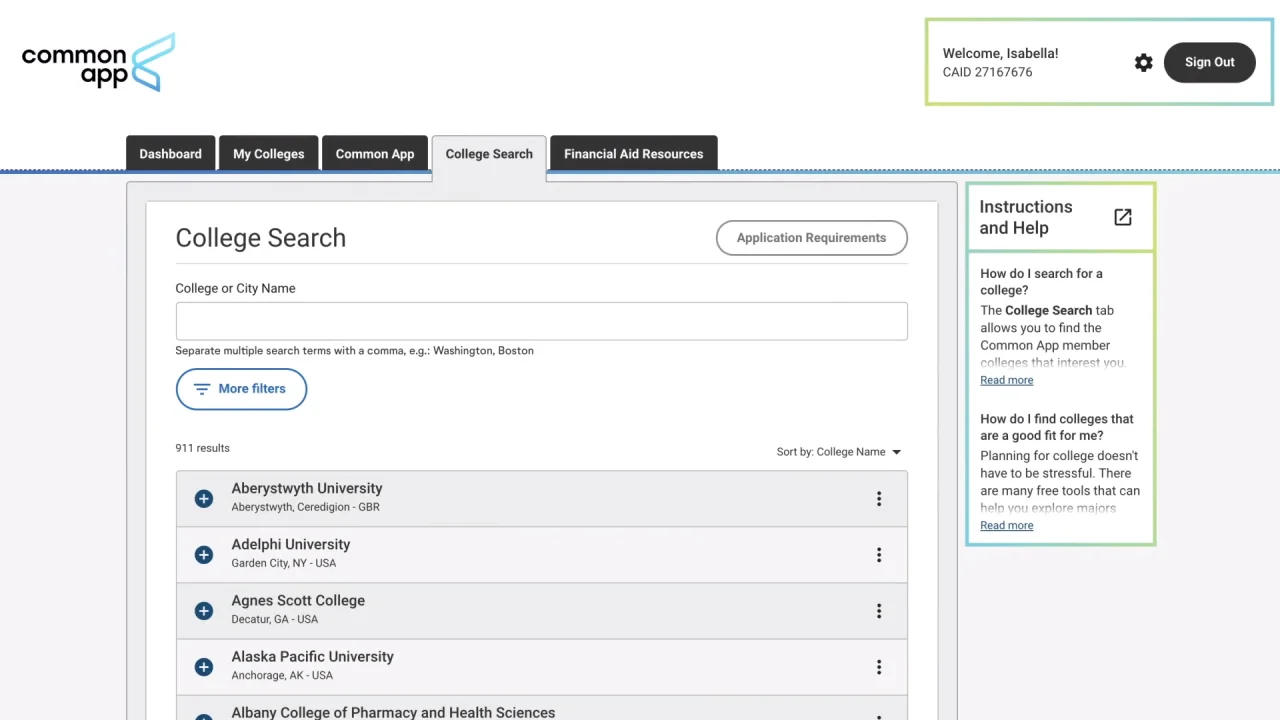
The Colleges tab is where you add schools to your list, track deadlines, and submit applications. This is also where you'll see which materials each college requires beyond the standard Common App sections. Some schools ask for additional essays, portfolios, interviews, or demonstrated interest tracking. Others accept the basic application as-is.
This tab makes it clear that "one application, many colleges" doesn't mean every application looks the same. The core sections stay consistent, but the requirements layer on top of that foundation. Students sometimes don't realize how much school-specific work they're committing to until they start adding colleges to their list and see the supplemental requirements pile up.
Planning matters here. If you're applying to twelve schools and half of them require multiple essays, that's a different workload than applying to twelve schools with minimal supplements.
How to Use the Common App Correctly
Start by creating your account months before your first deadline. You don't need a finalized college list to begin. Opening the platform early lets you see what information you'll need, how much space you have to describe your activities, and where the essay prompts will take you. This removes the panic that comes from discovering in October that you need to write 650 words about a meaningful experience when you haven't thought about what that experience might be.
The Common App rewards preparation, not speed. Students who rush through it treat the platform like a form to complete rather than a story to tell. Those who start early have time to reflect, revise, and make intentional choices about what to emphasize and what to omit.
Fill Out the Foundational Sections First
The Profile, Family, and Education sections form the backbone of your application. Complete these before you touch the Activities or Writing sections. They contain administrative details that rarely change and take minimal time to finish. Getting them done early means you won't be scrambling to remember your high school CEEB code or your parents' employer while also trying to finalize your personal essay the night before a deadline.
Proactive Error Mitigation
These sections also help you spot gaps or inconsistencies early. If your school's grading system doesn't fit the Common App's dropdown options, you'll know to ask your counselor how to handle it. If you're unsure whether to report a test score, you have time to research each college's testing policy instead of guessing under pressure.
Draft Your Essays Outside the Platform
The Common App's text editor is functional, but it's not where you should be writing. Draft your personal essay and supplemental responses in a separate document where you can track revisions, share drafts with trusted readers, and avoid the risk of losing work if the platform times out. Once your essay is polished, paste the final version into the Common App.
Strategic Response Differentiation
If you're applying to eight schools and each one asks a version of "Why do you want to attend here?" drafting those responses in one document helps you avoid repeating the same phrases or examples. You can see where your reasoning overlaps and where you need to differentiate your answers based on what each school actually values.
Refining Narrative Precision
Many students find that feedback tools like Kollegio's AI college counselor help them refine their essays before they ever enter the Common App. Instead of submitting a draft and hoping it lands, you get specific suggestions on where your narrative loses focus, where your tone shifts awkwardly, or where a stronger example would clarify your point.
The AI doesn't write the essay for you. It shows you where your own writing could be clearer, sharper, or more authentic.
Add Colleges Gradually, Not All at Once
Resist the urge to add every school on your list as soon as you open the platform. Adding colleges one at a time, or in small groups, keeps the Colleges tab manageable and prevents you from getting overwhelmed by the sheer volume of supplemental requirements. It also gives you space to focus on each school's specific questions without mixing up details or accidentally submitting generic responses.
Expanding the Common App Horizon
According to StudyCo’s guide on the Common App, more than 1,000 colleges and universities accept the Common Application, though students should carefully select which schools to apply to rather than applying to all of them. Strategically adding schools lets you assess the workload each one requires before committing to the full list.
Some colleges request a single short supplement. Others ask for five essays, a portfolio review, and demonstrated interest tracking. You won't know which category a school falls into until you add it to your list and review the requirements section.
Review Supplemental Requirements Before You Start Writing
Every college has its own set of additional questions, essays, or materials beyond the standard Common App sections. Some ask why you're interested in their school. Others want to know how you'll contribute to their community, what academic programs excite you, or how you've handled failure. These are part of your application and often carry more weight than students realize.
Read through all of a school's supplemental prompts before you start drafting any of them. This helps you see where your answers might overlap and where you need to differentiate. If three schools ask about your intended major, you don't want to submit the same 250-word response to all of them.
Each school has distinct strengths, faculty, and reasons its program might align with your goals. Your supplements should reflect that specificity.
Submit Only After a Full Review
Before you click submit for any school:
- Review every section of your application. Check that:
- Your activities are listed in order of importance.
- Your descriptions are specific and free of typos.
- Your essays answer the prompts directly
- Look at your Testing section to confirm you've reported the scores you intended to share.
- Double-check that your recommenders have submitted their letters and that your counselor has uploaded your transcript.
This sounds tedious, but it catches mistakes that are easy to miss when you're moving fast. A missing word in an activity description. A supplemental essay that cuts off mid-sentence because you pasted it incorrectly.
Eliminating Submission Errors
A school where you accidentally left the "Why us?" essay blank because you thought you'd already filled it in. These errors don't disqualify you, but they create unnecessary friction when admissions officers are trying to understand your application.
What Students Get Wrong About Editing and Submission
You can edit most sections of your application as many times as you want before you submit to a specific college. Once you submit, though, that version is locked for that school.
The Iterative Submission Strategy
If you realize later that you made a mistake or want to update your activities list, those changes will only apply to schools you haven't submitted to yet. This is why submitting all your applications at once, without reviewing each one individually, creates problems. You lose the ability to refine your materials as you go.
Customizing the Standardized Core
Students also assume that because the Common App is a shared platform, all their applications are identical. They're not. The core sections stay the same, but the supplements, the "Why this college?" essays, and the way you prioritize certain activities or experiences should shift depending on where you're applying.
A liberal arts college seeks intellectual curiosity and community engagement. A large research university might prioritize academic rigor and independent initiative. The Common App gives you the framework. You adjust the emphasis.
Where Students Commonly Struggle With the Common App

Even when students understand the Common App's structure and follow the mechanics correctly, they still get stuck. The platform doesn't fail because of technical glitches or confusing navigation. It fails because it asks students to make strategic decisions without providing guidance on how to do so. You're told to list ten activities, but not which ten are most important.
You're given 650 words for a personal essay, but no feedback on whether your draft sounds authentic or generic. The Common App collects information. It doesn't teach you how to present yourself.
Choosing Which Activities to Include (And How to Describe Them)
The Activities section provides 10 slots, and 150 characters per description. Most students approach this like a resume, listing everything they've done in reverse chronological order. That's a mistake. Admissions officers don't want a comprehensive inventory of your high school career. They want to see where you invested your time, what you learned, and what kind of person you'll be on their campus.
Strategizing Activity Hierarchy
The challenge is that the platform doesn't help you prioritize. It treats your summer job at a coffee shop the same way it treats your leadership role in student government. The structure is neutral. It's up to you to decide which experiences shaped your interests and which ones were just ways to fill time.
Students who haven't thought through this distinction end up with activity lists that look scattered, where nothing stands out because everything gets equal weight. Describing those activities in 150 characters compounds the problem. You can't tell a full story. You can barely fit a sentence.
Moving from Participation to Impact
Students default to vague phrases like "participated in debate tournaments" or "volunteered at an animal shelter" because they don't know what else to say. Those descriptions convey little about your role, impact, or why the experience mattered. The issue is that most students haven't reflected deeply enough on their activities to know what makes them worth mentioning in the first place.
Making Essays Sound Personal Instead of Generic
The personal essay is where students feel the most pressure and make the most mistakes. They know it's important. They've heard that it needs to be authentic and reveal something meaningful about who they are. But when they sit down to write, they freeze.
- What counts as meaningful?
- What if their life doesn't include a dramatic turning point or hardship?
- What if the story they want to tell feels too ordinary?
The Trap of Inauthentic Performance
So they write what they think admissions officers want to hear. They choose topics that sound impressive but don't actually matter to them. They use formal language that doesn't sound like their voice. They avoid vulnerability because it feels risky. The result is an essay that could have been written by anyone, full of generalizations and clichés that convey nothing specific about the applicant.
According to Education Week’s analysis of college application trends, 44% of first-time applicants submitted test scores, but the essay remains one of the few areas where every student has an equal opportunity to distinguish themselves.
Uncovering Value in the Everyday
The problem isn't that students can't write. It's that they don't trust their own stories. They assume that the everyday moments that shaped their thinking aren't interesting enough to matter. But those are exactly the details that make an essay memorable.
Managing Different Supplements and Deadlines
The Common App centralizes your core application, but it doesn't manage the school-specific work that builds on top of it. Each college adds its own supplemental essays, questions, and requirements. Some ask one 250-word response. Others ask five essays totaling 2,000 words.
The deadlines vary. Early Decision is November 1st. Regular Decision is January 1st. Some schools have priority deadlines in between. Keeping all of this straight without a system becomes overwhelming fast.
The "Hidden" Application Workload
Students underestimate the amount of supplemental work they're committing to when building their college list. They see that a school accepts the Common App and assume most of the work is done. Then they add it to their list and discover it requires:
- Three additional essays
- A portfolio review
- Demonstrated interest tracking
By the time they realize how much writing they need to do, they're already behind.
The Research Requirement for Supplemental Success
The other problem is that supplements require research. You can't write a convincing "Why us?" essay without understanding what makes a school different from the others on your list. That takes time. You need to read about:
- Specific programs
- Faculty
- Campus culture
- Opportunities
You need to connect those details to your interests in a way that sounds genuine, not like you copied the website's wording. Most students start this process too late, when they're already juggling schoolwork, other applications, and looming deadlines.
Keeping Track of Scholarships Outside the Common App
The Common App doesn't integrate with most scholarship platforms. Students apply to colleges through one system, then search for scholarships through a dozen others. Some scholarships have deadlines before college applications are due. Others open after you've already submitted. The timelines don't align, and there's no central hub to track them.
Proactive Financial Planning
Many students don't start looking for scholarships until after they've been accepted, which means they miss opportunities that could have reduced their financial burden. Others find scholarships but don't realize they need separate essays, letters of recommendation, or proof of financial need.
Scaling the Administrative Burden
The administrative work multiplies. You're not just managing college applications anymore. You're managing a parallel process with its own requirements and deadlines. Students who handle this well treat scholarship applications as a separate project with its own timeline.
- They build spreadsheets
- They set reminders
- They dedicate specific blocks of time to writing scholarship essays.
Students who struggle often treat it as an afterthought, something they'll deal with once college applications are complete. By then, they've missed most of the deadlines.
Feeling Unsure If They're Doing It Right
Even after students complete every section, review their essays, and submit their applications, they still worry.
- Did they emphasize the right activities?
- Did their personal essay reveal too much or not enough?
- Did they respond to the supplemental prompts as the college expected?
The Common App doesn't provide feedback. It doesn't tell you if your application is strong or if you missed something important.
The Risk of Unvetted Submissions
Students don't have someone reviewing their materials before submission, catching errors, or helping them think through how admissions officers will interpret their writing. They're making high-stakes decisions based on guesses about what colleges value, and they won't know if those guesses were right until decisions come out months later.
Limitations of Traditional Reviewers
The familiar approach is to ask teachers, parents, or friends to review your application. That helps catch typos and awkward phrasing, but it doesn't address the underlying issue. Most people reading your application aren't admissions officers. They don't know what makes an activity description compelling or how to spot when an essay loses focus halfway through.
Leveraging Data-Driven Feedback
Platforms like Kollegio's AI college counselor provide students with feedback grounded in how admissions offices evaluate applications. Instead of guessing whether your activities list communicates focus or looks scattered, you get specific suggestions on which experiences to prioritize and how to describe them more clearly.
Refining Narrative Momentum
The AI reviews your essays and points out where your narrative loses momentum or where a stronger example would clarify your point. It doesn't write your application for you. It helps you see where your own writing could be:
- Sharper
- More specific
- More authentically you
Systemic Gaps in Application Platforms
The underlying issue isn't that the Common App is broken. It's that the platform was built to collect information, not to coach students through the decisions that determine whether their application stands out or blends in. That gap between structure and strategy is where most applicants get stuck, and it's also where the right support makes the biggest difference.
Related Reading
- Easiest College Majors
- Best College Majors
- Hardest College Majors
- How To Get A Full Ride Scholarship
- College Majors List A–z
- Is Computer Science A Good Major
- Is Business Administration a Good Major
How Kollegio Helps Students Use the Common App More Effectively

Kollegio doesn't replace the Common App. It prepares you for it. The platform provides students with AI-driven guidance that mirrors what expensive private counselors offer, but it's free and available whenever they need it. Instead of guessing whether your activities list tells a coherent story or wondering if your essay sounds generic, you get specific feedback before you ever paste anything into the application.
The gap between knowing what the Common App asks for and knowing how to present yourself strategically is where most students lose ground. Kollegio fills that gap by helping you make better decisions about which experiences to emphasize, how to describe them clearly, and whether your essays reveal something authentic about who you are.
Narrowing Your College List Before You Start Applying
Adding schools to the Common App is easy. Determining which schools align with your academic profile, financial needs, and personal goals is more challenging. Most students build their lists based on name recognition, rankings, or where their friends are applying. They end up with a mix of reach schools they probably won't get into and safety schools they don't actually want to attend, with no clear strategy connecting them.
Precision-Based College Matching
Kollegio's college matching tool analyzes your GPA, test scores (if you have them), intended major, location preferences, and financial constraints to suggest schools where you're likely to be admitted and where you'd genuinely fit. Recommendations are based on:
- Admissions data
- Acceptance rates
- How well your profile aligns with what each college values.
This means when you start adding schools to your Common App list, you're doing it with intention, not hope.
Preventing Mid-Cycle Pivot Crises
Students who skip this step often realize halfway through the application process that they're applying to schools that don't offer their major, can't meet their financial needs, or require supplemental essays they don't have time to write well.
Clarifying Your Activities Before You Describe Them
The Activities section gives you 150 characters per entry, which isn't enough space to explain context, impact, or why the experience mattered. Students who haven't thought through what made each activity meaningful default to surface-level descriptions that admissions officers skim past. "Member of robotics team" doesn't communicate leadership, problem-solving, or growth. It just confirms you showed up.
Maximizing the Activities Section
Kollegio's activity feedback tool reviews your descriptions and suggests ways to make your role and contributions clearer. It identifies where you've been vague, where you could quantify your impact, and where stronger verbs would communicate what you actually did. The AI doesn't rewrite your activities for you. It shows you where your own language could be sharper.
This matters because the Activities section is one of the few places where you can fully control the narrative. Your transcript is what it is. Your test scores don't change. But how do you describe spending 15 hours a week for three years tutoring younger students in math? That's yours to shape.
The students who get this right use specific details that reveal commitment and impact. The ones who don't sound interchangeable.
Building Essay Outlines That Lead Somewhere
Staring at a blank screen with 650 words to fill and no clear direction is where most students freeze. They know the essay matters. They've heard it should be personal and authentic. But they don't know what story to tell or how to structure it to build toward something meaningful rather than just recounting events.
Moving Beyond the "Draft and Pray" Method
The familiar approach is to pick a topic that sounds impressive and start writing. That works occasionally, but more often it produces drafts that meander, lose focus halfway through, or end without making a clear point. You finish writing and can't tell if it's good or if it just sounds like every other essay about overcoming challenges or learning the value of teamwork.
From Anecdote to Insight
Kollegio's AI-guided brainstorming helps you generate ideas, test different angles, and build outlines before you commit to a full draft. The platform asks questions that prompt you to reflect on what actually changed as a result of an experience, not just what happened. It helps you identify moments in your life that reveal something specific about:
- How you think
- What you value
- How you've grown
The result is an essay that still sounds like you, just better organized and more intentional. You're not outsourcing your voice. You're getting feedback that helps you find it.
Discovering Scholarships That Match Your Profile
Most scholarship searches occur outside the Common App, so students either forget about them entirely or spend hours scrolling through databases of opportunities they don't qualify for. A scholarship for students pursuing nursing doesn't help if you're planning to study engineering.
One that requires demonstrated financial need won't work if your family's income disqualifies you. The volume of options becomes noise unless you have a way to filter out what doesn't apply to you.
Strategic Scholarship Filtering
Kollegio's scholarship finder tailors results to your academic interests, demographic background, location, and financial situation. Instead of sorting through hundreds of irrelevant listings, you see opportunities where you're genuinely eligible and where the award amounts justify the application effort.
The platform also tracks deadlines, so you're not discovering a perfect scholarship three days after it closed.
Strategic Efficiency in Funding
You still need to write scholarship essays, gather letters of recommendation, and submit applications. But it removes the friction of figuring out where to start and which opportunities are worth your time. Students who use targeted scholarship searches apply to fewer programs and win more often because they focus their energy on matches that make sense.
Organizing Everything in One Place
The Common App manages your college applications, but it doesn't track your essay drafts, scholarship deadlines, activity revisions, or college research notes. Most students end up with information scattered across Google Docs, spreadsheets, email threads, and handwritten notes.
When you need to reference something quickly, you're searching through five different places trying to remember where you saved it.
The Command Center Approach
Kollegio centralizes college exploration, essay planning, activity feedback, and scholarship discovery in a single dashboard. You can see:
- Which schools are you researching
- Which essays still need work
- Which scholarships have upcoming deadlines
- Where are you in the overall process
This doesn't sound transformative until you're juggling ten applications with different supplement requirements and realize you can't remember which essay you wrote for which school.
From High-Pressure Guesswork to Calm Execution
The platform doesn't submit applications for you or replace the Common App's function. It handles the preparation and organization surrounding the application, so when you're ready to complete the Common App, the hard thinking is already done. You're not making decisions under pressure. You're executing a plan you've already built.
Use Kollegio's AI College Counselor for Free Today!
If you're using the Common App and want help choosing colleges, planning essays, and staying organized without paying thousands for a private counselor, Kollegio gives you access to AI-driven guidance that's free and available whenever you need it. The platform doesn't submit applications on your behalf. It handles the thinking, planning, and feedback that determines whether your application stands out or gets lost in the pile.
Your application stays yours. Kollegio helps you clarify which experiences matter most, how to describe them in limited space, and whether your essays reveal something authentic about who you are. Instead of guessing whether your materials are strong enough, you get specific feedback before you ever paste anything into the Common App.
Use Kollegio for free today to manage your entire application process in one place, without the confusion or cost that keeps most students from getting the support they need.
Related Reading
- How To Prepare For College
- Is Marketing A Good Major
- Is Economics A Good Major
- Is Finance A Good Major
- Is Political Science A Good Major
- Is Business A Good Major
- Is Business Administration A Good Major
- Is Accounting A Good Major