
Caltech's average SAT score falls between 1545 and 1580, placing it among the most selective schools in the country alongside institutions where questions like " What ACT score is needed for Harvard, or Caltech's average SAT score, carry real weight in planning a competitive application. Understanding what that range actually means, how admitted students perform across math and evidence-based reading sections, and where a given score lands relative to the full applicant pool gives students a clearer picture of what they are working toward.
Stop wondering.
Start matching.


Reaching that clarity on your own can be difficult without reliable data and honest benchmarking. Students who want a practical read on their academic profile relative to Caltech's admitted class can get targeted guidance from an AI college counselor.
Table of Contents
- Why Caltech's SAT Scores Attract So Much Attention
- What Is the Average SAT Score at Caltech?
- How Competitive Is Caltech Admissions?
- What Matters Besides SAT Scores?
- What SAT Score Should You Aim For?
- How Kollegio Helps Students Build Stronger College Applications
- Use Kollegio's AI College Counselor for Free Today!
Summary
- Caltech's SAT score profile sits at the outer edge of standardized testing. The middle 50% composite range for admitted students runs from 1540 to 1580, with the math section showing almost no spread, ranging from 790 to 800 at both the 25th and 75th percentiles. That compression reflects a student body already operating at the ceiling of quantitative measurement, not a school where a strong math score creates separation.
- Caltech's acceptance rate makes the score context even sharper. The Class of 2029 saw just 427 students admitted from 11,285 applicants, a 3.78% acceptance rate, with the entering class totaling around 230 students. When every competitive applicant already meets the quantitative threshold, adding more of the same signal does not change outcomes. Differentiation matters more than accumulation at this level of selectivity.
- Academic depth carries more weight than raw GPA at selective schools. Over 80% of colleges consider GPA more important than SAT scores in admissions decisions, and at Caltech, that weight shifts further toward course rigor. A student who earned a 3.8 across AP Physics, Multivariable Calculus, and AP Chemistry presents a different case than one who earned a 4.0 through less demanding coursework. The transcript is a record of choices, not just outcomes.
- Extracurricular activities are evaluated for depth, not volume. Extracurriculars and community involvement are weighted factors at over 50% of selective universities, and Caltech's admissions readers are specifically trained to distinguish genuine intellectual engagement from strategic positioning. A student who spent three years investigating a specific scientific problem signals something fundamentally different from one who joined six clubs in their senior year.
- Essays and recommendation letters function as evidence, not decoration. Caltech's prompts are designed to surface how a student thinks, and generic enthusiasm for science reads as noise in a pool where every applicant loves science. The strongest recommendation letters do not summarize accomplishments. They reveal how a student behaves under pressure, which is what Caltech is trying to predict when the transcript and scores look nearly identical across thousands of applicants.
- For students scoring at 1565 or above, additional test prep yields diminishing returns quickly. A 1580 and a 1600 will not be evaluated differently by an admissions reader, but how a student spent the months leading up to submission will be. Time invested in deepening a research project, refining essays, or pursuing a science competition with real intellectual stakes typically moves the needle more than a fourth retake.
- Kollegio's AI college counselor addresses this trade-off directly by mapping a student's full academic profile against admitted-student data, so the SAT score serves as a single clear input rather than the primary source of admissions anxiety.
Why Caltech's SAT Scores Attract So Much Attention
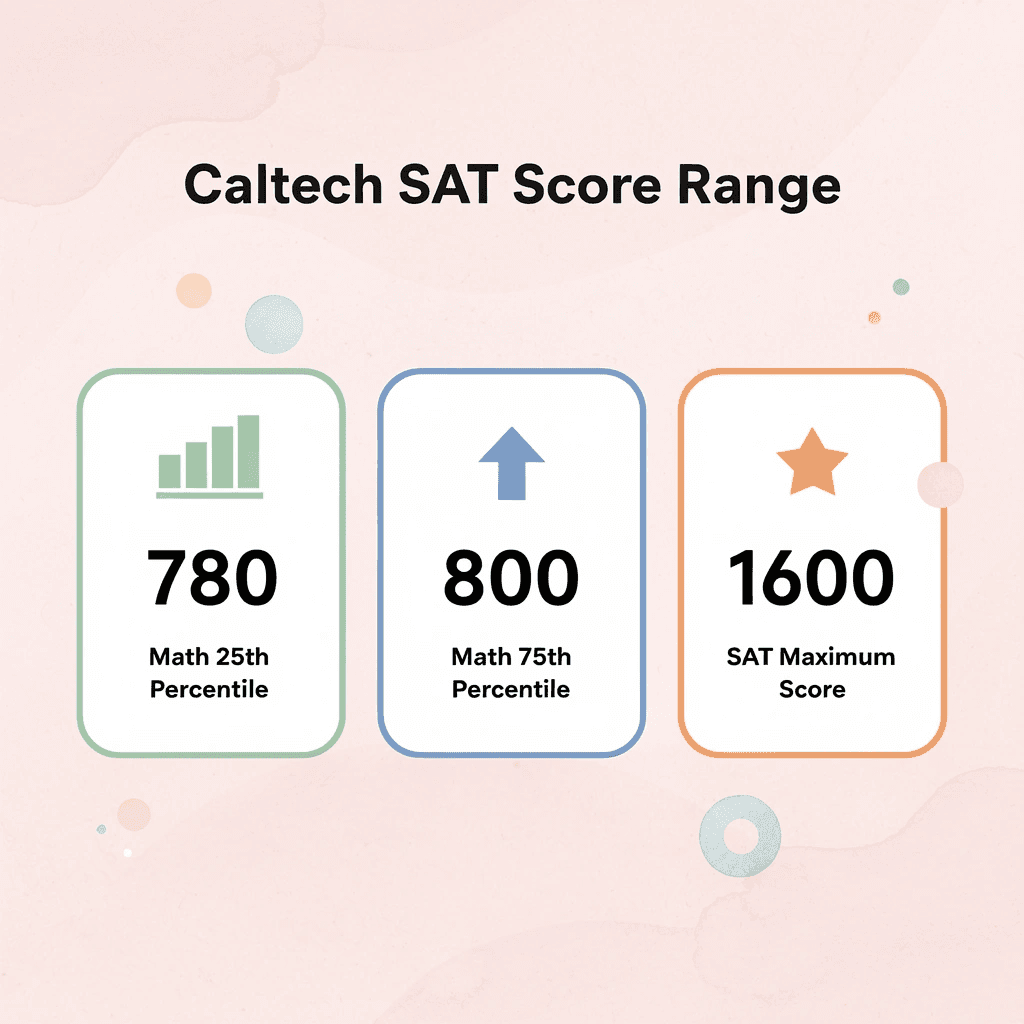
Caltech's SAT score data gets attention because it sits at the outer edge of what standardized testing can measure. According to Caltech Undergraduate Admissions, the SAT Math 25th percentile for admitted students is 790, meaning even the lower end of the admitted class scores near-perfect on the math section. At Caltech, a near-perfect score is the floor, not a distinguishing factor.
"The SAT Math 25th percentile for admitted Caltech students is 790 — meaning even the bottom quarter of the admitted class scores near-perfect on math." — Caltech Undergraduate Admissions
🔑 Takeaway: At Caltech, a 790+ Math score isn't a competitive advantage — it's the minimum baseline. Near-perfect scores are expected, not exceptional.
Students focus on that floor because SAT scores feel like something they can control in ways that research experience or faculty recommendations don't. But this focus creates a wrong picture: at Caltech, math aptitude isn't the differentiator. What separates admitted students from rejected ones with identical scores is everything beneath the surface of a transcript.
🎯 Key Point: Identical SAT scores do not mean identical outcomes. At Caltech, the real differentiator is what lies beyond the numbers: your intellectual curiosity, research depth, and authentic passion for science.
⚠️ Warning: Obsessing over SAT optimization while neglecting research experience or meaningful extracurriculars is one of the most common and most costly mistakes Caltech applicants make.
Why do students misread Caltech's score data as a checklist?
Most students treat Caltech's score data like a job posting's minimum requirements: hit the number and move forward. According to PrepScholar, the average SAT score for admitted students is 1545, with a 75th percentile of 1570. However, Caltech's admissions process doesn't work like a checklist. Students who treat those figures as targets rather than context often spend too much time on test prep and too little on the parts of their application that make them stand out.
Chasing a number while neglecting the full profile causes many strong applicants to lose ground. Most students research Caltech's score ranges independently without understanding how their academic profile compares across all dimensions Caltech evaluates. Our AI college counselor at Kollegio addresses that gap by pulling together thousands of data points to show students where they stand across every component of Caltech's admissions profile, not just the SAT.
What does Caltech's score profile actually tell you?
Understanding Caltech's score profile tells you whether you're academically competitive enough to make applying worthwhile and helps you build a smarter college list. It doesn't tell you whether you'll get in, and conflating these two things is where students make costly strategic errors.
What Is the Average SAT Score at Caltech?
According to Caltech Undergraduate Admissions, the middle 50% of Caltech's SAT composite scores fall between 1540 and 1580. This range shows where most students who enroll at Caltech score — not the lowest score you need to get in.
"The middle 50% of Caltech's SAT composite scores fall between 1540 and 1580 — placing it among the most competitive score ranges in the country." — Caltech Undergraduate Admissions
🎯 Key Point: The 1540–1580 range represents the middle 50% of enrolled students, meaning 25% of admitted students scored below 1540 and 25% scored above 1580.
⚠️ Warning: Don't treat the middle 50% range as a minimum cutoff — it's a benchmark for competitiveness, not a hard requirement for admission.
SAT Score Range | What It Means |
|---|---|
Below 1540 | Bottom 25% of enrolled Caltech students |
1540–1580 | Middle 50% — the core competitive range |
Above 1580 | Top 25% of enrolled Caltech students |

Where the math score really separates Caltech
The math section reveals Caltech's unusual profile. Caltech Undergraduate Admissions reports that the SAT Math 25th to 75th percentile runs from 790 to 800, a compressed range at the top of the scale. Most elite universities show meaningful spread in their math scores. Caltech's compression reflects the specific type of student the institute selects: someone who has already pushed quantitative thinking to its natural ceiling.
What does a perfect math score actually get you?
A perfect math score puts you inside the pool. What happens next depends on what the score cannot capture: the research project you ran independently, how you think through problems without clear answers, and the intellectual curiosity evident in your essays.
Why does test prep alone leave the application story thin?
Students often spend months practicing for the SAT while their application story remains undeveloped. The score strengthens, but the narrative stays weak. Platforms like Kollegio address this problem. The AI college counselor uses personalized data to help students understand their academic standing and build their profile with the same rigor they apply to test preparation.
What a score in range actually buys you
Scoring within Caltech's middle 50% demonstrates you can handle the coursework. It does not demonstrate fit, curiosity, or original thinking. A 1575 with a generic research background and safe essays is weaker than a 1545 paired with a compelling independent project and distinctive intellectual voice. The score is the entry condition, not the argument.
How does this distinction change the way you build your college list?
Understanding this difference changes how you build your college list. Caltech's score profile is one piece of a much bigger picture of fit. Once you see how small the admitted class is in terms of actual enrollment numbers, every non-score element takes on different importance.
Related Reading
- What ACT Score Is Needed for Harvard
- Average Act Score For Nc State
- Average Sat Score For Unc
- Average Sat Score For Umd
- Average Sat Score For Uc Berkeley
- Average SAT Score for Virginia Tech
- Average Sat Score For Brown
- Average SAT Score for UVA
- Average SAT Score for Michigan
- Average Sat Score For Ohio State
How Competitive Is Caltech Admissions?
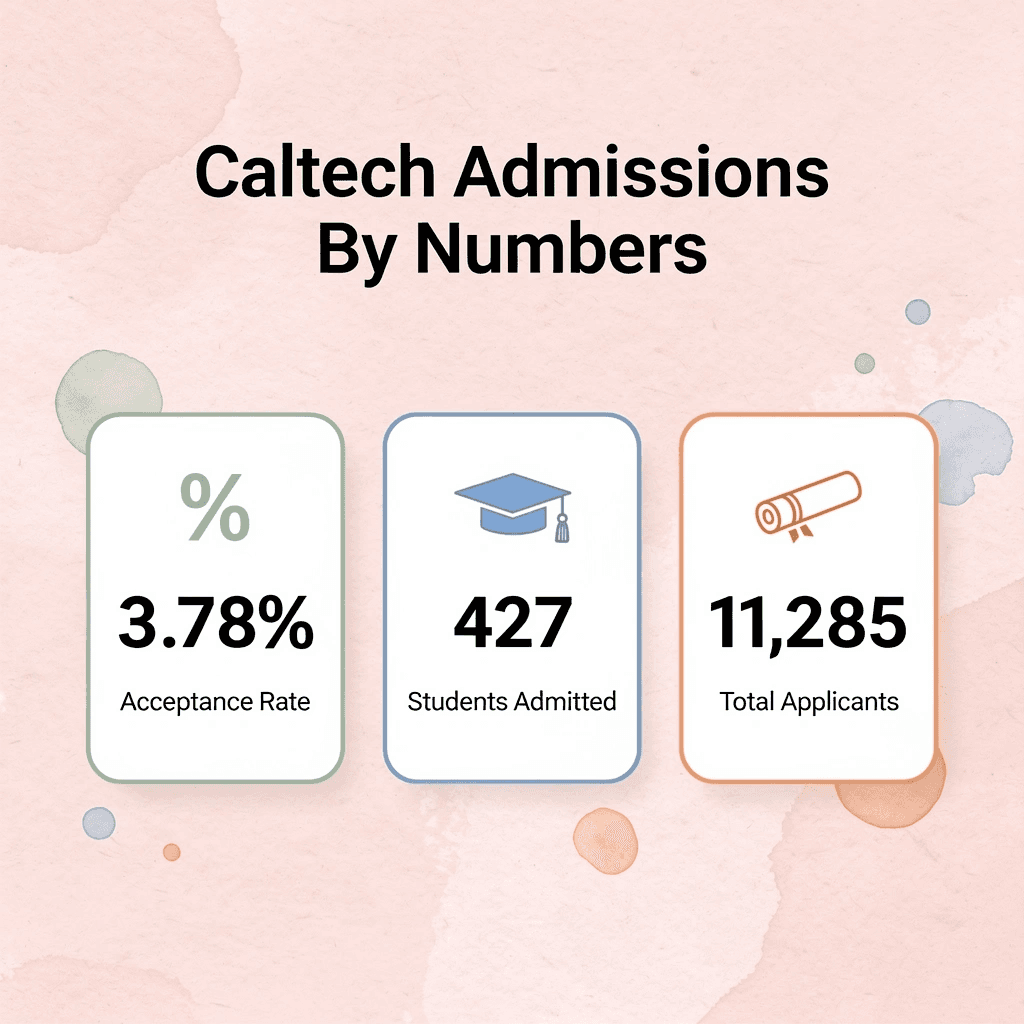
Caltech admits far fewer students per year than most people think. According to AdmitStudio, the Class of 2029 saw just 427 students admitted from 11,285 applicants — a 3.78% acceptance rate. That is not a funnel with a narrow opening. That is a needle.
"Just 427 students were admitted from 11,285 applicants — a 3.78% acceptance rate for Caltech's Class of 2029." — AdmitStudio
🔑 Takeaway: A 3.78% acceptance rate places Caltech among the most selective institutions in the world — more competitive than most Ivy League schools.
Metric | Class of 2029 |
|---|---|
Total Applicants | 11,285 |
Students Admitted | 427 |
Acceptance Rate | 3.78% |
Rejection Rate | 96.22% |
The entering class is around 230 students. Every seat is contested by dozens of applicants with near-perfect SAT scores, straight-A transcripts, and hands-on research experience. This scarcity is built into the system by design.
⚠️ Warning: Perfect grades and test scores alone do not guarantee admission. With a class size of only ~230 students, Caltech seeks candidates who demonstrate exceptional depth beyond academic achievement.
💡 Tip: Because every seat carries significant weight, your application must transcend credentials. Your research narrative, intellectual curiosity, and fit with Caltech's culture are critical differentiators.
Why has the acceptance rate kept falling in recent years?
AdmitStudio notes that the Class of 2028 reached a historic low of 2.27%, reflecting both increased applications and Caltech's commitment to maintaining a small class size. This compression means even modest increases in applicant qualifications raise the bar for all candidates.
What actually moves the needle when every applicant looks qualified?
Most students approach a school this selective by strengthening what is already strong: improving their GPA, raising their SAT score, adding another activity. When every applicant meets the basic numerical requirements, adding more of the same does not change the outcome. What changes results at this level of selectivity is being different, not doing more. Students who treat their applications as checklists tend to look like thousands of others doing the same.
Building a Caltech application without understanding how your profile compares to the admitted class is like navigating without coordinates. Our AI college counselor at Kollegio replaces guesswork with personalized fit analysis based on thousands of data points, enabling students to stop optimizing blindly and build a strategy that reflects their actual strengths. Understanding acceptance rates provides useful context, but it only tells you how hard the door is to open. It does not tell you which key actually fits.
What Matters Besides SAT Scores?
Strong SAT scores get your application read, not admitted. At Caltech, nearly every applicant has scores near the top of the range, so math and composite scores work as entry credentials rather than competitive advantages. The real evaluation begins after that threshold is crossed.
"Strong SAT scores get your application read, not admitted — at elite schools like Caltech, they function as entry credentials, not competitive advantages." — Kollegio Admissions Insight
🎯 Key Point: Once you hit Caltech's score threshold, your SAT is essentially neutralized — what separates admitted students lies entirely beyond the numbers.
💡 Tip: Don't pour all your energy into chasing a perfect SAT score. Invest that time into building standout extracurriculars, compelling essays, and meaningful research — the factors that actually drive admissions decisions at top-tier schools.
Factor | Role in Admissions |
|---|---|
SAT Score | Entry credential — gets you past the filter |
Essays | Reveals personality, voice, and depth |
Extracurriculars | Demonstrates passion and impact |
Research / Projects | Shows intellectual initiative |
Letters of Recommendation | Validates character and potential |

Academic depth over academic breadth
C2 Education reports that over 80% of colleges prioritize GPA over SAT scores in admissions decisions. At Caltech, course rigor matters even more. Admissions officers assess whether students selected the most challenging classes available and performed well. A 3.8 GPA in AP Physics, Multivariable Calculus, and AP Chemistry tells a different story than a 4.0 in easier classes. Your transcript reflects the choices you made, not just your grades.
What does depth in extracurriculars actually signal to Caltech?
The failure point for most Caltech applicants is not how many activities they participate in but how deeply they go. Progress Learning notes that extracurricular activities are weighted factors at over 50% of selective universities, and Caltech is firmly in that group. A student who spent three years investigating a specific chemistry problem demonstrates something fundamentally different from one who joined six clubs in their senior year. Admissions officers distinguish between genuine intellectual curiosity and strategic positioning.
How can students tell if their activities feel authentic rather than constructed?
Most students approach extracurriculars by collecting options and stacking activities to create an impressive resume. Caltech's admissions readers are trained to identify authentic intellectual engagement versus strategic positioning. Kollegio's AI college counselor helps students assess which activities genuinely reflect their interests, ensuring their profile feels coherent rather than constructed.
Why do essays and recommendations carry so much weight at Caltech?
Essays reveal whether an application comes alive or collapses into generalities. Caltech's prompts expose how a student thinks, not what they have done. Generic enthusiasm for science becomes noise in a pool where every applicant loves science. What stands out is specificity: a student who can explain exactly why a particular problem fascinates them, describe how they approached it, and demonstrate genuine comfort with uncertainty. That kind of writing is hard to fake and nearly impossible to coach into someone who does not feel it.
What do strong recommendation letters reveal that transcripts cannot?
Recommendation letters are important for the same reason. A letter from a physics teacher who watched a student rebuild a failed experiment three times and return with a new idea tells admissions officers something a transcript cannot. The best letters reveal character under pressure, which is what Caltech seeks to predict. Once you understand what Caltech seeks in a profile, a different question surfaces: what score should you realistically aim for?
Related Reading
- What Sat Score Is Required For Uf
- Average Sat Score For Uga
- Average Act Score For Georgia Tech
- What SAT Score Is Required for Cornell
- What SAT Score Is Required for Harvard
- What Is The Combined Essay Score For Sat
- Average Sat Score For Virginia Tech
- Average Sat Score For Uva
- Average Sat Score For Georgetown
- Rice University Average Sat Score
- Caltech Average Sat Score
- Average Sat Score For Michigan
What SAT Score Should You Aim For?
Aim for 1560 or above. If you score anything below 1540, seriously consider retaking the test or strengthening the rest of your application. This is not a soft suggestion: it's a critical benchmark that separates competitive applicants from the rest of the pool.
🎯 Key Point: A score of 1560+ is your real target for Caltech. Anything below 1540 requires a clear strategy: either retake the SAT or significantly strengthen every other part of your application.
"If you score anything below 1540, think about retaking the test or working hard to make the rest of your application stronger."
⚠️ Warning: Don't assume a strong GPA or extracurriculars will fully compensate for a weak SAT score at a school as quantitatively rigorous as Caltech.
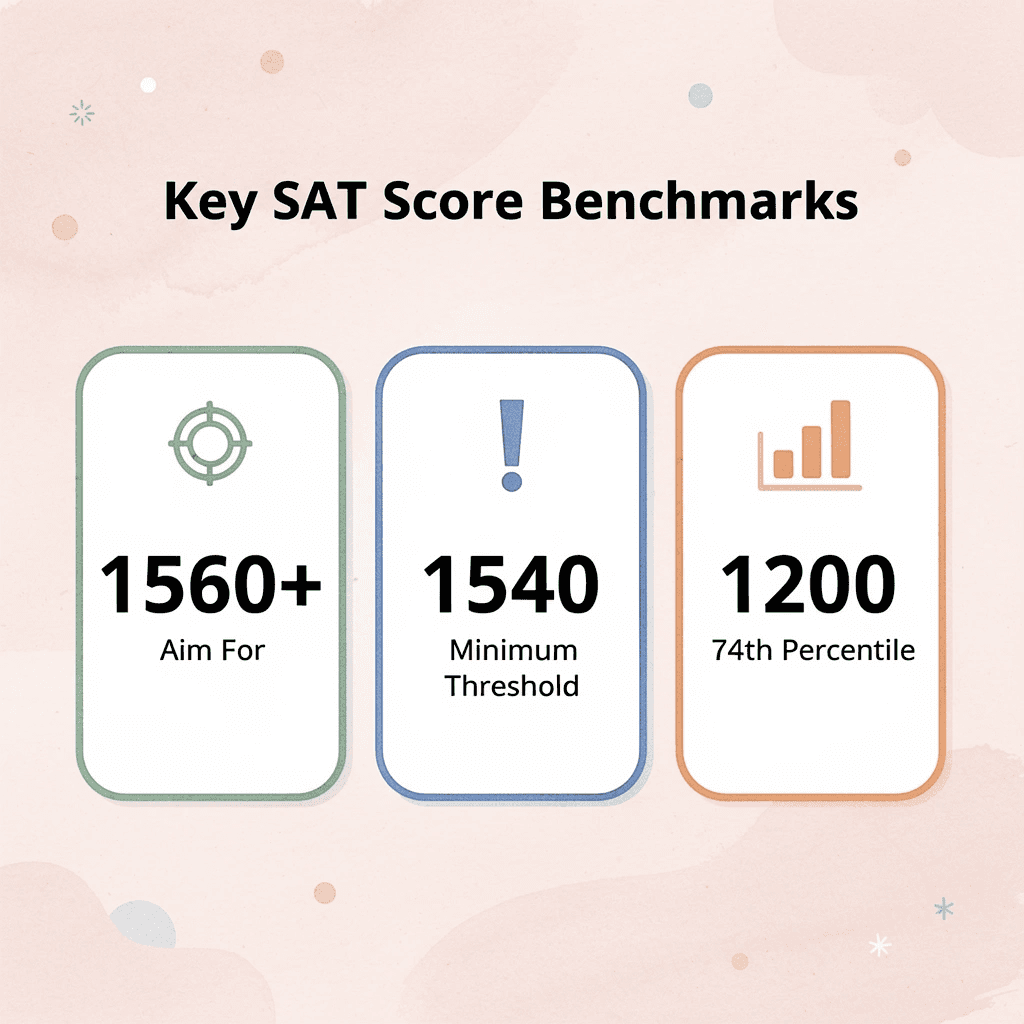
According to Kaplan Test Prep, a score of 1200 or above puts students in about the 74th percentile across the country. Caltech's students who get accepted usually score 300 to 400 points higher than the national benchmark. This striking difference shows that Caltech's coursework starts where most colleges finish — and the SAT math section is a direct signal of whether a student can actually handle that level of rigor without burning out early.
SAT Score Range | Percentile | What It Means for Caltech |
|---|---|---|
1200+ | ~74th percentile | Below Caltech's competitive range |
1400–1499 | ~94th–96th percentile | Still under typical Caltech admits |
1500–1539 | ~97th–98th percentile | Approaching range, but borderline |
1540–1600 | ~99th percentile | Target zone for competitive applicants |
🔑 Takeaway: The 300–400 point gap between the national average and a typical Caltech admit isn't just a number — it reflects how elite the academic environment truly is. The SAT math section, in particular, is a direct preview of the problem-solving intensity you'll face from day one.
Where the score actually matters
Your SAT score functions as a minimum requirement, not a grade. Once you reach it, additional points yield diminishing returns. Magoosh's SAT research shows that a score of 1400 or higher places students in the top 5% nationally, while top schools like MIT typically accept students with scores of 1500 or above. A 1580 and a 1600 are judged identically by admissions readers. What matters is whether you spent that time on a meaningful experiment or practice tests that no longer serve you.
When does retaking the SAT stop being worth it?
If you're sitting at 1565 and considering taking the test a fourth time, compare that option to deepening a research project, refining your essays, or pursuing a science competition with real intellectual stakes. A free AI college counselor like Kollegio can clarify this tradeoff. Our platform maps your academic profile against thousands of data points to show where your application is strong and where attention will have the most impact.
Below 1540, what to do next
Scores below 1540 shift the burden of proof onto other parts of your application. Caltech's holistic review means a student with a 1510, three years of independent research, and a compelling intellectual narrative can still make a credible case. The stronger your non-score profile, the less your SAT composite defines your candidacy.
How Kollegio Helps Students Build Stronger College Applications
Getting into a good college involves much more than a high SAT score. The students accepted to the most competitive schools build strong overall profiles aligned with their academic goals, interests, and aspirations.
"The students who get accepted to the most competitive schools build strong overall profiles — not just high test scores." — College Admissions Insight
🎯 Key Point: A high SAT score alone is insufficient. Top colleges evaluate the full picture of who you are as a student and person.
Kollegio helps students stop focusing only on test scores and instead focus on building smarter application strategies. Students get access to personalized tools and targeted information that help them understand exactly where they stand and what steps will make their applications stronger.
💡 Tip: Use Kollegio's personalized tools early in the process — the sooner you understand your application gaps, the more time you have to meaningfully address them.
Application Focus Area | Without Kollegio | With Kollegio |
|---|---|---|
Test Score Strategy | Narrow, score-only focus | Balanced within a broader profile plan |
Profile Building | Unclear next steps | Personalized action steps |
School Fit | Guesswork | Data-informed targeting |
⚠️ Warning: Students who focus exclusively on test prep often overlook critical profile elements — like extracurriculars, essays, and demonstrated interest — that top schools weigh heavily.
How does Kollegio help students find the right university match?
One of the biggest challenges students face is knowing which universities are realistic targets. Kollegio provides personalized college guidance and university matching based on academic performance, interests, and goals, helping students identify schools where they're likely to be competitive while discovering opportunities they may not have considered. The platform offers admissions insights that help students understand what universities value. Rather than focusing exclusively on SAT scores, students can evaluate how GPA, extracurricular involvement, essays, and course rigor contribute to their overall profile.
How does Kollegio support planning and affordability for selective schools?
Applying to selective universities like Caltech requires careful preparation, as deadlines can quickly become overwhelming. Our AI college counselor at Kollegio helps students stay organized and approach the admissions process strategically, prioritizing what matters most. For many families, affordability is as important as admissions chances. Our AI college counselor at Kollegio helps students discover scholarship opportunities and identify institutions offering strong financial aid or merit-based awards, enabling them to build balanced college lists that consider both fit and cost.
What does building a complete college application profile look like?
Kollegio gives students tools to understand their academic standing and receive personalized recommendations, providing a clearer picture of their strengths and areas for improvement than anonymous statistics online. College admissions depend on building a complete profile. Strong grades, meaningful extracurricular activities, thoughtful essays, and strategic planning help students stand out.
Use Kollegio's AI College Counselor for Free Today!
Knowing your target score is a starting point, not a strategy. The real work is understanding how every part of your application fits together—something that once cost thousands in private counseling fees.
"The real work is understanding how every part of your application fits together—something that once cost thousands in private counseling fees."
⚠️ Warning: Don't mistake having a target score for having a real admissions plan. Without understanding how your full application profile connects, you're leaving your chances to guesswork.

That's where Kollegio's AI college counselor changes the equation entirely. In your first free session, our AI college counselor gives you personalized university recommendations, a realistic read on your admissions chances, and concrete guidance on building a stronger application.
💡 Tip: Your first session is completely free—use it to get personalized insights that would typically cost thousands through a private counselor.
🎯 Key Point: Kollegio's AI college counselor delivers three powerful tools in one free session: personalized university recommendations, an honest admissions assessment, and an actionable application roadmap.
What You Get | Traditional Counseling | Kollegio AI (Free) |
|---|---|---|
Personalized University Recommendations | ✅ (costly) | ✅ Free |
Realistic Admissions Chances | ✅ (costly) | ✅ Free |
Application Improvement Guidance | ✅ (costly) | ✅ Free |
Typical Cost | $150–$300/hour | $0 |
Related Reading
- What SAT Score Is Required for Duke
- What Sat Score Is Required For Mit
- What Sat Score Is Required For Harvard
- What Sat Score Is Required For Ut
- What Sat Score Is Required For Princeton
- What Sat Score Is Required For Texas A&m
- What Sat Score Is Required For Yale
- What Sat Score Is Required For Notre Dame
- What Sat Score Is Required For Ucla
- What Sat Score Is Required For Columbia
- What Sat Score Is Required For Stanford
- What Sat Score Is Required For Ivy League
- What Sat Score Is Required For Cornell
- What Sat Score Is Required For Nyu
- What Act Score Is Needed For Alabama