
Choosing the right college major might be one of the most consequential decisions you'll make in your early twenties. The pressure to pick a major that leads to career success, financial stability, and personal fulfillment can feel overwhelming, especially when you're also trying to figure out who you are and what you care about. This guide will help you identify the best college majors today, examining which academic programs offer strong career prospects, which fields align with different personality types, and how to evaluate degree options based on your unique strengths and goals.
Stop wondering.
Start matching.


That's where having expert guidance makes all the difference. Kollegio's AI college counselor can walk you through this decision by analyzing your interests, academic strengths, and career aspirations to suggest college majors that truly fit who you are. Instead of relying on guesswork or generic advice, you'll get personalized recommendations that consider earning potential, job market trends, and how different academic paths connect to real-world opportunities.
Summary
- Nearly one-third of college students change their major at least once, according to U.S. Department of Education data from 2022, and most switches happen because students choose based on reputation rather than readiness. The real cost isn't just academic delays or increased debt. It's the emotional toll of realizing you invested time and energy into a path that never felt right, reinforcing doubt that lingers well beyond campus.
- Rankings evaluate majors using aggregated data such as median salaries and employment rates, but these metrics can't predict individual outcomes. Two students can graduate with identical majors from the same school and end up in completely different places five years later, depending on the electives chosen, internships secured, and the depth of engagement with the material. The label doesn't create the value. How you use it does.
- More than 1,800 college majors are offered across U.S. institutions, according to MyMajors, creating decision fatigue before students even begin comparing options. When you add endless contradictory "best major" lists, each using different criteria to crown different fields, the search for clarity becomes its own source of stress. The sheer volume of conflicting information fragments the decision rather than clarifying it.
- The strength of a student's high school curriculum is one of the most important factors in admissions decisions, according to the National Association for College Admission Counseling, with over 60% of colleges rating curriculum strength as very important or somewhat important. Colleges evaluate whether your coursework, activities, and stated major form a coherent narrative. A biology applicant with three years of lab experience and AP science courses presents credibility. The same major with minimal science coursework and unrelated activities raises questions about readiness.
- More than 1 in 5 students (21%) frequently or very frequently reconsider their field of study, according to BestColleges research. That doubt surfaces when coursework doesn't match expectations, or when students realize they chose based on external metrics rather than understanding what the work actually requires. Lists describe outcomes but rarely explain the day-to-day reality, leaving students unprepared for the gap between what they expected and what the major demands.
- The National Center for Education Statistics reports that 30% of students change their major at least once, and many switches occur because the original choice was based on external pressure or incomplete information rather than a genuine fit.
- Kollegio's AI college counselor addresses this by analyzing actual coursework, activities, and goals to identify majors that align with existing preparation, helping students build applications in which the major confirms, rather than contradicts, the pattern.
The Real Problem With Searching for the "Best" College Majors

The real problem isn't that students search for the best college majors. It's that they trust rankings to make a deeply personal decision for them. Lists promise certainty in a moment of anxiety, but they can't account for who you are, what energizes you, or how you learn best. That disconnect creates choices based on fear rather than fit.
When you start with a list, the decision shifts. You stop asking "what makes sense for me?" and start asking "what looks safest?" The focus moves from alignment to optics. Computer science tops the chart, so you convince yourself you should love coding. Finance promises six figures, so you ignore the economics that bore you. Engineering sounds impressive, so you overlook that you've never enjoyed math under pressure.
This isn't about ambition. It's about mistaking external validation for internal clarity.
When rankings replace reflection
Most students don't realize how much weight they're giving to other people's priorities. A major ranks high because it performs well on metrics that matter to researchers, employers, or economists. Median salary five years out. Job growth projections through 2030. Unemployment rates during recessions. Those numbers reflect real outcomes, but they don't reflect your strengths, your curiosity, or the kind of work that keeps you engaged past the first paycheck.
According to the U.S. Department of Education's 2022 data, nearly one-third of college students change their major at least once, and many do so because they chose based on reputation rather than readiness. The switch often happens after a difficult semester, when coursework reveals a mismatch between expectation and reality. By then, students have invested time, tuition, and emotional energy into a path that never felt right to begin with.
The cost isn't just academic. Switching majors can delay graduation, increase student debt, and create doubt that lingers well beyond campus. Worse, it reinforces the belief that you made the wrong choice when the real issue was starting with the wrong question.
The hidden cost of chasing prestige
Strong students are most affected by this pattern. They're capable enough to succeed in competitive majors, so they push through even when the fit feels off. They take the hardest classes, join the right clubs, and build resumes that look flawless on paper. But the application narrative starts to fracture. Coursework doesn't connect to extracurriculars. Essays sound rehearsed instead of reflective. Admissions officers read hundreds of these profiles each cycle and can tell when a student is performing rather than exploring.
Prestige becomes a trap. You choose biology because it's pre-med, even though chemistry makes more sense for your interests. You declare business because it's versatile, even though you've never taken an accounting course. You commit to a STEM field because it sounds rigorous, even though your best work has always been in writing or design. The major stops being a tool for growth and becomes a credential you're chasing to avoid judgment.
That's the tension rankings never address. The major that looks best on a list often creates the most regret later, because it was never chosen with you in mind.
When fear drives the decision
Fear shows up in predictable ways. Fear of picking something that sounds useless. Fear of disappointing parents who expect a practical major. Fear of falling behind peers who seem certain about their paths. Fear of choosing wrong and realizing too late. These aren't irrational concerns. College is expensive, competitive, and high-stakes. But when fear becomes the primary driver, the decision stops being about fit and starts being about risk avoidance.
You end up choosing what feels defensible rather than what feels right. If someone questions your major, you want an answer that sounds smart. "It has strong job prospects." "The starting salary is above average." "It's a growing field." Those answers work in conversation, but they don't sustain you through four years of coursework, internships, and career exploration. They don't help you when the work gets hard, and you need a reason to keep going that's bigger than a ranking.
The problem compounds when students don't fully understand what a major involves. They see "engineering" and imagine innovation, but not the hours of problem sets. They see "marketing" and imagine creativity, but not the data analysis. They see "psychology" and imagine helping people, but not the research methods courses. The gap between expectation and reality only becomes visible after commitment, and by then the choice feels locked in.
What gets lost in the search
When students begin with rankings, they skip the most important part of the decision-making process: understanding themselves. What subjects have you returned to, even when they weren't required? What kind of work makes time disappear? What environments bring out your best thinking? What skills do you want to build, and why do they matter to you? These questions take longer to answer than scrolling through a list, but they're the only ones that lead to clarity.
Choosing a major isn't about finding the objectively best option. It's about finding the path that aligns with how you think, what you value, and where you want to go. That alignment doesn't guarantee an easy road, but it creates resilience when challenges surface. You know why you're there. You know what you're building toward. You know the work matters to you, not just to a ranking algorithm.
The students who thrive in college aren't always the ones who picked the most prestigious major. They were intentionally selected. They understood the tradeoffs. They connected their choice to their goals. They built a narrative that made sense, not just to admissions officers, but to themselves.
That kind of clarity doesn't come from a list. It comes from reflection, exploration, and honest assessment of what you're ready to commit to. Tools like Kollegio's AI college counselor help students move past generic rankings by analyzing individual strengths, interests, and career goals to suggest majors that actually fit. Instead of starting with what's popular, start with what's personal, and the decision becomes less about avoiding mistakes and more about building momentum toward what matters.
But even with better tools, the core challenge remains the same.
So why do these lists keep failing students in such predictable ways?
Related Reading
- College Majors
- Common App
- Early Action Vs Early Decision
- First Generation College Student
- Weighted Vs Unweighted Gpa
- What Should I Major In
- How Many Colleges Should I Apply To
- Passion Project Ideas
Why "Best College Major" Lists Create More Confusion Than Clarity

The confusion starts with volume and ends with paralysis. When students search for guidance on choosing a major, they find thousands of articles, each ranking different fields using different criteria. One list crowns computer science, another boosts nursing, and a third champions finance. The sheer number of contradictory answers doesn't clarify the decision. It fragments it.
According to MyMajors, there are more than 1,800 college majors available across U.S. institutions. That number alone creates decision fatigue before a student even begins comparing options. Add in the endless stream of "best major" content, each promising certainty through rankings, and the search for clarity becomes its own source of stress.
When averages erase individuality
Most rankings rely on aggregated data. Median salaries, employment rates, and graduate school placement percentages. These numbers reflect outcomes across millions of students, but they can't predict what happens to you specifically. Two students can graduate with the same major from the same school and land in completely different places five years later, depending on the electives they chose, the internships they secured, the professors they connected with, and how deeply they engaged with the material.
Lists treat majors as static products with guaranteed results. Pick engineering, earn this salary. Choose a business, expect the job market. But outcomes depend far more on execution than selection. A biology major who pursues undergraduate research, builds relationships with faculty, and applies to competitive summer programs will have different opportunities than someone who completes the degree with minimal engagement. The major itself doesn't create the outcome. How you use it does.
That distinction gets lost when students rely on rankings. They assume the label carries the value, when the real work happens in how you build skills, seek mentorship, and position yourself within the field.
Why school-specific context disappears
A major that thrives at one institution may be underdeveloped at another. Faculty expertise, research funding, internship pipelines, advising quality, and industry connections vary widely across colleges. A psychology program at a research university with active labs and graduate student mentors offers a different experience than the same major at a school where professors teach five courses per semester with no research budget.
Rankings ignore this. They evaluate majors as if they function identically everywhere, when the infrastructure supporting that major matters as much as the curriculum itself. A student choosing based on a national ranking might commit to a program that looks strong on paper but lacks the resources to deliver meaningful opportunities.
The same applies to institutional strengths. Some schools excel in preparing students for specific industries. Others prioritize graduate school placement. Some invest heavily in career services and employer relationships. Others focus on academic theory. When you choose a major without understanding how your school supports it, you're making a decision with incomplete information.
The engagement gap no ranking captures
BestColleges reports that more than 1 in 5 students (21%) say they frequently or very frequently reconsider their field of study. That doubt often surfaces when coursework doesn't match expectations, or when students realize they chose based on external metrics rather than internal readiness.
The problem isn't always the major. It's the mismatch between what the student thought they were signing up for and what the work actually requires. Lists describe outcomes but rarely explain the day-to-day reality of the major. What does a week in chemical engineering actually look like? How much writing does political science require? What kind of thinking does economics reward? These questions matter more than salary projections, but they're harder to quantify and easier to overlook.
Students enter majors expecting one kind of challenge and encounter another. They thought finance meant strategy, but it requires comfort with quantitative analysis. They assumed communications would be creative, but it involves significant research and data interpretation. They believed history was memorization, but it demands argument construction and evidence synthesis. The gap between expectations and experience creates friction that rankings never account for.
How pressure replaces clarity
When students read these lists, they often feel behind. If their interests don't align with what's ranked highest, they start questioning whether those interests are valid. If they're drawn to a major that doesn't appear on "top earning" lists, they worry they're making a mistake. The decision becomes defensive. They choose what feels safest to explain, not what feels right to pursue.
That pressure shows up in application essays. The narrative sounds rehearsed because the choice wasn't personal. Students cite job growth as the reason they want to major in economics, not because they find market behavior fascinating. They describe engineering as a path to innovation, but they've never spent time prototyping or solving design problems. Admissions officers read thousands of these essays every cycle, and the lack of genuine engagement is obvious.
The emotional cost compounds over time. Students commit to majors they can defend but don't enjoy. They push through difficult coursework without the intrinsic motivation that sustains hard work. They build resumes that look polished but don't reflect actual curiosity. By the time they realize the fit is off, they've already invested semesters, tuition, and confidence into a path that was never theirs to begin with.
What gets ignored in the noise
Rankings can't account for how you think, what energizes you, or which environments bring out your best work. They don't measure whether you prefer structured problem-solving or open-ended exploration. They don't assess whether you thrive in collaborative settings or need long stretches of independent focus. They don't consider whether you're motivated by helping individuals, analyzing systems, or building tangible products.
These aren't soft factors. They're the variables that determine whether a major feels like momentum or friction. A student who loves debate and persuasive writing might excel in political science or philosophy, even if those fields don't rank among the highest-paying. Someone who thinks in systems and enjoys troubleshooting might find fulfillment in information technology or operations management, even if those fields don't carry the prestige of traditional STEM degrees.
When students skip the self-assessment and start with rankings, they're outsourcing the most important part of the decision. They're letting aggregated data answer a question that only they can resolve. The result isn't clarity. It's a choice that sounds good in theory but feels hollow in practice.
Platforms like Kollegio's AI college counselor help students move beyond generic rankings by analyzing individual strengths, interests, and career goals to recommend majors that align with how they think and work. Instead of starting with what's popular, students start with what's personal. The decision shifts from risk avoidance to intentional fit, and the narrative becomes something they can own rather than merely defend.
But even when students find better tools, another layer of confusion surfaces.
What happens when the major you choose doesn't match what colleges actually care about during admissions?
What Colleges Actually Evaluate When You Declare a Major

Admissions decisions aren't made by comparing majors against each other. They're made by assessing whether your intended major makes sense given everything else in your application. Colleges evaluate preparation, consistency, and credibility. The major itself matters far less than the story it tells about how you think and what you've been building toward.
When you declare an intended major, you're not locking yourself into a contract. You're providing context. Admissions officers use that information to understand whether your academic choices, activities, and interests form a coherent narrative. A student applying as a biology major with three years of lab experience, AP courses in chemistry and calculus, and a summer research position presents a credible profile. A student claiming the same major with no science coursework beyond the minimum and activities focused entirely on debate raises questions. The major doesn't fail them. The lack of alignment does.
Academic preparation matters more than the major's prestige
Colleges look first at whether you've taken the coursework that prepares you for what you're claiming to pursue. According to guidance from the National Association for College Admission Counseling, the strength of a student's high school curriculum is one of the most important factors in admissions decisions, outweighing the specific major itself. Over 60% of colleges rate curriculum strength as "considerably important" when evaluating academic readiness.
Advanced coursework signals more than intelligence. It signals commitment. A student who takes AP Calculus BC, Physics C, and Computer Science A before applying as an engineering major demonstrates sustained effort in relevant subjects. A student who avoids advanced math and science yet still declares engineering raises doubts. Admissions officers don't expect perfection, but they do expect preparation. The rigor of your transcript should support the ambition of your intended major, not contradict it.
This applies across all fields. If you're applying as a history major, have you taken advanced courses in history, government, or literature? If you're pursuing economics, have you completed calculus and shown interest in data analysis? If you're drawn to psychology, have you explored biology, statistics, or research methods? The specific courses matter less than the pattern they reveal. Colleges want to see that you've tested your interest and built the foundation to succeed.
Sustained interest creates credibility
Admissions officers are trained to spot patterns over time. A student who has engaged with a subject area consistently across multiple years appears more credible than someone who declares interest late with no supporting evidence. Research summarized by NACAC and echoed in admissions guidance from selective universities shows that long-term engagement signals curiosity, self-awareness, and genuine commitment, traits colleges value regardless of the major's perceived prestige.
Sustained interest doesn't require perfection. It requires continuity. A student interested in environmental science might take biology and chemistry courses, join an environmental club, volunteer with a local conservation group, and write about climate policy for the school newspaper. None of those activities alone proves commitment, but together they form a narrative. The major becomes believable because the student has spent years exploring it from multiple angles.
The opposite pattern creates friction. A student who declares pre-med as a senior but has never taken advanced science courses, shadowed a physician, or engaged with healthcare in any meaningful way looks opportunistic. The major feels like a last-minute decision designed to impress rather than a reflection of genuine interest. Admissions officers read thousands of applications every cycle. They recognize the difference between exploration and performance.
Activities and coursework should reinforce each other
Colleges evaluate whether your extracurriculars align with your stated academic interests. According to admissions guidance from institutions like Harvard College, consistency across academics and activities strengthens an application, regardless of the major's perceived prestige. A student applying as a computer science major who has completed programming courses, built personal projects, participated in hackathons, or contributed to open-source software presents a coherent profile. A student applying to the same major with no technical activities raises questions about readiness and motivation.
This doesn't mean every activity must connect directly to your major. Colleges value well-rounded students who pursue diverse interests. But when there's no overlap at all between what you say you want to study and how you've spent your time, the narrative weakens. A student declaring physics with no math or science coursework, no independent projects, and no evidence of problem-solving outside the classroom raises concerns. The major feels like an idea rather than a direction.
The strongest applications show depth in a primary area and breadth elsewhere. A student passionate about journalism might edit the school newspaper, attend a summer writing workshop, and intern at a local publication while also playing varsity soccer and volunteering at a food bank. The journalism activities provide depth. The other pursuits show a range. Together, they create a profile that feels authentic and multidimensional.
Fit with the institution's offerings matters
Majors are not evaluated in isolation. Colleges assess whether your interests align with what they actually offer: faculty strengths, research opportunities, curriculum structure, and departmental focus. A major that fits well at one school may be less compelling at another, which is why admissions officers care about how thoughtfully a student has researched and articulated that fit.
A student applying to a liberal arts college known for interdisciplinary programs should explain how that structure supports their goals. A student applying to a research university with strong graduate programs should connect their interests to specific labs, faculty, or resources. Generic statements about wanting to study biology don't demonstrate fit. Specific references to a professor's research on neural development, a unique dual-degree program, or access to a particular medical center do.
This is where many applications falter. Students choose majors based on national rankings without understanding how those majors function at the specific school they're applying to. They write essays about wanting to study business at a college with a limited business program, or declare an engineering interest at a school where engineering is competitive and requires a separate application process. The mismatch indicates that the student hasn't conducted the research, undermining the credibility of the entire application.
Platforms like Kollegio's AI college counselor help students move beyond generic major selection by analyzing individual academic backgrounds, extracurricular involvement, and career interests to suggest paths that align with both personal strengths and institutional fit. Instead of choosing a major based on external rankings, students can identify options that match how they've already been spending their time and energy, creating applications that feel intentional rather than reactive.
The shift from validation to alignment
All of this reinforces a critical belief shift. Colleges care far more about why you chose a major than which major you chose. An intended major is a signal, not a commitment. It tells admissions officers how you think about your interests and whether your choices make sense given your background. A well-supported major strengthens your application. A poorly supported one creates doubt, even if the major itself ranks highly on every "best of" list.
The students who navigate this successfully don't start by asking what major looks best. They start by asking what they've been building toward. They look at the courses they've taken, the activities they've pursued, the topics they've revisited, and the work that's kept them engaged even when it wasn't required. Then they choose a major that reflects that pattern. The narrative becomes clear because it's honest. The application becomes strong because it's coherent.
Without alignment, preparation, and context, even the most highly ranked major is just a label. With those elements in place, any major can become a compelling part of your story. The question isn't which major colleges prefer. It's whether the major you choose reflects who you've been and where you're heading.
Only after understanding this does a list of majors actually become useful.
Related Reading
- Easiest College Majors
- Hardest College Majors
- How To Get A Full Ride Scholarship
- College Majors List A–z
- Is Computer Science A Good Major
- Is Business Administration a Good Major
20 Best College Majors (By Broad Academic & Career Direction)

Once you understand how colleges evaluate majors, a list finally becomes useful. Not as a ranking, but as a map of academic directions and outcomes. Below are commonly chosen majors, grouped by pathway, with context on why they're strong options and who they tend to fit best, based on widely cited education and labor data.
STEM & Technical Fields
1. Computer Science
Computer science, computer engineering, and chemical engineering majors had median earnings of $80,000 immediately after graduating, according to the Federal Reserve Bank of New York. Computer science majors benefit from strong demand, flexible career paths, and clear skill-based signaling to employers and graduate programs. The major rewards are logical thinking, persistence through debugging, and comfort with abstraction. Students who thrive here often enjoy solving puzzles, building systems, and iterating until something works.
2. Engineering (Mechanical, Electrical, Civil)
Engineering majors are valued not just for outcomes, but for rigor. Admissions officers and employers alike recognize the discipline and problem-solving required to succeed in these programs. Aerospace engineering majors had a median income of $125,000 a year in mid-career, according to the Federal Reserve Bank of New York. The coursework is structured, cumulative, and demanding. Students who excel tend to prefer clear parameters, applied mathematics, and tangible results over open-ended exploration.
3. Data Science / Statistics
Data science sits at the intersection of mathematics, programming, and domain expertise. The field has grown rapidly as organizations across healthcare, finance, technology, and government seek professionals who can extract meaning from complex datasets. These majors appeal to students who enjoy abstract reasoning paired with real-world application. The work requires comfort with ambiguity, since raw data rarely tells a clean story without interpretation.
4. Information Systems
Information systems bridge technical and business skill sets. Students learn database management, systems architecture, and project coordination alongside organizational strategy. The major fits those who want technical depth without a pure engineering focus, and who find satisfaction in making technology work for people rather than building it from scratch.
Best for students who enjoy problem-solving, math, logical thinking, and applied learning.
Health & Life Sciences
5. Biology
Biology is one of the most popular undergraduate majors, serving as a common foundation for medical school, research, and graduate study. Outcomes vary widely depending on engagement beyond coursework. A biology degree paired with strong academic performance, clinical experience, and undergraduate research creates pathways into competitive programs. Without those elements, the major becomes less distinct. Students who thrive here often pursue depth through lab work, field studies, or mentorship with faculty members who are conducting active research.
6. Nursing
Nursing programs are competitive and structured, which admissions officers often view as a clear, intentional pathway. The curriculum combines science coursework with clinical rotations, creating early exposure to professional environments. Students drawn to nursing typically value direct patient interaction, procedural learning, and career stability. The work requires emotional resilience, physical stamina, and comfort with high-stakes decision-making.
7. Public Health
Public health has gained visibility and importance, particularly following global health crises. The field spans epidemiology, health policy, community health, and environmental health. Outcomes improve significantly at the graduate level, where specialization and research opportunities deepen. Undergraduates interested in public health often combine coursework with internships at health departments, nonprofits, or research institutions to build practical experience.
8. Neuroscience
Neuroscience majors are often evaluated for rigor rather than immediate job outcomes. The coursework is interdisciplinary, drawing from biology, chemistry, psychology, and computational modeling. Colleges view the major favorably when students demonstrate research engagement and a clear academic narrative. Students who succeed here tend to enjoy complexity, are comfortable with uncertainty, and pursue independent projects or lab positions early.
Best for students seeking clinical, research, or service-oriented pathways and comfortable with structured science coursework.
Business & Economics
9. Business Administration
Business remains one of the most commonly awarded bachelor's degrees in the U.S., and its strength lies in flexibility. Outcomes depend heavily on internships, specialization, and institution. Students who treat business as a general credential often struggle to differentiate themselves. Those who focus on specific functions like supply chain management, operations, or organizational behavior create clearer narratives. The major rewards students who seek early work experience and build skills through applied projects.
10. Economics
Economics majors often see strong long-term earnings, especially when paired with quantitative coursework. Admissions officers value economics for analytical rigor, not just career outcomes. The major teaches modeling, data interpretation, and systems thinking. Students who excel tend to enjoy working with incomplete information, testing hypotheses, and understanding how incentives shape behavior. The coursework becomes increasingly mathematical as students progress, requiring proficiency in calculus and statistics.
11. Finance
Finance majors frequently pursue careers in banking, consulting, and corporate finance. Outcomes vary significantly by school and experience. Students at institutions with strong recruiting pipelines and active alumni networks see different opportunities than those at schools without established industry connections. The major suits students who are comfortable with quantitative analysis, fast-paced environments, and performance-based evaluation.
12. Accounting
Accounting offers one of the clearest school-to-career pipelines. The profession requires certification, which creates structured pathways and predictable outcomes. Students who choose accounting often value stability, procedural work, and clear advancement criteria. The coursework is technical and cumulative, rewarding attention to detail and consistency.
Best for students who like analysis, markets, numbers, and applied decision-making.
Social Sciences
13. Psychology
Psychology is among the top undergraduate majors by enrollment. Outcomes depend heavily on graduate study, but colleges value psychology for research literacy, writing, and analytical skills. The major covers experimental design, statistical analysis, and the application of theory. Students who thrive often pursue research assistant positions, independent studies, or internships in clinical or organizational settings. Without those experiences, the degree becomes less differentiated.
14. Political Science
Political science remains one of the most common pre-law majors. The coursework emphasizes argument construction, evidence evaluation, and institutional analysis. Students interested in law, policy, or government often pair political science with internships in legislative offices, advocacy organizations, or legal clinics. The major rewards those who enjoy debate, writing, and understanding how power structures function.
15. Sociology
Sociology emphasizes systems thinking and social analysis. The major covers research methods, data collection, and the application of theory across contexts such as education, criminal justice, and public policy. Admissions officers value it when paired with research, policy interest, or applied projects. Students who succeed tend to ask structural questions rather than individual ones, seeking patterns across populations rather than isolated cases.
16. International Relations
International relations majors are evaluated heavily on context. Language study, global experience, and institutional fit matter more than the title alone. The major suits students interested in diplomacy, global development, or international business. Outcomes improve when students build regional expertise, pursue study abroad, or intern with international organizations.
Best for students who enjoy research, writing, theory, and understanding complex systems.
Humanities & Arts
17. English
English majors develop transferable skills in writing, analysis, and communication. Long-term outcomes are strongest when paired with clear focus areas like law, publishing, or education. The major rewards students who read critically, write clearly, and revise extensively. Those who treat English as purely interpretive often struggle to articulate career relevance. Those who build portfolios, pursue internships, or develop specialized knowledge create stronger narratives.
18. History
History majors are often overrepresented among successful law and graduate school applicants due to their emphasis on research and argumentation. The coursework teaches archival work, source evaluation, and narrative construction. Students who excel tend to enjoy deep investigation, are comfortable with ambiguity, and pursue thesis projects or independent research.
19. Philosophy
Despite stereotypes, philosophy majors score highly on standardized tests like the LSAT and GRE. Colleges value philosophy for intellectual rigor and clarity of thought. The major teaches logic, ethical reasoning, and argument analysis. Students drawn to philosophy often enjoy abstract thinking, conceptual precision, and questioning assumptions others take for granted.
20. Visual & Performing Arts
Outcomes vary widely, but admissions officers evaluate arts majors primarily on process, growth, and commitment, not commercial success. Students who build portfolios, participate in exhibitions or performances, and demonstrate sustained creative practice create compelling applications. The major rewards those who are self-directed, comfortable with critique, and driven by intrinsic motivation rather than external validation.
Best for students who value depth, interpretation, intellectual identity, and sustained inquiry.
How to Read This List Correctly
Across all categories, the pattern is consistent. These majors are not "best" in isolation. Outcomes vary based on engagement, institution, and preparation. Context and alignment matter more than labels.
Students who choose a major based solely on lists often miss the most important step: understanding how the major connects to their academic preparation, extracurricular involvement, and long-term goals. Platforms like Kollegio's AI college counselor help students move beyond generic rankings by analyzing individual strengths, interests, and career goals to suggest majors that align with how they've already been spending their time and energy. Instead of starting with what's popular, students start with what's personal. The decision shifts from risk avoidance to intentional fit, and the narrative becomes something they can own rather than merely defend.
This list is most powerful when used to narrow directions, not to make decisions by default.
But knowing which majors exist and what they offer is only half the equation.
How to Use This List Without Making the Same Mistake

Start with what you've already done, not what ranks highest. Look at the courses you've taken, the subjects where you've chosen to go deeper, and the activities that reflect sustained interest. If your transcript shows three years of advanced math and science, computer science or engineering becomes easier to support. If you've spent weekends writing for the school paper and summers interning at a magazine, communications or journalism makes narrative sense. The major should confirm a pattern that already exists in your application.
Match majors to your existing story
Strong applications feel inevitable. Every piece reinforces the others. When your activities, coursework, and stated interests all point in the same direction, admissions officers see coherence. When they don't, they see strategy. A student who claims an interest in political science but has never taken government, joined a debate, or engaged in policy work raises questions. The major feels like an idea borrowed from a list rather than a direction built from experience.
This doesn't mean every hour of high school needs to connect to your major. You can play sports, volunteer, and explore unrelated interests. But somewhere in your application, there should be depth. A cluster of activities, courses, or projects that demonstrate you've tested your interest and built skills over time. The major becomes the label for what you've already been doing.
Evaluate how the same major differs by school
Computer science at a liberal arts college, with small classes and close faculty mentorship, differs from computer science at a large research university, which emphasizes graduate teaching assistants and competitive internship pipelines. Biology at a school with active undergraduate research labs offers different opportunities than biology at an institution focused primarily on teaching. The major's name stays the same, but the experience changes.
Before committing, ask what resources support the major at each school. Which faculty members teach core courses? What research opportunities exist for undergraduates? How strong are the department's industry connections or graduate school placement rates? A major that thrives at one institution may be underdeveloped at another. Context matters more than the title.
Use lists to narrow, not to decide
The goal isn't to pick from the top five. The goal is to reduce the overwhelming number of options down to a manageable set that aligns with your preparation and interests. A list helps you see what exists. It shows you fields you might not have considered. It provides language for describing academic directions. But it can't tell you which major fits your specific strengths, goals, or learning style.
Treat the list as a filter. Cross out majors where you lack foundational coursework. Remove fields that don't connect to any of your activities or interests. Eliminate options at schools where the department is weak or misaligned with your goals. What remains should be a short set of realistic directions, each supported by evidence in your application.
Then evaluate those options based on alignment. Which major reflects how you actually think and work? Which connects to skills you've already started building? Which creates a narrative you can explain with specificity rather than generalities? The answer to those questions matters far more than where the major ranks on someone else's list.
Most students treat major selection as a single high-stakes decision made in isolation. Students who choose well view it as the final step in a longer process of self-assessment, exploration, and honest evaluation. They've already spent time testing their interests. They've already built a foundation through coursework and activities. The major doesn't create their direction. It confirms it.
Platforms like Kollegio's AI college counselor help students move past surface-level rankings by analyzing individual academic backgrounds, extracurricular patterns, and stated goals to surface majors that actually fit. Instead of starting with what's popular or prestigious, students start with what's already present in their own experience. The tool doesn't make the decision. It helps clarify which options align with the story the student has already been building.
The list gives options, and alignment makes the decision
When you use a major list as a starting point rather than an endpoint, it becomes more helpful. You gain vocabulary for describing your interests. You discover fields you didn't know existed. Identify which directions align with your preparation. But the decision itself comes from understanding yourself, not from trusting aggregated data about outcomes you can't predict.
Students who treat lists as answers end up back where they started, confused and second-guessing. Students who treat lists as tools for exploration make decisions they can defend, not just to admissions officers, but to themselves when the coursework gets hard, and they need a reason to keep going that's bigger than a ranking.
But knowing how to choose is only part of the process.
How Kollegio Helps You Choose and Present the Right Major
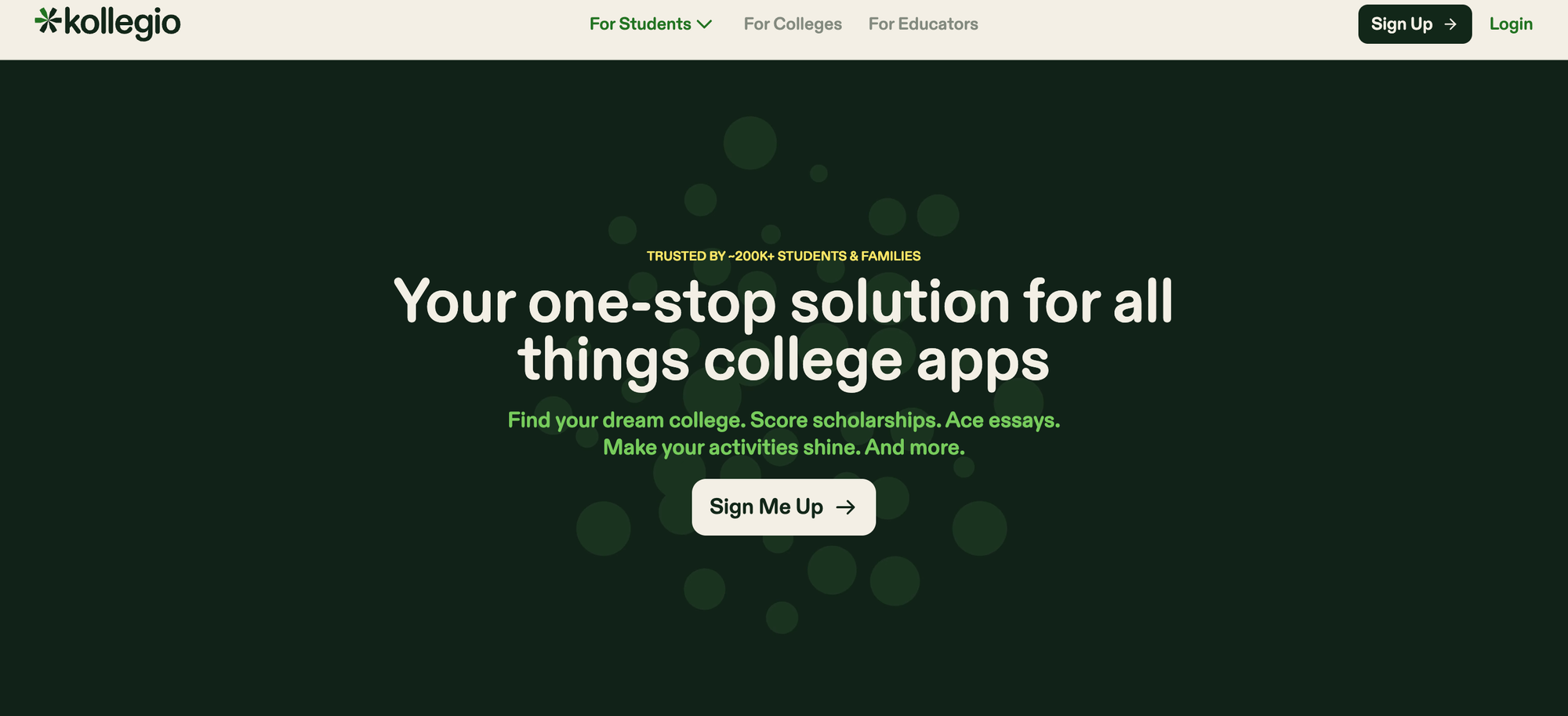
Kollegio starts where generic rankings stop. It analyzes your actual coursework, activities, and stated goals to surface majors that align with what you've already built, not what sounds impressive in theory. The platform doesn't recommend majors based on national salary averages or employment rates. It identifies patterns in your academic choices and extracurricular commitments and shows which fields naturally build on that foundation.
The difference matters because choosing a major isn't about finding the objectively best option. It's about finding the path that makes sense given your preparation and interests. A student with three years of programming experience, AP Computer Science coursework, and hackathon participation receives different guidance than someone drawn to technology but lacking technical depth. The first profile supports a computer science application. The second might benefit from information systems or a related field where the narrative feels more credible.
Personalized exploration based on what you've actually done
Most students approach major selection by browsing lists and hoping something clicks. Kollegio reverses that process. It starts with your transcript, activities list, and stated interests, then identifies academic directions where you've already demonstrated readiness. If you've taken advanced biology, chemistry, and calculus while volunteering at a hospital, the platform recognizes that pattern and surfaces health science pathways. If your strongest coursework centers on history and government with debate experience, it suggests political science, international relations, or pre-law tracks.
This approach eliminates the guesswork that creates weak applications. You're not trying to convince admissions officers you care about a field you discovered last month. You're articulating a direction you've been exploring for years, and the major becomes the natural next step rather than a strategic pivot.
College-specific program comparisons
The same major functions differently across institutions. Psychology at a liberal arts college, with close faculty mentorship and small seminar courses, offers different opportunities than psychology at a large research university, where undergraduates compete for lab positions. Business programs vary in specialization options, internship pipelines, and teaching philosophy. Engineering departments differ in research funding, industry partnerships, and undergraduate involvement in faculty projects.
Kollegio helps students understand these distinctions before committing. It compares how specific programs are structured at each school on your list, what resources support the major, and which institutional strengths align with your goals. A student interested in environmental science can see which schools emphasize field research, which focus on policy, and which integrate engineering approaches. That context prevents the common mistake of choosing a major based on its national reputation without understanding how it actually operates at the schools you're applying to.
Connecting majors to the rest of your application
Your intended major doesn't exist in isolation. It should reinforce your activities, strengthen your essay narrative, and align with your college list. When those elements pull in different directions, admissions officers notice. A student declaring pre-med with no science activities, minimal advanced coursework, and essays focused entirely on creative writing raises questions about authenticity.
Kollegio identifies these disconnects before you submit. It analyzes whether your major choice is supported by your transcript, whether your activities demonstrate sustained interest, and whether your essays articulate clear reasoning. If gaps exist, the platform suggests where to add depth or how to reframe your narrative so everything tells the same story. The goal isn't perfection. It's coherence. Admissions officers should be able to review your application and understand why this major is a good fit for you.
According to the National Center for Education Statistics, 30% of students change their major at least once. Many of those switches happen because the original choice was based on external pressure or incomplete information rather than a genuine fit. When students start with self-assessment and build their major choice around existing preparation, they're far less likely to second-guess themselves once coursework begins.
Feedback on how your choices read to admissions officers
Students often can't see their applications the way admissions officers do. You know your intentions, but reviewers only see what's on the page. A major that feels like a natural choice to you might read as opportunistic if the supporting evidence is weak. Kollegio provides that external perspective. It evaluates whether your reasoning is clear, whether your preparation is credible, and whether your narrative will hold up under scrutiny.
This isn't about gaming the system. It's about making sure your application communicates what you actually mean. If you're genuinely interested in economics but your coursework and activities suggest otherwise, that's a presentation problem, not a fit problem. The platform helps you either strengthen the evidence or reconsider whether a different major better reflects your actual experience. Either way, you end up with a choice you can defend confidently, not just to admissions officers, but to yourself when the work gets difficult.
Most students handle major selection by browsing rankings, asking friends, or defaulting to what sounds safe. As complexity increases (more schools, more majors, more conflicting advice), that approach fragments. Important context is lost, decisions stall, and students end up choosing out of fear rather than clarity. Kollegio's AI college counselor centralizes the process by analyzing your full profile and providing personalized guidance tailored to your preparation, interests, and goals. The result is a major choice that sounds like you and strengthens your application rather than creating doubt.
But even with the right major and a strong application, one question remains.
Use Kollegio's AI College Counselor for Free Today!
If you want help choosing the best college major for you and explaining that choice clearly to colleges, use Kollegio for free today and get personalized guidance across your entire application. Our AI guides you like a $10,000 counselor would, helping you every step of the college application process. You'll move from confusion to clarity, from generic rankings to a major that reflects your actual preparation and interests, and from doubt to confidence in how you present that choice to admissions officers.
The decision doesn't have to feel overwhelming. It just needs to feel honest. When you start with what you've already built rather than what sounds impressive, the key choice becomes simpler. When you have tools that analyze your full profile instead of offering generic advice, the application becomes stronger. When you get feedback that accounts for how admissions officers actually evaluate majors, the narrative becomes something you can own. That's what Kollegio provides, and it's available now, for free, whenever you're ready to move forward.
Related Reading
- How To Prepare For College
- Is Marketing A Good Major
- Is Economics A Good Major
- Is Finance A Good Major
- Is Political Science A Good Major
- Is Business A Good Major
- Is Business Administration A Good Major
- Is Accounting A Good Major