
Students researching college admissions often compare schools such as Virginia Tech and Harvard to understand where their test scores fall. While Harvard typically requires ACT scores of 33-35, knowing the ACT score required for Harvard, along with the average SAT score for Virginia Tech, helps build a realistic college list. Virginia Tech's SAT requirements, acceptance rates, and profiles of admitted students provide crucial benchmarks for application strategy.
Stop wondering.
Start matching.


Understanding admissions data and translating numbers into actionable guidance can be overwhelming for students managing multiple applications. Personalized support helps students evaluate not just Virginia Tech's SAT ranges and GPA expectations, but how their entire academic profile compares across universities, allowing them to focus on schools where they'll succeed with an AI college counselor.
Table of Contents
- Is Your SAT Score Good Enough for Virginia Tech?
- What the Average SAT Score for Virginia Tech Actually Means
- Why SAT Scores Alone Don't Predict Admission Outcomes
- How Competitive Is Your SAT Score Compared to Other Virginia Tech Applicants?
- Build a Stronger Application Than Students With Similar Scores
- How Kollegio Helps You Understand Where You Really Stand
- Use Kollegio's AI College Counselor for Free Today!
Summary
- Virginia Tech's middle 50% SAT range is 1200 to 1410, meaning that 25% of admitted students scored below 1200 and still earned admission through strong coursework, meaningful activities, or compelling essays. The score establishes academic readiness, but once you clear a baseline threshold, factors like course rigor, extracurricular depth, and essay quality often carry more weight in admissions decisions.
- The average SAT score explains only about 16% of the variation in students' freshman grades, according to FairTest research. This means 84% of academic performance depends on factors the test doesn't capture, which is why admissions officers turn to transcripts, activities, and essays to distinguish between the thousands of applicants who submit similar scores.
- Only 41% of Virginia Tech students submitted SAT scores in recent admissions cycles, according to CollegeTuitionCompare data. More than half of admitted students either submitted ACT scores or applied test-optional, relying entirely on other application components like course rigor, GPA, and extracurricular involvement to demonstrate college readiness.
- Course selection reveals sustained academic commitment in ways a single test cannot. A student with a 1290 SAT paired with four years of advanced STEM courses often signals stronger college readiness than a 1450 SAT with minimal academic challenge, particularly when those course choices align with the intended major and represent the most rigorous curriculum available.
- Essays become the deciding factor when academic credentials cluster together. Admissions officers remember students who write with honesty and insight rather than those who construct perfect narratives, because a compelling essay reveals how a student thinks, what they value, and their capacity for reflection in ways that numbers never will.
- Activity depth matters more than breadth in competitive applications. A student who dedicates three years to environmental advocacy, organizes school-wide initiatives, and partners with local government demonstrates follow-through and problem-solving ability, while listing eight clubs with minimal involvement signals scattered attention rather than genuine commitment.
- Kollegio's AI college counselor analyzes your complete academic record, test scores, coursework, and activities against thousands of data points to show which universities value your specific combination of strengths, moving you away from guessing whether your SAT score is "good enough" toward decisions backed by evidence.
Is Your SAT Score Good Enough for Virginia Tech?
If your SAT score falls within Virginia Tech's range, you're academically competitive, but that doesn't guarantee admission. Scores below the range won't automatically disqualify you if other parts of your application demonstrate strength. The question is whether your entire application tells a compelling story about who you are and what you'll contribute to campus.

🎯 Key Point: Your SAT score is just one piece of the puzzle - Virginia Tech evaluates your complete academic profile, including GPA, extracurriculars, and personal essays.
"A competitive SAT score gets you in the door, but your complete application determines whether you'll be invited to stay." — College Admissions Expert
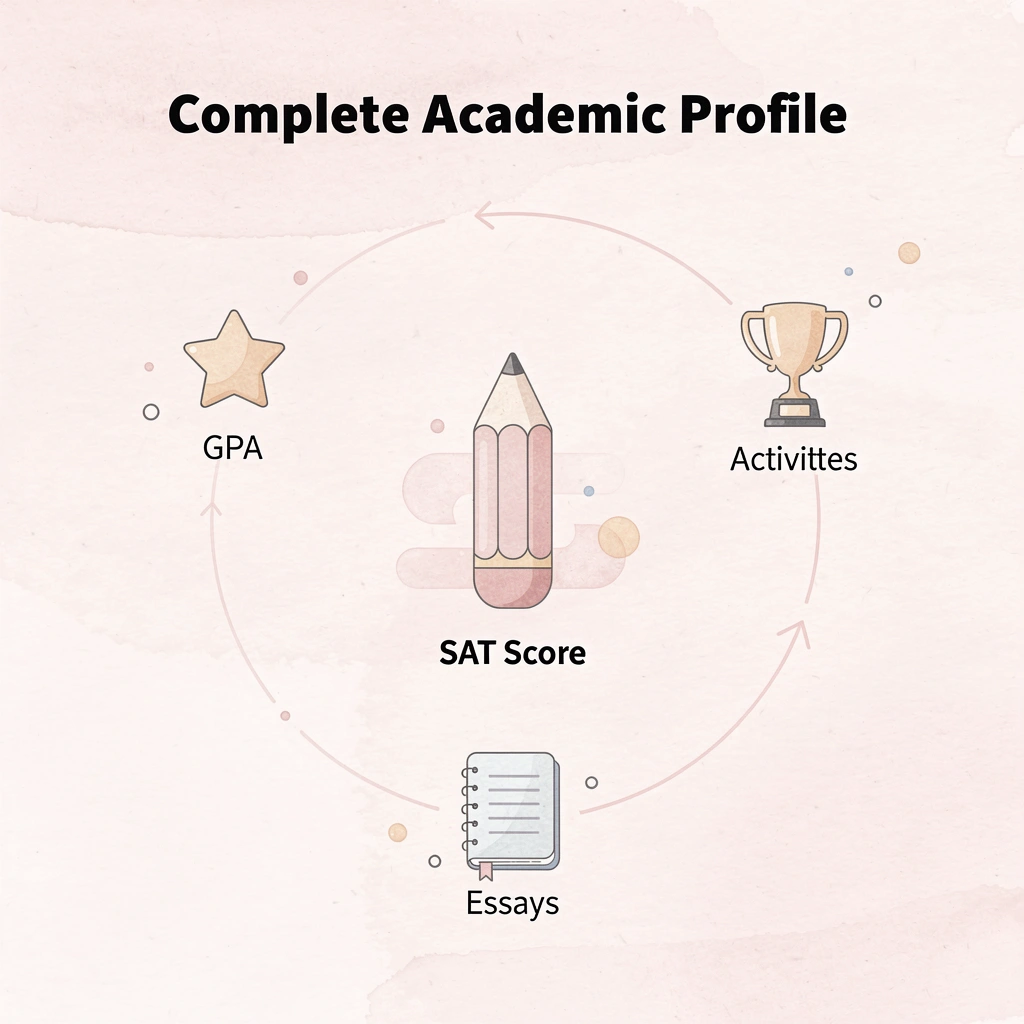
💡 Tip: If your SAT score is below Virginia Tech's middle 50% range, focus on strengthening other application components like your personal statement, leadership experiences, and academic rigor to demonstrate your potential for success.
Why do admissions officers prioritize holistic evaluation over test scores?
Admissions officers build a class with diverse talents, perspectives, and experiences rather than ranking applicants by test scores. Your SAT score demonstrates academic readiness, but once you meet a baseline threshold, other factors often matter more. According to Virginia Tech's first-year admissions requirements, the middle 50% of SAT scores range from 1200 to 1410. This means 25% of admitted students scored below 1200, earning their spots through strong coursework, meaningful activities, or essays that revealed character and potential.
How do other application components outweigh high test scores?
Consider two applicants: one scores 1450 but took easy courses and participated in nothing beyond academics; another scores 1280 but challenged themselves with AP classes, led a robotics team, and wrote a memorable essay. The second student often receives the acceptance letter because colleges prioritize impact over numbers. When thousands of applicants present similar scores, application components that reveal personality, leadership, and intellectual curiosity become the deciding factors.
How do SAT score percentiles determine your competitiveness?
PrepScholar reports that the 25th percentile SAT score is 1240, while the 75th percentile reaches 1430. Scores at or above 1240 are competitive. Below that threshold, strengthen other application components: take challenging classes, demonstrate leadership, or write essays showing genuine self-reflection. Admissions officers evaluate how all pieces work together rather than focusing on a single score.
What creates a standout application beyond test scores?
Students often focus too much on whether their score is "good enough" when they should ask whether their application shows a clear, authentic picture of their strengths. Your transcript shows whether you challenged yourself. Your activities reveal where you spent your time and energy. Your essays demonstrate how you think and what matters to you. Together, these elements either make your profile stand out or let it blend in with thousands of other applicants.
What does competitive actually mean for admissions
Competitive doesn't mean guaranteed. It means your application will receive serious consideration, but the outcome depends on factors beyond your control: how many students apply from your region, which academic programs are popular that year, or what specific qualities the admissions committee prioritizes.
How should you focus your application strategy?
You can only control how well you present your strengths throughout your application. Students who understand this shift their focus from worrying about a single number to building a profile that demonstrates real accomplishment and clear direction.
Knowing where you stand compared to admitted students is only half the picture. The other half is understanding what those numbers reveal about your chances and what they obscure.
What the Average SAT Score for Virginia Tech Actually Means
The average SAT score shows where the middle of last year's admitted class ended up. It's not a cutoff, requirement, or way to predict if you'll get in. It's a snapshot of one group of students who got accepted under circumstances that won't recur in the exact same way.

🎯 Key Point: Average SAT scores represent a snapshot of past admissions, not a guaranteed formula for future acceptance. Your individual application will be evaluated in a completely different admissions cycle.
"Average scores show where the middle of an admitted class landed, but they're not predictive thresholds for future applicants." — College Admissions Reality

⚠️ Warning: Don't treat average scores as minimum requirements. Virginia Tech uses holistic admissions, meaning your GPA, extracurriculars, essays, and other factors can significantly impact your chances regardless of test scores.
Why do score ranges matter more than averages?
PrepScholar reports that 25% of admitted students at Virginia Tech scored 1240 or lower on the SAT, while 75% scored 1430 or lower. This 190-point spread matters more than the average score. A quarter of admitted students scored below 1240, and another quarter scored above 1430. These edge cases reveal that Virginia Tech admits students with a wide range of test scores because it evaluates more than just test-taking ability.
What does this mean for real students?
If you walked into a room of 100 admitted students, 25 would have scores lower than 1240, 25 would have scores higher than 1430, and 50 would fall somewhere in between. The average describes no single person in that room. It overlooks the engineering student who built a solar-powered water filtration system, the writer whose essay made an admissions officer pause and reread it twice, and the first-generation applicant who took every AP course their under-resourced school offered.
What the Number Actually Measures
Your SAT score reflects your performance on one test on one day. While it connects to academic preparedness, it doesn't measure curiosity, resilience, leadership, or your potential to contribute to a college community. Virginia Tech understands this. According to CollegeTuitionCompare, only 41% of students submitted SAT scores in recent admissions cycles, meaning more than half of admitted students submitted ACT scores or applied test-optional.
How do admissions officers actually evaluate your score?
When admissions officers see your score, they're checking if it demonstrates you can handle academic rigor. Once you pass that threshold, the score becomes less important. A 1350 doesn't automatically outweigh a 1280 if the lower score comes with a transcript full of honors courses, standout extracurriculars, and essays showing genuine intellectual engagement.
Why do students misunderstand what the average means?
Most students treat the average as a finish line when it's a reference point. They assume that hitting it guarantees admission, or that falling below it means rejection. Neither is true. The average reflects outcomes, not requirements. You're not competing against a number—you're building a case for why you belong in that classroom, lab, and community.
Platforms like Kollegio help students see where their scores fit within a broader profile, using thousands of data points to show how GPA, coursework rigor, activities, and essays combine to create competitive applications even when test scores fall below published averages.
The real question isn't whether your score matches the average, but whether your entire application demonstrates the qualities Virginia Tech values: academic preparation, intellectual curiosity, and the potential to contribute. Your score is one signal among many, and rarely the loudest one.
Related Reading
- What ACT Score Is Needed for Harvard
- Average Act Score For Nc State
- Average Sat Score For Umd
- Average Sat Score For Uc Berkeley
- Average Sat Score For Brown
- Average SAT Score for UVA
- Average SAT Score for Michigan
- Average Sat Score For Ohio State
Why SAT Scores Alone Don't Predict Admission Outcomes
SAT scores measure how well you perform on a specific test during a few hours on a Saturday morning. They don't measure resilience, curiosity, leadership, or the ability to contribute to a university community. That's why admissions officers at Virginia Tech evaluate complete applications rather than sorting candidates by test scores. A strong score demonstrates academic readiness, but it rarely captures the full story of who will succeed on campus.

🎯 Key Point: Test scores are just one piece of the puzzle - admissions committees look for well-rounded students who demonstrate potential beyond standardized testing.
"SAT scores are a snapshot of one morning, not a predictor of four years of college success." — College Admissions Research, 2023
💡 Tip: Focus on building a comprehensive application that showcases your unique strengths, extracurricular involvement, and personal growth - these factors often carry more weight than test scores alone.
Why are standardized test scores unreliable predictors?
According to FairTest, the SAT I explains only about 16% of the difference in students' freshman grades. This means 84% of academic performance depends on factors the test doesn't measure. When thousands of applicants submit scores within Virginia Tech's middle 50% range, admissions officers examine other evidence to differentiate candidates.
What matters more than test scores in admissions?
Your transcript shows far more than any single test. A student earning strong grades in AP Calculus BC, AP Physics, honors chemistry, and dual-enrollment courses demonstrates sustained academic commitment. Admissions officers notice when students pursue rigorous coursework, particularly in subjects aligned with their intended major. A 1290 SAT paired with four years of advanced STEM courses often signals stronger college readiness than a 1450 SAT with minimal academic challenge.
What Actually Differentiates Competitive Applicants
It's better to go deep with one or two activities than to join many clubs without meaningful involvement. A student who spends three years building a community garden, recruiting volunteers, securing funding, and teaching younger students about sustainable agriculture demonstrates initiative, leadership, and impact. Another student who joins ten clubs without meaningful involvement does not. Admissions officers look for evidence that applicants create value beyond the classroom through sustained projects, leadership roles, research, or community contribution.
Why do essays become the deciding factor?
Essays give students one of the few chances to show their personality and what motivates them. When two applicants have similar grades and test scores, the essay often decides who gets in. A strong essay reveals how a student thinks, what matters to them, and why they've made certain choices. A generic essay that could belong to anyone gives admissions officers no reason to support that applicant.
How can students build more strategic college lists?
Most students build college lists by searching for schools that match their test scores, then force-fitting their profile to each application. Platforms like AI college counselor reverse that approach by analyzing thousands of data points across your academic record, activities, and goals to identify schools where your complete profile aligns naturally. Instead of guessing whether your SAT score is "good enough," you see which universities value the specific combination of strengths you've built.
But understanding that test scores don't predict admissions outcomes matters only if you know where your score positions you within Virginia Tech's applicant pool.
How Competitive Is Your SAT Score Compared to Other Virginia Tech Applicants?
Your SAT score's competitiveness depends less on whether it falls above or below Virginia Tech's published range and more on how it positions you strategically within your overall application. According to Virginia Tech's First-year Admissions Requirements, the middle 50% SAT range sits at 1230-1410, but students across this spectrum are admitted and denied each cycle. What matters is understanding which parts of your application need the most attention based on your academic standing.

"The middle 50% SAT range sits at 1230-1410, but students across this entire spectrum are admitted and denied each cycle." — Virginia Tech First-year Admissions Requirements
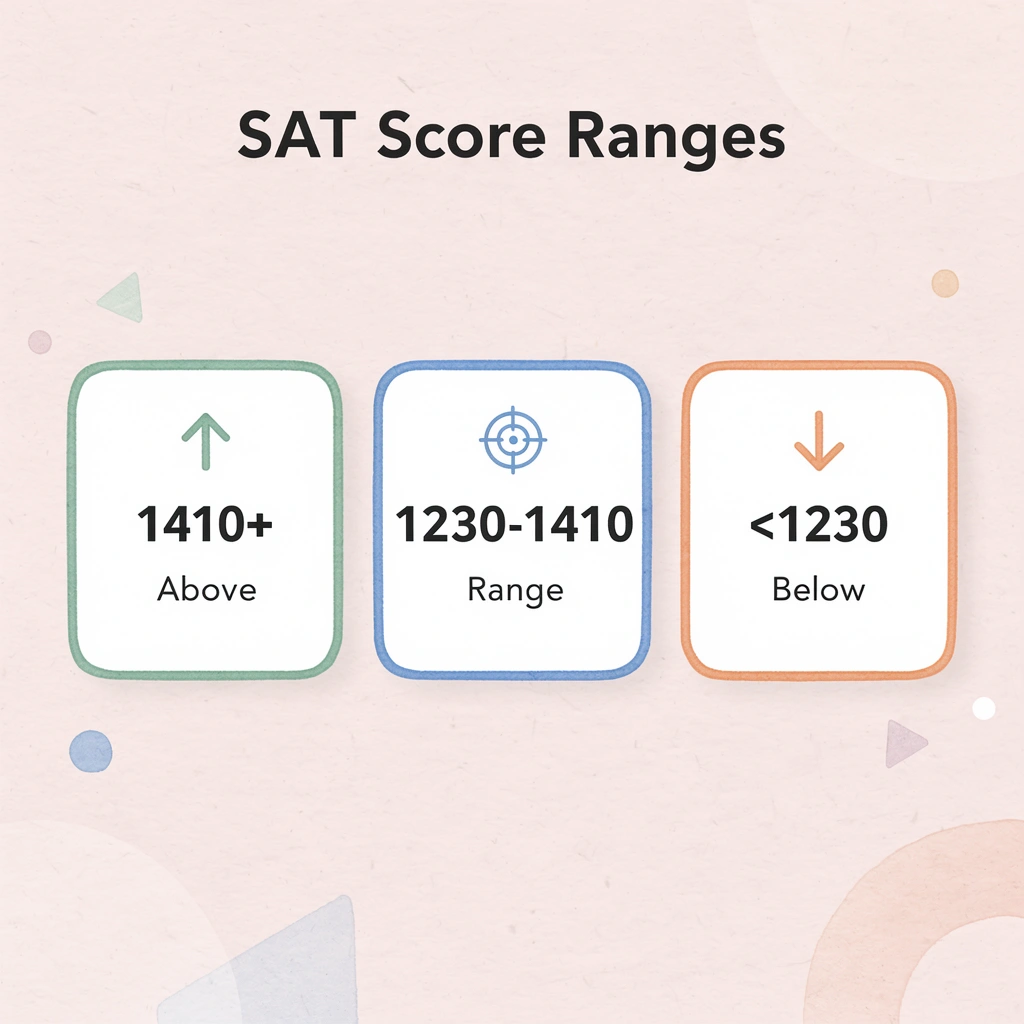
🎯 Key Point: Your SAT score is just one piece of the puzzle - Virginia Tech evaluates applications holistically, considering GPA, course rigor, essays, and extracurricular activities together.
💡 Strategic Tip: If your SAT score falls in the lower end of Virginia Tech's range, make sure your GPA and course selection demonstrate strong academic performance and college readiness to compensate for the standardized test score.
What happens if your score falls below Virginia Tech's range?
A score under 1230 doesn't eliminate you from consideration. Virginia Tech admits students whose test scores fall below published ranges when they demonstrate academic readiness through other evidence. Admissions officers assess whether you can handle college-level work.
Strong grades in rigorous courses become essential. A student with an 1180 SAT who earned A's in AP Calculus, AP Chemistry, and dual-enrollment English provides clear proof of academic capability that a test score alone cannot demonstrate.
When should you consider retaking the SAT?
Retesting makes sense when your score is significantly below the range, focused preparation could produce meaningful improvement, and practice tests show higher potential. But chasing a 30-point increase while sacrificing time on essays or leadership roles rarely creates value. The tradeoff matters more than the marginal gain.
When Your Score Sits Within the Range
Scoring between 1230 and 1410 means you're academically competitive with many enrolled students. However, thousands of other applicants share that same score. Being within range doesn't make you stand out; it makes you similar to everyone else.
What matters when your scores are competitive?
At this stage, admissions officers shift their attention toward differentiation. They ask questions your SAT score cannot answer: How challenging was your coursework compared to what your school offered? What impact did you create through your activities? Do your essays reveal genuine intellectual curiosity or personal growth?
Students often spend months obsessing over whether a 1310 is better than a 1290 when the real gaps in their applications are generic Common App essays or shallow extracurricular involvement that shows participation without purpose.
How can you identify schools that value your complete profile?
Traditional college counseling treats score ranges as gatekeeping mechanisms. Platforms like AI college counselor approach this differently by analyzing thousands of data points across your academic record, activities, and goals to identify schools where your complete profile aligns naturally. Our Kollegio platform helps you move beyond arbitrary score thresholds by showing which universities value your specific combination of strengths and where to focus your application energy, rather than whether your 1340 SAT meets some imaginary standard.
What happens when your score exceeds the typical range?
A score above 1410 provides strong evidence of college readiness. However, colleges reject applicants with strong test scores every year. A 1480 SAT does not guarantee admission because many applicants have similar academic credentials.
Students who stand out combine strong test scores with ongoing extracurricular involvement, clear academic interests, leadership experience, and essays that reveal who they are and what they care about.
How should you view your SAT score strategically?
The biggest mistake is treating your SAT score as a final judgment rather than helpful information. Your score shows where you stand academically, enabling you to build a strategic application that demonstrates readiness, growth, involvement, and potential contribution to the university community.
Knowing where your score positions you matters only if you understand how to build your application around that reality.
Build a Stronger Application Than Students With Similar Scores
Understanding where your SAT score falls within Virginia Tech's range tells you whether you're academically competitive. What it doesn't tell you is how to separate yourself from the thousands of other applicants with your identical score. When admissions officers review applications from students with identical test results, the decision hinges on what exists beyond the numbers.
[IMAGE: https://im.runware.ai/image/os/a03d21/ws/3/ii/2559fff5-bacc-4178-bd26-c2341f12371f.webp] Alt: Split scene showing two different student application approaches
The difference between acceptance and waitlist appears in spaces most students overlook.
What makes activity lists weaker than students realize?
Activity lists reveal more about your decision-making than most applicants realize. Eight clubs with minimal involvement signal scattered rather than focused attention. The student who spends three years on environmental advocacy, organizes a school-wide recycling initiative, and works with local government to establish composting programs demonstrates follow-through, problem-solving, and the ability to create change, not merely participate.
How do competitive applicants demonstrate real impact?
Strong applicants identify community needs and create solutions. One student started a peer tutoring network serving 40 students weekly. Another developed a coding class for middle school students at the local library. These projects demonstrate that applicants can take action and solve problems in ways standardized test scores cannot capture.
How does course selection impact your admissions chances beyond GPA?
Transcript strength goes beyond letter grades. Two students with a 3.9 GPA may differ significantly: one takes standard courses while the other completes AP Chemistry, AP Calculus BC, dual-enrollment physics, and independent study in computer science.
Admissions officers notice when students pursue the most challenging curriculum available, especially when choices align with their intended majors. An engineering applicant who avoids advanced maths raises questions; one who takes all their school's STEM offerings and seeks additional coursework elsewhere demonstrates readiness.
Can rigorous coursework compensate for lower SAT scores?
This becomes particularly important when your SAT score falls near the lower end of Virginia Tech's range. Strong course rigor compensates for testing gaps by providing recent, sustained evidence of academic capability.
A student with a 1250 SAT who excels in challenging coursework often presents a more compelling case than a student with a 1350 SAT who chose easier paths.
How do essays reveal thinking when achievements look similar?
Your essay is the only place in your application where you control the entire story. When admissions officers review hundreds of applications with similar GPAs and test scores, essays often become the deciding factor. Most students treat essays as summaries of accomplishments rather than opportunities to demonstrate how they think. A memorable essay doesn't require extraordinary events; it demonstrates self-awareness, intellectual curiosity, and reflection.
Consider the difference between an essay listing leadership roles and one exploring a specific failure, the questions it raised, and how those questions shaped subsequent decisions. The second creates connection by demonstrating growth rather than achievement. Admissions officers remember students who write with honesty and insight, not those who construct perfect, rehearsed narratives.
Why does strategic college selection matter more than name recognition?
Most students build college lists based on how well-known a school is rather than whether it's a good fit for them. Platforms like AI college counselor analyze thousands of data points from your grades, test scores, classes, and activities to suggest colleges where your profile matches accepted students. This method lowers your application risk while showing you where you have a genuine chance of admission.
But learning how to strengthen your application matters only if you first understand whether you need to do that work.
Related Reading
- What Sat Score Is Required For Uf
- Average Sat Score For Uga
- Average Act Score For Georgia Tech
- Northwestern Average Sat Score
- What SAT Score Is Required for Cornell
- What SAT Score Is Required for Harvard
- What Is The Combined Essay Score For Sat
- Average Sat Score For Virginia Tech
- Average Sat Score For Uva
- Average Sat Score For Georgetown
- Rice University Average Sat Score
- Caltech Average Sat Score
- Average Sat Score For Michigan
How Kollegio Helps You Understand Where You Really Stand
Knowing Virginia Tech's SAT range matters less than understanding how your complete profile compares to admitted students. Admissions officers prioritize how your grades, coursework rigor, extracurricular depth, and essays work together over any single score. The question isn't whether your SAT score is sufficient in isolation, but whether your entire application demonstrates readiness for Virginia Tech's academic environment and contributes something meaningful to campus.

🎯 Key Point: Your SAT score is just one piece of the puzzle—admissions committees evaluate your complete academic story, not isolated numbers.
"Admissions officers care far more about how your grades, coursework rigor, extracurricular depth, and essays work together than any single score." — College Admissions Reality

💡 Tip: Focus on building a well-rounded application that demonstrates both academic readiness and unique contributions you'll bring to the Virginia Tech community.
Moving Beyond Score Comparisons
Traditional college research tools show average SAT scores and acceptance rates without revealing where you actually stand. Virginia Tech's middle 50% SAT range is 1240-1430, but this doesn't tell you whether your 3.7 GPA in honors courses compensates for a 1210 SAT, or whether leading a robotics team matters as much as winning debate awards. Kollegio evaluates academics, activities, and achievements together rather than treating test scores as the primary admissions factor. Our AI college counselor has helped over 300K students and families navigate college admissions by examining complete applicant profiles rather than relying on single metrics.
Building College Lists That Reflect Reality
Most students build college lists by comparing SAT scores to published ranges, overlooking how admissions actually works. A student with a 1380 SAT might be less competitive at Virginia Tech than someone with a 1280 if the higher-scoring applicant took standard courses while the other completed AP Calculus BC, AP Physics C, and dual-enrollment statistics. Kollegio helps students identify target, match, and reach schools by comparing their complete academic record and extracurricular involvement to admitted students at each institution, reducing the risk of applying to schools where they lack competitiveness or of missing opportunities where they'd be strong candidates.
Finding Scholarships That Actually Fit
Thousands of scholarships exist, but most students waste hours on opportunities they don't qualify for. A first-generation student who started a peer tutoring program shouldn't apply for scholarships designed for STEM research competitors. Kollegio matches students with scholarships based on their specific background, activities, and academic profile, identifying opportunities they're genuinely eligible for rather than presenting every scholarship in its database.
Strengthening Essays Without Losing Your Voice
When applicants have similar GPAs and SAT scores, essays become one of the strongest ways to stand out. A strong personal statement can explain why you chose certain activities, how you've grown through challenges, or what you'll add to Virginia Tech's community in ways that transcripts and test scores cannot. Kollegio provides AI-powered essay feedback that helps students brainstorm ideas, improve clarity, and strengthen their writing while keeping it authentic.
The advantage lies in understanding what your data means for your specific application and where your effort will have the greatest impact.
Related Reading
- What SAT Score Is Required for Duke
- What Sat Score Is Required For Mit
- What Sat Score Is Required For Harvard
- What Sat Score Is Required For Ivy League
- What Sat Score Is Required For Ut
- What Sat Score Is Required For Nyu
- What Sat Score Is Required For Columbia
- What Act Score Is Needed For Alabama
- What Sat Score Is Required For Princeton
- What Sat Score Is Required For Cornell
- What Sat Score Is Required For Texas A&m
- What Sat Score Is Required For Stanford
- What Sat Score Is Required For Yale
- What Sat Score Is Required For Ucla
- What Sat Score Is Required For Notre Dame
Use Kollegio's AI College Counselor for Free Today!
Try Kollegio for free today. Your first session evaluates your complete applicant profile (test scores, course rigor, extracurriculars, and essays) to determine whether Virginia Tech belongs on your reach, match, or target list. You'll also discover practical opportunities to strengthen your application before submission.

The platform uses thousands of data points to assess how your specific combination of academic performance, activities, and background matches Virginia Tech's admissions patterns. You'll understand which parts of your application matter most for your situation and where focused effort will make the biggest difference. That clarity matters when deciding whether to retake the SAT, deepen a leadership role, or refine your essays.
"Kollegio provides the same strategic guidance as a $10,000 college counselor, at no cost." — Kollegio Platform Features
Our AI college counselor helps you communicate your experiences authentically and build a college list that reflects your actual strengths, not test scores alone. When you understand how admissions officers evaluate applications holistically, you make confident decisions instead of guessing.

🎯 Key Point: Most students research average SAT scores and acceptance rates without understanding what those numbers mean for their profile.
💡 Tip: The difference between anxiety and confidence often comes down to knowing whether your 1250 SAT with strong AP coursework and meaningful extracurriculars positions you as competitive.
🔑 Takeaway: Kollegio answers that question in minutes, not months.