
Average SAT Score for Vanderbilt: What Score Do You Really Need?
Vanderbilt University attracts thousands of high-achieving students each year, making standardized test scores a crucial factor in admissions decisions. Understanding Vanderbilt's average SAT score helps applicants gauge their competitiveness and set realistic targets. Just as students researching what ACT score is needed for Harvard want clear benchmarks, prospective Commodores need straightforward data about Vanderbilt's expectations. The university's admitted students typically score well above national averages, reflecting the institution's academic rigor and selectivity.
Successful applicants generally fall within specific score ranges that align with Vanderbilt's academic standards and peer institutions. These benchmarks provide valuable insight into admission requirements, though test scores represent just one component of a holistic review process. Students seeking personalized guidance to meet these standards and strengthen their overall applications can benefit from working with an AI college counselor.
Summary
- Vanderbilt's average SAT score of 1540 sits more than 500 points above the national average of approximately 1029, creating a competitiveness gap that surprises many applicants who performed well in their own schools. This extreme concentration of high scorers means test performance functions as a baseline expectation rather than a distinguishing factor when thousands of candidates present nearly identical credentials within the 1510-1560 range.
- The middle 50% of admitted students scored between 1510 and 1560, a remarkably narrow 50-point band that reveals how academically uniform Vanderbilt's admitted class has become. One in four admitted students scored below 1510, which still places them in roughly the 99th percentile nationally, demonstrating that, by most standards, exceptional scores represent the lower boundary at highly selective institutions.
- Vanderbilt functions as a reach school for nearly every applicant because fewer than 5% receive offers, even when their credentials exceed the published averages. When acceptance rates drop to 10 times the 50% threshold that typically defines match schools, no amount of credential matching changes the fundamental math of extreme selectivity.
- Course rigor evaluation depends on whether students maximized opportunities available at their specific high school rather than on absolute AP course counts. A student who completed every advanced course at a small rural school demonstrates initiative comparable to that of a student at a well-resourced suburban school with twice as many options, because admissions officers assess challenge relative to context.
- Sustained extracurricular commitment over multiple years demonstrates more meaningful impact than superficial participation across numerous activities. A student who spent three years building a community tutoring program from five participants to fifty reveals a capacity for long-term contribution that resume building through late-stage club joining cannot replicate.
- Kollegio's AI college counselor analyzes academic metrics, extracurricular depth, leadership experiences, and essay strength together to classify schools as reach, match, or target based on how your complete profile compares to admitted students across multiple dimensions.
The Average SAT Score for Vanderbilt Is Higher Than Most Students Expect
Many students research colleges by comparing their SAT scores to Vanderbilt's average, assuming this number reflects their chances of admission. If your score matches the average, you feel confident. If it falls below, you expect rejection.
💡 Tip: Average SAT scores tell only part of the admissions story—don't rely on them alone to gauge your chances.

The problem is that average SAT scores give a wrong picture of how competitive admissions are.
⚠️ Warning: Average scores can be misleading because they don't show the full range of accepted students or other crucial factors like GPA, extracurriculars, and essays.
"Average SAT scores give a wrong picture of how competitive admissions are at top-tier universities like Vanderbilt." — College Admissions Reality Check
🔑 Takeaway: Understanding the complete admissions landscape requires looking beyond average test scores to assess your chances realistically.
How does Vanderbilt's SAT average compare nationally?
PrepScholar reports an average SAT score of 1540 for Vanderbilt's admitted students, placing the school among the most selective universities in the country. For context, College Board data show that the class of 2025 averaged 521 in Reading and Writing and 508 in Math, for a total of approximately 1029. Vanderbilt's admitted students score more than 500 points above the national average.
What mistakes do students make with SAT averages?
This leads to two common mistakes. First, some students believe that matching Vanderbilt's average SAT score makes them a strong admissions candidate, not realizing that many applicants have scores within or above that range. Test scores demonstrate academic readiness but rarely distinguish an applicant on their own. Second, some students eliminate schools after seeing below-average test scores. Admissions officers evaluate academic rigor, GPA, extracurricular involvement, leadership, recommendations, and essays, not test scores alone.
Why should you look beyond the average SAT score?
SAT scores remain a primary tool for comparing students because they're easy to measure in an otherwise unclear process. However, admissions decisions at highly selective institutions are far more complex. Understanding what Vanderbilt's average SAT score means is important: it shows the academic profile of admitted students, not a minimum requirement or admission guarantee. Rather than asking, "Do I match Vanderbilt's average SAT score?" ask instead, "How does my overall application compare to the students Vanderbilt typically admits?" This approach gives you a clearer picture of your competitiveness. But knowing the average tells only part of the story; the range of admitted scores reveals what matters more.
What Is the Average SAT Score for Vanderbilt?
PrepScholar reports an average SAT score of 1540 for students admitted to Vanderbilt. To understand what this means, examine the full distribution of scores, not just the average.

💡 Key Point: A 1540 SAT score places Vanderbilt in the highly competitive category, with admitted students typically scoring in the top 1-2% of all test takers nationwide.
"An average SAT score of 1540 represents students scoring in the 99th percentile, making Vanderbilt one of the most selective universities in the country." — PrepScholar Analysis
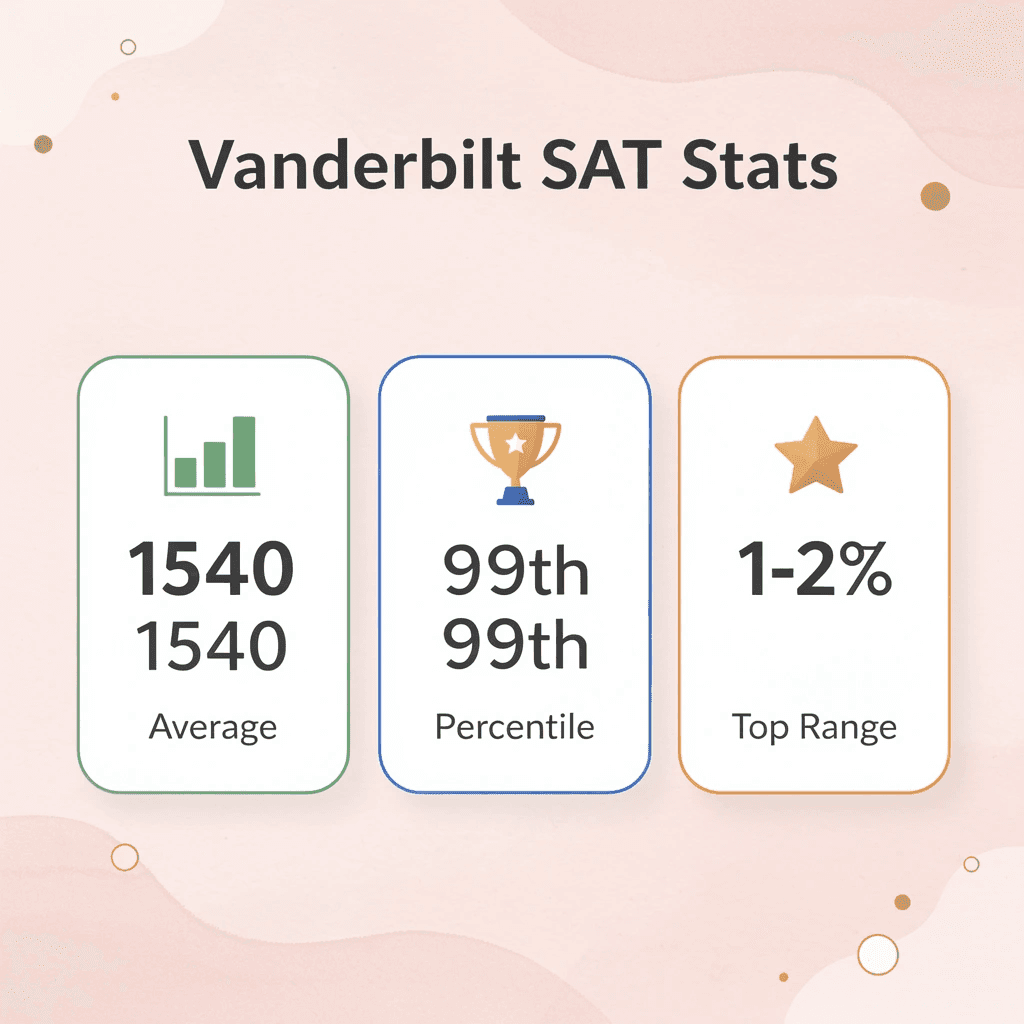
🎯 Important: The average score tells only part of the story - understanding the 25th-75th percentile range gives you a much clearer picture of your admission chances and what scores are actually competitive for Vanderbilt applicants.
The range matters more than the midpoint
The middle 50 percent of admitted students scored between a 25th-percentile SAT score of 1510 and a 75th-percentile score of 1560. This narrow 50-point band demonstrates how academically similar Vanderbilt's admitted class has become: one in four students scored below 1510, while another quarter scored above 1560. A 1510 places you in roughly the 99th percentile nationally, yet at Vanderbilt, it sits at the lower boundary of the middle range. This doesn't mean a 1510 is weak; it means the applicant pool has become so competitive that nearly every admitted student brings test scores considered outstanding at most other universities.
Why do students misinterpret average score data?
Students often treat the average as a target score, assuming that hitting 1540 makes them competitive. Thousands of applicants submit scores at or above 1540 every year, yet Vanderbilt admits fewer than 5 percent of its total applicant pool. The score demonstrates academic readiness but doesn't set you apart from the majority of applicants with similar credentials.
What factors do students underestimate in admissions?
Students focus on what they can measure—test scores and GPA—while underestimating harder-to-quantify factors: the rigor of coursework, the depth of extracurricular commitments, the authenticity of essays, and the strength of recommendations. Admissions officers seek students who will contribute meaningfully to campus life, not simply perform well on standardized tests.
How can students move beyond score-focused college planning?
Sorting through score ranges, comparing your profile across dozens of schools, and assessing your competitiveness without expert guidance can create unnecessary stress and often lead to mismatched college lists. Tools like AI college counselor help students move past guesswork by analyzing thousands of admissions data points to recommend schools where their complete profile, not just test scores, aligns with what admissions teams value. The average tells you where the center lies, but it doesn't explain why some students with lower scores are admitted while others with higher scores aren't.
Related Reading
- What ACT Score Is Needed for Harvard
- Average Act Score For Nc State
- Average Sat Score For Unc
- Average Sat Score For Ohio State
- Average Sat Score For Umd
- Average Sat Score For Uc Berkeley
- Average Sat Score For Brown
Why Matching the Average SAT Score Does Not Guarantee Admission
Matching Vanderbilt's average SAT score puts you in the middle of a competitive group. When thousands of applicants have scores between 1510 and 1560, test performance becomes expected rather than something that makes you stand out. Admissions officers use scores to confirm that students are ready for college work, but they make decisions based on what students have built, led, and contributed beyond standardized testing.

🎯 Key Point: Having a competitive SAT score is just the entry ticket to be considered—it doesn't guarantee admission when most applicants have similar scores.
"When thousands of applicants have scores between 1510 and 1560, test performance becomes something that is expected rather than something that makes you stand out." — Vanderbilt Admissions Reality
⚠️ Warning: Don't assume that hitting the average score means you're a shoo-in for admission. The real competition happens in extracurriculars, essays, and leadership experience.
What makes credential saturation such a challenge?
The challenge intensifies when considering how many students arrive with nearly identical academic profiles. Education Week reports differences between student grades and standardized test scores, demonstrating that colleges must examine deeper patterns of success rather than relying solely on test scores. A 1540 SAT score shows you can do the work, but it doesn't explain who you are or what you'll add to campus life. When acceptance rates drop below 5 percent, admissions teams must choose between hundreds of academically qualified students who look similar on paper.
How do colleges differentiate between similar candidates?
This is where holistic review becomes tangible. Officers assess intellectual curiosity through course selection, leadership through sustained extracurricular involvement, and character through recommendation letters.
Two applicants with identical SAT scores may present different stories: one spent three years building a nonprofit serving underrepresented students, while another focused solely on test preparation. Both are capable, but only one demonstrates the initiative and impact that selective universities prioritize.
What Actually Separates Competitive Applicants
The strongest applications show depth rather than breadth. Admissions officers notice students who commit to meaningful work over multiple years and demonstrate growth, resilience, and measurable impact. A student who founded a coding club that expanded from five members to fifty, secured funding, and partnered with local schools demonstrates more than technical skill: the ability to identify problems, mobilize resources, and sustain effort through challenges. That narrative carries more weight than a slightly higher SAT score.
Why do families focus too heavily on test score averages?
Most families build their college list by comparing test scores to published averages, then removing schools where scores fall below the middle 50 percent. This approach creates unnecessary worry and often results in mismatched lists. Our AI college counselor at Kollegio analyzes thousands of admissions data points to suggest schools where a student's complete profile, not test scores alone, matches what admissions teams value.
How do coherent application stories outweigh higher scores?
Strong applications tell coherent stories. Essays connect to extracurricular experiences that reflect values mentioned in recommendation letters and align with academic choices. Admissions officers discern authentic pursuits from strategic ones. A 1560 SAT score paired with a disjointed application loses to a 1520 paired with a compelling, consistent narrative. But test scores aren't the only numbers that matter, and understanding how Vanderbilt weighs different academic metrics reveals what admissions officers prioritize.
How Vanderbilt Evaluates Applicants Beyond Test Scores
Vanderbilt evaluates applicants through a holistic review process that considers academic rigor, extracurricular depth, leadership impact, intellectual curiosity, and personal character alongside test scores. When thousands of applicants present SAT scores within the 1510-1560 range, admissions officers distinguish candidates by examining how they've challenged themselves academically, contributed to their communities, and demonstrated genuine passion for learning. Test scores confirm readiness, but the rest of the application reveals potential.

🎯 Key Point: Your test scores get you in the door, but your unique experiences and demonstrated impact are what make you stand out in Vanderbilt's competitive applicant pool.
"When thousands of applicants present SAT scores within the 1510-1560 range, admissions officers tell candidates apart by looking at how they've challenged themselves academically and shown genuine passion for learning." — Vanderbilt Admissions Insight

⚠️ Warning: Don't assume that hitting Vanderbilt's middle 50% test score range guarantees admission—the majority of your application success depends on non-academic factors that demonstrate your fit and potential contribution to campus.
Why does course rigor matter more than GPA alone?
Admissions officers assess whether students maximized the academic opportunities available to them. A student who completed every AP course at a small rural school demonstrates the same effort as one at a well-resourced suburban school with twice as many options. The question isn't whether you took 15 AP courses, but whether you pursued the most challenging curriculum you could access.
How does academic trajectory influence admissions decisions?
Your academic path matters. Steady improvement over four years demonstrates resilience and intellectual growth. A student who struggled freshman year but improved through junior year often presents a stronger narrative than one whose grades plateaued after sophomore year, even with identical overall GPAs.
Depth beats breadth in extracurricular evaluation
Admissions officers focus on sustained commitment over breadth. A student who built a community tutoring program from five to fifty students has a greater impact than one who joined ten clubs without leadership roles or measurable contributions. The quality of involvement reveals character, work ethic, and the capacity to create change. Leadership extends beyond formal titles: starting initiatives, solving problems, mentoring peers, or mobilizing others around causes all demonstrate leadership capacity. According to AdmitStudio, only about 6 out of every 100 applicants gain admission, making these qualitative factors crucial for differentiation when academic credentials cluster tightly together.
How do essays transform statistics into human stories?
Application essays reveal how students think, what motivates them, how they've grown from failure, and what drives their intellectual curiosity—details that accomplishments listed elsewhere cannot convey. Strong essays feel genuine, specific, and reflective rather than polished to the point of losing individual voice. Admissions officers read thousands each cycle, and the ones that stand out do so through authenticity.
How can students objectively evaluate their applications?
Most students lack examples from thousands of other applications to fairly judge their own. Platforms like AI college counselor help by examining course difficulty, extracurricular activities, essay topics, and grades together rather than separately, allowing students to identify their real strengths and address weak areas before applying. But knowing how you compare to other applicants matters only if you're considering the right schools.
Related Reading
- What Sat Score Is Required For Uf
- Caltech Average Sat Score
- Average Sat Score For Uga
- What Is The Combined Essay Score For Sat
- Average Sat Score For Virginia Tech
- Northwestern Average Sat Score
- Average Sat Score For Michigan
- Rice University Average Sat Score
- Average Sat Score For Uva
- Average Act Score For Georgia Tech
- Average Sat Score For Georgetown
How to Determine Whether Vanderbilt Is a Reach, Match, or Target School
For nearly every applicant, Vanderbilt works as a reach school. With acceptance rates below 5%, even students whose credentials exceed the published averages face significant uncertainty. The question isn't whether your SAT score qualifies you; it's whether your complete application stands out in a pool where thousands of candidates present nearly identical academic profiles.

"Match schools typically have a 50% acceptance rate or higher for applicants whose profiles match up with admitted student averages. Vanderbilt's acceptance rate sits ten times lower than that threshold." — CollegeVine Blog
This reality frustrates students with competitive credentials. According to the CollegeVine Blog, match schools typically have a 50% acceptance rate or higher for applicants whose profiles align with admitted student averages. Vanderbilt's acceptance rate sits ten times lower than that threshold.
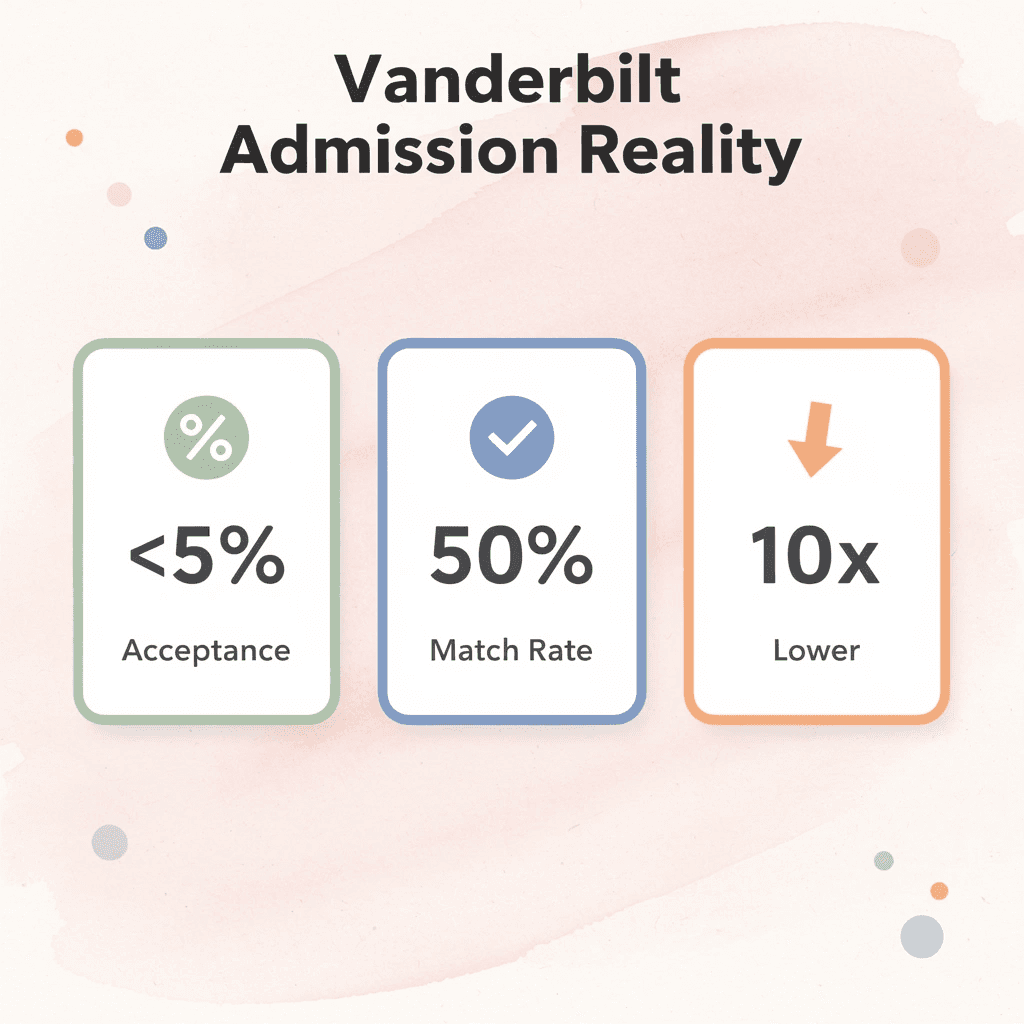
🎯 Key Point: Even if your stats exceed Vanderbilt's published averages, the ultra-low acceptance rate means you should always classify it as a reach school in your college planning strategy.
⚠️ Warning: Don't let strong test scores or high GPA create false confidence—holistic admissions at elite schools like Vanderbilt mean academic credentials alone aren't enough to guarantee admission.
How does your academic foundation position you?
Start by comparing your academic foundation to Vanderbilt's admitted student profile. If your SAT or ACT score falls within or above the middle 50% range, your GPA demonstrates strong performance in rigorous coursework, and your class rank places you among the top students, you've met the baseline threshold. However, this doesn't move Vanderbilt from reach to match status, given that 95% of applicants receive rejection letters.
What makes extracurricular involvement distinctive?
Next, evaluate how deep and unique your extracurricular involvement is. Admissions officers look at sustained commitment, meaningful impact, and leadership, not the number of activities you join. A student who spent three years building a community tutoring program from five to fifty participants tells a different story than one who joined five clubs in their senior year. The former demonstrates the capacity for long-term contribution; the latter suggests resume-building.
How do institutional priorities affect your competitiveness?
Think about what Vanderbilt cares about when building each class. The school looks at where students come from geographically, what they want to study, whether they come from underrepresented backgrounds, and what special talents they have. Your application is compared with those of other students with similar profiles. How competitive you are depends on how many other applicants share your characteristics.
Why do students misunderstand school classifications?
The confusion stems from treating published statistics as predictive of admission. Students see their scores fall within Vanderbilt's middle 50% range and assume they're a good fit, but acceptance rates below 5% mean that strong credentials alone cannot predict acceptance. Others rule out schools entirely when their scores fall at the 25th percentile, not realizing that 25% of admitted students scored at or below that mark.
What tools help evaluate complete admission profiles?
Students building college lists need tools that evaluate complete profiles against realistic admission probabilities, not just test-score alignment. Platforms like Kollegio analyze course rigor, extracurricular depth, essay strength, and academic performance together, helping students understand how admissions officers might interpret their entire application within Vanderbilt's applicant pool. Understanding whether Vanderbilt qualifies as a reach matters only if you know what that classification means for your application strategy and how to build a college list that maximizes both opportunity and realistic outcomes.
How Kollegio Helps You Assess Your Vanderbilt Admissions Chances
How does Kollegio assess your Vanderbilt admissions competitiveness?
Figure out how competitive you are for Vanderbilt by analyzing how your complete profile compares to admitted students across multiple areas, not just test scores. Our Kollegio assessment combines academic metrics, extracurricular depth, leadership impact, and essay strength into a single framework that ranks your application relative to Vanderbilt University's 6% acceptance rate.
Why do traditional assessment methods fall short for competitive schools?
Most students assess their chances by manually comparing SAT scores to published ranges and guessing whether extracurriculars meet standards based on forum advice. As application complexity increases—balancing GPA context, course rigor, activity descriptions, essay narratives, and recommendation quality—this fragmented approach creates critical gaps. Students overestimate their strength in one area while overlooking weaknesses in another, or they abandon competitive schools because they cannot see how their full story compensates for a single lower metric.
How do AI platforms provide comprehensive application analysis?
AI college counselor platforms like Kollegio analyze thousands of data points across your entire application to create personalized college recommendations that classify schools as reach, match, or target based on your specific strengths. Rather than wondering whether a 1520 SAT balances weaker leadership experience, you receive positioning that accounts for how admissions officers weigh each component, identifies scholarship opportunities, and provides essay feedback that strengthens your narrative.
How does this assessment reveal your true admissions position?
The platform shows which application components strengthen your Vanderbilt candidacy and which need development. A student with a 1530 SAT and strong GPA but minimal extracurricular depth learns that academic metrics meet baseline expectations, yet the application lacks differentiation in a pool where Vanderbilt University reports an SAT range of 1510-1560 among admitted students. Another student with a 1490 SAT but three years of sustained community impact through a self-started nonprofit discovers that leadership narrative and demonstrated initiative may compensate for slightly lower test performance.
What actionable strategy emerges from this clarity?
This clarity transforms vague worry into an actionable plan. You stop asking whether you're "good enough" and start identifying the specific improvements that would move your application from a long shot to a real possibility. Understanding where you stand helps only if you turn that assessment into concrete decisions about where to apply, how to spend your application effort, and which stories to emphasize in essays.
Use Kollegio's AI College Counselor for Free Today!
Kollegio's AI college counselor analyzes your academic metrics, extracurriculars, leadership experiences, and goals to create a personalized assessment of your competitiveness across dozens of schools. Each school gets sorted into reach, match, or target based on thousands of data points. You get a tailored college list that shows exactly where your application strengths put you, which schools are realistic opportunities, and where you might need to strengthen specific parts before applying.
🎯 Key Point: The AI analyzes multiple dimensions of your profile simultaneously, giving you a comprehensive view rather than just looking at test scores or GPA in isolation.
"Thousands of data points power each school assessment, creating personalized reach, match, and target categories for every applicant."
Assessment Category | What It Means | Action Required |
|---|---|---|
Reach Schools | Low admission probability | Strengthen weak areas |
Match Schools | Moderate admission probability | Maintain current trajectory |
Target Schools | High admission probability | Apply confidently |
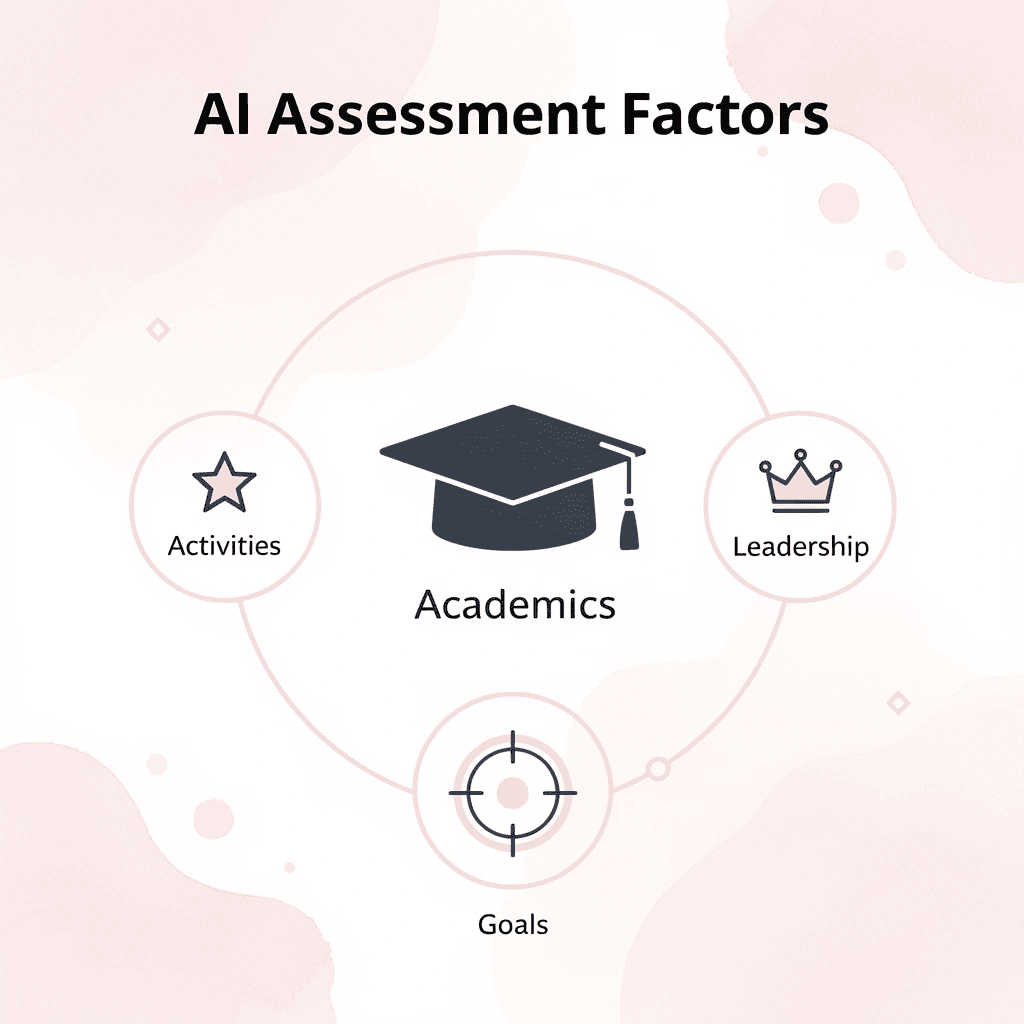
When you create your free Kollegio profile, you stop wondering whether a 1520 makes Vanderbilt worth the effort and start seeing how your complete application compares to admitted student profiles across multiple dimensions. That clarity lets you allocate time strategically, focusing essay effort on schools where your profile creates genuine competitive advantage rather than spreading energy across fifteen applications. The assessment generates insights in minutes that typically require hours of research across fragmented sources.
🔑 Takeaway: Strategic time allocation based on data-driven insights can dramatically improve your admission outcomes compared to the traditional "spray and pray" approach.
💡 Tip: Use your competitive advantage analysis to prioritize which schools deserve your best essay drafts and most polished supplemental responses.
Related Reading
- What Sat Score Is Required For Columbia
- What Sat Score Is Required For Princeton
- What Sat Score Is Required For Texas A&m
- What Sat Score Is Required For Stanford
- What Sat Score Is Required For Harvard
- What Sat Score Is Required For Ivy League
- What Sat Score Is Required For Notre Dame
- What Sat Score Is Required For Mit
- What Act Score Is Needed For Alabama
- What Sat Score Is Required For Ucla
- What Sat Score Is Required For Nyu
- What Sat Score Is Required For Duke
- What Sat Score Is Required For Yale
- What Sat Score Is Required For Ut
- What Sat Score Is Required For Cornell
Author
Trailblazer Marketing