
The average SAT score for Ohio State falls between 1230 and 1430, and knowing where a student stands within that range can shape everything from test prep priorities to application strategy. Understanding what admitted students typically score gives applicants a realistic benchmark and a clearer sense of what it takes to be competitive.
Stop wondering.
Start matching.


Hitting a target score is only half the challenge; knowing how to get there is the other half. For personalized guidance on Ohio State's SAT expectations and a concrete plan to improve admission odds, students can turn to Kollegio's AI college counselor.
Table of Contents
- The average SAT Score for Ohio State Can Feel Hard to Interpret
- What Is the Average SAT Score for Ohio State?
- Why SAT Scores Alone Do Not Determine Admission
- How to Know Whether You Should Retake the SAT
- Building a Strong Ohio State Application Beyond Test Scores
- How Kollegio Helps You Understand Your Chances at Ohio State
- Use Kollegio's AI College Counselor for Free Today!
Summary
- Ohio State's middle 50% SAT range for admitted students sits between 1270 and 1480, with an informal midpoint around 1375. Most students treat that midpoint as a cutoff, but it is a distribution, not a threshold. Students scoring in the 1270s have earned admission, and so have students scoring at 1480, for different combinations of reasons.
- Ohio's statewide average SAT score is 1027, below the national average of 1029, which makes Ohio State's admitted student average of roughly 1375 significantly above both state and national benchmarks. That gap signals genuine selectivity, but selectivity that operates across a wide range rather than at a single fixed point. A student scoring 1300 is competing within a class that includes students at both ends of that spectrum.
- Retaking the SAT is most likely worth the investment when a student's score falls below the 25th percentile of admitted students (1280), because closing that gap moves them from an outlier position into the middle of the admitted pool. Students already scoring within the competitive range often gain more by investing those months in essays, leadership roles, or research projects. The retake decision should also account for program-specific expectations, since engineering and business tracks at Ohio State tend to skew toward the upper end of the admitted range.
- SAT scores are only one part of how Ohio State evaluates applicants. The university reports an average admitted GPA of 3.8 or higher, and academic consistency across four years carries weight that a single test sitting cannot replicate. Beyond grades, admissions readers look for depth of extracurricular involvement, genuine leadership, and essays that are specific and honest rather than polished and generic.
- The broader test-optional shift adds important context to how much weight scores carry. Only 39% of 2025 SAT takers met college readiness benchmarks, down from 45% in 2019, and more than 80% of U.S. four-year colleges will not require SAT scores for fall 2025 admissions, according to FairTest. Selective universities, including Ohio State, are increasingly evaluating applicants through a more complete picture of who they are and what they have done.
- Ohio State has an acceptance rate of approximately 60.6%, placing it in a competitive middle tier where outcomes are genuinely uncertain even for strong applicants. A balanced college list built around academic fit, program strength, and financial reality protects students from having no strong options when decisions arrive. Early Action applicants targeting Engineering, Honors, or the Morrill Scholarship Program face a November 1 deadline, and filing the FAFSA by February 1 is critical for maximizing financial aid consideration.
- Kollegio's AI college counselor addresses this by bringing together college matching, SAT context, scholarship discovery, and essay feedback in one place, so students can see how their full profile, not just their test score, stacks up against Ohio State's admitted class.
The average SAT Score for Ohio State Can Feel Hard to interpret
A single number rarely tells the full story. When students search for Ohio State's average SAT score, they want a quick way to answer "do I belong here?" before investing more time and hope. That feeling makes sense, but the quick answer often misleads.
"A single number rarely tells the full story: Ohio State's average SAT score is far more nuanced than a headline figure suggests."
🎯 Key Point: The average SAT score is a starting point, not a verdict. Understanding the full range of admitted students gives you a far more accurate picture of where you stand.
💡 Tip: Instead of fixating on one number, look at the middle 50% score range — this tells you far more about your real chances of admission than a single average ever could.

What does Ohio State's SAT range actually show?
According to NextAdmit, Ohio State's middle 50% SAT range is 1270 to 1480, with an average of about 1375 out of 1600. This range indicates that admitted students scored between 1270 and 1480. However, the average cannot reveal why those students were admitted, what else they contributed to their applications, or how heavily Ohio State weighted test scores.
The problem arises when you treat the average as a cutoff rather than a distribution. A student with a 1310 sees the 1375 average and assumes they are behind, ignoring the full shape of the admitted class. Ohio State has automatic admissions pathways tied to class rank, meaning some students are admitted without their SAT scores being a primary factor. The average includes those outcomes without explaining them.
Why does comparing one number miss the bigger picture?
Most students search for a single benchmark, compare their score against it, and draw conclusions without the necessary context. Our AI college counselor works differently, drawing on thousands of data points from real admissions outcomes to show students where their full profile stands, not just where a single number lands relative to a published average.
Context shifts depending on which schools you compare. North American Tutors reports that Ohio's statewide average SAT score is 1027, below the national average of 1029, while Ohio State's admitted-student average of roughly 1375 is significantly above both benchmarks. This gap signals genuine selectivity across a range rather than at a single fixed point. A student scoring 1300 competes within a class that includes students at 1270 and 1480.
How does misreading averages lead students to the wrong decisions?
The worry from misunderstanding averages pushes students toward unhelpful choices. Some retake the SAT, chasing a number that may not change their result. Others remove Ohio State too early. Both responses treat a distribution as a final decision.
Once you see what the real numbers show about who gets in and why, your perspective on your own chances shifts.
What Is the Average SAT Score for Ohio State?
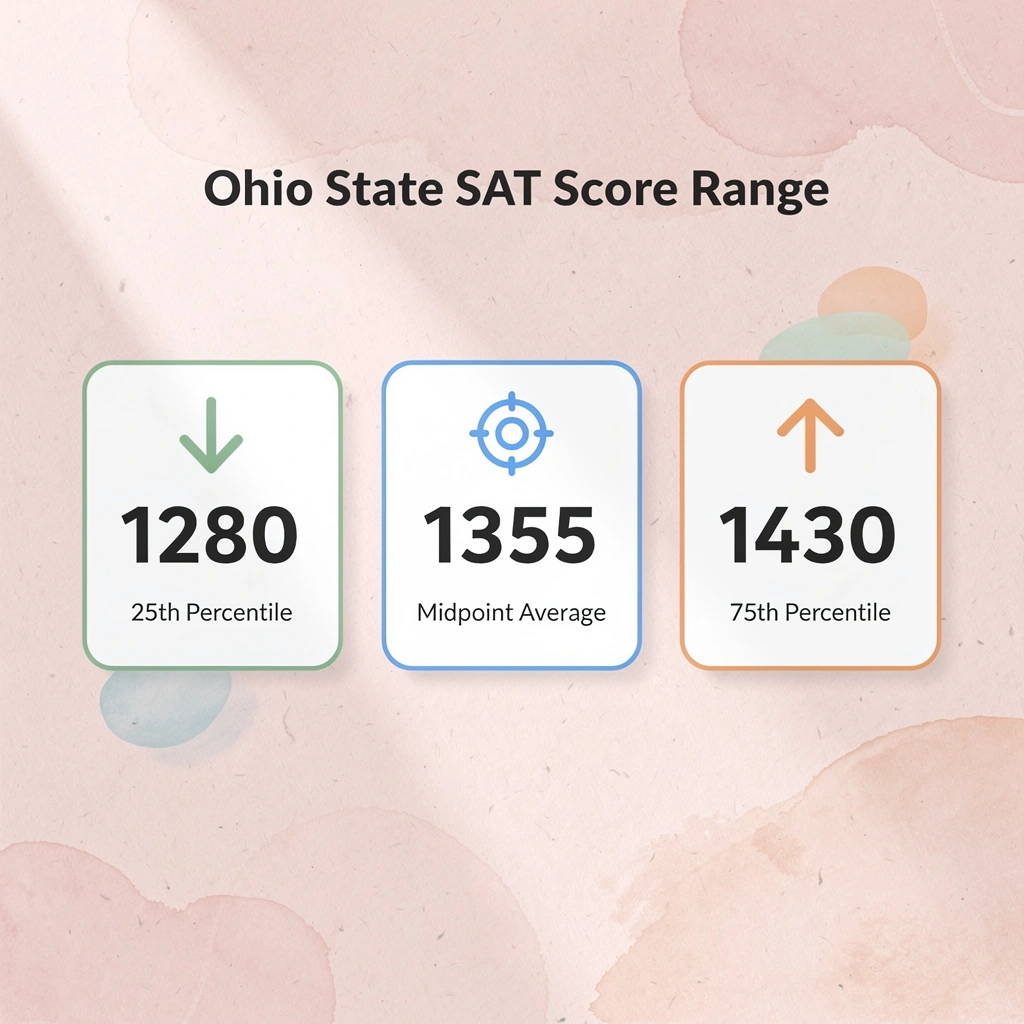
According to PrepScholar's analysis of Ohio State University admissions data, the 25th percentile SAT score is 1280, and the 75th percentile is 1430. This range shows the spread of real admitted students, not a made-up midpoint that everyone is trying to reach.
"The 25th percentile SAT score is 1280 and the 75th percentile is 1430 for admitted Ohio State students — meaning the majority of accepted applicants fall within this 150-point range." — PrepScholar Analysis
🎯 Key Point: Scoring at or above 1430 puts you in the top 25% of admitted students, significantly boosting your admissions competitiveness.
💡 Tip: If your score falls below 1280, your SAT is considered a weak point in your application — focus on raising your score before submitting.
What does the midpoint of that range actually mean?
The informal midpoint of that range is around 1375, simply the center of a wide band that includes students who scored meaningfully lower and considerably higher, all admitted for different combinations of reasons.
How does misreading the average cost affect students' real opportunities?
Most students find the midpoint, compare their own score to it, and draw a conclusion about their chances. A student with a 1310 who reads "average of 1375" may quietly remove Ohio State from their list, not because the data said no, but because the presentation made it feel that way.
This pattern has a real cost. Students who would have been strong applicants, given their grades, course rigor, and extracurricular depth, step back from schools where they had a genuine shot. Our AI college counselor, built on thousands of data points, helps reframe that picture by showing where a student's full profile actually stands rather than reducing their chances to a single score comparison.
What score range actually matters for competitive programs?
For general admission to Ohio State's Columbus campus, the university's own admissions data shows a middle 50% SAT range of 1270 to 1470. Students targeting selective programs such as engineering, business, or the Honors and Scholars program should note that the competitive profile skews toward the upper end of that range. A 1320 may be within reach for general admission but sits at the lower edge for direct-admit engineering.
Score context matters more than the score level itself.
Related Reading
- What ACT Score Is Needed for Harvard
- Average Act Score For Nc State
- Average Sat Score For Unc
- Average Sat Score For Umd
- Average Sat Score For Uc Berkeley
- Average SAT Score for Virginia Tech
- Average Sat Score For Brown
- Average SAT Score for UVA
- Average SAT Score for Michigan
- Average Sat Score For Ohio State
Why SAT Scores Alone Do Not Determine Admission
Your SAT score is real information and belongs in your application. But it has never been the whole story, and Ohio State's admissions process is built around that reality.
"A single test score has never been the whole story — holistic admissions evaluates the full picture of who a student is, not just what they scored." — AGB Trusteeship
🎯 Key Point: Ohio State uses a holistic admissions process, meaning your SAT score is one factor among many — not a make-or-break number.
💡 Tip: Focus on strengthening every part of your application — essays, extracurriculars, GPA, and letters of recommendation — because no single metric defines your candidacy.

What do admissions officers actually evaluate beyond the test?
Admissions officers evaluate academic performance across all four years of high school, not a single test result. A student with a 3.9 GPA while taking six AP courses demonstrates sustained effort under genuine academic pressure over time, something a standardized test cannot replicate.
The same logic applies outside the classroom. A student who spent three years leading a robotics team signals something distinct about how they operate. Admissions readers distinguish between a resume built for optics and one built from genuine investment. Essays, letters of recommendation, and personal context reveal what grades and scores cannot.
Why does fixating on your score create a narrow picture?
Most students focus on what is easiest to measure: the score. But that creates a narrow picture of a student who is almost certainly more interesting than their test results suggest. Our AI college counselor at Kollegio helps students clearly see their full profile and match them to schools where their actual strengths make them competitive candidates.
How is the broader admissions industry shifting away from test scores?
Context matters. According to the College Board's 2025 SAT Suite of Assessments Annual Report, only 39% of 2025 SAT takers met college readiness benchmarks, down from 45% in the class of 2019. Meanwhile, FairTest reports that more than 80% of U.S. four-year colleges will not require SAT scores for fall 2025 admissions. The industry is adjusting to what admissions officers have long understood: a score tells part of the story, not all of it.
The question worth considering is not whether your score is high enough, but whether your application makes a clear and honest case for who you are and what you will bring to campus.
How to Know Whether You Should Retake the SAT
Taking the SAT again is worth it when there is a big gap between your current score and the range of scores for students admitted to Ohio State. If your score is below the 25th percentile of admitted students (1280), a meaningful improvement moves you from an outlier into the middle of the pool. A small gain within an already competitive range rarely does.
"If your score falls below the 25th percentile of admitted students (1280), retaking the SAT can move you from the margins of the applicant pool to the heart of it — a shift that genuinely matters to admissions."
🎯 Key Point: The 1280 threshold is your benchmark. Scoring below this means a retake could deliver a real admissions advantage — not just a marginal ego boost.
⚠️ Warning: If you're already scoring within the competitive range, chasing a small score bump is rarely worth the time and stress. Focus your energy on other parts of your application instead.

When does a score improvement actually change your competitive position?
According to C2 Education, a score at the 75th percentile or higher is competitive for college admissions; for Ohio State, this means a score of 1470 or higher. If you're at 1360, three months of prep may yield only modest gains. A stronger essay, a leadership role, a research project, or a meaningful community commitment could strengthen your application more than a 30-point increase in score.
Students who score 1220 and then improve to 1310–1320 meaningfully strengthen their applications. Students who score a 1400 and aim for a 1430 often sacrifice the parts of their applications that admissions officers discuss in committee.
How can you make the retake decision strategic rather than emotional?
Most students make this decision based on gut feeling or parental pressure rather than facts and data. Our AI college counselor at Kollegio compares a student's full profile against thousands of data points, making the retake decision strategic rather than emotional.
What specific programs expect matters. According to C2 Education, top programs usually expect scores well above the school average. A student applying to the College of Engineering with a 1290 SAT faces a different situation than one applying to a major that places less weight on scores. The retake decision should consider where you're applying within Ohio State, not whether you meet the university-wide requirement.
What's the clearest rule of thumb for deciding whether to retake?
If a retake would move you from below the 25th percentile to within the middle 50 percent, it's worth pursuing. If it would move you from the middle of the range to slightly higher, your time is better spent elsewhere.
But knowing when to retake is only one piece of the puzzle. The bigger question is what you do with the rest of your application once that decision is made.
Related Reading
- What Sat Score Is Required For Uf
- Average Sat Score For Uga
- Average Act Score For Georgia Tech
- Northwestern Average Sat Score
- What SAT Score Is Required for Cornell
- What SAT Score Is Required for Harvard
- What Is The Combined Essay Score For Sat
- Average Sat Score For Virginia Tech
- Average Sat Score For Uva
- Average Sat Score For Georgetown
- Rice University Average Sat Score
- Caltech Average Sat Score
- Average Sat Score For Michigan
Building a Strong Ohio State Application Beyond Test Scores
Your SAT score tells one part of the story. The rest of the application is where most students either lose ground or quietly separate themselves from the competition.
💡 Tip: Don't let a strong test score make you complacent. Admissions officers examine the full picture, and non-score elements can be the deciding factor.
"The rest of the application is where most students either lose ground or quietly separate themselves from the competition."

Ohio State evaluates applicants holistically, reading for evidence of who you are beyond test scores. According to The Ohio State University Undergraduate Admissions, an average GPA of 3.8 or higher is typical for admitted first-year students. A strong GPA built through challenging coursework demonstrates academic consistency and tells a more complete story than a single test score.
🔑 Takeaway: A 3.8+ GPA earned through rigorous courses signals far more than raw ability — it proves sustained effort, discipline, and readiness for Ohio State's academic environment.
⚠️ Warning: Relying solely on a high test score without a competitive GPA or strong coursework is one of the most common mistakes applicants make — and it can cost you an acceptance.
Why does specific, honest writing outperform polished summaries?
The failure point in most application essays is that students write what they think admissions officers want to hear rather than what is true about them. Ohio State's review process explicitly weighs personal qualities like resilience, collaboration, and purpose, which surface only when the writing is specific and honest. A student who describes recovering from a failed robotics competition, including what broke down and what they rebuilt, will resonate more than one who writes a polished summary of their accomplishments. Precision and vulnerability, when they appear together, are hard to ignore.
Does depth of extracurricular involvement matter more than breadth?
Extracurricular involvement follows the same logic: depth beats breadth. Three years of sustained commitment to one organization, with growing responsibility and measurable impact, reads more clearly than eight clubs listed without context. Ohio State highlights leadership and engaged involvement as admissions criteria, so the question is not how many activities you joined but what you built or changed while there.
How should you build a balanced college list that protects your options?
Most students build their college list by aiming as high as possible and treating the rest as an afterthought. Ohio State, with a 60.6 percent acceptance rate according to PrepScholar, sits in a competitive middle tier where outcomes are uncertain even for strong applicants. A balanced list built around academic fit, program strength, and financial reality protects you from having no strong options when decisions arrive. Our AI college counselor at Kollegio uses thousands of data points to generate personalized college recommendations, match students to scholarships, and surface direct admissions opportunities, putting strategic clarity within reach for every student regardless of budget.
When should you lock in your Ohio State application timeline?
Ohio State's Early Action deadline is November 1; students targeting Engineering, Honors, Scholars, or the Morrill Scholarship Program should treat that date as non-negotiable. Filing the FAFSA by February 1 maximizes financial aid consideration, and missing that window can cost real money regardless of application strength. Students who avoid last-minute scrambles map the calendar in September and work backward from every deadline.
How do all the pieces of your application work together?
The strongest applications present every piece—essays, GPA, activities, and timing—as a clear argument for why the student belongs at Ohio State. Knowing where you stand in that argument is harder than it sounds.
How Kollegio Helps You Understand Your Chances at Ohio State
Knowing where you stand is one thing. Knowing what to do about it is another, and most students face that second problem alone.
"The gap between having information and knowing how to act on it is where most college applicants get stuck." — Kollegio
💡 Tip: Don't stop at knowing your numbers. Understanding what they mean for your specific application is where the real work begins.

The typical approach: a student checks Ohio State's published SAT ranges, compares their score, then opens five browser tabs, a spreadsheet, and maybe a Reddit thread, trying to figure out whether their GPA, activities, and essays are competitive. The information lives in a dozen different places with no connection between them.
⚠️ Warning: Piecing together scattered data from unconnected sources leads to incomplete conclusions—and potentially the wrong decision about where to apply.
Why does fragmented information hurt your application?
This fragmentation has a real cost. Students often underestimate how competitive they are because they lack an organized way to see how all the parts of their applications work together. A 1310 SAT paired with a 3.9 GPA, two years of steady leadership in one organization, and a specific essay tells a different story than a 1310 with a thin activity list and a generic personal statement. The numbers are identical. The applications are not.
How does Kollegio bring your full profile together in one place?
This is the gap that Kollegio closes. Instead of asking students to manually search test scores, college profiles, and financial aid databases, our AI college counselor combines personalized college matching, scholarship discovery, essay feedback, and activity framing in one place. The platform serves more than 200,000 students and is built on the principle that every student deserves guidance equivalent to a $10,000 private counselor, without the price tag. Ohio State is evaluated in your complete profile and appropriately placed in a balanced list of reach, target, and likely schools.
The scholarship piece matters more than most students expect. Searching for financial aid without a targeted filter exhausts students from households without existing college counseling networks, who often spend hours on unrealistic awards. Our scholarship finder narrows the field based on your academic record, interests, and background.
How can essay and activity feedback sharpen your application?
Essays and activity presentations are where applications either sharpen or blur. Most students struggle to judge their own writing because they're too close to it, and they often describe their extracurricular involvement in terms of participation rather than accomplishment. Both problems can be addressed with the right feedback system, provided you access it before the deadline.
Related Reading
- What SAT Score Is Required for Duke
- What Sat Score Is Required For Mit
- What Sat Score Is Required For Ut
- What Sat Score Is Required For Texas A&m
- What Sat Score Is Required For Stanford
- What Sat Score Is Required For Columbia
- What Sat Score Is Required For Yale
- What Sat Score Is Required For Princeton
- What Sat Score Is Required For Nyu
- What Sat Score Is Required For Notre Dame
- What Sat Score Is Required For Harvard
- What Sat Score Is Required For Cornell
- What Act Score Is Needed For Alabama
- What Sat Score Is Required For Ucla
- What Sat Score Is Required For Ivy League
Use Kollegio's AI College Counselor for Free Today!
Getting the right feedback before the deadline makes the difference between an application that reads as a clear fit and one that blends into a pile of 60,000 others.
"Getting the right feedback before the deadline makes the difference between an application that reads as a clear fit and one that blends into a pile of 60,000 others." — Kollegio
🎯 Key Point: The earlier you get personalized feedback, the better your chances of standing out in a highly competitive applicant pool.
💡 Tip: Your first session is completely free — there's no reason to wait until the deadline is looming.
Our AI college counselor provides that structure at no cost. In your first session, you get a personalized college list showing where Ohio State fits your profile, scholarship matches, and specific guidance on whether your SAT score, essays, or extracurricular presentation would make the biggest difference.
✅ Best Practice: Use your free first session to identify the single highest-impact area of your application and tackle it before the deadline.