
Michigan students planning to apply to selective universities need more than a rough sense of where their test scores land. The average SAT score for Michigan test-takers is around 1050, but that number only becomes meaningful when compared against the specific benchmarks of target schools, whether that is the University of Michigan, a Big Ten peer, or an Ivy League institution, where the bar rises considerably higher. Understanding that gap is the first step toward building a focused, realistic application strategy.
Stop wondering.
Start matching.


Raw score data rarely tells the full story on its own, and interpreting it without context can lead students to aim too low or overlook schools where they are genuinely competitive. Knowing how a 1200 SAT or a 26 ACT compares to a given school's admitted class requires school-specific data and an honest look at the full application picture. Students who want that clarity without the guesswork can get personalized score analysis and a step-by-step testing roadmap from Kollegio's AI college counselor.
Table of Contents
- Why So Many Students Misjudge Their Chances at Michigan
- Average SAT Score for Michigan and What It Really Tells You
- Why the Average SAT Score Doesn't Predict Admission Outcomes
- What Your SAT Score Means for Your Michigan Application
- Application Factors Students Underestimate Most
- How Kollegio Helps You Understand Where You Stand
- Use Kollegio's AI College Counselor for Free Today!
Summary
- Michigan's SAT average of 1050 masks a critical readiness gap. According to the Michigan League for Public Policy, 72% of Michigan high school students are considered not college-ready. This statistic reflects more than test scores. It captures gaps in academic preparation, course rigor, and the support systems students need to build competitive applications for selective universities.
- Test scores explain only 16% of the variation in freshman grades, according to FairTest. If SAT performance predicts so little about actual college success, it cannot reliably predict admission decisions either. Admissions officers use scores as one signal of academic preparation, then evaluate the rest of the application to assess intellectual curiosity, resilience, leadership, and potential contributions to campus.
- The University of Michigan's middle 50% SAT range spans from 1360 to 1530, with PrepScholar reporting an average Math score of 740. These numbers describe who got admitted last year, not what guarantees admission this year. A quarter of enrolled students scored below 1360, while another quarter scored above 1530. The range reflects outcomes among successful applicants, not requirements that trigger acceptance or rejection.
- Students who score within Michigan's middle 50% often assume their numbers guarantee competitive standing. Thousands of applicants in this 170-point range share similar scores, making statistical differences between a 1420 and 1480 insignificant. At this threshold, admissions officers spend less time evaluating academic capability and more time assessing what students will contribute through leadership, intellectual curiosity, and authentic engagement beyond the classroom.
- Course rigor signals readiness more clearly than many students recognize. A student taking AP Calculus BC, AP Chemistry, and college-level physics with a 3.8 GPA demonstrates stronger preparation than someone maintaining a 4.0 by avoiding advanced coursework. When two students from the same high school apply with similar test scores, admissions officers notice who chose the most challenging path available versus who protected their grades by selecting easier classes.
- AI college counselor analyzes complete application profiles using thousands of data points across test scores, course selection, extracurricular depth, and essay quality to show where students actually stand relative to schools like Michigan.
Why So Many Students Misjudge Their Chances at Michigan
Most students reduce their college prospects to a single comparison: their test score versus the school's published average. If they fall below that number, they assume rejection. If they exceed it, they assume acceptance. This ignores how selective admissions actually works, where test scores represent just one data point among dozens that shape an admissions officer's decision.
"Test scores represent just one data point among dozens that shape an officer's decision — yet most students treat them as the only number that matters." — Admissions Insight
⚠️ Warning: Comparing your score to a published average and stopping there is one of the most common — and costly — mistakes applicants make.
🎯 Key Point: Selective admissions are a holistic review process. Your test score is never evaluated in isolation — it sits alongside your essays, recommendations, extracurriculars, GPA, and more.

How does conflicting advice create false certainty in admissions?
Conflicting advice scattered across forums, guidance counselors, and admissions blogs fuels this confusion. One source insists you need a 1500+ SAT to compete at Michigan; another claims scores barely matter compared to essays and leadership. Students absorb these contradictory messages and default to the simplest metric they can control: hitting or exceeding an average. This creates false certainty in a process designed to resist simple formulas.
The readiness gap nobody discusses
According to the Michigan League for Public Policy, 72% of Michigan high school students are considered not college-ready. This reflects gaps in academic preparation, course rigor, and support for competitive college applications. Students fixating on raising their SAT score by 50 points often overlook critical questions: Does their transcript demonstrate challenging coursework that Michigan expects? Do their activities show sustained commitment and meaningful impact, or merely scattered attempts?
Does a higher score always beat a stronger application?
Consider two applicants targeting Michigan. The first scored 1450 but took standard courses, participated in three clubs without leadership roles, and submitted generic essays. The second scored 1380 but challenged themselves by taking AP Calculus BC and college-level physics, founded a tutoring program serving 40 students, and writing essays that revealed genuine intellectual curiosity about environmental policy. Admissions officers see hundreds of 1450s but far fewer students demonstrating both academic courage and meaningful community contribution.
Why do students with competitive scores still get denied?
When students treat admissions like an equation (score + GPA = outcome), they misunderstand what universities seek. Michigan doesn't rank applicants by test scores alone. Officers evaluate whether a student can handle difficult coursework, contribute to campus life, and strengthen the incoming class. A score proves academic capability; the rest of the application proves fit, drive, and potential. Many students with competitive scores get denied because nothing else distinguishes them. Others with modest scores gain admission because everything else demonstrates readiness.
Published numbers answer only half the question. The other half requires understanding what those numbers represent and why they matter less than most students assume.
Related Reading
- What ACT Score Is Needed for Harvard
- Average Act Score For Nc State
- Average Sat Score For Umd
- Average Sat Score For Uc Berkeley
- Average SAT Score for Virginia Tech
- Average Sat Score For Brown
- Average SAT Score for UVA
- Average SAT Score for Michigan
- Average Sat Score For Ohio State
Average SAT Score for Michigan and What It Really Tells You
According to PrepScholar, Michigan's middle 50% SAT range is 1360–1530. This means 25% of admitted students scored below 1360 and 25% scored above 1530. The range describes where half of enrolled students fell — not a hard cutoff for admission or rejection.
"Michigan's middle 50% SAT range is 1360–1530 — meaning the majority of admitted students landed within this competitive band." — PrepScholar
🔑 Takeaway: The 1360–1530 range is a benchmark, not a barrier — scoring outside it doesn't automatically disqualify or guarantee admission.
💡 Tip: If your score falls below 1360, focus on strengthening other parts of your application — GPA, extracurriculars, and essays all carry significant weight in Michigan's holistic review process.
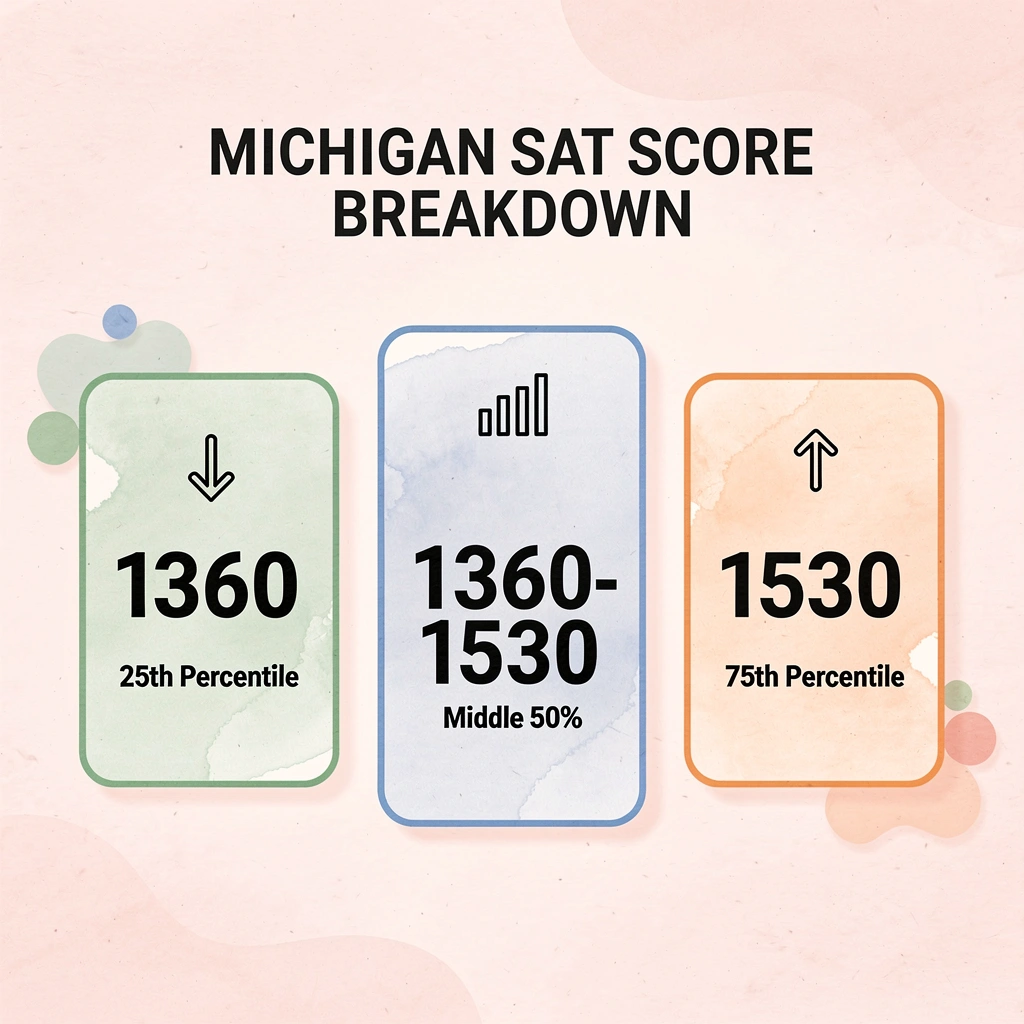
What These Percentiles Actually Measure
These ranges describe outcomes, not requirements. When you see that PrepScholar reports the average SAT Math score is 740, with a 25th percentile of 680 and a 75th percentile of 780, you're viewing a snapshot of who got in last year. The data shows patterns among successful applicants but cannot predict whether your 1390 will be strong enough or whether someone else's 1510 will fall short. Admissions officers review each application individually, weighing test scores alongside course rigor, essays, recommendations, and demonstrated impact.
Why comparing yourself to the average misleads you
Most students focus on whether their score exceeds Michigan's midpoint of 1445, assuming anything lower hurts their chances. This overlooks how admissions works. A student with a 1370 who took the hardest courses available, started a community organization, and wrote a compelling essay about overcoming obstacles may be far more competitive than someone with a 1480 who chose easier classes and submitted generic materials. The score opens the door to a full review, but everything else determines whether you walk through it.
Does scoring inside the middle 50% guarantee a strong application?
This mistake compounds when building college lists. Students see Michigan's range, compare it to their score, and either remove the school as too competitive or assume admission is likely. Neither conclusion follows from the data. Thousands of applicants with scores within Michigan's middle 50% are denied each year because their applications lack depth, while others with scores below the 25th percentile gain admission because their other credentials demonstrate readiness and fit.
How admissions officers actually use test scores
Admissions committees use test scores as one signal of academic preparation, then assess intellectual curiosity, resilience, leadership, and potential contribution to campus through the rest of the application. A 1400 from a student who used all of their high school's course offerings and showed initiative beyond the classroom tells a different story than a 1400 from someone who took standard classes and participated in activities without depth. Context matters more than the number itself.
How can you tell if your score is truly competitive at Michigan?
Platforms like AI college counselors analyze thousands of data points from your profile to identify schools that match your grades, activities, and personal story. Our AI college counselor moves beyond score ranges: instead of guessing whether your 1420 is competitive at Michigan, you receive personalized insights based on how admissions teams evaluate applications, not merely whether your score falls within a published range.
But knowing where your score fits within Michigan's range leaves the bigger question unanswered: why do so many students with strong scores get denied while others with modest scores get in?
Why the Average SAT Score Doesn't Predict Admission Outcomes
The average SAT score describes admitted students, not future ones. Most applicants treat it as a threshold, even though it's a historical snapshot.
[IMAGE: https://im.runware.ai/image/os/a01d21/ws/3/ii/84e37574-c63c-4f88-9cf7-fe1e74008131.webp] Alt: Magnifying glass examining a historical snapshot, illustrating how average SAT scores describe past admitted students rather than predicting future outcomes
According to FairTest, the SAT explains only about 16% of the variation in students' freshman grades. Since test scores predict so little about classroom performance, they cannot reliably predict admission outcomes. Admissions officers treat test scores as one piece of information among many, not as a predictor.
The Range Reveals More Than the Average
Michigan publishes a middle 50% range because successful applicants arrive with different test scores. A student scoring 1360 might bring exceptional leadership experience and a compelling personal story. Another scoring 1530 might have strong academics but limited involvement beyond the classroom. Both get admitted because admissions teams ask different questions than "Who scored highest?"
When students focus too much on whether their score sits above or below 1470, they miss the more important evaluation happening behind the scenes: whether their complete application demonstrates readiness, curiosity, and potential contribution to Michigan's community.
Why does holistic review change everything?
Most students who focus only on test scores discover too late that admissions officers consider much more: how you challenged yourself in school, leadership roles you assumed, ways you served your community, and genuine insight you shared in essays. A strong score opens the door to that conversation, but it cannot answer these questions on its own.
How does analyzing your full profile reveal your real chances?
Platforms like Kollegio help students understand this difference by considering thousands of pieces of information across their entire profiles, not just test scores. Instead of wondering if a 1450 makes you competitive, you can see how your complete application compares to students who were actually admitted based on all the factors Michigan looks at.
If your SAT score by itself cannot predict your outcome, what does it tell you about your chances?
Related Reading
- What Sat Score Is Required For Uf
- Average Sat Score For Uga
- Average Act Score For Georgia Tech
- Northwestern Average Sat Score
- What SAT Score Is Required for Cornell
- What SAT Score Is Required for Harvard
- What Is The Combined Essay Score For Sat
- Average Sat Score For Virginia Tech
- Average Sat Score For Uva
- Average Sat Score For Georgetown
- Rice University Average Sat Score
- Caltech Average Sat Score
- Average Sat Score For Michigan
What Your SAT Score Means for Your Michigan Application
Your SAT score signals that you can handle Michigan's academic workload, but it does not predict admission. Once your score demonstrates academic readiness, the rest of your application determines whether you stand out among thousands of other academically qualified candidates.
"Your SAT score signals academic readiness — but standing out among thousands of equally qualified applicants requires far more than a strong test result." — Admissions Insight
🎯 Key Point: A competitive SAT score gets you into the pool — it does not get you out of it. Michigan receives applications from thousands of academically qualified students each cycle, making the rest of your application the true differentiator.
💡 Tip: Once you've met the academic readiness threshold, focus on crafting a compelling personal narrative, showcasing extracurricular depth, and securing strong letters of recommendation — these factors move the needle.
[IMAGE: https://im.runware.ai/image/os/a05d22/ws/3/ii/418127e8-99a8-42b3-8928-58fe6b5f4d1b.webp] Alt: Icon scale showing SAT score balanced against full application factors
If your score falls below the middle range
Students often abandon their Michigan applications when their scores fall below the 25th percentile, but this instinct misunderstands how admissions committees evaluate applications.
Does a below-range score disqualify you from Michigan?
A score below PrepScholar's reported 25th percentile, 1360, does not disqualify you; it shifts the focus to other parts of your application. Admissions officers seek evidence that you challenged yourself within your circumstances. A student from a rural high school with few AP classes who scored 1340 while taking every available advanced course makes a stronger case than someone from a well-resourced school who avoided rigorous classes despite having the opportunity.
What matters more than your score at this threshold?
What matters more: demonstrating intellectual curiosity through independent projects, measurable leadership impact, or grades showing sustained improvement through challenges. Your transcript reveals your work ethic and problem-solving ability. Your score demonstrates readiness for college-level work.
If your score sits within Michigan's middle 50%, does it actually help you stand out?
Falling within the middle range creates a false sense of security. Thousands of applicants share that same score band. PrepScholar reports the 75th percentile at 1530, meaning the competitive middle stretches across a 170-point range where differences become statistically insignificant.
What are admissions officers actually evaluating when your score is in the middle range?
Admissions officers spend less time checking whether you can succeed academically and more time determining what you will add to campus. Both a 1420 and a 1480 demonstrate college readiness. The real difference comes from what you have built, led, or created outside the classroom. Your essays show how you think. Your recommendations show how you work with others. Your extracurricular record shows where you direct your energy when no one requires it.
Does retaking the SAT to gain 50 points actually improve your admission odds?
Many students in this range spend months retaking the SAT to move from a 1440 to a 1490, believing those 50 points will change their chances. They rarely do. The difference between students who get accepted and those who get rejected in this score range almost never comes down to test performance. It comes down to how clear your story is, what real impact you have shown, and how genuinely interested you are in ideas that matter to you.
If Your Score Exceeds the 75th Percentile
A score above the 75th percentile strengthens your application, but does not guarantee you will not be rejected. Selective universities turn away thousands of students with near-perfect scores each year because grades and test scores alone cannot create a diverse, dynamic freshman class.
Why do high-scoring students still get rejected?
The most common mistake high-scoring students make is assuming their test scores are all that matters in their application. They submit generic essays, superficial activity lists, and recommendations that describe them as "smart" without revealing who they are. A 1540, paired with a forgettable application, loses to a 1410, paired with a compelling story about sustained curiosity, meaningful contribution, or intellectual risk-taking.
What does a strong score actually do for your application?
Strong scores open the door. They do not walk you through it.
Why does your complete application matter more than your score?
Most students focus too much on whether their score is "good enough" when the real question is whether their complete application tells a clear, compelling story. Admissions officers evaluate you against other applicants who bring different strengths, backgrounds, and perspectives, not against an SAT cutoff.
How can you accurately compare your full profile with that of admitted students?
Students often compare themselves to Michigan's admitted-student averages to understand admissions decisions. Platforms like Kollegio analyze how your entire profile compares to admitted students, using thousands of data points across academics, activities, essays, and context rather than reducing your chances to a single test score.
What happens when students misjudge where they stand?
Your SAT score matters only as much as every other element that demonstrates you are ready, curious, and able to contribute. Students who misjudge their chances typically overweight one strength while ignoring gaps elsewhere.
Application Factors Students Underestimate Most
Students who spend months improving their SAT scores often discover too late that admissions officers prioritize other application components equally or more heavily. While test preparation consumes hundreds of hours, course selection, leadership development, and essay quality receive far less strategic attention — despite carrying equal or greater weight in admissions decisions.
"While test preparation consumes hundreds of hours, course selection, leadership development, and essay quality receive far less strategic attention despite carrying equal or greater weight in admissions decisions."
🚨 Warning: Pouring all your energy into test scores while neglecting essays and leadership is one of the most costly strategic mistakes a student can make in the admissions process.
💡 Tip: Treat your application as a portfolio — allocate intentional time to course rigor, extracurricular leadership, and essay crafting early, not just in the final weeks before deadlines.

Course Rigor and Academic Challenge
How hard your coursework is sends a stronger signal than many students realize. Admissions officers want to see if you chose challenging courses when available, not whether you protected your GPA by avoiding risk. A student who takes AP Calculus BC, AP Chemistry, and college-level physics while earning a 3.8 GPA demonstrates more readiness for Michigan's academic environment than one who maintains a 4.0 by avoiding advanced coursework. Your transcript reveals intellectual curiosity and willingness to push beyond your comfort zone.
This becomes especially visible when two students from the same high school apply with similar test scores. One chose the most rigorous path available; the other selected easier courses to preserve perfect grades. Admissions officers notice that choice and let it shape their interpretation of your application.
Leadership That Creates Measurable Impact
Leadership that creates results is hard to find. Most students list clubs and organizations without explaining what they accomplished or how they changed others. Admissions officers look for proof that you took action, fixed problems, or made something new. Starting a tutoring program that helps 30 students improve their grades matters more than holding a title in five different clubs where you barely participate.
The best applications demonstrate growth over time. You identified a problem, developed a solution, engaged others, and achieved measurable outcomes. This pattern shows admissions officers that you'll contribute to campus life beyond attending classes.
Essays That Reveal Who You Are
Two students with nearly identical grades and test scores can make vastly different impressions based on how they write about themselves. Essays offer the only chance to show admissions officers your voice, values, and perspective. A generic essay about overcoming challenges or learning the importance of hard work blends in with thousands of similar submissions, whereas an essay that shows specific moments of growth, genuine curiosity, or authentic self-reflection helps admissions officers understand who you are beyond the numbers.
According to the Common Application, approximately 1.2 million applicants submitted forms for the class of 2025. Essays are one of the few ways to stand out; generic essays miss the opportunity to show what makes a student's story distinct.
Demonstrated Fit and Institutional Understanding
Generic applications rarely succeed at selective universities. Admissions officers can tell when a student has researched what makes Michigan unique versus copying website language. Showing fit means explaining why specific programs, faculty research, campus resources, or community values align with your goals, what you'll contribute, and how you'll use the university's offerings.
Stronger applications demonstrate genuine interest in joining a specific community rather than attempting to impress with credentials alone. This shift changes how you write every essay and present your involvement.
How can data-driven tools help you demonstrate authentic fit?
Platforms like Kollegio help students move beyond generic positioning by analyzing how their profiles align with Michigan's values and priorities. Rather than guessing what admissions officers want, our AI college counselor provides data-driven insights into how your application strengths align with institutional priorities, making it easier to demonstrate authentic fit.
But understanding which factors matter most only gets you halfway there. The harder question is figuring out where your application stands now.
How Kollegio Helps You Understand Where You Stand
Knowing your SAT score is in Michigan's middle 50% range doesn't answer the question that matters: is your complete application competitive? Most students gather pieces of information from college websites, Reddit threads, and outdated books, then guess their chances without understanding how different factors work together. This guesswork creates stress and leads to poorly built college lists.
"Most students guess their chances without understanding how different factors work together — and that guesswork leads to poorly built college lists." — Kollegio
🎯 Key Point: A single stat like your SAT score tells you almost nothing about your real admissions odds. What matters is how all your factors combine.
🔑 Takeaway: Scattered research from Reddit threads, college websites, and outdated books creates a false sense of clarity. You need a tool that shows you where you actually stand, not just where one data point lands.

How does evaluating your full profile reveal your real chances?
An AI college counselor analyses your complete profile using thousands of data points rather than one or two numbers. Instead of comparing your 1410 SAT score to Michigan's average, you receive analysis showing how your test score combines with course rigor, extracurricular involvement, essay quality, and demonstrated interest in the school. This helps you determine whether Michigan is a reach, target, or likely school based on your actual strengths, not generic statistics.
How does spotting profile gaps early change your application strategy?
The platform identifies gaps before you submit applications. If your SAT score falls within Michigan's range but your course selection shows you avoided advanced maths despite stating interest in engineering, that mismatch becomes visible early enough to address. You might strengthen other application components, reconsider your intended major, or adjust your college list to include schools where your profile aligns more strongly.
Use Kollegio's AI College Counselor for Free Today!
Use Kollegio for free to evaluate your complete applicant profile against schools like Michigan, discover colleges that match your strengths, and identify scholarship opportunities. In your first session, you'll receive personalized college matches and real clarity on how Michigan fits into your admissions strategy.
"In your first session, receive personalized college matches and a clear picture of exactly where you stand in your admissions strategy." — Kollegio AI College Counselor
🎯 Key Point: Kollegio's AI College Counselor evaluates your entire applicant profile — for free — so you know exactly which schools are the right fit before you apply.
💡 Tip: Use your free first session to uncover scholarship opportunities you may have never considered, and get a data-driven match to schools like Michigan that align with your unique strengths.

Related Reading
- What SAT Score Is Required for Duke
- What Sat Score Is Required For Mit
- What Sat Score Is Required For Texas A&m
- What Sat Score Is Required For Stanford
- What Act Score Is Needed For Alabama
- What Sat Score Is Required For Nyu
- What Sat Score Is Required For Ucla
- What Sat Score Is Required For Harvard
- What Sat Score Is Required For Columbia
- What Sat Score Is Required For Princeton
- What Sat Score Is Required For Ut
- What Sat Score Is Required For Cornell
- What Sat Score Is Required For Ivy League
- What Sat Score Is Required For Yale
- What Sat Score Is Required For Notre Dame