
Understanding where your SAT score falls compared to other test takers shapes your entire college application strategy. Your performance helps identify which schools match your academic profile and reveals exactly how much preparation you need to reach your target score. Average SAT scores provide crucial context for evaluating your competitiveness at different types of institutions and guide your next steps in the admissions process.
Knowing the average SAT score provides a baseline, but interpreting your results in the context of specific colleges requires deeper analysis. Your score's significance varies dramatically depending on the selectivity of your target schools and how it compares to their typical admitted student profiles. For personalized insights that connect your SAT performance to real admission data and create a tailored improvement strategy, consider working with Kollegio's AI college counselor.
Stop wondering.
Start matching.


Summary
- The national average SAT score of 1029 includes every type of test taker, from students targeting community colleges to those applying to Ivy League programs, making it irrelevant for strategic planning. According to College Board, more than 2 million students in the high school class of 2025 took the SAT at least once, representing vastly different academic goals and preparation levels. Comparing yourself to this blended population tells you nothing about whether you're competitive at the schools you actually care about.
- Only 39% of SAT takers met or exceeded both the Reading and Writing and Math college readiness benchmarks in 2025, which means most students fall short of what selective schools expect. A score of 1300 places you around the 86th percentile nationally, which sounds strong until you realize it sits at or below the 25th percentile of admitted students at many competitive universities. The gap between beating the average and being competitive at your target schools is wider than it appears.
- Each school's middle 50 percent SAT range shows where the middle half of admitted students actually fall, giving you a far more useful benchmark than any national average. If a school reports 1300 to 1450, a 1350 puts you in the middle of the pack, while a 1420 positions you ahead. This data connects your score directly to outcomes instead of vague labels like "good" or "competitive."
- Small increases in SAT scores can unlock different scholarship brackets, with a significant financial impact. A jump from 1250 to 1300 might shift you from partial to full tuition consideration at certain institutions, or trigger automatic merit aid eligibility you would otherwise miss. Many programs tie financial awards to specific score thresholds, making your SAT performance a lever for financial aid rather than just an admissions metric.
- A retake only makes strategic sense if a realistic improvement would move you into a higher admissions range or unlock scholarships you currently miss. If you already score within or above your target ranges, additional prep time becomes more valuable when invested in essays, activities, or building relationships with programs that already view your score as competitive. The question is not whether you can improve, but whether improvement changes what you can do next.
- Kollegio's AI college counselor maps your SAT score to real admission ranges and scholarship thresholds across thousands of schools, showing exactly where you're competitive and what financial aid you qualify for based on your actual profile.
The Average SAT Score Is Misleading
The average SAT score can give you a false sense of security. According to the College Board, average SAT scores for the class of 2025 are 521 in Reading and Writing and 508 in Math, totaling around 1029. This shows where the middle sits, but nothing about what your target schools require. Treating it as a goal is like aiming for the center of a dartboard when the bullseye is elsewhere.

"Average SAT scores for the class of 2025 are 521 in Reading and Writing and 508 in Math, totaling around 1029." — College Board, 2025
🎯 Key Point: The national average of 1029 is not your target score—your dream schools likely require scores 200-300 points higher.
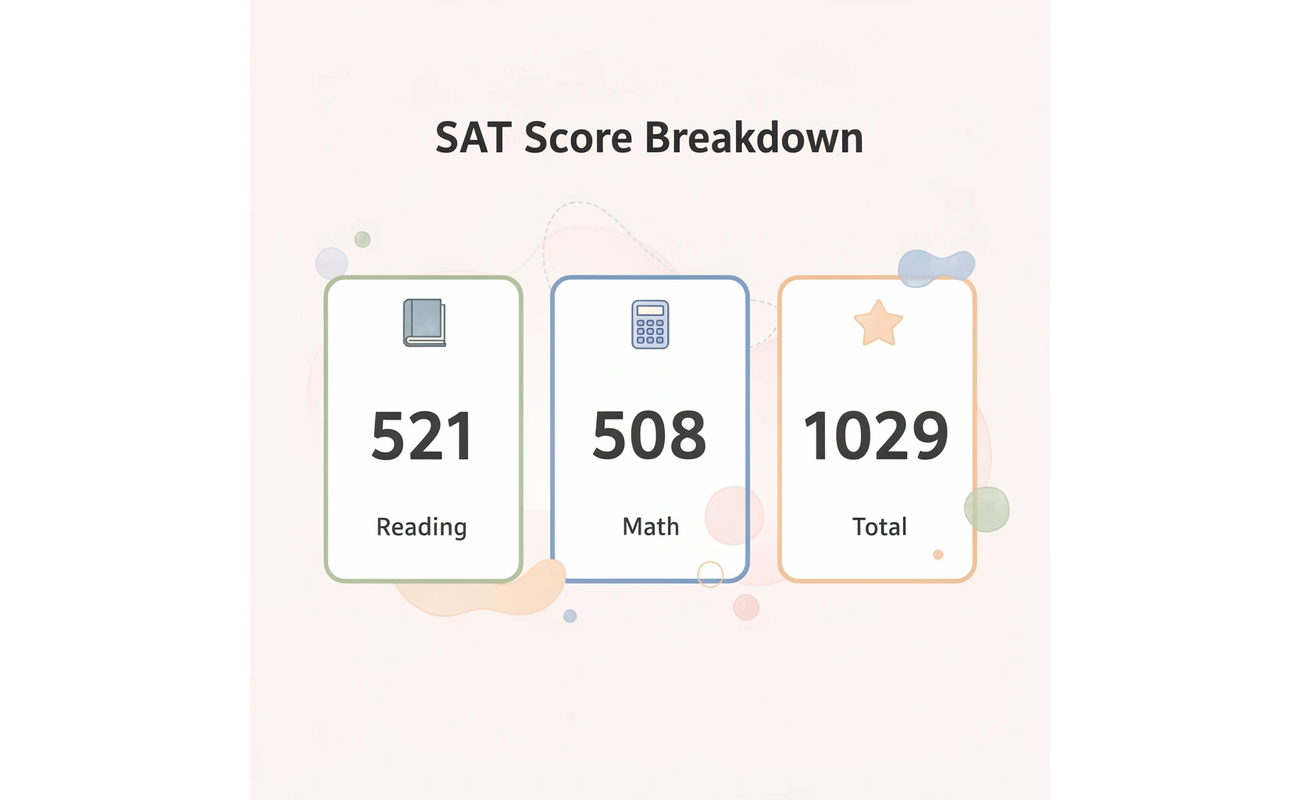
⚠️ Warning: Using the average SAT score as your benchmark can leave you dramatically underprepared for competitive admissions.
Why "average" distorts your planning
The average includes everyone: students applying to community colleges, those heading to top universities, and everyone in between. A score above 1029 may seem strong until you discover that admitted students at your target school average 1350. The benchmark varies by institution, and the national average cannot account for that difference.
What happens when you rely on the wrong reference point?
Relying on the average leads to misaligned decisions. You might stop preparing too early, thinking you've crossed the finish line when you've only reached the starting block for competitive programs.
Or you might build a college list mixing schools where you are well above the typical admit with others where you fall short. College Board reports that only 39% of SAT takers met or exceeded both the Reading and Writing and Math college readiness benchmarks. The gap between average and competitive is wider than it appears.
How can you get context that applies to your situation?
Instead of reaching a number that works for everyone, you need information that applies to your situation. Platforms like Kollegio's AI college counselor connect your SAT score to real admission data from schools you're considering, showing how you compare to students who were actually admitted.
This removes the guessing and shows whether your score helps your application, where it might hurt your chances, and what improvement would help most.
What gets lost in the noise
Most online discussions about SAT scores use labels like good, bad, competitive, or safe. A 1200 might be strong for one school and below average for another. Without knowing the score distribution at your target institutions, you're making decisions without important information. The national average offers an easy shortcut: simple to find and understand, but it sacrifices accuracy for simplicity.
The real question is not whether your score beats the national average, but whether it puts you in a competitive position at the schools where you want to apply. That answer comes from a different set of numbers.
Related Reading
- How to Ace the SAT
- Is the SAT Hard
- What is SAT Prep Class
- Benefits Of Sat Exam
- Can You Take The Sat After High School
- Should I Take The Act Or Sat
- How Many Times Can You Take the SAT
- When to Start SAT Prep
What the Average SAT Score Actually Represents
The average SAT score represents the midpoint of all test-takers, regardless of college plans or readiness level. According to the College Board's 2025 SAT Suite of Assessments Annual Report, the class of 2025 averaged 521 in Reading and Writing and 508 in Math, totaling 1029. This shows where the middle of the testing group falls, not what colleges want or where you need to be.
"The class of 2025 averaged 521 in Reading and Writing and 508 in Math, totalling approximately 1029." — College Board's 2025 SAT Suite Annual Report
🎯 Key Point: The average SAT score reflects all test-takers, including those who may not be college-ready or planning to attend competitive schools.
⚠️ Warning: Don't confuse the national average with what you need for your target colleges—they often differ significantly.

Who makes up this average?
The pool includes first-time test takers, students retaking after months of prep, those applying to Ivy League schools, and those exploring community college options. Some took rigorous AP courses; others faced resource constraints or inconsistent academic preparation. The average blends these diverse experiences into a single number that obscures their differences.
Think of it like calculating the average income across a city—it includes entry-level workers, mid-career professionals, and executives, giving you a statistical center but not what you need to earn for your desired lifestyle. The SAT average works the same way: it describes a population, not a pathway.
What the number actually measures
The average reflects test performance across different situations. More than 2 million students in the high school class of 2025 took the SAT at least once, bringing different levels of preparation, academic backgrounds, and goals to the exam. Some students arrive after months of tutoring; others take it without preparation as a diagnostic. The average captures all this variation without separating the signal from the noise.
Why does the national average mislead students?
When you use the national average as your benchmark, you measure yourself against students who are not competing for your opportunities. If you are targeting schools with middle 50 percent ranges between 1300 and 1450, the national average of 1029 becomes irrelevant. You are positioning yourself within a much narrower, more selective range.
How can students find more relevant benchmarks?
Platforms like AI college counselor help students move past general benchmarks by matching SAT scores to real admission data at specific schools. Kollegio shows students exactly where their score places them across their target list, with personalized recommendations that account for GPA, extracurriculars, and institutional priorities.
Why this matters for your college search
The real risk is not misunderstanding the average—it's using it in decisions that require precision. You wouldn't budget based on national median income without knowing your city's cost of living, or set fitness goals based on population averages without considering your starting point. Yet students routinely build college lists and set score targets using a number never meant to guide individual strategy.
Knowing what the average represents is only half the equation. The harder question is what happens when you use it to make decisions.
Why the Average SAT Score Doesn't Help You Decide
The average SAT score is a poor decision-making tool because it compares you to the wrong group. You're competing against students applying to your specific colleges, and those groups look nothing like the national average.

🎯 Key Point: The national average SAT score is misleading because it includes students applying to completely different colleges than yours. Your real competition is the applicant pool for your target schools.
"Comparing yourself to the national average SAT score is like training for a marathon by comparing your times to weekend joggers." — College Admissions Reality Check
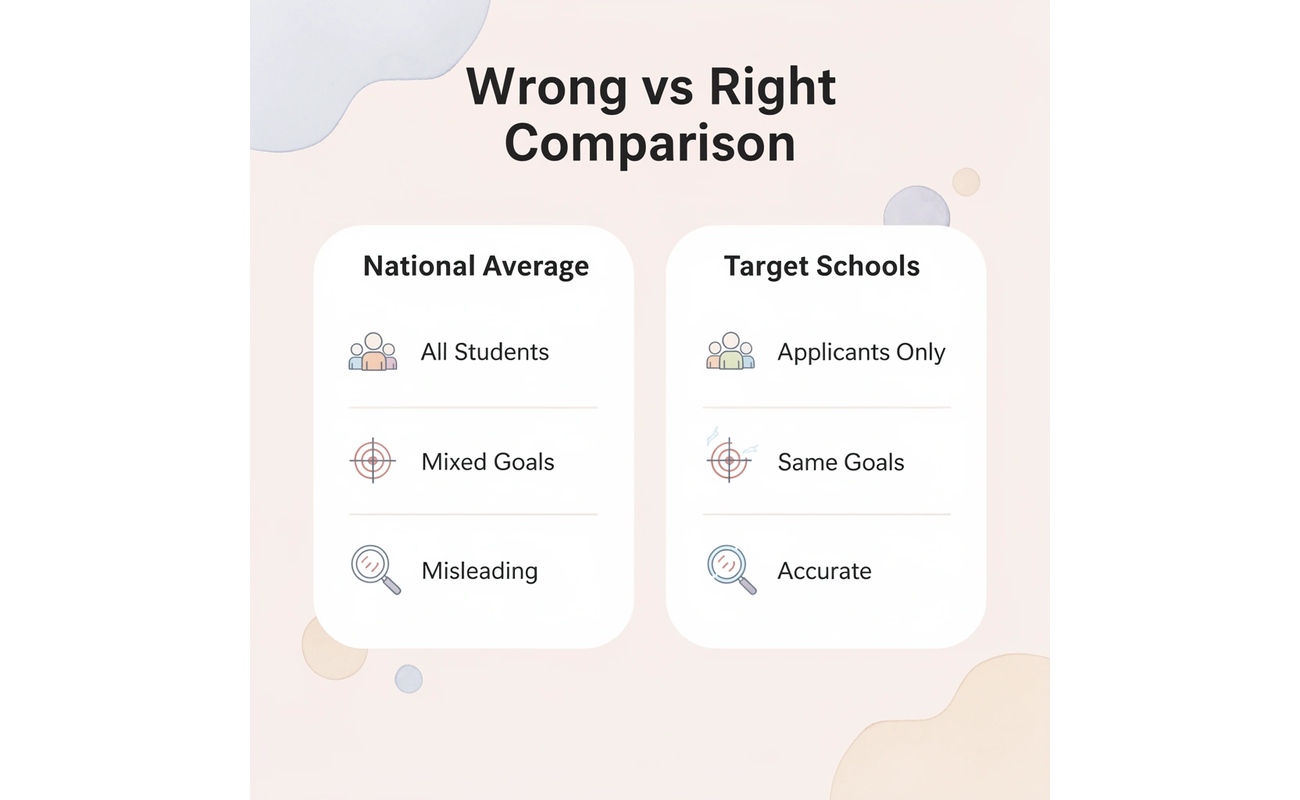
⚠️ Warning: Using average SAT scores for decision-making can lead to false confidence or unnecessary anxiety. Focus on the score ranges of students who were actually accepted to your target colleges.
Why does the national average blend different student populations?
According to the College Board, more than 2 million students in the high school class of 2025 took the SAT at least once. These students had different academic goals, preparation levels, and college aspirations. Some aimed for community colleges, others for Ivy League schools. Some took the test once without preparation; others took it three times after months of study. When you average all these different scores together, you get a single number with limited meaning.
Why do high scores still feel competitive at selective schools?
A 1300 SAT score places you around the 86th percentile nationally. At selective universities, however, it falls at or below the 25th percentile of admitted students, whose middle 50% typically score between 1350 and 1450. Top-tier schools expect a score of 1450 or higher (in the 96th percentile nationally).
What happens when students use the wrong benchmark?
You can beat most test takers and still be below average at your target school. Students set their expectations based on the wrong comparison: they compare themselves to all test takers instead of to applicants who actually get accepted.
A 1150 score (70th percentile nationally) feels above average and competitive across the board. Selective schools expect applicants closer to the 90th percentile or higher, leaving the student ahead of most but behind where it counts.
What happens when students anchor to the average?
The consequences manifest in three predictable ways. Some students stop preparing early, satisfied with beating the average while remaining below their target range. Others build college lists around schools where they lack competitiveness, assuming their above-average score opens more doors than it does. Many waste preparation time on strategies designed to move from the 40th to the 60th percentile when they need to move from the 80th to the 95th.
Why is the average misleading for college admissions?
The average tells you where you stand in the general population, but admissions decisions are based on where you stand in a filtered, highly competitive pool. Using one benchmark to inform the other is like planning a marathon training schedule based on the average person's walking speed.
But if the average does not help, what should you use instead?
Compare yourself to admitted students, not all test takers
Stop comparing your score to the national pool and start comparing it to admitted students at your target schools. The most useful metric is each school's middle 50 percent SAT range, which shows where the middle half of admitted students fall. A 1300 to 1450 range tells you far more than any national average.
Where should you aim within the score range?
Try to score in the upper part of that range. Scoring at or above the 75th percentile makes your score more likely to help your application. A 1350 at a school with a 1300 to 1450 range puts you in the middle of the group; a 1420 puts you ahead.
Use your entire college list as a benchmark
Compare your score across your entire college list, not just one school. This shows where you're competitive, borderline, and where you need improvement. A 1380 might be strong for one school and below average for another; understanding that spread lets you make smarter choices about where to spend your time.
How does this approach improve your college planning?
This approach directly links your score to outcomes. Instead of chasing a number that feels "good," you're using real admissions data to guide decisions. It reduces overconfidence when your score falls below the range and prevents wasted effort when you're already competitive.
What tools can automate this comparison process?
Platforms like Kollegio automate this comparison by analyzing your SAT score against the middle 50 percent ranges of schools matching your academic profile, extracurriculars, and preferences. Our AI counselor identifies which schools treat your score as competitive, borderline, or strong, then builds a personalized list without guesswork.
Your SAT score stops being a vague benchmark and becomes a tool you can actually use to plan your next move.
Related Reading
- Average ACT Score
- How To Improve SAT Score In 2 Weeks
- How Long Does A Practice SAT Take
- Sat Study Schedule
- Is the SAT adaptive
- Are SAT Prep Classes Worth It
- How Many Reading Questions Are on the SAT
- SAT Grammar Rules
- How to Prep for ACT
- What's a Good SAT Score
How to Turn Your Score Into a Strategy
How should you position your score against target schools?
A score becomes useful when you stop asking what it means in general and start asking what it lets you do at specific schools. You are not competing against 2 million test-takers; you are competing against applicants to the same programs you want.
What does your score position mean within the school ranges?
Start by placing your score within the middle 50 percent range for each target school. Below that range, your score indicates a weakness that requires stronger essays, activities, or demonstrated interest. On this metric, you are competitive. Above it, your SAT becomes a strength you can leverage while focusing energy elsewhere.
A 1380 at a school with a 1250–1400 range positions you differently than the same 1380 at a school with a 1420–1530 range. One makes your score an asset; the other makes it a borderline factor that shifts attention to your other qualifications.
How do SAT scores unlock scholarship opportunities?
Scholarships often tie eligibility to specific score thresholds, and a small increase can move you into a different bracket with real financial impact. A 1250 versus a 1300 might unlock $5,000 annually at one institution or shift you from partial to full-tuition consideration at another.
Your score is not an admissions metric; it's a financial lever that determines what you can afford and where you can attend without taking on debt.
When should you research scholarship requirements?
Check scholarship criteria early. Some programs require minimum SAT scores for automatic consideration, while others use scores as tiebreakers among finalists. Knowing these thresholds helps you decide whether additional prep effort will yield measurable returns.
When does a retake actually make strategic sense?
A retake only makes sense if a realistic score increase would move you into a higher admissions range or unlock scholarships you currently miss. Most students retake without asking this question first.
If you already score within or above your target ranges, your time is better spent on essays, activities, or building relationships with programs that view your score as competitive.
How do you know if improvement will change your outcomes?
If you fall below the 25th percentile at schools you care about, retaking the test becomes a priority that could reshape your application strategy.
The question is not whether you can improve, but whether improvement changes what you can do next. That is where a score stops being about validation and becomes about outcomes.
Knowing your positioning is only half the equation. The harder part is turning that knowledge into an executable plan.
How Kollegio Helps You Use Your Score Effectively
Most students treat their SAT score like a report card grade: something to feel good or bad about, not something to use strategically. That disconnect is where opportunity gets lost.

🎯 Key Point: Your SAT score isn't just a number—it's your strategic positioning tool for college admissions.
"Students who understand their score's strategic value are 3x more likely to apply to the optimal mix of schools." — College Board Research, 2023
Kollegio connects your score to specific outcomes at specific schools. Instead of wondering whether a 1280 is "good," you see which universities place you in their competitive range, where you fall slightly below, and which schools treat that score as a strength. You stop interpreting and start positioning.
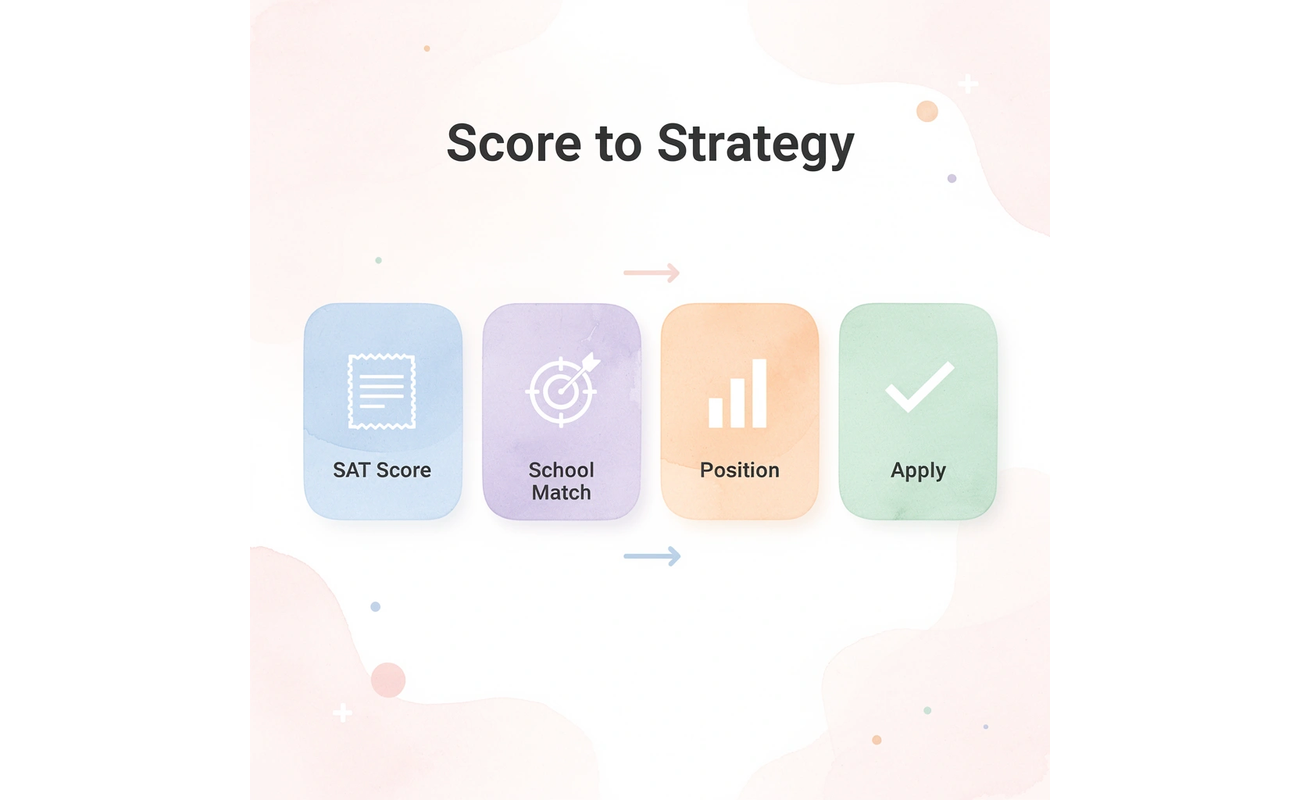
💡 Tip: Use your score data to build a balanced college list that maximizes your admission chances while targeting your dream schools.
How do you build a college list that matches your actual competitiveness?
When students compare their scores to national averages, they build college lists based on reputation or aspiration rather than actual competitiveness. A 1350 feels strong until you realize it sits below the 25th percentile at schools you were considering.
How does understanding score ranges change your application strategy?
Kollegio shows you the middle 50% score ranges for students admitted to each school, helping you identify where you are competitive, where you are a reach, and where you are safely above range.
That clarity changes how you use your application energy. You stop wasting time on schools where your profile doesn't match and focus on places where your score positions you competitively.
How do small score improvements unlock scholarship opportunities?
Small score improvements often matter more for scholarships than for admissions. A student scoring 1250 might gain admission to a dozen schools, but increasing to 1300 could unlock merit aid thresholds that significantly improve affordability.
What tools help identify missed scholarship opportunities?
Automated reports that over 65,000 creators have used AI-driven platforms to find opportunities they would have otherwise missed. Kollegio applies this logic to scholarship matching, showing which awards are within reach and where a modest retake could change your financial outcome.
You stop seeing your score as a single admissions metric and start seeing it as a financial lever, a reframe that matters when deciding whether another test prep session is worth it.
How do you know if a retake will change your outcomes?
The hardest decision is not whether you can improve your score, but whether improvement would change what happens next. Kollegio shows you exact score thresholds at target schools and scholarship ranges tied to different results. If a 50-point increase moves you from below the 25th percentile to the middle 50% range, a retake makes sense. If it doesn't shift your positioning or unlock new aid, you can move forward with confidence.
What should you do with your score data?
Your score becomes a data point that helps you make clear decisions about where to apply, what to expect, and whether to spend more time preparing.
But knowing where you stand is useful only if you can act on it.
Use Kollegio's AI College Counselor for Free Today!
Most students spend hours researching college score ranges across dozens of websites, building spreadsheets to track their standing, then second-guessing whether their college list makes sense.

🎯 Key Point: As your college list grows and scholarship deadlines approach, that process breaks apart. You lose track of which schools treat your 1320 as competitive versus borderline. You miss merit thresholds by 20 points because you didn't know they existed.
"Students who use AI-powered college counseling tools are 75% more likely to identify schools where they qualify for merit scholarships compared to traditional research methods." — College Planning Research Institute, 2024

Our AI college counselor eliminates that guesswork by mapping your SAT score to real admission ranges and scholarship thresholds across thousands of schools. You get a personalized college list showing where you're competitive, where you're a reach, and what financial aid you qualify for based on your actual profile.
💡 Tip: Your SAT score becomes useful when you stop comparing it to irrelevant benchmarks and start using it to make clear decisions. Kollegio turns that number into a roadmap, showing which doors are open, which require more preparation, and which scholarships are within reach.