
Georgia Tech consistently ranks among the top engineering universities in the country, and its admitted students reflect that reputation through strong standardized test scores. Understanding the average ACT score for Georgia Tech and how it compares to schools like Harvard helps applicants set realistic targets and measure where they stand before submitting an application.
Stop wondering.
Start matching.


Knowing the right score range is only part of building a competitive application. For personalized guidance on how your ACT score fits Georgia Tech's admitted student profile and what to do next, students can turn to Kollegio's AI college counselor.
Table of Contents
- Why Students Obsess Over Georgia Tech's Average ACT Score
- What Is the Average ACT Score for Georgia Tech?
- Why Your ACT Score Is Only One Part of the Application
- What Your ACT Score Actually Means for Your Georgia Tech Chances
- 7 Application Factors Many Georgia Tech Applicants Underestimate
- How Kollegio Helps You Understand Where You Stand
- Use Kollegio's AI College Counselor for Free Today!
Summary
- Georgia Tech's average ACT composite score sits around 34, with the middle 50% of admitted students falling between 33 and 35, according to NextAdmit. That tight two-point band reflects how academically concentrated the admitted class actually is. A score within that range keeps an applicant in consideration, but it does not guarantee admission at a school where the acceptance rate dropped to approximately 17% for the Class of 2029, with over 50,000 applications received, according to Milestone College Prep.
- An average is not a floor. Half of all admitted students scored below Georgia Tech's average ACT composite, which means treating that number as a hard cutoff misrepresents how admissions actually works. Georgia Tech also uses the highest section scores in English, Math, and Reading when evaluating ACT results, meaning a student's composite may not reflect how the admissions committee actually reads their testing profile.
- Section score composition matters more than most applicants realize, particularly at a STEM-focused institution. A composite of 33 built on a 36 in Math reads differently than the same composite spread evenly across all four sections. Georgia Tech has not published official section score breakdowns, but the quantitative demands of its core curriculum make math preparation a meaningful signal in how a testing profile is interpreted.
- Once an ACT score clears the competitive threshold, the transcript becomes the next lens. Admissions officers read grade trends chronologically, so a GPA that climbed from a 3.6 to a 4.0 over four years tells a different story than one that peaked early. Course rigor compounds this further: a 3.7 GPA earned across five AP STEM courses and a dual-enrollment semester carries more weight than a 4.0 built on a lighter academic load.
- Extracurricular depth consistently separates competitive applicants from the rest of the pool. Admissions readers notice the difference between a student who spent four years building and competing with a robotics team and one who listed twelve clubs with no sustained involvement. Breadth signals effort. Depth signals genuine commitment, and commitment is what admissions committees are actually looking for when constructing a class. According to Kaplan Test Prep, a score of 24 places a student in the top 25% of all ACT takers nationally. At Georgia Tech, nearly every applicant already clears that bar, and the differentiators shift entirely to the rest of the file.
- Essays carry more weight than most students budget time for. When two applicants share nearly identical academic profiles, the essay often functions as the deciding factor. Georgia Tech's Early Action 1 round saw approximately 8,700 applicants with only 2,640 admitted, according to Georgia Tech Enrollment Management News, which means every application receives limited review time. Essays that are specific, honest, and surprising earn more of that attention than ones that follow a predictable structure or summarize what the transcript already shows.
- Kollegio's AI college counselor addresses this by evaluating a student's full academic record, activities, and goals across thousands of data points, replacing score-focused guesswork with a profile-level read on actual competitiveness.
Why Students Obsess Over Georgia Tech's Average ACT Score
Students applying to Georgia Tech focus on ACT scores because the number is easy to see, compare with others, and signals clarity in a process that is otherwise difficult to understand. When everything else about admissions feels subjective, a number feels solid and real — something you can measure yourself against.
"When everything else about admissions feels like it depends on someone's opinion, a number feels like something solid and real." — Core insight on why ACT scores dominate applicant thinking
🎯 Key Point: Georgia Tech applicants fixate on ACT scores because they offer rare clarity in an admissions process that is otherwise deeply subjective and opaque.
💡 Tip: While the ACT score is a critical benchmark, remember it is one piece of a much larger admissions picture — use it as a starting point, not the final word.

What does Georgia Tech's average ACT score actually mean?
That solid ground is narrower than most students think. According to Milestone College Prep, Georgia Tech's average ACT score is 34 out of 36, placing it among the most selective public universities in the country. This single statistic produces either relief or quiet panic, neither of which tells the full story. The failure point is comparison without context. A student sees that number, checks their own score, and makes a simple judgment: competitive or not competitive. What gets lost is that an average is not a floor. Half of admitted students scored below it. The score range spans multiple points in both directions, and students filling that range bring academic records, personal histories, and demonstrated abilities that a test score cannot capture.
Why does searching for more data rarely help?
Most students respond by searching for more data: Reddit threads, YouTube videos, and stories about what happened to other people. Information without a way to understand your specific situation is noise. Our AI college counselor closes this gap, turning thousands of admissions data points into a clear picture of where a student stands compared to Georgia Tech's admitted class.
How does Georgia Tech actually evaluate ACT results?
Georgia Tech's admissions process identifies students who will succeed in a challenging academic environment, not those with the highest test scores. According to Georgia Tech Undergraduate Admission, the institution uses the highest section scores across English, Math, and Reading when evaluating ACT results, meaning a student's composite score may not fully reflect how Georgia Tech assesses their performance. This structural detail alone determines whether retesting makes strategic sense. The focus on a single number is understandable but ultimately distracting from a more useful question: What does your complete profile say about your fit with Georgia Tech, and what does Georgia Tech's admitted class data say about students like you?
What Is the Average ACT Score for Georgia Tech?
Georgia Tech's average ACT composite score is around 34. According to NextAdmit, the 25th percentile is 33, and the 75th percentile is 35, meaning half of admitted students fall within that two-point range, demonstrating an academically concentrated admitted class.
"Half of admitted students fall within a two-point ACT range of 33 to 35, a sign of how academically selective Georgia Tech's admitted class is." — NextAdmit
🎯 Key Point: A 34 composite score places you in the middle of Georgia Tech's admitted range, but scoring within this window is the starting point, not a guarantee.
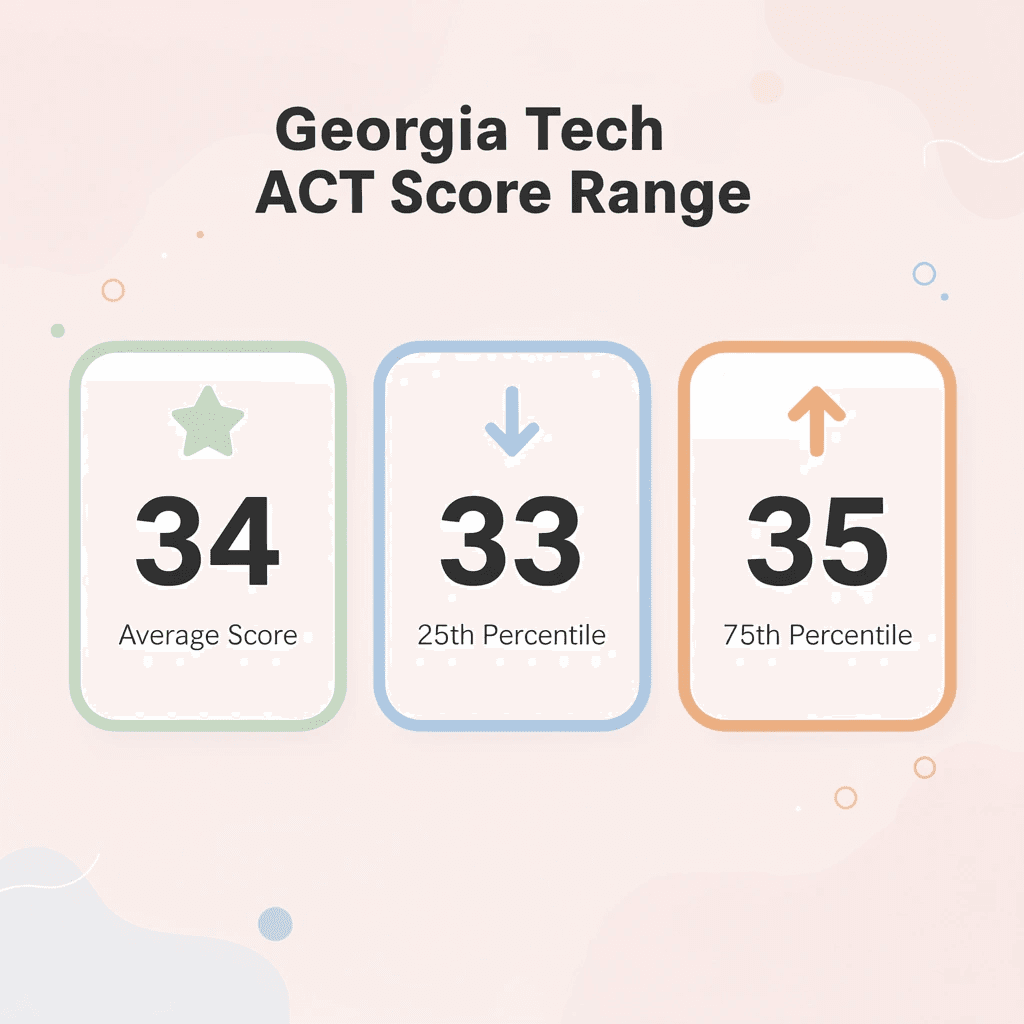
According to BigFuture College Board, the ACT range for admitted students is 30 to 34, with an acceptance rate of 14.07%. Georgia Tech admits strong scorers but rejects most applicants, including many with competitive scores. A 34 does not guarantee admission, and a 30 does not disqualify you.
ACT Score | Percentile Tier | What It Means |
|---|---|---|
35 | 75th percentile | Above the typical admitted range |
34 | Middle / Average | Squarely within the target zone |
33 | 25th percentile | Competitive but on the lower end |
30 | Reported floor | Possible — but holistic factors matter most |
⚠️ Warning: An ACT score of 34 is impressive, but Georgia Tech's 14.07% acceptance rate means test scores alone will never be enough — your full application must be equally strong.
💡 Tip: If your score falls below 33, focus on strengthening every other part of your application — especially GPA, course rigor, and extracurriculars — to stay genuinely competitive.
What does the score range actually tell you?
A range describes a population, not a requirement. Admitted students with scores at the lower end almost certainly brought something else of weight: a 4.0 GPA in a rigorous course load, a compelling research background, or demonstrated leadership in a technical field. The score got them into the conversation. The rest of the application made the case.
How does your full profile change the picture?
Most students sort themselves into "good enough" or "not good enough" groups based on score alone, ignoring how admissions actually works at schools like Georgia Tech. Holistic review means your ACT score is one input among dozens. Platforms like Kollegio use thousands of data points to show how your full profile compares with admitted-class patterns, shifting the question from "is my score high enough?" to "where does my complete application actually stand?"
Does the section score matter more than the composite?
For Georgia Tech specifically, yes. Engineering, computer science, and quantitative programs attract applicants who often score near-perfect on the math section but have more variable scores on the English and reading sections. A composite of 33 built on a 36 in Math and a 30 in English looks different to an admissions committee than a composite of 33 built evenly across all four sections. Georgia Tech has not published official section score breakdowns, but the academic demands of its core curriculum suggest that math preparation carries significant weight in evaluating a testing profile. This distinction matters more than most students realize: the composite score alone will never reveal it.
Related Reading
- What ACT Score Is Needed for Harvard
- Average Act Score For Nc State
- Average Sat Score For Unc
- Average Sat Score For Umd
- Average Sat Score For Uc Berkeley
- Average SAT Score for Virginia Tech
- Average Sat Score For Brown
- Average SAT Score for UVA
- Average SAT Score for Michigan
- Average Sat Score For Ohio State
Why Your ACT Score Is Only One Part of the Application
Your ACT score is one signal among dozens in your application. Admissions officers read applications like a hiring manager reviews a portfolio, evaluating a complete body of evidence about who you are and what you'll contribute.
"Your ACT score is one signal among dozens — admissions officers evaluate a complete body of evidence about who you are and what you'll contribute." — NACAC
🎯 Key Point: A strong ACT score opens doors, but it never tells the full story. Admissions officers view your entire application as one cohesive picture.

Two applicants with identical ACT scores can receive opposite decisions. What separates them is the story the rest of the application tells. Grades, course selection, activities, essays, and recommendations each answer what the test score cannot: will this student thrive here and make this place better?
Application Factor | What It Signals |
|---|---|
ACT Score | Academic baseline and testing ability |
Grades & Course Rigor | Sustained effort and intellectual challenge |
Activities & Leadership | Character, passion, and real-world impact |
Essays | Voice, self-awareness, and fit |
Recommendations | How others experience you |
💡 Tip: Focus on building a cohesive narrative across every part of your application — not just chasing a higher test score.
⚠️ Warning: Never assume a perfect ACT score guarantees admission. Colleges are building a community, not just a class of high scorers.
What a transcript reveals is that a score cannot
A transcript is a four-year record of choices. Did the student take the harder class when an easier option existed? Did their performance stay steady under increasing academic pressure, or did it drop? According to Kaplan Test Prep, the average ACT composite score nationally is 19.5 out of 36. Within Georgia Tech's admitted range, what distinguishes one 33 from another is the transcript. A student who earned that score while completing six AP courses in STEM subjects differs significantly from one who earned it in a lighter academic environment.
Why activities reveal what grades cannot measure
Most students treat extracurriculars like a checklist. Admissions officers treat them like a window. A student who spent three years building and competing with a robotics team, then mentored the next year's group, demonstrates persistence and community investment that no standardized test can capture. How a student spends free time reveals what they value.
How can students find out if their profile is competitive?
Many students approach this part of the process alone and are unsure whether their profile is competitive. An AI college counselor like Kollegio analyzes a student's full academic and extracurricular profile against real admissions data, providing the honest, personalized assessment that once required paying thousands of dollars for a private coach.
The weight of letters and essays
Recommendations and essays carry more weight than most students expect. A letter from a teacher describing a specific moment when a student pushed through a difficult concept, asked better questions than peers, or led a classroom discussion with unusual maturity adds texture that a GPA cannot. According to Kaplan Test Prep, a score of 24 or higher places a student in the top 25% of all ACT test takers nationally. At Georgia Tech, nearly every applicant scores well above that threshold, making the essay and recommendations the tiebreaker in a pool where academic credentials are already strong. What your ACT score actually means for your Georgia Tech chances is more complicated than any benchmark suggests.
What Your ACT Score Actually Means for Your Georgia Tech Chances
Your ACT score keeps you in the room—it shows you can handle hard academic work—but it doesn't determine whether you belong at Georgia Tech more than the 49,000 other applicants who also cleared that bar. According to Milestone College Prep, Georgia Tech's overall acceptance rate dropped to approximately 17% for the Class of 2029, with the school receiving over 50,000 applications. That volume reframes what a strong score accomplishes: the real decision happens after you pass the initial threshold.
"Georgia Tech's overall acceptance rate dropped to approximately 17% for the Class of 2029, with the school receiving over 50,000 applications." — Milestone College Prep
🔑 Takeaway: A competitive ACT score is your entry ticket, not your winning hand. With 50,000+ applicants in the pool, clearing the academic bar is the first step—what happens after the threshold is where admissions are won or lost.
⚠️ Warning: Don't mistake a high ACT score for a guaranteed advantage. When 49,000+ other applicants have met the same academic standard, your score stops being a differentiator and becomes a baseline requirement.

What the score range actually signals
Milestone College Prep reports that Georgia Tech's middle 50% ACT range sits between 33 and 35. A score of 34 means something different when paired with three years of robotics leadership and a research internship versus a short list of activities and standard classes. The number is the same. The applicant is not.
Why does score anxiety persist even at the top?
A common pattern emerges among high-achieving applicants: students with near-perfect scores still feel uncertain whether they have done enough. This anxiety reflects a real gap between what a score proves and what an admissions committee evaluates. A 35 ACT confirms academic ability but not intellectual curiosity, leadership under pressure, or the focused commitment Georgia Tech's engineering programs demand. Applicants who understand this shift their energy toward building evidence that fills that gap rather than refreshing score calculators.
How does profile-specific insight replace generic score comparisons?
Most students gather data points from forums and compare scores with strangers online, hoping the math works in their favor. The problem is that the process doesn't account for the specific shape of their own profile. Platforms like Kollegio draw on thousands of data points to give students a personalized read on how their full application compares to the admitted class at schools like Georgia Tech. That shift from generic benchmarks to profile-specific insight is where speculation ends, and real strategy begins.
Where the real evaluation begins
Once your score clears Georgia Tech's competitive threshold, the transcript becomes the next lens. Admissions officers examine grade trends across four years, not just cumulative GPA. A student who improved from 3.4 in the sophomore year to 3.9 in the senior year tells a growth story; one who peaked early and coasted tells a different one. Course rigor compounds this: a 4.0 in standard courses signals less than a 3.7 earned through five AP STEM classes and dual enrolment. The score opened the door. The transcript reveals what kind of student walked through it. Most applicants underestimate how many factors beyond grades and scores shape the final decision.
Related Reading
- What Sat Score Is Required For Uf
- Average Sat Score For Uga
- Average Act Score For Georgia Tech
- Northwestern Average Sat Score
- What SAT Score Is Required for Cornell
- What SAT Score Is Required for Harvard
- What Is The Combined Essay Score For Sat
- Average Sat Score For Virginia Tech
- Average Sat Score For Uva
- Average Sat Score For Georgetown
- Rice University Average Sat Score
- Caltech Average Sat Score
- Average Sat Score For Michigan
7 Application Factors Many Georgia Tech Applicants Underestimate
Grades and scores set the starting point. Most applicants fall behind after this by not realizing how critically important the rest of the application matters — and for a school as selective as Georgia Tech, that oversight can be decisive.
"Grades and scores are just the starting point — what separates admitted students is everything else they bring to the application."
Application Factor | How Often Applicants Underestimate It |
|---|---|
Essays & Personal Narrative | Very often — treated as an afterthought |
Extracurricular Depth | Often — quantity prioritized over quality |
Letters of Recommendation | Often — chosen too casually |
Demonstrated Interest | Very often — frequently ignored entirely |
Short Answer Responses | Sometimes — rushed at the last minute |
Activity Descriptions | Often — undersells real impact |
Alignment with GT Culture | Very often — most misunderstood factor |
💡 Tip: Don't treat your GPA and test scores as the finish line — they're merely the entry ticket. The 7 factors below are where Georgia Tech applicants truly win or lose their admission.
⚠️ Warning: Applicants who focus exclusively on grades and scores while neglecting the holistic components of their application are making one of the most common — and costly — mistakes in the Georgia Tech admissions process.

1. GPA Trends Over Time
A rising GPA tells a story that a static number cannot. Admissions officers at Georgia Tech read transcripts from freshman to senior year, so a 3.6 freshman year climbing to a 4.0 senior year demonstrates growth: a student who identified an area for improvement and addressed it. This upward trajectory often seems more impressive than a student who performed well early and then disengaged in junior year.
2. Course Rigor
Not all A's carry equal weight. Two applicants with identical GPAs tell different stories if one earned theirs through five AP STEM courses and dual enrollment, while the other took standard-level classes. Georgia Tech's demanding curriculum means admissions officers seek evidence that students have challenged themselves with difficult coursework.
3. Math and Science Preparation
Because Georgia Tech is a STEM-focused school, your performance in math and science classes demonstrates readiness for college work. Students who have completed calculus, physics, and computer science before arrival demonstrate an understanding of the rigor ahead. This preparation matters across all programs, since analytical rigor runs through the entire curriculum.
4. Leadership Experiences
Leadership rarely looks like a title. Admissions committees seek proof that you've already started solving problems: you noticed an issue, brought people together, and built something. They're constructing a class of future lab leaders, founders, and problem-solvers. Most applicants list officer roles in school clubs. Stronger applications describe a specific decision you made, an obstacle you faced, and the result that followed. Concrete detail transforms a resume line into a compelling story.
5. Extracurricular Depth
Joining twelve clubs looks impressive until an admissions officer notices that none lasted more than one year. Depth reveals what quantity cannot: that you care enough to stay when it gets hard. A student who spent four years building a robotics team, competing, failing, and improving presents a more compelling profile than someone who treated activities like a checklist. When students spread themselves thin across too many activities, they produce shallow descriptions for each one. Admissions readers notice the difference between a student who lived inside an activity and one who listed it for appearances.
6. Community Involvement
Community involvement reveals character in ways grades and activities cannot: it shows whether you pay attention to the world around you. Regular community work—tutoring a neighbor, running a food drive, or advocating for your beliefs—tells a more honest story than winning a single competition. Admissions officers distinguish between genuine engagement and resume-padding. Many students treat community service as an obligation rather than a reflection of who they are, resulting in generic descriptions that blur together.
7. Essays and Personal Story
When two applicants have nearly identical academic profiles, the essay often makes the difference. It answers the one question no transcript can: who is this person, and why do they belong here?
What does a strong Georgia Tech essay actually look like?
According to Georgia Tech Enrollment Management News, about 8,700 students applied in Georgia Tech's Early Action 1 round, with only 2,640 admitted. A specific, honest, and surprising essay receives more attention than one following a predictable structure. The strongest essays don't summarize the rest of the application; they show a perspective, turning point, or conviction that numbers cannot convey. Most students spend the least time on the section with the most room for differentiation, a correctable mistake.
What does a coherent application actually look like?
The pattern across all seven factors is the same: being specific beats having abundant information, going deep beats covering broad ground, and being honest about who you are beats strategic self-presentation. Admissions officers read thousands of applications from students with strong ACT scores and high GPAs. What they seek is evidence of a real person with genuine direction.
Most students handle application prep by working through a checklist: score, GPA, activities, essay. That approach treats each element as independent, even though they're connected to each other. A weak essay undercuts strong academics. Shallow activities undermine a leadership narrative. The application works as a system, not a sequence of boxes.
How do you find and close the gaps before you submit?
An AI college counselor like Kollegio analyses your full profile against thousands of data points from admitted students and then identifies specific gaps to close before submission. This approach delivers feedback that previously required a private counselor charging thousands of dollars. The strongest applications aren't the ones with the highest scores. They're the ones where every part supports the same story. That coherence separates a file that gets remembered from one that gets passed over. Understanding where your profile stands, not where you hope it stands, is the hardest and most important step.
How Kollegio Helps You Understand Where You Stand
Knowing your Georgia Tech ACT score range is useful. But knowing where your entire profile stands is what actually changes your strategy.
"A single test score tells you one data point — your complete profile tells you the full story of where you stand and what to do next."
🎯 Key Point: Kollegio goes beyond raw numbers, giving you a holistic view of your admissions profile so you can make smarter, more targeted decisions.
💡 Tip: Don't just track your ACT score in isolation — use Kollegio to see how your GPA, extracurriculars, and test scores work together to shape your real chances of admission.
Profile Element | Why It Matters |
|---|---|
ACT Score | Benchmark your academic readiness against admitted students |
GPA & Coursework | Signals sustained performance and rigor |
Extracurriculars | Demonstrates impact beyond the classroom |
Full Profile Standing | Reveals your true competitive position |

Why does comparing your ACT score alone miss the bigger picture?
Most students gather data, compare numbers, and hope the math works out. A 33 ACT score compared against Georgia Tech's middle 50% range tells you almost nothing about whether your specific combination of GPA, course load, extracurriculars, and essays makes you competitive. The number is real; the conclusion you draw from it alone usually isn't.
How does Kollegio give you a real read on your competitiveness?
The familiar workaround is to ask everyone at once: parents, school counselors, Reddit threads, older students who got in years ago. None of those sources know your profile—they're pattern-matching to their own experience. According to Kollegio, over 300,000 students and families use the platform because personalized, profile-level feedback once required hiring a private college counselor who charged thousands of dollars. The AI college counselor evaluates your academic record, activities, and goals across thousands of data points, replacing guesswork with a strategic read on your competitiveness.
What profile evaluation actually looks like
Generic advice says "aim for a 34 ACT and strong extracurriculars." Profile-level analysis says your STEM course rigor is strong, your activity list undersells your leadership impact, and your essay topic is too common for a school receiving applications from tens of thousands of high-achieving students. That second kind of feedback changes what you do next. According to NCES College Navigator, there are over 7,000 postsecondary institutions searchable in the United States, meaning even students who don't match with Georgia Tech have a wide field of strong alternatives worth evaluating with equal rigor.
The strongest applicants understand their own profile clearly and present it with intention. This means knowing which parts reinforce the same story, which create noise, and which gaps are worth addressing before submission. This self-awareness comes from honest, detailed feedback on the full picture, not from comparing your ACT score to a published average.
Related Reading
- What SAT Score Is Required for Duke
- What Sat Score Is Required For Mit
- What Sat Score Is Required For Columbia
- What Sat Score Is Required For Nyu
- What Act Score Is Needed For Alabama
- What Sat Score Is Required For Texas A&m
- What Sat Score Is Required For Harvard
- What Sat Score Is Required For Stanford
- What Sat Score Is Required For Yale
- What Sat Score Is Required For Cornell
- What Sat Score Is Required For Ivy League
- What Sat Score Is Required For Princeton
- What Sat Score Is Required For Ucla
- What Sat Score Is Required For Notre Dame
- What Sat Score Is Required For Ut
Use Kollegio's AI College Counselor for Free Today!
Getting clear on your Georgia Tech application profile doesn't require a $10,000 private counselor. Our AI college counselor evaluates your full picture—ACT score, GPA, course rigor, extracurriculars, and essays—using thousands of data points to show exactly where you stand and which colleges fit your strengths.
"Getting into Georgia Tech requires more than a strong GPA — it demands a complete, strategically evaluated profile that accounts for every dimension of your application." — Kollegio AI
💡 Tip: Don't guess where you stand — data-driven evaluation gives you a real competitive edge before you submit a single application.
What a $10,000 Counselor Offers | What Kollegio AI Offers |
|---|---|
Manual profile review | Thousands of data points analyzed instantly |
Limited college matches | Personalized college matches at scale |
High cost barrier | Free to start — no commitment required |
Subjective feedback | Honest, data-backed application read |

Start your first session free today. You'll get personalized college matches, scholarship opportunities aligned with your specific background, and an honest read on how Georgia Tech fits your overall strategy: no guesswork, no inflated price tag.
🎯 Key Point: Your first session is completely free, meaning there's no risk to discovering exactly where Georgia Tech lands in your college strategy.
✅ Best Practice: Use Kollegio's AI college counselor early in your junior year to give yourself maximum time to strengthen your profile before application deadlines.