
UT Austin SAT Scores: 2026 Admissions Profile & Ranges
UT Austin requires a score, uses it differently by major, and has a median 60 points above the number most applicants benchmark against. Here is what the data actually says.
If you searched "UT Austin test optional" anytime in the last two years, there is a real chance the results you found no longer apply. Cached guidance, outdated blog posts, and well-meaning advice from older applicants have left a surprising number of 2026 applicants working from the wrong set of rules. Before anything else about scores or ranges matters, you need to know the current policy cold. See our AI college counselor for how this works in practice.
Most high school students (college applicants) think the only thing that matters is whether their score falls inside a published middle-50 percent range, that if the number clears the threshold, they are competitive, and if it does not, they need to retest. The common assumption is that the score is the whole story. At UT Austin in 2026, that framing misses something more fundamental: whether a score is required at all, and what the university actually does with it once submitted. The University of Texas at Austin formally reinstated mandatory SAT/ACT submission starting with the 2024–2025 admissions cycle, announcing this reversal in March 2024 and ending the test-optional window that had been in place since the pandemic. For the 2026 cycle, submitting a score is not a choice; it is a hard requirement for every freshman applicant.

There is no test-optional pathway, no test-flexible alternative, and no exceptions published for domestic applicants. The word "mandatory" here means your application cannot be completed without a score on file. Freshman applicants must submit either SAT or ACT results.
Skipping this step does not produce a holistic review of your other materials; it produces an incomplete application. The confusion is understandable given how many flagship universities kept or extended test-optional policies, but UT Austin moved in the opposite direction. UT Austin allows applicants to self-report scores through the MyStatus applicant portal during the review process.
However, self-reporting does not replace official delivery. Official SAT scores must be sent directly from College Board using UT Austin's institution code 6882. Both steps are required to finalize your application.
Here is the detail most students miss entirely. Based on our market understanding of how UT Austin uses submitted scores, they are used to match applicants to specific majors and to identify candidates for student success and academic support programs.
Key takeaways
- UT Austin reinstated standardized testing requirements; any guidance you found before 2024 may be describing a policy that no longer exists.
- The published middle 50% SAT range of 1230–1490 covers every admitted student across every college; applicants targeting McCombs, Cockrell Engineering, or CS are competing against a materially narrower, higher band.
- A score inside the university-wide range does not mean you are competitive; it means you cleared a floor, not a finish line, in a pool where roughly 69% of applicants are still rejected.
- Texas Top 6% automatic admission guarantees a seat at UT Austin, not a seat in your intended major; engineering and business admits run through a separate, more selective review regardless of class rank.
- SAT and ACT ranges describe the same admitted class; reading either number without layering in GPA, residency, and intended major produces a placement call, reach, match, or safety, that is likely wrong.
- Sending scores to UT Austin requires two separate steps through College Board; missing the second step before the December 1 deadline can stall an otherwise complete application.
- Kollegio.ai's College Match Results pulls your SAT score, GPA, major interest, and residency into a single AI-generated profile and shows you exactly where UT Austin lands on your list, and why, so you know whether to keep prepping or redirect that energy.
UT Austin SAT Score Ranges and Averages — The Full 2026 Breakdown
SAT scores sit at the center of one of the most common miscalculations UT Austin applicants make: assuming that landing somewhere inside the middle 50% range means you are genuinely competitive, when the reality of where you fall within that band matters far more than the band itself. This section breaks down exactly what UT Austin's admitted score distribution looks like and what your number actually signals about your position in the pool. If you are using Kollegio to build your college list, this is the context that makes those recommendations meaningful rather than generic.

UT Austin's Middle 50% SAT Range Is 1230–1490
What that band actually means: the middle 50% composite SAT range for UT Austin admitted students is 1230–1490, according to widely corroborated reporting of the UT Austin Common Data Set. That band represents the 25th through 75th percentile of admitted students who submitted scores. A score below 1230 places you outside the bottom quartile of admits.
A score above 1490 puts you above the top quartile. But here is the part students consistently miss: a score at 1250 is not "in range" in any meaningful competitive sense. It sits at the statistical floor of a pool where the median admitted student scores roughly 170 points higher.
One of the most common struggles non-auto-admit applicants face is genuine uncertainty about what SAT score is actually "safe enough" for UT Austin. Estimates circulate across the full spectrum, anywhere from 1000 to 1550+, and without a reliable frame of reference, it is easy to either over-interpret a solid score or underestimate how competitive the pool really is. Understanding exactly where your number falls within the admitted distribution is the starting point for cutting through that noise.
That is precisely why Kollegio's onboarding profile and College Finder are designed to be used before recommendations are generated, so that when a personalized college recommendation surfaces UT Austin as a match, it is already grounded in your actual score profile, not a generic range.
Section-by-Section Breakdown — EBRW 620–730, Math 610–770
UT Austin's section ranges, drawn from Common Data Set reporting, show Evidence-Based Reading and Writing (EBRW) running from 620 at the 25th percentile to 730 at the 75th, with Math running from 610 to 770 across the same interval. A student scoring 690 EBRW and 710 Math, for a 1400 composite, sits near the 60th percentile of admits. That is inside the range, but well below what Cockrell Engineering or Computer Science admits are typically bringing in. The Math sub-score carries particular weight for STEM applicants, a point the next section addresses in detail.
Average vs. Median — Why the Mean and 1420 Median Tell Different Stories
The mean composite SAT for UT Austin admitted students sits at approximately 1355–1370, per Common Data Set reporting. The median among score-submitters is closer to 1420. The mean is pulled downward by admits at the lower end of the range, many of whom earned automatic admission through Texas's top 6% rule and brought strong rank profiles rather than top-end test scores.
The median reflects the actual midpoint of the score-submitting pool, and it skews significantly higher. If you are benchmarking your score against "the average UT Austin student," 1420 is the more honest reference point. This mean-versus-median gap is exactly the kind of context that gets lost when students try to self-assess without a structured framework.
A 1360 can feel like it clears the bar when measured against a loosely recalled "average," and that misread can lead to a college list that is badly miscalibrated. Kollegio's onboarding profile captures your scores in full context so that the Plan Applications feature can help you build a list where each school reflects a genuine read on your competitiveness, not an average distorted by a different applicant pathway than yours.
Related Reading
- Boston University SAT Scores
- UF SAT Scores
- UCLA SAT Scores
- Johns Hopkins SAT Scores
- Clemson SAT Scores
- Northwestern SAT Scores
- Villanova SAT Scores
- Georgetown SAT Scores
- Brown SAT Scores
- UPenn SAT Scores
- Boston College SAT Scores
- Vanderbilt SAT Scores
- Purdue SAT Scores
SAT Scores for UT Austin's Competitive Majors — McCombs, Cockrell, and CS
McCombs, Cockrell Engineering, and Computer Science pull that university-wide 1230–1490 range in two directions at once. A student with a 1380 who benchmarks against the institutional median and exhales is not reading the right number. The university-wide range is a composite of every admitted student across every college, from Fine Arts to Natural Sciences, and for anyone targeting one of those three programs, it functions as noise rather than signal.
One of the most common patterns we see among students applying to competitive UT Austin programs is arriving at the process with a score in hand, feeling reasonably confident because it clears the published university band, and only later discovering that the actual competitive pool for their target major operates at a completely different threshold. This is exactly the kind of gap that kollegio.ai's onboarding profile and personalized College Finder are designed to close before it costs an application cycle.
1. McCombs School of Business — Aim for 1470–1550 to Stay Competitive
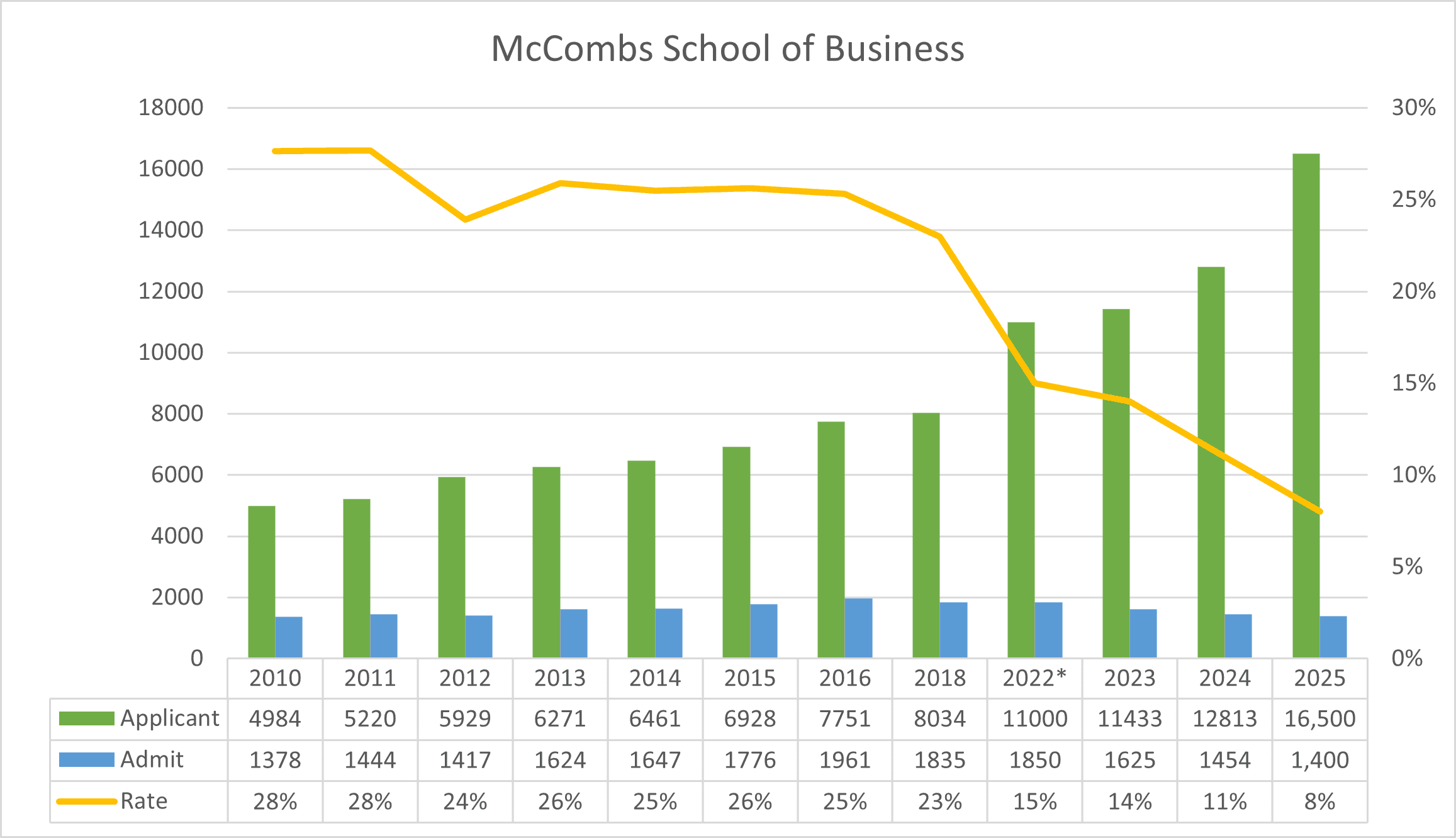
McCombs is one of UT Austin's most selective direct-admit programs, and its competitive pool reflects that. Admissions pattern data tracking UT Austin outcomes indicates that competitive McCombs applicants typically present composites toward the top of or above the published university-wide band, often in the 1470–1550 range, alongside class ranks in the top 4–6% of their graduating class. A score of 1380 that reads as "solidly inside the range" for a Liberal Arts applicant is functionally a weak signal here.
The Canfield Business Honors Program raises the bar further still, meaning even clearing the McCombs floor does not guarantee access to its most selective track. At the start of onboarding, before any recommendations are generated, Kollegio maps a student's composite, sub-scores, class rank, and intended major together. That means a McCombs-bound student with a score in the lower portion of the range sees their actual position in the McCombs pool, not a reassuring comparison against university-wide medians. The personalized college recommendations that follow are grounded in that program-specific read, not the noise of a collapsed institutional range.
2. Cockrell School of Engineering — A 1434 Average Masks a Brutal Acceptance Rate
Top 4–6% of their graduating class — the class-rank band competitive McCombs applicants typically present
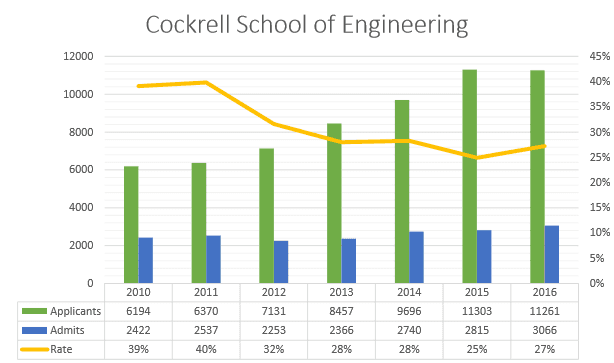
For Cockrell School of Engineering, the average admitted SAT composite sits around 1434, but that number does not tell the full story. Cockrell is among UT Austin's most applied-to programs, and admissions data consistently reflects a competitive acceptance rate well below the university-wide figure, meaning a score near the program average is a more precarious position than the number alone implies. Sub-score composition matters too: a 1460 with 780 Math outperforms a 1480 with 720 Math in an engineering pool, because program reviewers weight quantitative ability heavily when evaluating STEM readiness.
3. Computer Science at UT Austin — The Hardest Major Demands 1500+ and a Math-Heavy Profile
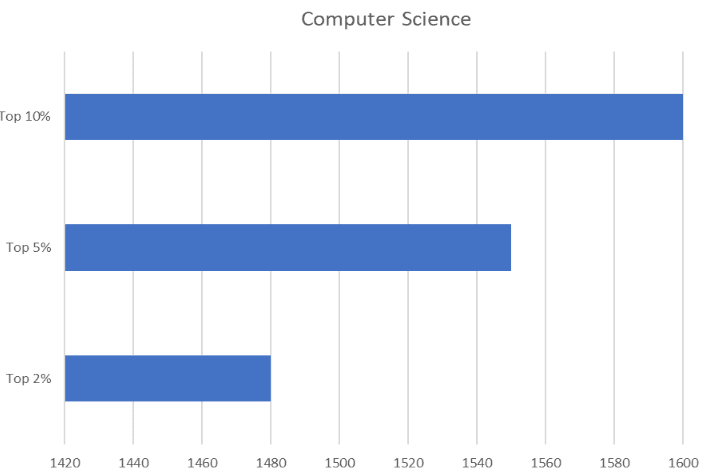
Computer Science at UT Austin is the most selective major in the entire university, and its de facto score floor sits at or above the published 75th percentile. Competitive CS admits typically present composites of 1500 or higher, with Math sub-scores in the 780–800 range. A strong composite built on EBRW does not substitute for a dominant Math section in this pool.
Applying to a less selective major with plans to transfer into CS later is a known workaround, but internal transfer into CS is highly competitive, GPA-dependent, and not a reliable fallback for an application that missed the CS threshold at freshman admission. This is precisely where having a full profile, composite score, Math sub-score, intended major, extracurricular depth, and essay readiness, mapped together changes the quality of the plan a student builds. Kollegio.ai's Activity Feedback tools exist to surface the parts of a profile that can move the needle when a score is on the edge of a program's competitive range; the AI Essay Planner serves the same function on the written side.
None of that work lands correctly if the score target anchoring preparation is the wrong number. The core problem is that one published range collapses wildly different competitive pools into a single number. A score in the middle of the university range can be a functional disqualifier for a student's actual target program, which is why major-specific benchmarks, not the school-wide band, should anchor your preparation goal.
Getting that benchmark right, early, before test prep strategy is set and applications are planned, is the difference between a preparation plan built on accurate signal and one built on institutional noise.
Related Reading
- Boston University SAT Scores
- UPenn SAT Scores
- UF SAT Scores
- UCLA SAT Scores
- Clemson SAT Scores
- Northwestern SAT Scores
- Villanova SAT Scores
- Georgetown SAT Scores
- Vanderbilt SAT Scores
- Boston College SAT Scores
- Purdue SAT Scores
- Johns Hopkins SAT Scores
- Brown SAT Scores
UT Austin GPA Requirements, Top 6% Automatic Admission, and How They Interact With Your SAT
GPA and SAT scores do not operate independently at UT Austin, and understanding how they interact is what separates a well-built application strategy from one based on incomplete assumptions. The Top 6% automatic admission rule creates a distinct pathway that changes how much weight your SAT actually carries, and the answer looks different depending on which college or major you are targeting. Kollegio walks you through both levers so you can see exactly where you stand and what your next move should be.

Top 6% Automatic Admission — What It Actually Guarantees (And What It Doesn't)
Most high school students think the SAT middle-50% range tells the whole story: "If my score is inside the published 1230–1490 range, I'm competitive. If it's below, I need to retest." Texas's Top 6% rule (HB 588) guarantees admission to UT Austin for students who graduate in the top 6% of their Texas public high school class. Full stop. The university cannot deny them a seat. What the rule does not guarantee is placement in a specific college or major within UT Austin.
A student admitted automatically still applies to a particular program, and competitive schools like Cockrell Engineering, McCombs Business, and Computer Science within the College of Natural Sciences use their own criteria to evaluate who gets in directly versus who gets redirected, according to UT Austin's published holistic review framework. One of the most common anxieties we see among students using Kollegio is this: a student who ranks just outside the top 6–10% of their class, but carries strong stats like a 1560–1590 SAT, feels entirely uncertain about their chances because automatic admission is out of reach. That uncertainty is real, and it is not resolved by a single number.
The automatic-admit threshold does not define the ceiling of who gets in; it defines the floor of one narrow pathway. Students outside it are evaluated holistically, which means the full picture of their application, essays, activities, recommendations, and demonstrated fit, all carry weight that a rank or score alone cannot replace.
You Still Must Submit SAT Scores Even With Automatic Admission — Here's Why
Automatic admission does not waive the SAT or ACT submission requirement. According to UT Austin's admissions policy documentation, all freshman applicants must submit test scores as part of a complete application. For top-6% students, this matters in two concrete ways: major-specific placement decisions and merit scholarship eligibility.
A student who submits a 1220 SAT alongside an automatic-admit application to Cockrell Engineering is not in the same position as a student who submits a 1470. The score doesn't determine whether you get into UT Austin; it can determine whether you get into the version of UT Austin you planned on attending, and whether merit aid closes the financial gap. This is precisely where Kollegio's Scholarship Finder and financial aid tools become practically useful for automatic-admit students.
Because scholarship eligibility often hinges on the same test scores that influence major placement, students who treat SAT prep as optional after securing their class rank are leaving two doors half-open at once.
UT Austin GPA Benchmarks — The 3.7 to 4.0 Unweighted Cluster Admitted Students Occupy
Students with strong GPAs (4.8 weighted, 3.8 unweighted) and competitive SAT scores (750 English, 680 Math) still face rejection or deferral at UT Austin, which creates real confusion about what thresholds actually matter for admission.
Admitted students cluster in the 3.7 to 4.0 range, even though UT publishes no official minimum GPA cutoff. A 1490 paired with a 3.4 unweighted GPA is not automatically competitive, despite the score sitting at the top of the published SAT middle-50% range. The score clears a filter; the GPA is what tells admissions readers whether the academic foundation is genuinely there.
We regularly see students with a 4.8 weighted GPA and a 3.8 unweighted, paired with a competitive but split test score profile (for example, 750 English, 680 Math). These students receive rejections or deferrals and are left genuinely unsure which threshold actually cost them. The answer is rarely one number.
UT Austin's holistic review treats the academic record, the score, and the program-specific context together. A 680 Math SAT subscore on an application to Cockrell Engineering signals something different than the same score on an application to the College of Liberal Arts, and students who understand that distinction before they apply are in a materially better position. Kollegio's onboarding profile, built at the very start of the onboarding process, before recommendations are generated, surfaces exactly this kind of program-specific context early, so students and families are building toward the right targets from day one rather than discovering misalignments after decisions arrive.
The Major-Placement Trap Top-6% Students Miss
This is the part that rarely shows up in the headline acceptance data. A top-6% student who deprioritizes SAT prep because they feel admission is secured can end up admitted to UT Austin but denied direct entry to their target program. It is entirely possible for a top-6% student with a strong GPA (say, a 3.8) to be redirected out of Cockrell or McCombs on first review because their SAT score signaled weaker quantitative preparation than the program expects, a gap that focused test prep during junior year could have closed before the application window opened.
UT Austin's major-specific admission and scholarship policies make clear that the program-level review operates on criteria separate from the automatic-admit guarantee. Out-of-state applicants face an even steeper version of this trap. Even with a 4.16 GPA, the out-of-state disadvantage at competitive programs like McCombs means that GPA and SAT alone do not overcome the structural headwind.
What fills that gap is the rest of the application, essays that demonstrate genuine fit and intellectual purpose, an activities profile that holds up under scrutiny, and recommendation letters that speak to the student's readiness in specific terms. Kollegio's AI Essay Planner, Recommendation Letter Co-pilot, and Activity Feedback tools are built for exactly this compounding challenge: students who have the numbers but need the full application to carry the weight the numbers can't. The students Kollegio reaches are actively building their applications and trying to understand what the process actually requires of them, not what the headline acceptance rate implies.
The goal is to meet them with honest, specific guidance while there is still time to act on it.
UT Austin ACT Comparison and Reach, Match, or Safety — Where Does Your Profile Land?
Two scores, one school, and most students still walk away unsure where UT Austin actually belongs on their list. That confusion is not a research failure; it is a structural one. The ACT and SAT ranges published on admissions pages look like separate data points, but they describe the same admitted class. Reading them together, alongside your GPA, residency, and intended major, is the only way to get an honest reach, match, or safety read, and it is exactly the kind of multi-variable synthesis that families struggle to do on their own without a structured tool to hold all the pieces at once.
ACT 29–34 Is UT Austin's Middle 50%: The SAT Concordance You Actually Need
The ACT equivalent of UT Austin's SAT middle 50% (1230–1490) is ACT 29–34, based on College Board concordance data. Specifically, ACT 29 converts to roughly SAT 1330 and ACT 33 to SAT 1490, which means the ACT band matching UT Austin's 1230–1490 SAT range starts below 29, not at it. If your ACT sits at 29 or 30, you are near the lower edge of the middle 50%, not comfortably inside it. That distinction matters when you are also targeting a competitive program. UT Austin reinstated standardized test score requirements in 2024, meaning these ranges now carry real admissions weight again, not just context weight.

Below the 25th Percentile on Either Test: UT Austin Is a Reach. An ACT below 29 (SAT below 1230) puts you below UT Austin's 25th percentile threshold. What most applicants in this position find is that a score below that floor means reach-level odds regardless of GPA. The score alone does not disqualify you, but it means the rest of your profile must carry significantly more weight, and holistic review at a school with a 31% overall acceptance rate leaves little margin.
This is a moment where building out your activities record with Kollegio's Activity Feedback tools and strengthening the rest of your application profile becomes especially critical; a weak test score cannot be offset by a thin extracurricular or essay record.
The Match Window — In-State Applicants With SAT 1300–1420 and a Less-Selective Major
For Texas residents applying to programs outside the most competitive schools (Cockrell Engineering, McCombs, CNS Computer Science), SAT 1300–1420 with a strong GPA and class rank lands in genuine match territory. Across the broader applicant pool, this combination represents the clearest match profile UT Austin offers. A score in the lower portion of this range headed toward Liberal Arts reads very differently from the same score aimed at direct-admit Computer Science, where the realistic competitive floor sits closer to 1500. That major-level nuance is one reason families need personalized college recommendations that match their full profile and goals, not just a score lookup, and it is precisely the gap Kollegio's personalized recommendations are built to close.
Why UT Austin Is Almost Never a True Safety
Auto-admit under the Texas Top 6% rule guarantees a seat at the university. It does not guarantee placement in your intended major. Students who qualify for automatic admission and then apply to Cockrell or McCombs still face program-level review, and denial rates in those programs are meaningful.
Treating UT Austin as a safety because you rank in the top 6% of your class is exactly the misread this section warns against. Families we work with often underestimate this risk until they try to build a balanced, realistic college list that accounts for academic profile, intended major, and financial situation simultaneously, the kind of list that requires more than one data point per school. Kollegio's College Finder and Scholarship Finder work alongside the onboarding profile to surface schools that genuinely anchor the safety tier, so the bottom of the list holds up under program-level scrutiny.
Out-of-State Applicants Face a Compounded Penalty That No Single Published Metric Captures
The core synthesis claim here is one that admissions data surfaces only when you read residency status alongside score and major: out-of-state applicants face roughly a 7–8% acceptance rate at UT Austin, compared to roughly 35% for Texas residents, meaning an out-of-state student who treats UT Austin as a match based on score alone is carrying far more risk than the published ranges suggest. There is a second layer to this that families frequently miss: out-of-state sticker price at UT Austin is meaningfully higher than in-state, and without strong merit aid, the financial calculus shifts in ways that are hard to see until an acceptance letter arrives without a scholarship attached. Students and families routinely struggle to weigh the true financial burden of a school, comparing, say, a full-ride offer at a strong state school against an out-of-state tuition bill, especially when they are not writing the check themselves in real time.
Kollegio's financial aid tools are designed to surface that comparison early, not after decision day, so residency, selectivity, and cost are read as a single integrated variable from the start rather than three separate surprises.
How to Send Your SAT Scores to UT Austin — And What Happens After
Sending your SAT scores to UT Austin involves two separate steps that are easy to conflate, and missing either one can leave your application incomplete after the deadline closes. This section walks through the institutional code, what self-reporting in MyStatus actually does and does not accomplish, and why getting the logistics right is only the starting point for understanding how your scores factor into UT Austin's admissions process.
To send your SAT scores to UT Austin, you need to complete two separate steps through College Board, not one. Students who skip the second step often discover the problem after the December 1 deadline has passed, and by then, an otherwise complete application can stall.

UT Austin College Board Code 6882, Used Before December 1
UT Austin's institutional code is 6882. When ordering official score reports through College Board's score-sending system, enter this code exactly. College Board processes and delivers score reports after you place the order, so submit well before December 1 to give delivery enough time. Ordering on November 30 is a genuine risk.
Self-Reporting in MyStatus Is Required but Does Not Replace Official Delivery
Self-reporting your SAT score in the MyStatus portal is a required step for preliminary review, but it is not a substitute for official delivery. According to industry guidance on score-sending, official score reports are the authoritative record colleges use for final admissions decisions, scholarship eligibility, and major placement. A student who self-reports a 1400 in MyStatus but never orders official scores through College Board may find their application flagged as incomplete after the deadline closes.
One thing that genuinely frustrates students and families at this stage is not knowing how much any of this actually matters. Getting the logistics right, the code, the portal, the deadline, is necessary, but it does not answer the harder question: how does UT Austin actually weigh your SAT score once it arrives? UT Austin uses a holistic admissions process, and that opacity is real.
A student with a strong GPA and a strong extracurricular record can still face rejection, which means score delivery is a prerequisite, not a guarantee. Understanding where your scores fit within your full profile is a separate and equally important challenge. Kollegio's onboarding profile and personalized college recommendations are designed specifically for this: at the very start of onboarding, before any recommendations are generated, Kollegio maps your scores, GPA, activities, and goals together so you can see how your SAT fits into a realistic college list, not just assume UT Austin is a match because the numbers look close.
Submit Every Test Date You Have
UT Austin superscores the SAT, combining your highest Evidence-Based Reading and Writing score and your highest Math score across all sittings. Send scores from every test date you have taken, not just your best single sitting, as confirmed by UT Austin's Testing Services. Each additional score report can only help your superscore: UT Austin takes the highest section scores across all sittings, so there is no penalty for submitting a weaker earlier attempt alongside a stronger recent one.
Your SAT Score Is Only Half the Picture — Here's How to Read Your Full UT Austin Profile
Most students treat their SAT score as the primary signal of where they stand with UT Austin, but the actual outcome depends on how that score interacts with GPA, class rank, residency status, and intended major all at once. Misreading any one of those variables in isolation, whether that means assuming a strong GPA is automatically enough or mistaking a CAP offer for a form of acceptance, can quietly distort your entire college list strategy. What follows breaks down how those four variables work together, and where students most commonly get the read wrong.

The Four Variables That Actually Determine Your UT Austin Outcome
Score is one input. The real read comes from running score, GPA, class rank, residency status, and intended major together, simultaneously. UT Austin's in-state acceptance rate for Fall 2025 was reported at approximately 35%, compared to roughly 7–8% for out-of-state applicants, a gap that admissions pattern data consistently attributes to residency preference under Texas enrollment policy rather than differences in applicant scores.
A 1490 paired with a 3.4 GPA is not automatically competitive, regardless of where that score sits in the published range. Optimizing any single variable while ignoring the others produces a false read. Class rank anxiety is a real and common trap here.
Students who are not in the top 5% or 10% of their class frequently assume UT Austin is simply out of reach, without ever testing what their full profile actually looks like against a specific major and residency pathway. That assumption can close doors that are not actually closed. And on the other end of the spectrum, a CAP offer, Coordinated Admission Program, is widely misread by students as a partial win, when it functions operationally as an in-state rejection to the student's first-choice major.
Mistaking a CAP offer for a form of acceptance shapes an entire college list strategy in the wrong direction. Both of these misreads trace back to the same root cause: evaluating one variable at a time instead of all four together. Kollegio's College Finder and Personalized College Recommendations are built on the complete student profile precisely so that the reach, match, and safety designations on a student's list reflect the real intersection, not the most optimistic single-variable read.
Why Your Intended Major Reshapes the Entire Reach, Match, Safety Calculation
UT Austin does not admit to the university uniformly. It admits to programs. McCombs, Cockrell Engineering, and CS within CNS each carry de facto score and rank minimums well above the school-wide 1230–1490 band.
A score that signals a strong match for Liberal Arts may fall short for Engineering without a compensating class rank or exceptional essay narrative. Applying to a less selective major as an entry point is a known strategy, but internal transfer into competitive programs like CS or McCombs is GPA-dependent, limited in seat count, and far from guaranteed; it functions as a contingency, not a reliable alternative path. This is the level of specificity that a score-range lookup cannot deliver.
When Kollegio generates personalized college recommendations that match a student's profile and goals, the major is not treated as a cosmetic field; it is a structural variable that determines whether a given school belongs on the reach column or the match column of that student's specific list, given their specific rank and residency status. That is the difference between a list built on complete profile data and one built on a published acceptance rate read in the abstract.
Related Reading
- Carnegie Mellon SAT Scores
- Tufts SAT Scores
- UC Berkeley SAT Scores
- UNC SAT Scores
- Auburn SAT Scores
- Columbia SAT Scores
- University of Michigan SAT Scores
- UConn SAT Scores
- Good ACT and SAT Scores
- NC State SAT Scores
- Wake Forest SAT Scores
- Ivy League SAT Scores
Next steps
If your SAT score sits comfortably inside the 1230–1490 range but you are still unsure where you actually stand, the path forward starts with reading that score inside its real context: major, residency, GPA, and class rank running simultaneously, not one variable at a time. Start with our AI college counselor.
The median admitted student scores closer to 1420, not the published mean, and that gap matters more once you layer in where you are applying. A 1380 aimed at Cockrell Engineering is competing in a pool where the de facto floor sits at or above the 75th percentile, while the same score headed toward Liberal Arts lands in genuine match territory. Out-of-state applicants face a 7–8% acceptance rate against a 35% rate for Texas residents, meaning residency alone can reclassify a match into a reach before a single essay is read. Together, those two realities point to one logical next step: get your full profile evaluated as a whole, not score-by-score.
Start with kollegio.ai's AI college counselor, which maps your score, GPA, class rank, residency status, and intended major together before generating any college recommendations. From there, your reach, match, and safety designations reflect your actual competitive position at UT Austin and every other school on your list.
Frequently Asked Questions
What are UT Austin's SAT section score ranges for EBRW and Math?
The Evidence-Based Reading and Writing (EBRW) section runs from 620 at the 25th percentile to 730 at the 75th percentile, while Math runs from 610 at the 25th percentile to 770 at the 75th percentile. These are drawn from UT Austin's Common Data Set reporting.
What is UT Austin's SAT institution code for sending official scores?
UT Austin's College Board institution code is 6882. You must send official scores directly from College Board using this code; self-reporting through the MyStatus applicant portal alone is not sufficient to finalize your application.
Can you still get into UT Austin with a low SAT score?
Students in the top 6% of an accredited Texas public high school class are guaranteed admission under the Top 6% rule regardless of their SAT score, but a low score can still affect which college or major you're placed into and your eligibility for merit scholarships. For non-auto-admit applicants, a score below the 1230 floor of the middle-50% range places you outside the bottom quartile of admitted students, and competitive programs like Computer Science effectively require 1500 or higher.
If I'm a top-6% automatic admit, do I still need to submit SAT scores?
Yes. Automatic admission does not waive the SAT or ACT submission requirement; all freshman applicants must submit test scores as part of a complete application. For top-6% students, the score still influences major-specific placement decisions and merit scholarship eligibility.
Is UT Austin test optional for the 2026 admissions cycle?
No. UT Austin formally reinstated mandatory SAT/ACT submission starting with the 2024–2025 admissions cycle. For 2026, submitting a score is a hard requirement for every freshman applicant; there is no test-optional pathway, no test-flexible alternative, and no published exceptions for domestic applicants.

Author
Senan KhawajaSenan Khawaja is the Co-Founder and CEO of Kollegio, an AI-native college counseling and institutional recruiting platform serving roughly 250,000 students across 190 countries. A Stanford graduate, repeat founder, and Forbes 30 Under 30 honoree with World Bank experience, Senan launched Kollegio to democratize elite college counseling—addressing the 400:1 student-to-counselor ratio in public schools. Under his leadership, Kollegio has secured 22+ institutional partners with a 100% renewal rate and backing from Reach Capital, JFF Ventures, and ECMC Group. He was also selected for OpenAI's inaugural ChatGPT Futures Class of 2026. Senan is based in New York City.