
USC SAT Scores: 2026 Admitted Student Stats & Ranges
USC's middle 50% SAT range sounds like a cutoff. It isn't. Here's what the numbers actually tell you, and how to decide whether submitting your score helps or hurts your application.
USC's published SAT numbers are the first thing most applicants look up, and for good reason. They give you a concrete anchor in an otherwise opaque process. But the common assumption is that a score inside the range is a green light and a score below it is a rejection letter, that once you know whether your score "qualifies," you know whether to apply. See our AI college counselor for how this works in practice.
The data is actually telling a much quieter story. The range describes who enrolled, not who qualified. Understanding that distinction changes how you use the numbers entirely.

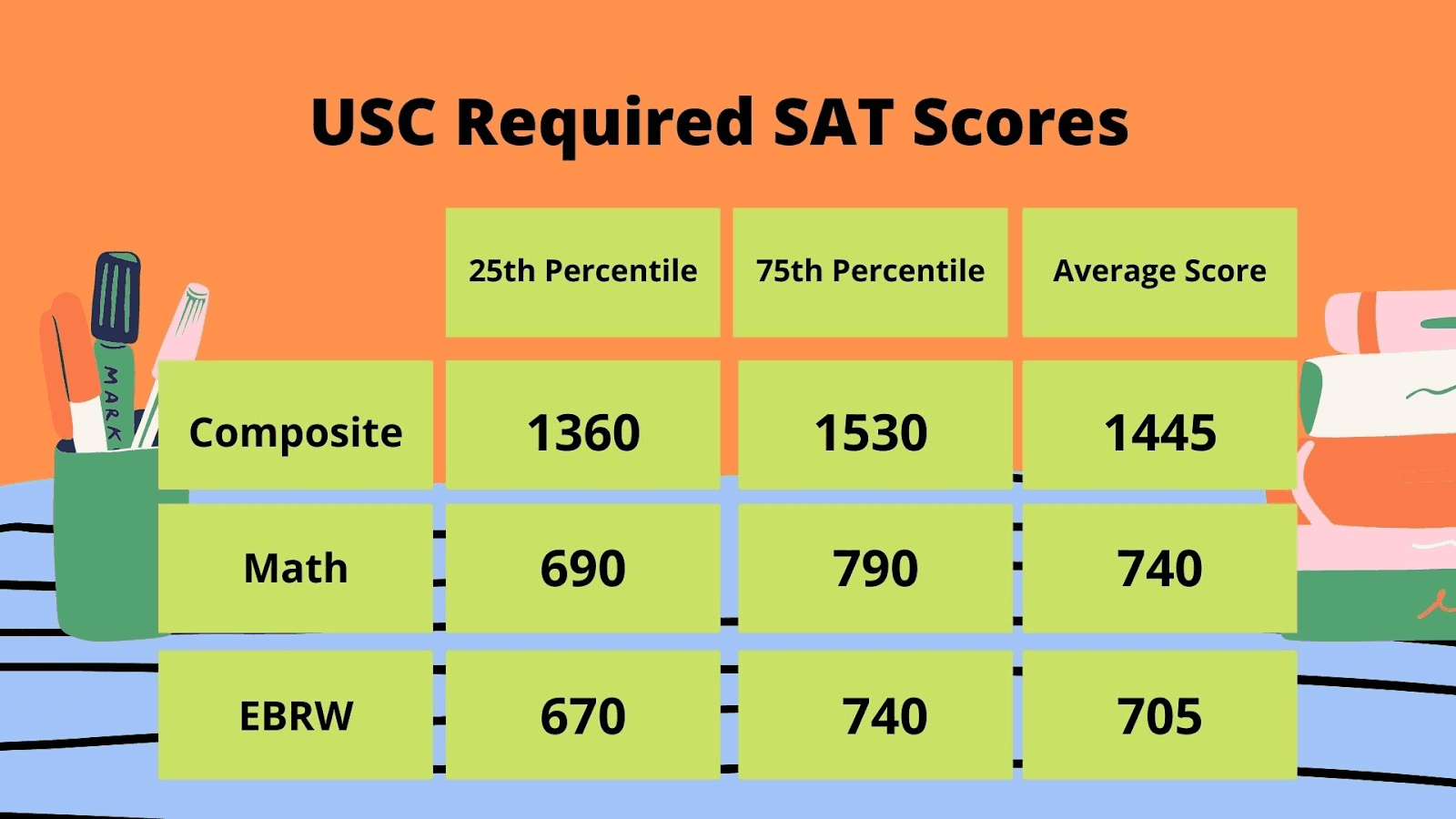
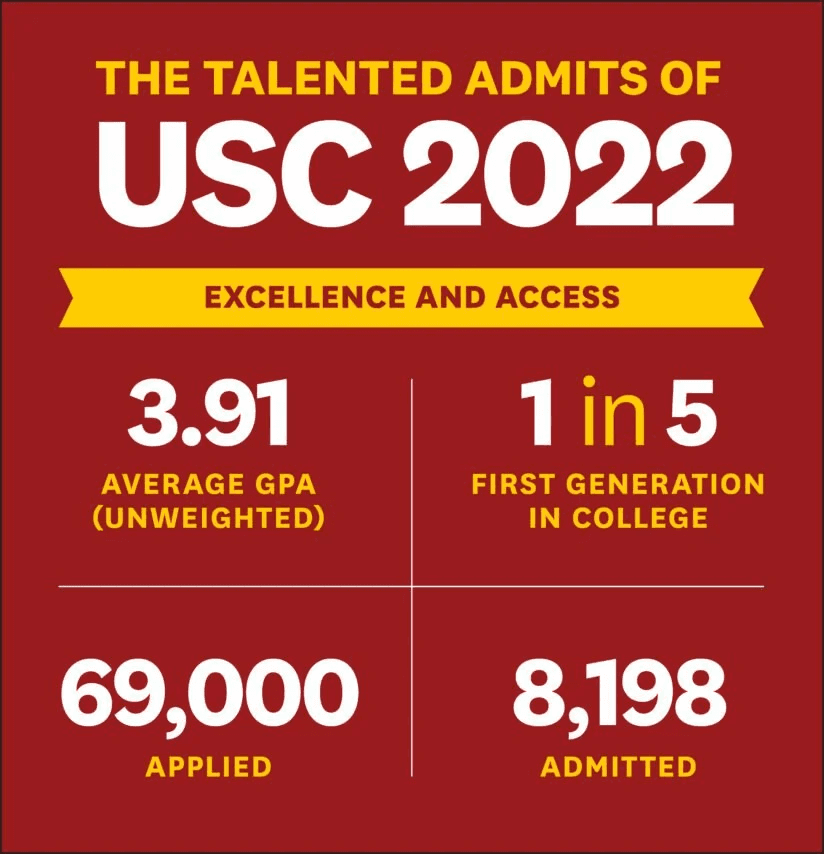
USC's middle 50% SAT composite range for the admitted class of 2025-2026 is 1450–1550. That figure comes from USC's official class profile and is corroborated by the Common Data Set, which remains the most authoritative published source for admitted student statistics. What the range tells you is straightforward: half of admitted students scored between 1450 and 1550. One quarter scored below 1450. One quarter scored above 1550. The number is a distribution, not a cutoff.
Students with borderline SAT scores (for example, a 1390) struggle to determine whether their score is competitive enough to submit to highly selective schools like USC, and that uncertainty creates real anxiety around the test-optional decision.
89% of applicants are rejected
Key takeaways
- USC's 2026 admitted student SAT middle 50% range runs roughly 1450–1550, a band wide enough that a score inside it tells you almost nothing about your actual odds.
- 60% of recently admitted USC students never submitted an SAT score, which means test-optional at USC is not a consolation path; it is a legitimate, well-traveled one.
- Submitting a score that sits inside the range can still hurt you if it reads as the weakest part of your application; the submit/withhold decision is strategic, not automatic.
- USC superscores the SAT, so splitting test prep across multiple sittings and targeting your strongest section dates is a concrete way to move your reported number.
- A 1480 paired with a 4.0 unweighted GPA and a strong extracurricular narrative lands differently than a 1480 next to a 3.5 and a thin activity list; the score is one variable in a weighted equation.
- At a 10–12% acceptance rate, USC is a reach for nearly every applicant, which makes the surrounding college list, not the USC application itself, the highest-leverage decision you make.
- kollegio.ai's College Finder runs your full profile through thousands of data points to surface schools where your SAT score, GPA, and interests actually position you as a strong candidate, not just schools that look similar to USC on a ranking chart.
USC's Test-Optional Policy for 2026–27 — What It Means If You Skip the SAT
Sixty percent of students admitted to USC in recent cycles never submitted an SAT score. That single fact should settle the anxiety around USC's test-optional policy, but it rarely does. The most common worry we see among students building their college lists is whether USC's test-optional policy is genuinely neutral, or whether walking in without a score quietly puts them behind applicants who do submit. That worry is understandable, and the data is the clearest answer to it.

USC Is Officially Test-Optional for the 2026-27 Cycle
USC is test-optional for the 2026-27 admissions cycle. Applicants who do not submit SAT or ACT scores are not penalized for the omission. The policy is not a soft suggestion or a leftover COVID accommodation. It is the operating standard for this cycle, and the admissions office reviews non-submitting applications on the full weight of everything else in the file.
What "No Penalty" Actually Means Inside a Holistic Review
"No penalty" is a specific operational claim. It means the reviewer does not record a missing score as a gap, a red flag, or an unanswered question. The file is evaluated on GPA, course rigor, essays, extracurriculars, and letters of recommendation, and the absence of a score column does not drag that evaluation down.
The missing score simply does not count against the applicant. That said, "no penalty" does not resolve every practical question a student faces. A student sitting on a 1330 SAT still has to decide whether going test-optional is a safe strategic call or a risky one for their specific profile.
A student with a 1390 has to weigh whether that score helps or hurts relative to the rest of their file. These are not policy questions; they are profile questions, and they require reading the full picture of a student's application before a recommendation makes sense. That is exactly the kind of judgment that belongs inside a balanced college list review, where each school on the list is matched to the student's actual academic profile rather than treated as a standalone calculation.
The Majority of Admitted Students Did Not Submit SAT Scores
Approximately 30 to 40 percent of admitted USC students submitted SAT scores in recent cycles. That means somewhere between 60 and 70 percent of admits went test-optional and still earned a spot. Non-submission is not a niche workaround used by a brave few. It is the majority behavior among the students USC actually accepted. Key takeaway: 60–70% of admitted USC students went test-optional; non-submission is the majority behavior, not a niche workaround.
One practical wrinkle that trips up students after they've made this decision: once the test-optional designation is selected on the Common App for USC, there is no visible mechanism inside the portal to reverse or update that choice if a higher score arrives later. Students who later improve their score can find themselves locked into a choice that no longer reflects their strongest application. Knowing this in advance, before the Common App is submitted, is the kind of detail that changes how a student plans their testing timeline, not just their submit/don't-submit decision.
The Real Decision Is Profile-Dependent, Not Policy-Dependent
A student with a 1390 who submits a score is attaching a number that may actively weaken their file against USC's admitted-student score distribution. A student with a strong GPA who goes test-optional may be hiding a score that would have added meaningful signal to their academics. Knowing USC won't penalize non-submission is necessary information, but it is not sufficient.
The right call depends on where that score sits relative to the rest of the file, what the GPA and course rigor communicate on their own, and how USC fits within the student's broader college list. Kollegio's College Finder and AI College Recommender are designed to surface exactly this kind of fit analysis before applications go out. When a student builds their profile at the start of the Kollegio onboarding process, before recommendations are generated, the platform maps their academic profile, interests, and financial situation against each school on their list, so the test-optional question at USC doesn't get answered in isolation. It gets answered in the context of a balanced, realistic college list where USC's role is already clearly defined.
What Is a Competitive SAT Score for USC — and When Submitting Actually Helps You
A score sitting inside USC's published SAT range tells you one thing: you are statistically similar to some admitted students. It does not tell you whether submitting that score actually helps your case. Those are two completely different questions, and confusing them is where most applicants lose strategic ground.

Yes, USC Superscores the SAT — What That Changes About Your Test Strategy
USC officially superscores the SAT, pulling your highest Evidence-Based Reading and Writing score and your highest Math score from separate test sittings to build your best possible composite. This policy applies to all SAT scores you choose to submit. The practical implication is direct: if you scored 730 Reading/Writing in March and 780 Math in October, USC sees a 1510, not the lower composite from either individual sitting.
That makes targeted retakes genuinely worthwhile. Sitting for the SAT a second time to push one weak section above your previous mark is a real strategy here, not a wishful one. Superscoring also matters for a specific trap students fall into: a strong Math score paired with a weak Reading/Writing score.
A student carrying a 790 Math but only a 500 Reading/Writing has a composite of 1290, well below USC's competitive range, yet may feel the Math score alone signals quantitative strength. It does not work that way. USC evaluates the superscore composite, not individual sections in isolation, so a lopsided profile still produces a composite that falls short.
That student's real move is a targeted Reading/Writing retake, not submission of the current score. Kollegio's onboarding profile, completed at the very start of onboarding before any recommendations are generated, surfaces exactly this kind of subscore imbalance early, so students know what to fix before they run out of test dates.
The Range Is Not Flat — Why 1540 and 1460 Are Not Equally Competitive
A common assumption is that any score inside the 25th-to-75th percentile band earns equal footing. In practice, position within the range carries real signal. USC's admitted student data places the 25th percentile near 1450 and the 75th near 1550, with the midpoint around 1490–1510. A 1540 sits in the top quarter of that band; a 1460 sits at the floor, and it reads differently again next to a 3.6 GPA in a light course load. The range is a distribution, not a flat green zone.
This distinction matters acutely for students targeting USC Marshall or other competitive USC programs. A student with a 3.82 unweighted GPA who earns a 1570 superscore is not simply "inside the range"; that score sits near the 75th percentile ceiling and actively reinforces the academic signal. A 3.82 GPA is genuinely competitive at USC, but students in that position often underestimate how much a strong test score can consolidate an otherwise complete profile rather than merely check a box.
- Conversely, a lower composite at the floor of the range does the opposite. Subscore composition adds another layer.
Applicants targeting USC's Business, Economics, or Accounting programs who carry a low Math subscore, say, a 660 Math against a decent composite of 1430, face a specific credibility problem. A 660 Math on a business application sends a signal about quantitative readiness that the overall composite cannot fully mask. Admissions readers for quantitative programs notice. That is not a reason to panic, but it is a reason to retake with the Math section as the primary target before deciding whether to submit at all.
The 50th-Percentile Threshold — The Practical Submission Tipping Point
The clearest submission rule of thumb is this: if your superscore lands at or above the midpoint (roughly 1490–1510), submitting it generally adds positive signal. Below that midpoint, the calculus depends heavily on your GPA, course rigor, and the story your application tells. A 1480 alongside a 4.0 unweighted GPA in AP-heavy coursework reads very differently from the same score alongside a 3.5 in standard-level classes.
The score does not exist in isolation; it either reinforces or contradicts everything else on the page. Kollegio's College Finder and AI College Recommender are built around exactly this kind of holistic read, matching a student's academic profile, interests, and family financial situation to a balanced, realistic college list. When Kollegio's onboarding profile captures GPA, course rigor, and superscore together, the resulting recommendations account for how those elements interact, rather than treating each data point separately. That matters because the submission decision is never just about the number.
Below the 25th Percentile — Why Test-Optional Often Serves You Better
A 1390, for example, sits clearly below USC's 25th percentile threshold of roughly 1450–1460. USC's admissions FAQ states that students should submit scores only when those scores reflect their academic abilities positively in the context of the application. A 1390 does not meet that bar for USC; it pulls the academic narrative downward rather than supporting it. Going test-optional in that scenario is not a concession; it is the strategically correct choice, and USC's own guidance supports it. Students with scores in this range often feel the uncertainty most acutely: is a 1390 close enough? Could submitting it hurt?
The answer is direct: at USC, a 1390 is below the floor of the competitive range, and withholding it removes a data point that works against you. Kollegio's Plan Applications feature and College Finder help students in this position build lists where their full profile, GPA, course rigor, activities, and essays, carries the application, rather than forcing a below-range score into schools where it will weigh them down.
USC Admissions Statistics and Acceptance Rate — SAT in the Context of a 10% Acceptance Rate
The acceptance rate is the most honest number USC publishes, and it says something most applicants miss entirely. USC's overall acceptance rate sits at approximately 10 to 12%, which means the school rejects roughly nine out of every ten students who apply. That single figure reframes every other statistic in the admissions profile, including the SAT range.
What the Acceptance Rate Actually Tells You
Here is the synthesis claim worth stating plainly: a 1480 SAT does not occupy a fixed position in the applicant pool; it is simultaneously a potential liability on a thin application and a complete non-issue when paired with rigorous coursework and a compelling narrative, because USC's holistic review weighs GPA rigor, essays, and activities alongside scores, while an 11% acceptance rate confirms that in-range scores still fail the majority of applicants who hold them.

Key takeaway: An in-range SAT score is not enough; the rejected pool includes many applicants with scores inside USC's published band whose broader application did not carry equal weight. This is based on the university's own admissions data. That number does not describe who gets rejected. It describes how little margin exists for an unbalanced application. The students who fill that rejected 88 to 90% are not mostly under-qualified. A significant share had SAT scores inside the published range. They were turned away because the rest of their application did not carry equal weight. Think about what that means concretely.
A rejected applicant might present a 1500 SAT, a 3.95 weighted GPA across a rigorous schedule, and a focused activity list. USC's holistic review evaluates academic achievement, test scores, essays, extracurriculars, letters of recommendation, and personal qualities together. No single factor is qualifying or disqualifying on its own.
One fear that surfaces repeatedly among applicants navigating this process: a single failing grade, say, an F in AP Pre-Calculus, feels catastrophic when the published acceptance rate is hovering near 10%. That fear is understandable, but it also reveals exactly the kind of single-variable thinking that leads applicants astray. USC reviewers see the full transcript in context.
One difficult grade inside a genuinely rigorous course load reads differently than a clean GPA built on undemanding classes. The question is never one data point in isolation; it is always the pattern of the whole application. That distinction is hard to see clearly when you are deep inside your own file, which is precisely where expert guidance through the complex college admissions process becomes the difference between a reactive decision and a strategic one.
Another pressure point: applicants who did not select rush delivery from College Board sometimes realize, uncomfortably close to USC's Early Action deadline of November 1, that their scores may not arrive in time. That logistical anxiety compounds the stress of an already demanding process. Knowing your score timeline, your application sequencing, and which factors actually move the needle, before the deadline window closes, is not a luxury. It is a strategic prerequisite.
GPA Rigor Sits Right Next to the SAT
The average unweighted GPA among admitted USC students is roughly 3.9, according to USC's class profile data. A 3.9 earned through AP and honors coursework reads differently than the same GPA in a lighter schedule. USC's reviewers see both numbers side by side, and the contrast is immediate. This is where score fixation becomes genuinely costly. Students who spend weeks retaking the SAT to move from 1480 to 1520 while leaving their activity list thin or their essays underdeveloped are optimizing the wrong variable. The score moved.
The application did not. That is the exact diagnostic problem Kollegio is built to solve. When a student builds their profile on Kollegio, at the very start of the onboarding process, before any recommendations are generated, the platform maps academic record, course rigor, extracurricular depth, and essay development together.
Tools like the College Finder, Activity Feedback, and AI Essay Planner surface which factor is actually holding an application back, rather than leaving a student to guess. Kollegio's activity tools help present the extracurricular record in its strongest form, and a Recommendation Letter Co-pilot supports the letters that sit alongside every other element in USC's holistic review. The real strategic error is not having a low score; it is failing to diagnose the weakness at all.
Without seeing how all six dimensions of a USC application interact, scores, GPA rigor, essays, activities, recommendations, and personal qualities, a student cannot make a sound decision about where to invest their remaining time. That visibility is what navigating this process with genuine guidance is supposed to provide.
Related Reading
- Boston University SAT Scores
- UF SAT Scores
- UCLA SAT Scores
- Johns Hopkins SAT Scores
- Clemson SAT Scores
- Northwestern SAT Scores
- Villanova SAT Scores
- Georgetown SAT Scores
- Brown SAT Scores
- UPenn SAT Scores
- Boston College SAT Scores
- Vanderbilt SAT Scores
- Purdue SAT Scores
Should You Submit Your SAT to USC? How to Make the Right Call for Your Profile
Here is a hard truth most students discover too late: the question "is my 1480 good enough for USC?" is the wrong question entirely. The right question is whether submitting that score makes your specific application stronger or weaker, and the answer depends entirely on what surrounds it.

The Two-Variable Rule — GPA and Rigor Share the Vote
An SAT score does not walk into USC's review alone. According to USC's 2024-2025 Common Data Set, the admitted student middle 50% runs from roughly 1450 to 1550, with the 50th percentile sitting near 1500. That means a 1480 lands just below the median, which is neither disqualifying nor impressive on its own.
What shifts its meaning is the GPA and course rigor sitting beside it. A 3.95 GPA across a full IB curriculum tells a reader the 1480 is consistent with demonstrated academic strength. A 3.7 GPA with inconsistent rigor tells a different story, and the score suddenly highlights a weakness instead of confirming a strength.
One complexity students regularly face at this stage is split scores, a strong Math section paired with a lower Evidence-Based Reading and Writing score, or vice versa. Whether to submit when your composite is 1480 but one section trails significantly is not a straightforward judgment call. The composite is what USC superscores and what gets benchmarked against that 1400–1560 middle-50% range, but a lopsided profile inside a borderline composite adds another layer of uncertainty.
That is exactly the kind of nuance a personalized profile review can untangle: Kollegio's College Finder maps your academic record, course rigor, and score breakdown together so you can see exactly what signal you are sending before you send it.
The 1480 Question Answered Directly — Just Below the 50th Percentile
A 1480 is not a yes and not a no. Per PrepScholar's analysis of USC admissions data, the 25th percentile sits around 1450 and the 75th around 1550, placing 1480 in the lower half of the admitted range. Submitting a score in this band is additive only when the rest of the profile is strong enough to make the number feel like confirmation rather than apology.
USC superscores the SAT, combining your highest section scores across all sittings, so the real first step is constructing the highest composite you can build before deciding whether that number earns its place on the application. Students also regularly confuse self-reporting with official submission. USC's test-optional policy allows you to decide whether to include scores at all, but if you do submit, official scores through College Board are required for enrollment verification. Understanding that distinction before you hit submit matters more than most students realize.
When Submitting Actively Hurts You — The Score-Narrative Contradiction
Under USC's test-optional policy, withholding a borderline score costs nothing. But submitting it invites the reader to weigh it, and if it contradicts the rest of your profile, it creates doubt. A student with a compelling leadership narrative, a high GPA, and a rigorous course load who submits a 1420 is essentially asking the reader to reconcile two signals that point in opposite directions.
Post-submission regret is real and more common than applicants expect. Students who chose not to submit their SAT often spend the weeks after wondering whether they made the wrong call, not because the decision was wrong, but because they made it without a complete picture of their profile relative to USC's pool. Making that call before you apply, with your full academic record in front of you, is the difference between a confident strategic choice and second-guessing that follows you through decision season.
Kollegio's personalized college recommendations are built on exactly that logic: the platform matches your profile and goals to fit, including whether your score strengthens or weakens your case at each specific school, so the submit-or-withhold question has a defensible answer grounded in your data, not anxiety.
How Merit Scholarship Eligibility Changes the Calculus
One documented exception to test-optional logic is merit aid. USC's Presidential and Trustee scholarship programs consider academic achievement comprehensively, and students pursuing those awards report that submitting a strong score supports their case. This is also where transfer applicants face particular uncertainty: a 1450 (for example, 750 Math / 700 Reading) may sit right at the 25th percentile threshold on paper, but for a competitive program like Computer Science, the relevant benchmark is the admitted pool for that specific major, not the university-wide median.
USC's Common Data Set reports university-wide figures; program-level competitiveness requires reading your score against your full profile and target major simultaneously. Kollegio's Scholarship Finder and financial aid tools are built to surface exactly these kinds of merit aid considerations, including how your academic profile interacts with scholarship eligibility, so the score submission decision and the financial aid strategy are made together, not in isolation. Smarter enrollment decisions come from seeing the whole board at once, and that starts with building your complete student profile before recommendations are generated.
Comparable Schools to USC — Matches and Safeties for Students Who Also Have USC on Their List
Build a college list around USC the wrong way, and you end up with a stack of reaches, two token schools you'd never actually attend, and an application season that feels like everything is riding on one envelope. That emotional weight is real, and it shows up in your essays. The fix is not adding random schools to hit a number.
It is finding schools where your SAT score tells a genuinely strong story, so USC stops feeling like the only option that matters. One of the most consistent patterns among students building lists with USC as a target: the list ends up structurally unbalanced, reaches clustered at the top, vague placeholders at the bottom, and no clear logic connecting them. Identifying true comparable alternatives is harder than it sounds, especially when the student is also struggling to name safety schools they would genuinely attend.
That gap is not a character flaw. It reflects how difficult it is to evaluate dozens of schools across selectivity, culture, and fit at the same time, without a framework that surfaces the right matches for a specific student profile. That is exactly the problem kollegio.ai's College Match Results are built to address.
At the very start of the onboarding process, before any recommendations are generated, Kollegio builds a Student Profile that captures academic stats, intended major, campus culture preferences, and financial considerations. From that profile, the College Finder and AI College Recommender surface schools where a student's numbers and priorities are genuinely well-positioned, not just schools that fill a spreadsheet row. The result is a list with structural integrity: reaches, matches, and safeties that connect to each other rather than sitting in separate, unrelated piles.
A student with a 1490 SAT who applies only to USC and two Ivies with no real safety is not being ambitious. They are being unprotected. The same student with Tulane and Boston University on their list, schools where a 1490 lands above the median, walks into USC's application with less anxiety and, typically, clearer writing. The list is the strategy. Here is how six comparable schools stack up for students who have USC in their sights, schools where your SAT score tells a stronger story and USC stops feeling like the only option that matters.
1. UCLA — Closest Match for USC Applicants Seeking LA Prestige

UCLA's middle 50% SAT range for admitted freshmen runs from 1310 to 1530, per the UCLA 2025 First-Year Profile. A student scoring 1480 sits comfortably above UCLA's 25th percentile, meaning the same score that feels borderline at USC signals genuine strength here. That positioning is precisely the kind of data point Kollegio's College Match Results surface when building a student's list, showing not just where a score falls, but where it tells a stronger story relative to the admitted pool. The real tradeoff: UCLA's acceptance rate for out-of-state applicants is significantly lower than its headline figure, per the UCLA freshman admission profile, so California residents benefit far more from this positioning than students applying from out of state.
2. UC San Diego — Strong Match for STEM-Focused USC Hopefuls
UCSD's middle 50% SAT range sits around 1280 to 1530 for the Class of 2028, making it a true match for most USC-range applicants. STEM programs here are nationally ranked and genuinely competitive, which matters if your intended major overlaps with USC's Viterbi School. Because Kollegio captures intended major during the onboarding profile step, STEM-focused students are matched to schools where their academic priorities are reflected in the recommendation, not just their test scores. The limitation worth naming: UCSD's campus culture is distinct from USC's, and students who prioritize social life and school spirit sometimes find the fit weaker than the academics suggest.
3. UC Santa Barbara — Accessible Match with Strong Academic Reputation
Image: USC SAT Scores - uc santa barbara accessible match
UCSB's middle 50% SAT range of approximately 1230–1480 makes it a realistic match or slight safety for students targeting USC SAT scores in the upper-middle tier. Its economics, marine science, and physics programs carry genuine national prestige. The coastal campus appeals to students drawn to USC's California lifestyle. The tradeoff is that UCSB lacks USC's entertainment industry and professional network advantages.
4. Tulane University — Private School Match with Similar Selectivity Profile
Image: USC SAT Scores - tulane university private school match
Tulane's middle 50% SAT range for the Class of 2029 is approximately 1390 to 1530, with an acceptance rate that has tightened considerably in recent cycles. For students who want a private university experience with strong pre-professional programming, Tulane belongs on a USC-anchored list as a genuine match, not a fallback. Kollegio's Plan Applications feature helps students track and manage these schools as a coordinated strategy rather than a scattered set of individual bets, so no school on the list gets treated as an afterthought.
5. University of Washington — Solid Safety for High-Scoring USC Applicants
UW Seattle offers a meaningful safety option for students with strong USC SAT scores, with a middle 50% SAT range of approximately 1200–1480 and a significantly higher acceptance rate than USC's current 10–12%. Its computer science and business programs are nationally respected, and its Pacific Northwest tech industry ties rival USC's LA connections. The tradeoff is that out-of-state tuition costs can approach or exceed USC's private tuition.
6. Boston University — East Coast Private Match for USC-Level Scorers
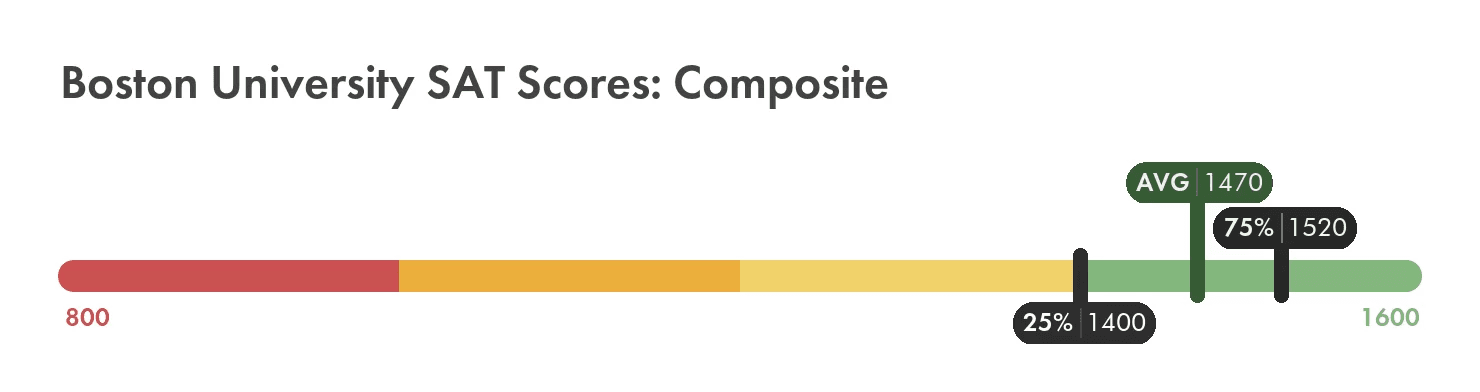
BU's middle 50% SAT range of approximately 1340–1530 makes it a true match school for students whose USC SAT scores land in the competitive middle band. Its large urban campus, strong communications and business schools, and active alumni network mirror several of USC's most appealing qualities. Students who want a private research university experience as a backup to USC will find BU a credible alternative. The tradeoff is that BU lacks USC's entertainment industry proximity.
Related Reading
- Carnegie Mellon SAT Scores
- Tufts SAT Scores
- UC Berkeley SAT Scores
- UNC SAT Scores
- Auburn SAT Scores
- Columbia SAT Scores
- University of Michigan SAT Scores
- UConn SAT Scores
- Good ACT and SAT Scores
- Wake Forest SAT Scores
- NC State SAT Scores
- Ivy League SAT Scores
Next steps
If your SAT score has you cycling between "good enough to apply" and "not worth trying," the path forward starts with recognizing that the score range describes who enrolled, not who qualified. Sixty to seventy percent of recently admitted USC students never submitted a test score, yet USC's acceptance rate sits near 10%. The range is a portrait of a minority of admits, not a gate every serious applicant must pass through. Start with our AI college counselor.
The hidden asymmetry in USC's test-optional policy means submitting a score below the competitive range on an otherwise strong profile adds a negative data point where none was required, while withholding it costs nothing. And a 1480 sitting just below the 50th percentile is not a fixed position: paired with a 4.0 unweighted GPA and rigorous coursework, it reads as confirmation; paired with a thin application, it reads as a liability. Together, these realities point to one action: build your full profile first, then decide whether your score strengthens or weakens your specific file.
Start with kollegio.ai's AI college counselor, which maps your GPA, course rigor, score breakdown, and activities together before generating any recommendations. From there, the submit-or-skip question stops being a guess and becomes a decision grounded in your actual data.
Frequently Asked Questions
Is 1450 a good SAT score for USC?
A 1450 sits exactly at USC's 25th percentile, meaning it is at the floor of the middle 50% range, not below it, but at the very bottom. Because position within the range carries real signal, a 1450 reads differently than a score near the midpoint of 1490–1510 or the 75th percentile ceiling of 1550, especially when paired with a lighter course load or lower GPA.
Should I submit a 1480 to USC?
It depends on the rest of your file. A 1480 sits just below USC's estimated midpoint of 1490–1510, so the post's practical rule of thumb is that scores at or above that midpoint generally add positive signal, while scores below it depend heavily on your GPA and course rigor. A student with a 1480 and a 4.0 unweighted GPA in AP-heavy coursework presents very differently than one with the same score and a 3.5 in standard-level classes.
Is there a minimum SAT score required to get into USC?
USC does not publish a hard minimum SAT cutoff, and the school is test-optional for the 2026–27 cycle, so no score is technically required at all. That said, the post notes that submitting a score below 1450, USC's 25th percentile, rarely helps and can actively hurt, and USC's own admissions guidance says students should submit scores only when those scores reflect their academic abilities positively in the context of the application.
If I go test-optional at USC, am I actually at a disadvantage compared to students who submit scores?
No, the post is direct on this point. Approximately 60 to 70 percent of students admitted to USC in recent cycles did not submit SAT scores, making non-submission the majority behavior among admitted students, not a workaround. USC's test-optional policy means the admissions office reviews non-submitting applications on the full weight of everything else in the file, and the missing score does not count against the applicant.
Does USC superscore the SAT, and does it actually matter for my strategy?
Yes, USC officially superscores the SAT, pulling your highest Reading and Writing score and your highest Math score from separate test sittings to build your best possible composite. This makes targeted retakes genuinely worthwhile: if you scored 730 Reading/Writing in March and 780 Math in October, USC sees a 1510, not the lower composite from either individual sitting.

Author
Senan KhawajaSenan Khawaja is the Co-Founder and CEO of Kollegio, an AI-native college counseling and institutional recruiting platform serving roughly 250,000 students across 190 countries. A Stanford graduate, repeat founder, and Forbes 30 Under 30 honoree with World Bank experience, Senan launched Kollegio to democratize elite college counseling—addressing the 400:1 student-to-counselor ratio in public schools. Under his leadership, Kollegio has secured 22+ institutional partners with a 100% renewal rate and backing from Reach Capital, JFF Ventures, and ECMC Group. He was also selected for OpenAI's inaugural ChatGPT Futures Class of 2026. Senan is based in New York City.