
Notre Dame SAT Scores: 2026 Stats and Admissions Data Guide
Your SAT score is not a verdict. Here is what Notre Dame's actual enrollment data says about where your number stands, and when submitting it helps or hurts your file.
Notre Dame publishes more standardized testing data than most students ever find. The common assumption is that if you can find the right SAT range data, you'll know whether you have a realistic chance at Notre Dame. The problem is not that the numbers are hidden; it is that most students stop at the first figure they see, compare it to their own score, and call it a verdict.
That single-number approach misses the full picture that Notre Dame's Common Data Set actually provides, and the gap between what you know and what you need to know can quietly tilt your entire college list. Notre Dame's SAT score ranges for enrolled Class of 2029 students come directly from the university's Common Data Set, published through Notre Dame's Office of Institutional Research. These figures reflect students who actually enrolled, making them a more meaningful benchmark than admitted-only figures. See our AI college counselor for how this works in practice.

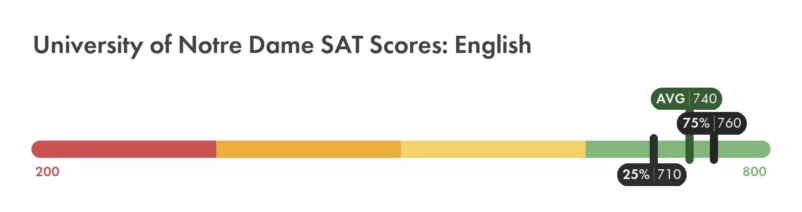
The composite range of 1460 to 1540 anchors the full picture. The section-level rows reveal something the composite alone cannot: Math skews slightly higher than EBRW across both percentile cutoffs, a pattern worth noting if your strengths lean in one direction. The middle 50% composite range means that half of all enrolled students scored between 1460 and 1540.
One quarter scored below that range, and one quarter scored above 1540. A student scoring 1500, for example, lands squarely inside this band: competitive on paper, but not automatically advantaged over the rest of the pool. What this range does not tell you is how many students below that range were admitted anyway, or what else in their application carried the weight.
Notre Dame's holistic review means the composite is a filter, not a formula. For STEM-track applicants, a Math score below 735 is a more noticeable gap than an EBRW score at the same absolute level.
Key takeaways
- Notre Dame's middle 50% SAT range for admitted students runs roughly 1460–1540, but sitting inside that band is an entry ticket, not an acceptance letter.
- Stopping at the middle 50% range and calling it a verdict is the single most common mistake applicants make; the range only tells you where the conversation starts.
- Notre Dame superscores the SAT, which changes the strategic weight of every test attempt; a student with multiple sittings is not working with the same number as one who tested once.
- Test-optional at Notre Dame is not a safe default: students with a 1570 are still being rejected, and submitting a score below the middle 50% without a compelling reason to do so can hurt more than help.
- ACT and SAT scores are not interchangeable at Notre Dame; which score you submit, and whether you submit at all, is a strategic call that depends on how your full profile reads alongside the number.
- Notre Dame's acceptance rate for the Class of 2029 Regular Decision round sat near 11%, the most competitive in university history; a strong SAT is necessary but nowhere near sufficient.
- Duke, Georgetown, and Vanderbilt share enough SAT overlap with Notre Dame that they routinely get miscategorized as straightforward matches; the numbers underneath that surface similarity tell a different story.
- Kollegio.ai's College Finder closes the gap by generating a personalized list of recommended schools built around your full profile, not just your SAT, and showing you exactly why each school made the cut.
Notre Dame ACT Score Ranges and What They Mean Alongside Your SAT
A student holding a 34 ACT and a 1490 SAT faces a real strategic question before hitting submit: which score actually positions them better at Notre Dame? The answer depends on more than a quick concordance lookup, because Notre Dame's superscore policy changes what each number actually represents, and students actively researching this decision deserve a precise, evidence-backed answer rather than a generic guess.
Key takeaway: Notre Dame superscores both exams independently, so your effective ACT or SAT score, pulling your highest section scores across every test date you submit, may be meaningfully higher than any single sitting.

Notre Dame's enrolled Class of 2029 posted a middle 50% ACT range of 33 to 35, placing it among the most selective universities in the country. A 33 keeps you in the conversation; a 35 puts you comfortably inside the range. Worth noting: these benchmarks reflect superscore composites, not single-test results, which makes them more reachable across multiple sittings than they first appear. The university superscores both exams independently, pulling your highest section scores across every test date you submit, so your effective ACT or SAT score may be meaningfully higher than any single sitting.
Using the College Board ACT-SAT Concordance, an ACT 33 converts to roughly 1470 on the SAT, and an ACT 35 converts to approximately 1540, aligning almost exactly with Notre Dame's published SAT middle 50% range of 1460 to 1540. If your superscore SAT and superscore ACT land on opposite ends of their respective ranges, submit the score that sits higher within its respective band. This is exactly the kind of decision that catches students off guard mid-application. Kollegio reaches students while they're actively searching, before the wrong choice is locked in.
At the very start of the Kollegio onboarding process, before recommendations are generated, Kollegio's College Finder captures your test scores, sittings, and superscored results so every downstream recommendation reflects your real competitive position, not a placeholder number. From there, the College Finder and AI College Recommender surface schools where your actual superscore profile is strongest, and Plan Applications keeps your submission checklist organized around the deadlines and requirements, like Notre Dame's test-optional nuances, that matter most. No invented analysis, no generic advice: just your numbers, mapped to the schools where they carry the most weight.
Related Reading
- Boston University SAT Scores
- UF SAT Scores
- UCLA SAT Scores
- Johns Hopkins SAT Scores
- Clemson SAT Scores
- Northwestern SAT Scores
- Villanova SAT Scores
- Georgetown SAT Scores
- Brown SAT Scores
- UPenn SAT Scores
- Boston College SAT Scores
- Vanderbilt SAT Scores
- Purdue SAT Scores
Notre Dame's Test-Optional Policy — What It Actually Means for Your Application
Deciding whether to submit your SAT score to Notre Dame feels like a guessing game, and that uncertainty is real. Here is what makes it genuinely disorienting: students with a 1570 SAT are still being rejected or waitlisted, and international applicants carrying a 1520 alongside a strong GPA are seeing the same outcome. That pattern forces an honest question: if a near-perfect score doesn't guarantee admission, what is the score submission decision actually doing for your file? The submission data from Notre Dame's own admissions office reframes that question, because the choice you make carries more weight than most students expect, and more nuance than a single number can capture.

Yes, Notre Dame Is Test-Optional, But Only Through the 2026–27 School Year
Notre Dame's test-optional policy applies to both first-year and transfer applicants through the 2026–27 admissions cycle, as confirmed in Notre Dame's official transfer FAQ. Standardized test scores are not required for admission consideration during this window. What the policy does not do is make the submission decision consequence-free, and treating it as a pressure-release valve is where many applicants quietly lose ground. A rejected 1570 is proof that scores are necessary but not sufficient, which means the rest of the file, including essays, activities, and qualitative evidence of fit, is doing heavier lifting than students often prepare for.
Nearly 60% of Enrolled Students Submitted Scores — What That Ratio Actually Signals
Industry research shows that nearly 60% of enrolled students in the Class of 2029 submitted test scores. That figure covers students who actually matriculated, not just those who applied.
Key takeaway: The majority of students who chose Notre Dame included their scores, a collective signal from competitive applicants that submitting a strong score adds something meaningful to the file rather than simply satisfying a checkbox.
But the rejections make clear that those same enrolled students did more than submit a score; they built complete files. For families working with Kollegio, the College Finder and Activity Feedback tools exist precisely to surface that fuller picture before a single application is submitted, because scores alone are not what separates enrolled students from rejected ones.
Withholding a Strong Score Is Rarely a Neutral Move
Notre Dame states that its strongest applicants typically demonstrate significant quantitative evidence. Withholding a competitive score does not erase that expectation; it just removes one of the clearest ways to meet it. A student sitting on a 1490 who goes test-optional is not hiding a weakness; they are leaving a data point on the table that admissions officers say they expect to see from top-tier candidates.
This is also where international applicants face a compounding disadvantage: a 1520 SAT in an international context may be evaluated differently than the same score from a domestic applicant, making the surrounding evidence in the file — course rigor, recommendation letters, essay quality — proportionally more consequential. Kollegio's Recommendation Letter Co-pilot and AI Essay Planner are built to strengthen exactly those surrounding elements, because when the score is strong but not conclusive, the written file must carry the argument.
AP and IB Results as Quantitative Evidence — The Alternative Notre Dame Actually Accepts
Notre Dame's official language is direct: AP or IB exam results can serve as alternative quantitative evidence in place of SAT or ACT scores, a policy detail confirmed in the Notre Dame transfer FAQ. Test-optional is not a gap in the file; it is a substitution. Strong AP scores across rigorous coursework make that substitution credible.
For parents trying to stay informed on these decisions without turning every conversation into a negotiation, Kollegio's platform is designed to keep the college application timeline visible and organized, so the right questions get raised at the right moments, without creating conflict with a teenager who already feels the pressure. When building the student profile at the start of the Kollegio onboarding process, before any recommendations are generated, the platform maps existing AP and IB results alongside test scores so the quantitative evidence picture is clear from day one, and the submission decision becomes a strategy, not a guess.
Notre Dame has also added a video component to its application for the current cycle, a signal that holistic, multi-dimensional evidence is precisely what the admissions office is seeking, making a complete, well-prepared file more important than ever.
Notre Dame Admissions Statistics — GPA, Acceptance Rate, and What the Full Profile Looks Like
Acceptance rates tell one story. Admitted profiles tell another. For the Class of 2029, Notre Dame received the largest applicant pool in university history and admitted roughly 11% of Regular Decision applicants, according to Notre Dame's own admissions announcement. That number reframes everything: thousands of students with scores inside the middle 50% range were rejected, which means the SAT is not the gate most students think it is.
Notre Dame's 11% Acceptance Rate and Class of 2029 Selectivity
Key takeaway: Selectivity at this level is not a test-score filter; it is a full-profile filter. The practical implication: a score inside the competitive range describes the floor of the admitted class, not the profile of a typical admit.
Thousands of rejected applicants held scores in the same band. A 4.7 weighted GPA is not always enough, particularly for international applicants, for whom the perceived bar appears disproportionately high relative to domestic peers. Sitting with a strong academic profile and still receiving a rejection is a disorienting experience, and it is precisely why understanding the full-profile filter, not just the test-score filter, matters before you apply, not after.
GPA and Course Rigor — The Academic Signal That Outranks Your Test Score
Selectivity at this level is not a test-score filter; it is a full-profile filter.
11% Notre Dame's acceptance rate for Class of 2029
Notre Dame's admissions office is explicit: academic preparation, including GPA and the rigor of coursework such as AP and IB courses, sits at the center of the holistic review. Admitted students typically present a 4.1 weighted GPA across a demanding course load. The transcript is read first because it shows what a student did over four years, not on one Saturday morning.
Course rigor is the part students most often underestimate. Admissions officers can see the difference between a school's most challenging curriculum and a comfortable one. Choosing the easier path to protect GPA is a visible trade-off, and it reads that way in review.
This is one of the areas where early, structured guidance makes a tangible difference. Kollegio's College Finder, completed at the very start of the onboarding process, before any recommendations are generated, captures a student's academic record, course load, and goals in full. That profile then powers Kollegio's personalized college recommendations, matching students to schools that genuinely fit their academic preparation, interests, and family's financial situation, rather than schools they are reaching toward based on brand name alone.
Building a balanced, realistic college list grounded in an honest reading of the profile is one of the clearest ways to reduce the anxiety that comes from applying only to reaches and then waiting.
Notre Dame's Admissions Factor Hierarchy — What Is Very Important vs. Considered
Notre Dame's Common Data Set places rigor of secondary school record and GPA among the factors weighted most heavily. Standardized test scores appear alongside these factors but are not ranked above them. The hierarchy matters because students who optimize only for test scores are essentially polishing one item on a long checklist. The factors that carry meaningful weight in the review are:
- Essays
- Character and personal qualities
- Extracurricular activities
Students admitted with scores in the 1400s frequently point to a rigorous course load, a distinctive personal essay, or sustained leadership in a single activity as the factors that carried their application. A high score on a thin profile does not clear the bar, and one of the most common mistakes applicants make is discovering that reality only after decisions are released, while anxiously refreshing portals and calling admissions offices for updates that have not yet arrived. Navigating the full complexity of this process — course selection strategy, essay development, activity framing, financial aid planning — is exactly the work Kollegio is built to support.
The platform's AI Essay Planner, Activity Feedback tools, Recommendation Letter Co-pilot, and Scholarship Finder work together so that every dimension of a student's application reflects the same coherent, well-prepared profile, not just the test score. The goal is not to manufacture a better applicant on paper. It is to help a student understand and present the full story of who they already are, across every factor an admissions office actually weighs.
Related Reading
- Boston University SAT Scores
- UPenn SAT Scores
- UF SAT Scores
- UCLA SAT Scores
- Clemson SAT Scores
- Northwestern SAT Scores
- Villanova SAT Scores
- Georgetown SAT Scores
- Vanderbilt SAT Scores
- Boston College SAT Scores
- Purdue SAT Scores
- Johns Hopkins SAT Scores
- Brown SAT Scores
Comparable Reach, Match, and Safety Schools for Notre Dame Applicants
Duke University sits at roughly the same altitude as Notre Dame in the admissions landscape on paper, but the numbers underneath that surface similarity tell a more sobering story. Duke's middle 50 percent SAT range overlaps closely with Notre Dame's, which is exactly why SAT-anchored college lists routinely miscategorize it. The critical error students make is treating that score overlap as evidence of peer-level odds.
It is not. Duke's Class of 2030 acceptance rate was 4.7%, less than half of Notre Dame's roughly 11–12%. That gap matters far more than the SAT overlap.
A Notre Dame-range applicant with a 1510 or even a 1540 is not a peer-level candidate at Duke; they are a long-shot applicant at a school that rejects the overwhelming majority of students with identical scores. Duke's own admissions office makes this explicit: the review is explicitly holistic, centering intellectual curiosity, authentic engagement, and community contribution, not score thresholds.
That distinction carries a concrete planning implication. A 1540 scorer who earns admission to Notre Dame and a 1540 scorer who earns admission to Duke are not interchangeable candidates. The Duke admit cleared a demonstrably steeper holistic bar. Treating those two outcomes as equivalent, and therefore treating Duke as a peer school rather than a genuine long-shot reach, is the central planning error Notre Dame-range applicants make when building their lists without accounting for what Duke actually evaluates.
This is precisely the kind of miscategorization that kollegio.ai's College Finder, surfaced through the AI College Recommender, is designed to catch before it costs a student a balanced list. When a student builds their profile at the very start of the Kollegio onboarding process, before recommendations are generated, the platform maps schools against the full holistic picture, not score ranges alone. Duke appears on that list where it belongs: as a genuine long-shot reach, flagged accordingly, so it never anchors a list as an expected outcome. Reaching students while they are actively searching, and actively building that profile, is the moment when correcting this miscategorization has the most planning value.
Duke belongs on a Notre Dame-range applicant's list. Its distinct culture, research depth, and collaborative campus environment are real draws that justify the application. But it belongs in the long-shot reach column, held there by honest odds, not repositioned as a peer school by a misleading SAT overlap.
For Notre Dame-range applicants, the comparable schools break down across three tiers. Here is how the key options compare:
[MISSING: comparison table row for University of Virginia — see edit log, para 0137]
1. Duke University — Top Reach School for Notre Dame SAT Score Applicants
Duke is the quintessential reach for students whose Notre Dame SAT scores land in the 1460–1540 range. With an acceptance rate near 4.7% versus Notre Dame's ~11%, Duke demands an even more competitive academic profile. Students drawn to research-intensive environments with strong pre-professional programs will find Duke a natural aspirational pairing. The tradeoff: significantly lower odds make it a high-risk addition to any college list.
2. Vanderbilt University — Comparable Reach with a Southern Campus Appeal
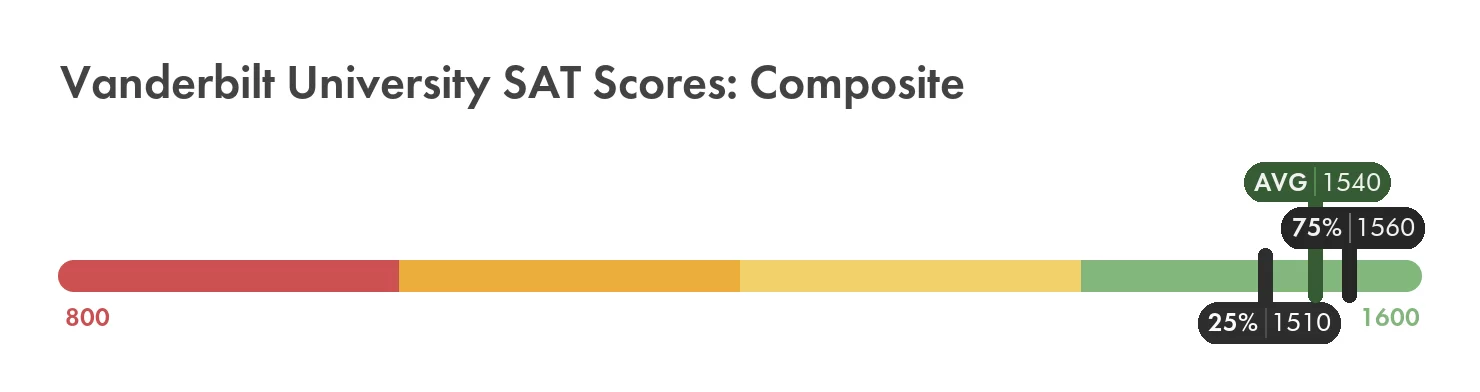
Vanderbilt's SAT middle 50% range sits close to Notre Dame's upper band, and its acceptance rate has fallen sharply in recent cycles. That combination puts it firmly in reach territory for Notre Dame-range applicants, not a match. The honest tradeoff is that even a 1540 scorer faces steep odds, so Vanderbilt should never anchor a list as an expected outcome.
3. Boston College — The Closest Mission-Aligned Match School

Boston College is the most defensible match-tier school for Notre Dame applicants. Its SAT middle 50% range runs slightly lower, its acceptance rate sits above Notre Dame's, and its Jesuit mission creates genuine cultural overlap. Students drawn to Notre Dame's faith-integrated environment and strong alumni network will find a comparable experience at BC. The one limitation: BC's acceptance rate has tightened in recent years, so treating it as a guaranteed acceptance is overconfident.
4. University of Virginia — Strong Public University Match for High Scorers
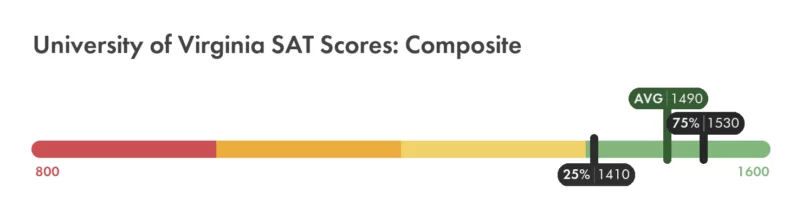
UVA's SAT range overlaps meaningfully with Notre Dame's, but the placement depends entirely on residency. Out-of-state applicants face meaningfully lower acceptance rates than in-state applicants, making UVA a true match only for students whose full profile is competitive across holistic criteria, not simply students whose scores land in the right band.
5. Wake Forest University — Accessible Reach with a Tight-Knit Academic Community
Wake Forest appeals to Notre Dame applicants seeking a smaller, highly selective liberal arts-focused university where SAT scores in the 1350–1480 range are genuinely competitive. Its test-optional policy adds flexibility, and its strong undergraduate teaching reputation resonates with students who value close faculty relationships. The tradeoff: Wake Forest carries less national name recognition than Notre Dame and has a smaller alumni network for post-graduation career placement.
6. Villanova University — Reliable Catholic Safety School for Notre Dame Applicants
Villanova is the most commonly cited safety school for Notre Dame applicants, offering a Catholic Augustinian identity, strong business and engineering programs, and an SAT middle 50% range of roughly 1300–1480, meaningfully below Notre Dame's. Students who value faith-based community and strong alumni networks in the Northeast will find Villanova a genuine fit, not just a fallback. The tradeoff: it lacks Notre Dame's national athletic prestige and overall research output.
How to Use Your SAT Score to Build a Smarter Notre Dame Application Strategy
Two students can hold the same SAT score and walk away from Notre Dame's admissions process with completely different outcomes. That gap is not random. It comes from how a score interacts with every other part of a profile, and understanding that interaction is what separates a thoughtful application strategy from a hopeful one.
Students with strong SAT scores, 1560 and above, still face unpredictable holistic outcomes at highly selective schools, which makes it hard to build a reliable application strategy around test scores alone.
How Notre Dame SAT Scores Are Weighed Against Your Full Application
Notre Dame's Common Data Set confirms that academic rigor, GPA, and the strength of the overall record rank as the most heavily weighted admissions factors, with standardized test scores listed as important but not primary. A 1480 paired with a 3.9 unweighted GPA, rigorous AP coursework, and a focused extracurricular narrative reads as a complete, coherent application. That same 1480 alongside a declining GPA and thin activity record reads as a profile with unresolved questions.
Key takeaway: The score did not change. The signal it sends did.
The Submit-or-Withhold Decision Is a Profile Calculation, Not a Cutoff Comparison
The real strategic question for Notre Dame applicants is not whether their SAT score falls inside the published range, but whether submitting it will strengthen or dilute their specific holistic profile. This distinction matters because roughly 40% of enrolled Notre Dame students did not submit scores, yet Notre Dame's acceptance rate remains highly selective. A score near the 25th percentile (around 1460) may actively hurt a student whose non-score signals are exceptional, while non-submission paired with strong holistic signals could outperform it entirely. Submitting a score that falls at the bottom of the range is not automatically safe. It is only worth submitting if it strengthens the full picture, not just clears a threshold.
What to Do Next Based on Where Your SAT Score Falls for Notre Dame
Most students handle this by cross-referencing score ranges on several admissions data sites and still finish unsure, because no static table knows their actual profile. The hidden cost is a college list built on incomplete signals. If your superscore sits above 1540, submit it and put your remaining time into essays and activities. If it sits between 1460 and 1540, submit only when the rest of your file is equally strong. If it sits below 1460, lead with AP or IB results as your quantitative evidence and treat test-optional as the default.
Related Reading
- Carnegie Mellon SAT Scores
- Tufts SAT Scores
- UC Berkeley SAT Scores
- UNC SAT Scores
- Auburn SAT Scores
- Columbia SAT Scores
- University of Michigan SAT Scores
- UConn SAT Scores
- Good ACT and SAT Scores
- Wake Forest SAT Scores
- NC State SAT Scores
- Ivy League SAT Scores
Next steps
If your SAT score sits inside Notre Dame's middle 50% range and you still can't tell whether your application is actually competitive, the path forward starts with treating your score as one input in a holistic calculation rather than a verdict on its own. Start with our AI college counselor.
Notre Dame's holistic review places academic rigor and GPA above test scores as the primary academic signal, and with the largest applicant pool in school history, a score inside the 1460 to 1540 range is statistically shared by thousands of rejected applicants. That means the range describes the floor of the admitted class, not the profile of a typical admit. At the same time, roughly 40% of enrolled students did not submit scores at all, which means the submit-or-withhold decision is a profile calculation, not a cutoff comparison. Together, those two realities point to one conclusion: you need guidance that maps your specific score, GPA, course rigor, and activity record into a single coherent strategy before you finalize your list or your submission decision.
Start by running your full profile through the AI college counselor at Kollegio. From there, you get a personalized college list calibrated to where your actual profile is competitive, alongside clear signal on whether submitting your score strengthens or dilutes your Notre Dame application.
Frequently Asked Questions
Does Notre Dame superscore the SAT?
Yes. Notre Dame superscores both the SAT and ACT independently, pulling your highest section scores across every test date you submit. This means your effective SAT score may be meaningfully higher than any single sitting, making the published middle 50% range of 1460–1540 more reachable across multiple attempts than it first appears.
How does my SAT Math score compare to my Reading score at Notre Dame?
Math skews slightly higher than Evidence-Based Reading and Writing (EBRW) across both percentile cutoffs in Notre Dame's enrolled Class of 2029 data. The middle 50% Math range is 735–790, while the EBRW range is 720–770, so a weaker Math score is a more noticeable gap, particularly for STEM-track applicants.
What percentage of Notre Dame students submitted SAT scores?
Nearly 60% of enrolled students in the Class of 2029 submitted test scores. That figure reflects students who actually matriculated, not just those who applied, a signal that submitting a strong score adds something meaningful to the file rather than simply satisfying a checkbox.
Can a score below 1460 still get me into Notre Dame?
Yes, though the post is careful not to overstate the odds. One quarter of enrolled Class of 2029 students scored below 1460, and Notre Dame's holistic review means the composite is a filter, not a formula. Essays, character, extracurricular activities, and course rigor all carry meaningful weight, but the post notes that a below-range score makes the rest of the file do heavier lifting.
What else matters beyond the SAT if I want to stand out in Notre Dame's application?
Notre Dame's Common Data Set places rigor of secondary school record and GPA among its most heavily weighted factors, ranked above standardized test scores. Essays, character and personal qualities, and extracurricular activities also carry meaningful weight. Students admitted with scores in the 1400s frequently point to a rigorous course load, a distinctive personal essay, or sustained leadership in a single activity as the factors that carried their application.
Author
Trailblazer Marketing