
Cornell SAT Scores Breakdown: What You Need to Get In 2026
Cornell's mid-50% SAT range is 1510 to 1560, but the composite alone lies. Here is what your section scores, your target college, and that 8.4% acceptance rate actually tell you about where you stand.
Cornell's middle 50% SAT composite range sits at 1510 to 1560. Most high school applicants think that if they can just find the "required" SAT score and hit it, they'll know whether they can get into Cornell. That single band, pulled directly from Cornell's Common Data Set, answers the question most applicants are really asking: not "what score do I need?" but "where do I actually stand?" See our AI college counselor for how this works in practice.
The difference between those two questions is the difference between treating admissions like a pass/fail test and treating it like the positioning exercise it actually is. The middle 50% SAT composite range for Cornell University is 1510 to 1560, based on Cornell's 2024–2025 Common Data Set.

This means 25% of admitted students scored below 1510, and 25% scored above 1560. The average admitted student lands somewhere in the 1520 to 1540 range, well above the 1500 "target" many applicants treat as a magic threshold. The 25th percentile (1510) is the floor where competitive review begins, not a disqualifying cutoff. The 75th percentile (1560) is where score advantage plateaus. An 8.4% acceptance rate means thousands of applicants above that ceiling are still rejected every cycle, a pattern documented consistently across admissions research and Common Data Set reporting.
8.4% Cornell's acceptance rate — thousands rejected above 1560
Key takeaways
- Cornell's middle 50% SAT composite range for enrolled students is 1510–1560. That band, pulled from the Common Data Set, is the number that actually tells you where you stand.
- Section scores matter separately: Cornell's math and reading/writing benchmarks split in ways that can disqualify a strong composite if one section lags significantly behind.
- There is no single Cornell SAT target: the university runs seven distinct admissions pools by college, and a score that makes you competitive for Arts & Sciences can leave you short for Engineering.
- Cornell officially ended its test-optional policy for Fall 2026 and beyond; any application strategy built on pandemic-era flexibility is now outdated.
- Cornell superscores the SAT, which means submitting every sitting, including weaker ones, is the strategically correct move, not a liability.
- Clearing the SAT range is a threshold, not an acceptance. Over 90% of enrolled first-years graduated in the top 10% of their high school class, and course rigor is weighted above test scores in Cornell's holistic review.
- Kollegio.ai's AI College Recommender analyzes your full profile, SAT scores, GPA, intended major, and personal fit, to generate a personalized college list that places Cornell accurately as a target, reach, or safety relative to schools that actually match where you stand.
Cornell SAT Section Score Ranges — Where Math and Reading/Writing Benchmarks Split
The composite SAT score you see on your score report tells one story. The section breakdown tells another, and for Cornell, the gap between those two stories matters more than most applicants realize. Most high school students applying to college think that if they can just find the "required" SAT score and hit it, they'll know whether they can get into Cornell. That assumption misses something important: Cornell doesn't just evaluate your composite, it evaluates the shape of your score.
One applicant scored 1450 on the SAT and opted out of submitting it because it fell below Cornell's 50th-percentile score range, aware that the score did not meet Cornell's Math and Reading/Writing benchmarks.

Cornell's Official Section Score Ranges: 730–770 EBRW, 770–800 Math
Cornell's mid-50% SAT section ranges are not symmetric. Evidence-Based Reading and Writing sits between 730 and 770, while the Math section runs from 770 to 800. That 40-point shift between the two ranges is not a rounding artifact. It reflects where Cornell's admitted class actually clusters when you disaggregate the composite.
Key takeaway: Cornell's Math mid-50% range (770–800) sits a full 40 points above its EBRW range (730–770), meaning quantitative strength is a baseline expectation, not a bonus, and a strong composite can still carry a hidden section-level flag.
A student with 770 EBRW and 780 Math lands squarely at the midpoint of both ranges. A student with 800 EBRW and 740 Math clears the verbal ceiling but falls below the Math floor. On paper, their composites may look nearly identical.
In practice, the second profile carries a flag that the composite alone will never surface. Two patterns that come up repeatedly among students building their college lists illustrate this precisely:
- A student scores 1450 overall and, aware that it falls below Cornell's 50th-percentile threshold, opts not to submit, a sound test-optional instinct, but one that still leaves the underlying section imbalance unaddressed when shaping a target list.
- A 1440 composite built on 790 Math and 650 EBRW.
- The Math score clears Cornell's floor comfortably; the EBRW score sits 80 points below the bottom of the verbal range.
- The composite drags both profiles away from Cornell's competitive band, but for opposite reasons, and a strategy built around chasing a composite number alone will miss that distinction entirely.
The 40-Point Gap That Exposes Cornell's Quantitative Identity
The 40-point separation between the EBRW and Math ranges signals something structural about Cornell's admitted class. Quantitative strength is not a bonus at Cornell; it is a baseline expectation across nearly every college in the university. This pattern shows up even outside engineering.
Students applying to economics, policy, or life sciences programs encounter applicant pools where Math scores cluster near the top of the range. A composite built on verbal strength and a middling Math score can look competitive in aggregate while quietly trailing the field on the dimension Cornell's programs weight most. Conversely, a student with a dominant Math score and a significantly lagging EBRW, like the 790M / 650E split referenced above, carries a different but equally real risk: falling below the verbal floor in programs where writing-intensive coursework is central to the curriculum.
That is precisely why building a balanced, realistic college list that matches a student's actual academic profile, section by section, not just composite, is one of the most consequential steps in the process. Kollegio's College Finder surfaces this kind of section-level read at the very start of the onboarding process, before recommendations are generated, so the list reflects where a student genuinely stands rather than where a rounded composite suggests they might.
Why a 1550 Composite Can Still Be a Red Flag for Cornell Admissions
A 1550 built on 800 EBRW and 750 Math tells a different story than a 1550 built on 770 EBRW and 780 Math. The second profile lands closer to Cornell's Math floor, while the first clears it comfortably, and in a pool where quantitative strength is a baseline expectation across nearly every college in the university, that difference is worth stress-testing before you finalize your target score. Kollegio's College Finder is designed for exactly this kind of stress-test.
Rather than matching students to schools on composite alone, the platform factors section-level strength into its recommendations, so a student whose EBRW is lagging sees a list calibrated to that reality, not a list built around an aggregate number that obscures it. Getting that picture right before applications are submitted, not after a test-optional decision is already locked in, is where the work of building a genuinely balanced college list actually begins.
Related Reading
- Boston University SAT Scores
- UF SAT Scores
- UCLA SAT Scores
- Johns Hopkins SAT Scores
- Clemson SAT Scores
- Northwestern SAT Scores
- Villanova SAT Scores
- Georgetown SAT Scores
- Brown SAT Scores
- UPenn SAT Scores
- Boston College SAT Scores
- Vanderbilt SAT Scores
- Purdue SAT Scores
SAT Scores by Cornell College — Engineering, Arts & Sciences, and Beyond
Cornell's Seven Applicant Pools — Why College Selection Is Part of Your SAT Strategy
This makes the specific college of application the first variable to fix before any score target becomes interpretable at all. Seven different applicant pools sit behind the single name "Cornell University." Treating them as one is the most common strategic mistake students make when setting an SAT target, because a score that puts you squarely in the competitive range for one college can leave you below the effective threshold for another.
One of the subtler anxieties students bring to this process is a perceived imbalance between their GPA and their SAT score. A 3.83 unweighted GPA alongside a 1580 composite and a strong extracurricular record can still feel like the GPA is the weak link, and that anxiety frequently drives them toward the wrong college target entirely. The right response isn't to panic about the GPA; it's to understand which of Cornell's seven pools actually evaluates that profile favorably.
That is exactly the kind of college-fit question Kollegio's College Finder and personalized recommendation tools are built to answer at the very start of the student profile-building process, before any application plan is set.
1. Cornell Engineering — Highest Cornell SAT Score Bar (1560–1590 Range)
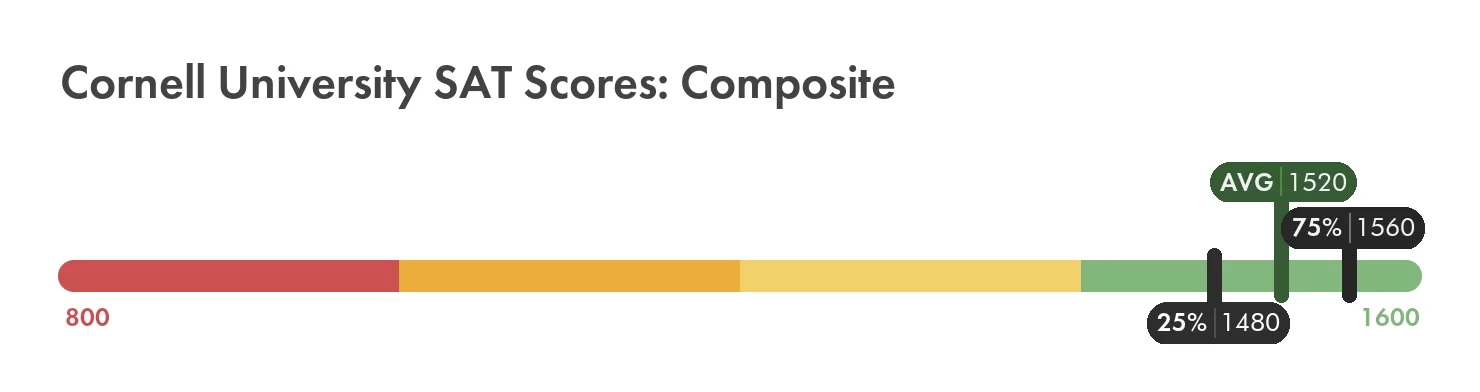
The College of Engineering consistently demands the highest Cornell SAT scores of any undergraduate division, with competitive applicants typically scoring in the 1560–1590 range. Math section performance is especially scrutinized, given the quantitative rigor of the curriculum. Students targeting CS or ECE should treat anything below 780 Math as a meaningful disadvantage. The tradeoff: even a near-perfect SAT won't compensate for a weak STEM course load.
2. College of Arts & Sciences — Broad 1500–1570 SAT Window with Holistic Flexibility
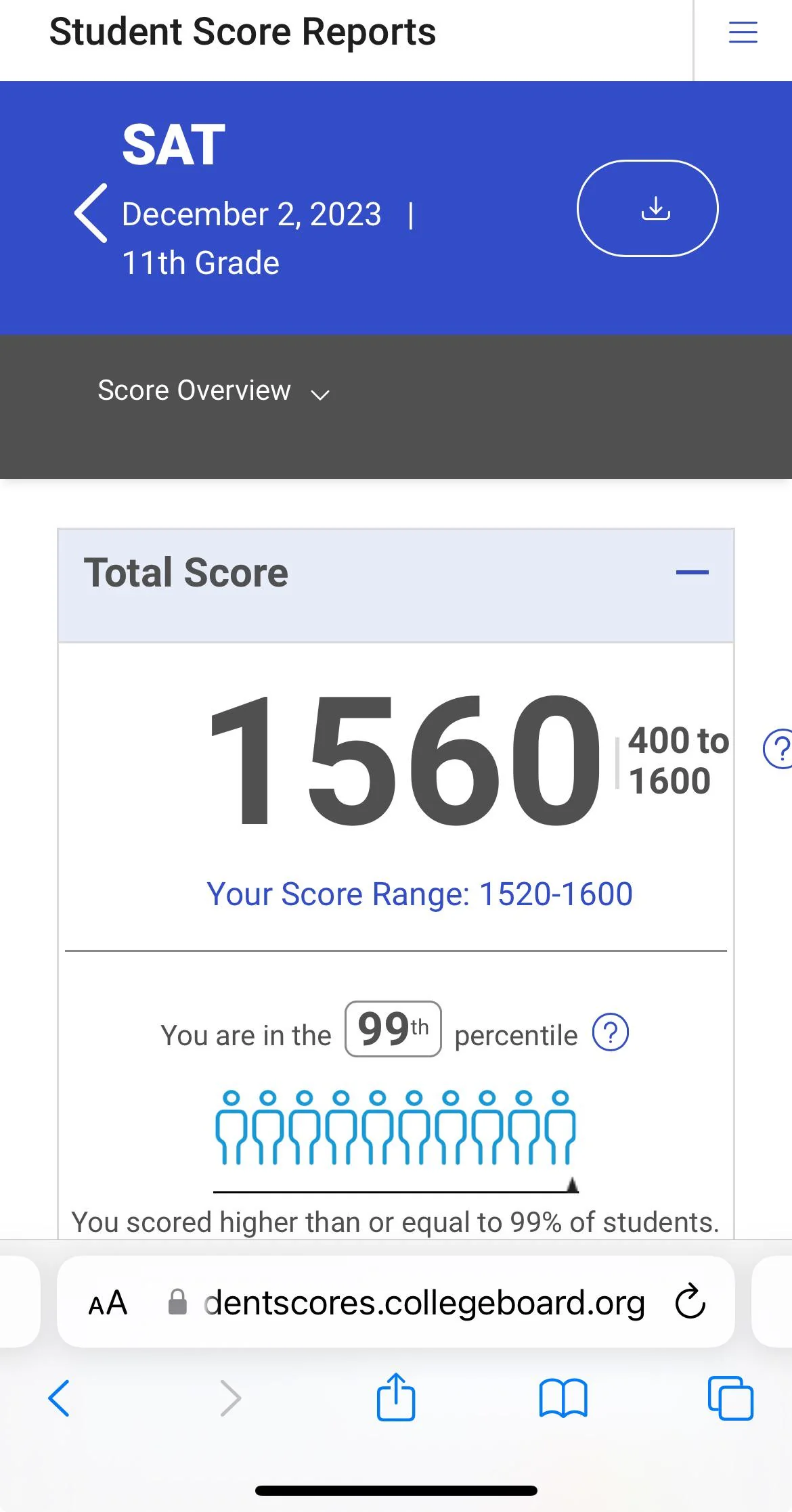
Cornell's College of Arts & Sciences operates within the university-wide SAT middle 50% of 1500–1570 but applies the most holistic review of any Cornell college. Students with scores closer to 1500 can remain competitive if essays, intellectual curiosity, and extracurriculars are exceptional. This is the right college for applicants whose SAT scores are solid but not elite. The tradeoff is that holistic review makes outcomes less predictable than score-driven programs.
3. Dyson School of Applied Economics & Management — Competitive 1520–1560 SAT with Business Focus

The Charles H. Dyson School within Cornell's SC Johnson College of Business targets applicants with SAT scores in the 1520–1560 range, balancing quantitative aptitude with demonstrated leadership and business acumen. Both Math and Evidence-Based Reading scores matter here, as the curriculum blends economics with management. Applicants should pair strong scores with concrete business or entrepreneurship experience. The limitation: Dyson's small class size makes it one of Cornell's most selective internal programs.
4. Nolan School of Hotel Administration — Most Accessible Cornell SAT Entry Point (~1450–1530)

The Peter and Stephanie Nolan School of Hotel Administration historically accepts Cornell SAT scores somewhat lower than Engineering or Arts & Sciences, with competitive applicants often in the 1450–1530 range. Industry experience, hospitality-specific extracurriculars, and demonstrated passion for the field carry significant weight. This is the right path for applicants whose SAT scores are strong but not Ivy-ceiling level, provided their hospitality narrative is compelling. The tradeoff: the program's prestige means competition is still fierce.
5. Cornell's University-Wide SAT Middle 50%: The 1500–1570 Benchmark Every Applicant Needs to Know
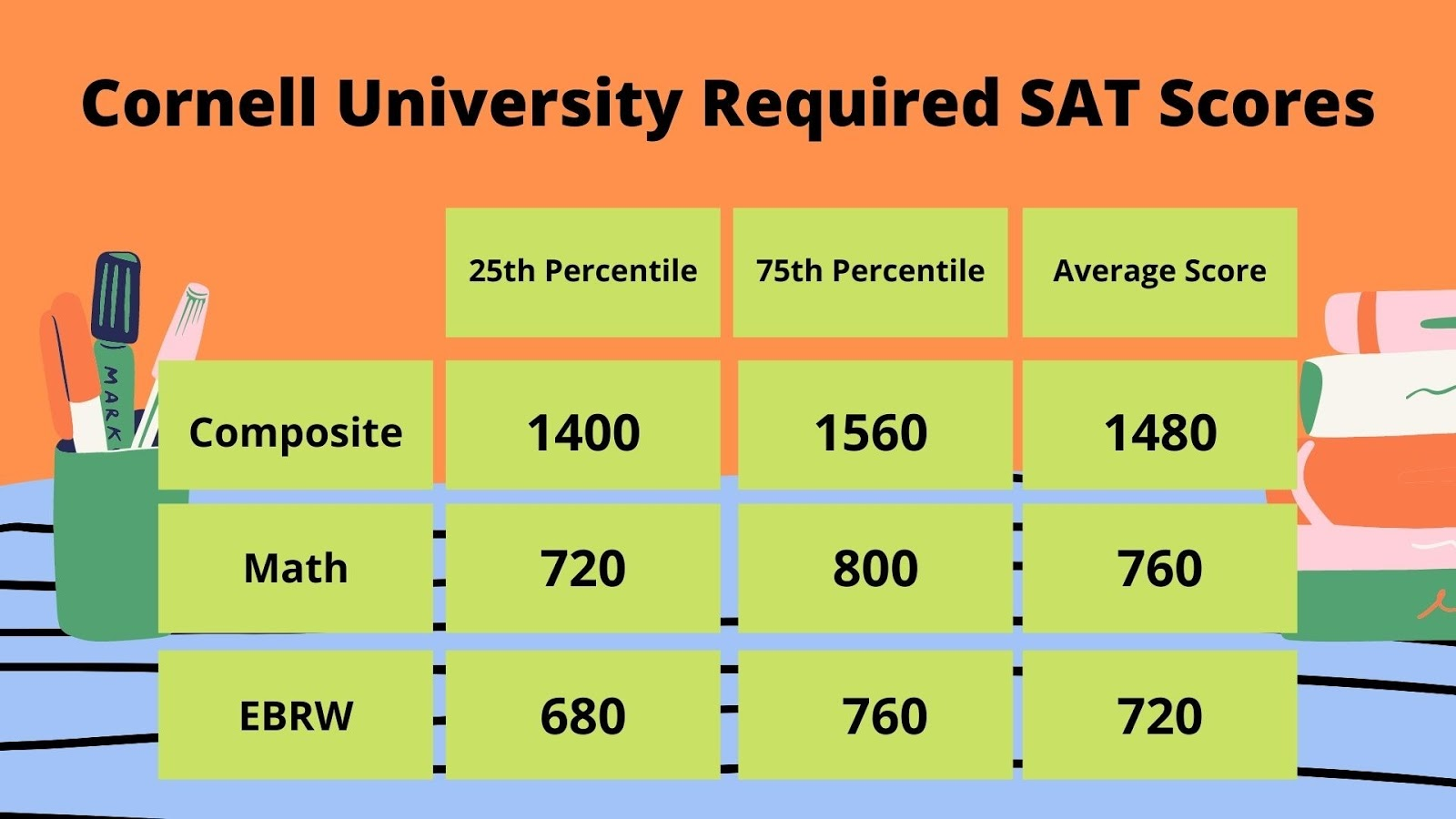
Cornell's official SAT middle 50% range of 1510–1560 is the single most important benchmark for applicants across all colleges. Scoring at or above 1570 places you in the top quartile university-wide, while scores below 1500 put you statistically outside the middle range. This figure, reported by College Board's BigFuture, applies regardless of which Cornell college you target. The key limitation: this is a university aggregate, and individual college ranges vary meaningfully above and below this band.
6. College of Architecture, Art & Planning (AAP): Portfolio-Weighted Admissions Where SAT Plays a Supporting Role

Cornell AAP is unique among Cornell's colleges in that portfolio quality can meaningfully offset a lower SAT score. Applicants to Architecture in particular are evaluated heavily on creative work, making this the best-fit college for artistically gifted students whose Cornell SAT scores sit at the lower end of the competitive range (~1480–1540). The SAT still matters for demonstrating academic readiness, but it rarely drives the admissions decision alone. The tradeoff: portfolio preparation demands significant time investment alongside test prep.
7. Cornell's Test-Optional Policy Era — How Waived SAT Scores Reshaped Applicant Strategy
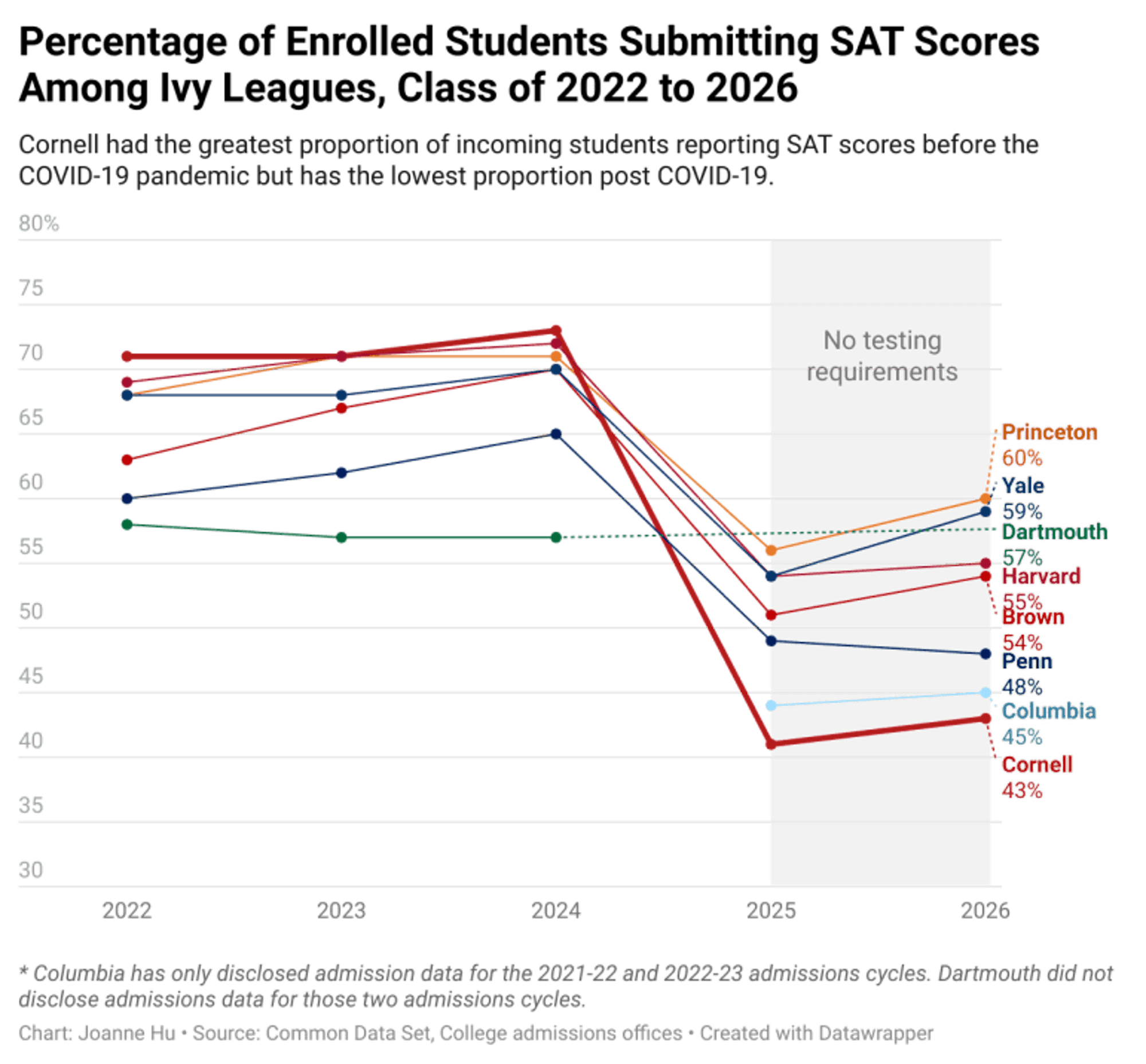
During Cornell's test-optional and test-blind policy period, many applicants chose not to submit SAT scores, fundamentally shifting how admissions officers weighted other application components. Data from the Cornell Daily Sun reveals this policy affected applicant self-selection and admit profiles. For current applicants, understanding this era matters because Cornell has since returned to requiring test scores, meaning the 1500–1570 benchmark is once again a hard signal. The tradeoff: applicants who thrived test-optional may now need to invest in score improvement.
Is Cornell Test-Optional? Why the Policy Changed, and What It Means for You
No student planning to apply to Cornell for Fall 2026 or later can skip the SAT or ACT anymore. If you built your college list assuming Cornell's pandemic-era flexibility quietly became permanent, that assumption now has real consequences for your timeline and your strategy.

Cornell Is No Longer Test-Optional — The Exact Effective Date
Cornell University officially reinstated its standardized testing requirement for all first-year applicants entering Fall 2026 and beyond, as confirmed by Cornell's admissions office. This is not a soft recommendation or a "we encourage you to submit" nudge. It is a hard requirement. Students who planned to apply test-optional to Cornell must now treat a competitive SAT or ACT score as a non-negotiable part of their application. A junior targeting Cornell's Early Decision round in late 2025 can no longer skip test prep and rely on a test-optional pathway.
What Cornell's Multi-Year Task Force Actually Found
Cornell's reversal was not reactive. It followed a multi-year Task Force on Standardized Testing that examined whether scores add meaningful, equitable signal to admissions decisions. The Task Force concluded they do, specifically when scores are read alongside GPA, course rigor, essays, and recommendations. Part of what drove that conclusion is a real tension the policy created: test-optional submission rules made it harder for admissions committees to evaluate candidates on a consistent data set, because applicants with lower scores could simply withhold them, reducing the information available to readers trying to compare profiles fairly. Cornell's reinstatement, widely reported as part of a broader Ivy League shift, closes that gap by putting every applicant on the same evidentiary footing.
Key takeaway: A score is now a required floor you must clear, not a sufficient condition for admission. Students who read "test-optional" as "scores don't matter" and students who read "required" as "a good score gets you in" are both misreading the policy in opposite directions.
That conclusion matters because it reframes what "required" actually means in practice.
What the Policy Shift Means for Your Application Strategy Right Now
The practical cost of missing this policy change is significant. Students who were advised to skip the SAT under test-optional assumptions are now caught underprepared, with fewer test dates left and no score to submit. That is one of the most disruptive patterns we see at this stage of the planning cycle: a college list built on assumptions that have since changed, and a student who discovers it mid-process, when the options for correction are narrowest.
The score submission question itself is also genuinely complex. A 1490 SAT sits near the lower edge of Cornell's typical admitted-student range, and that anxiety — is my score strong enough to submit or does it hurt me? — is one of the first things a realistic list-building process needs to address. The calculus shifts further when scores are mixed: a strong composite with a weaker math sub-score, for example an ACT composite in the low 30s but an ACT Math of 29, carries different weight depending on which Cornell college you are targeting. Engineering applicants face more scrutiny on the math sub-score than applicants to other colleges within the university, which means the same composite number can be a competitive asset in one college and a soft spot in another.
If you discovered this shift mid-process and your college list was built around schools you assumed shared Cornell's old flexibility, your list may need a full rebuild. Kollegio's College Finder walks through your full academic profile, interests, and family financial situation at the very start of onboarding, before recommendations are generated, so that every school on your list reflects your actual score, not a policy environment that no longer exists. That includes balancing targets, reaches, and safeties against current requirements, not last cycle's.
Kollegio's Scholarship Finder and financial aid tools run alongside that process, so financial fit is built into the list from day one rather than discovered after decisions arrive. Now that you know score submission is mandatory, the most useful next step is matching your current score to the right test calendar and identifying which remaining SAT dates give you the most ceiling-raising opportunities before your application deadline.
How to Submit SAT Scores to Cornell — Superscoring, Self-Reporting, and Official Codes
Here is a strategic detail that catches most Cornell applicants off guard: submitting every SAT sitting, including the ones you're embarrassed about, is not just acceptable at Cornell. It is the optimal move. Understanding why changes how you plan your entire test calendar.

Cornell Superscores the SAT
Cornell superscores the SAT by pulling your highest Evidence-Based Reading and Writing score and your highest Math score from across all submitted test dates, then combining them into the strongest possible composite. Per Cornell's official standardized testing policy, students benefit most by submitting scores from every sitting so Cornell can build the highest composite from the full set. A student who scores 760 Math in October and 770 EBRW in March ends up with a 1530 superscore, potentially meeting Cornell's 25th percentile threshold, even though neither single sitting hit that mark alone.
This matters especially for applicants who feel a specific sitting was a liability. A student carrying a 1440 (790M / 650E), a profile many assume is a weakness at an Ivy, may actually be sitting on more optionality than they realize. The 790 Math is a ceiling-level section score.
The path forward is not to hide that same sitting; it is to retake and improve the EBRW side, letting Cornell superscore both dates into a stronger composite. Withholding the lower sitting shrinks the pool Cornell uses to build that composite and can quietly lower the number Cornell actually sees.
Self-Reporting vs. Official Scores, What Cornell Requires at Each Stage
Cornell's score submission process works in two distinct stages. Here is what each stage requires:
One confusion applicants run into: scores arriving that they did not intentionally submit. If an August SAT sitting appears on your Cornell record even though you only designated a December sitting through Common App, that is not an error you need to panic over. College Board's reporting rules and Cornell's own receipt practices can surface sittings you did not manually select. What matters is that Cornell's superscoring policy turns that unexpected score into a neutral-to-positive input rather than a penalty.
Cornell's admissions blog on testing policy is the clearest plain-language source for understanding exactly what gets used and how. Applicants also frequently conflate Cornell's policy with Score Choice, the College Board feature that lets you select which dates to send to most schools. Cornell's own standardized testing policy page is the authoritative place to verify what the school actually requires, because Score Choice availability does not automatically mean a school restricts its review to only the dates you select.
Why Taking the SAT Multiple Times Is a Feature, Not a Red Flag
Cornell's superscoring policy creates a structural asymmetry that most applicants miss entirely. Because Cornell considers only your best section scores across all sittings, each additional test date is a ceiling-raising opportunity with no downside. There is no penalty for a lower second sitting.
When you do need to send official scores, use SAT code 2098 for Cornell University and ACT code 2726. If you have not yet requested your scores through College Board's score-send portal, do that well before your application deadline. Processing times vary, and waiting until the last week creates unnecessary risk. Navigating these decisions well, which sittings to retake, whether to apply test-optional, and how a given score fits into a realistic college list, is exactly where having a structured picture of your full academic profile pays off.
At Kollegio, the onboarding profile captures your scores, coursework, activities, and family priorities in one place from the very start of onboarding, before any college recommendations are generated. That profile feeds directly into the College Finder, so the list you build reflects your actual academic position, including where a current SAT score genuinely helps you, where it is neutral, and where strengthening it before Round 2 testing would move the needle most. Building a balanced, realistic college list that matches your academic profile, interests, and your family's financial situation is not guesswork when the underlying data is organized correctly from the start.
Related Reading
- Boston University SAT Scores
- UPenn SAT Scores
- UF SAT Scores
- UCLA SAT Scores
- Clemson SAT Scores
- Northwestern SAT Scores
- Villanova SAT Scores
- Georgetown SAT Scores
- Vanderbilt SAT Scores
- Boston College SAT Scores
- Purdue SAT Scores
- Johns Hopkins SAT Scores
- Brown SAT Scores
Cornell GPA Requirements and Holistic Review — Why Your SAT Score Is Only Half the Story
Hitting Cornell's SAT range feels like clearing the bar. It isn't. The bar has three dimensions, and most applicants only measure one.
Key takeaway: Cornell's admissions data reveals a compounding credentialing threshold: over 90% of enrolled first-year students graduated in the top 10% of their high school class, course rigor is rated "Very Important" above test scores in the official holistic review hierarchy, and the mid-50% SAT range is 1510–1560, these three variables function as a composite gate, not a menu of interchangeable strengths. A student with a 3.7 GPA in non-rigorous coursework has not cleared the admissions bar; they have cleared one dimension of it.

Conversely, an applicant with a 1480 score paired with a top-decile class rank and a maximum AP load may present a stronger academic signal than a score-alone comparison suggests.
One of the most disorienting realities applicants face is not knowing how much weight Cornell places on GPA relative to fit, extracurricular alignment, or course context, and that uncertainty makes it genuinely hard to strategize. That confusion is compounded by a deeper structural problem: GPA alone is an unreliable signal of academic capability. A 4.0 from a school with few advanced offerings is not the same credential as a 4.0 from a school where students routinely compete across six or seven AP courses.
Without a way to contextualize your own transcript against Cornell's actual admitted cohort, you risk optimizing for the wrong variable entirely.
What Cornell's Admitted GPA Profile Actually Looks Like
Cornell's admitted students typically present unweighted GPAs at or near 4.0, with weighted GPAs of 4.2 or higher depending on AP and IB load. That isn't a soft benchmark; it's a structural signal about who actually earns a spot. A 3.5 unweighted GPA is not a minor gap from that profile; it's a meaningful distance from the cohort Cornell actually admits.
This is precisely why the onboarding profile inside Kollegio maps your academic record, GPA, class rank, and course load, against benchmarks like these before any college recommendations are generated. At the very start of the Kollegio onboarding process, before recommendations are surfaced, the platform contextualizes where your profile actually sits relative to Cornell's admitted cohort, not where it feels like it sits. That distinction protects families from a costly misread: treating a strong-but-insufficient GPA as a green light when it is, in reality, a yellow one.
Course Rigor as the Hidden Third Variable
Cornell's CDS (2024–2025) rates "rigor of secondary school record" as Very Important, placing it above standardized test scores in the official holistic review hierarchy. That ranking matters. A 3.9 earned in AP and honors courses is read very differently from a 3.9 earned in standard-level classes.
Grade inflation is real, and admissions readers know it. A 4.0 from a school where few students take advanced coursework and a 4.0 from a school where students routinely take six or seven APs are not the same credential, even when they appear identical on a transcript, and Cornell's admissions readers, who review school profiles alongside individual applications, are specifically trained to account for that difference. The challenge for most applicants is that this contextualization happens inside the admissions office, invisibly, and families never see it.
Kollegio's Activity Feedback tools address this by helping students present the full picture of their academic and extracurricular record, not just the numbers, but the context that makes those numbers legible to a reader. Because missing this layer doesn't just cost a student a competitive edge; it can cost them an acceptance, and in some cases, financial aid opportunities that were never correctly positioned in the first place. Getting the academic narrative right, authentically, not inflated, is the first step toward telling your story in a way that holds up under the scrutiny of holistic review.
Why Class Rank Completes the Composite Signal
Cornell's own data makes the third dimension explicit: over 90% of enrolled first-year students graduated in the top 10% of their high school class. That figure is not incidental context; it is a direct indicator of how Cornell's admissions readers triangulate academic strength when GPA and test scores alone leave ambiguity. A student with a 3.9 unweighted GPA and a 1520 SAT who graduated 15th in a class of 200 has not cleared the same threshold as a student with identical numbers who graduated 8th. The rank resolves the ambiguity that GPA and scores leave open.
This is where the composite gate logic becomes most consequential. Applicants who optimize for test score preparation without understanding how class rank and course rigor interact with that score can spend months and significant resources improving a variable that was never the limiting factor in their profile. A 10-point SAT gain does not compensate for a class rank that places a student outside Cornell's top-decile cohort, and no amount of extracurricular depth fully offsets an academic signal that falls short of the structural threshold Cornell's own enrollment data describes. The three dimensions compound; they do not substitute for one another.
Kollegio's College Finder is designed specifically to surface this kind of composite read before a student commits to a positioning strategy. By mapping GPA, class rank, and course load together against Cornell's admitted cohort benchmarks, the platform identifies which dimension of the academic signal is actually the binding constraint, so that the time and effort a family invests between now and application deadlines is directed at the variable that will move the needle, not the one that already clears the bar.
Comparable Schools to Cornell — How to Build a Reach, Match, and Safety List Around Your SAT
Building a college list around one school's SAT range is like packing for a trip with only one destination in mind, then being surprised when the flight gets cancelled. Cornell sits in a narrow, uncomfortable band on most students' lists, and understanding exactly where it falls, relative to the schools above and below it in selectivity, and relative to your family's financial picture, is what separates a list that holds up from one that collapses under pressure.

Where Cornell Actually Sits in the Ivy League SAT Landscape
Cornell carries the lowest middle-50% SAT composite range among all eight Ivy League schools, a conclusion that follows directly from comparing published Common Data Set figures across all eight institutions. Its middle 50% composite range runs from 1510 to 1560. That single fact trips students up constantly.
"Lowest SAT Ivy" sounds like an easier target, but it only means the other seven are harder. A score at 1510 still places a student at the very bottom of Cornell's admitted range, where every other part of the application has to carry significant weight. One layer of confusion families we work with consistently face: Cornell sits at #12 in US News and #5 among Ivies, a ranking position that makes it genuinely difficult to categorize as a reach, match, or safety relative to schools ranked above and below it in other lists.
Ranking position and SAT range are two different signals, and treating them as interchangeable is how lists get built with dangerous structural gaps. Kollegio.ai's College Finder surfaces both signals together during the student profile-building process, before recommendations are generated, so the list reflects academic profile and institutional fit simultaneously, not one at the expense of the other. There is a second factor families frequently underweight when Cornell appears on a list: its financial aid packages are widely perceived as meaningfully lower than those offered by peer Ivies like Dartmouth and Yale, making Cornell a more expensive real-world option even after aid is applied.
A list built around SAT score without accounting for net cost is only half a list. Kollegio.ai's Scholarship Finder and financial aid tools are designed to close that gap, connecting your family's actual financial situation to the aid landscape at every school on the list, not just the ones that feel like targets.
The Reach Tier Above Cornell — Columbia, Princeton, and Dartmouth
Columbia, Princeton, and Dartmouth all report middle-50% SAT ranges that sit at similar or slightly higher bands than Cornell, based on each institution's published Common Data Set figures. For a student scoring in the 1500 to 1530 band, these three schools represent true reaches, not just strong ones. The score gap between Cornell and its Ivy peers is smaller than most students expect, which means a student who lists Cornell as a target and Columbia as a reach is not spacing those schools far enough apart to build real structural protection.
The Match Tier Below Cornell — Vanderbilt, Georgetown, and Notre Dame
For a student scoring in the 1450 to 1500 band, these three schools offer genuine match territory, where a score lands inside or near the middle of the admitted pool rather than at its floor.
A common anxiety worth naming directly: Vanderbilt's acceptance rate has dropped so sharply, sitting now around 5%, that many families treat it as harder than Cornell. Selectivity and score range are related but not identical signals. A school can have a lower acceptance rate than Cornell while still admitting students across a wider SAT band, which is exactly the kind of nuance that distorts list-building when families rely on a single metric. Kollegio.ai's College Finder results are built to surface this distinction, matching a student's academic profile against admitted score ranges, acceptance rate context, and financial fit together, so the match tier on a list reflects reality rather than surface-level rankings anxiety.
The Strong-Fit Tier — Colgate, Tulane, and Boston University
For students whose scores fall in the 1350 to 1450 band, schools like Colgate, Tulane, and Boston University represent genuine fit territory, competitive enough to be meaningful targets, with admitted SAT ranges where a score in this band lands inside or near the middle of the pool rather than at its floor. These schools are not consolation prizes; they are the layer of the list that gives a Cornell application its structural integrity. A balanced list that accounts for academic profile, financial situation, and score-range context at every tier is the foundation Kollegio.ai's College Finder and Plan Applications tools are designed to help families construct, starting at the very beginning of the process, before a single application is submitted.
Next steps
If your SAT score leaves you wondering whether Cornell is a realistic target or wishful thinking, the path forward starts with reading your score against the specific Cornell college you plan to apply to, not against a single university-wide cutoff.
Cornell's per-college admissions structure means a composite that clears the general mid-50% range can still fall below the effective threshold for Engineering, where Math scores cluster between 770 and 800, while landing comfortably inside the competitive band for CALS or ILR. That makes college selection part of your SAT strategy, not a separate decision. At the same time, Cornell's reinstated testing requirement means a score is now a required floor you must clear, but the task force framing that drove the reinstatement positions it as one input evaluated alongside GPA, course rigor, and class rank.
A strong composite paired with a rigorous course load reads very differently from the same score paired with a 3.7 in standard coursework. Together, these two realities point to one action: map your full academic profile against each college's actual competitive range before you finalize a list.
Start with an AI college counselor that captures your SAT score, section breakdown, GPA, course load, and intended Cornell college in one place, then surfaces where your profile genuinely competes across reach, match, and safety tiers. From there, the same profile feeds essay planning, financial aid modeling, and application timelines, so nothing is built on a benchmark that was never the right number to begin with.
Frequently Asked Questions
What is Cornell's average SAT Math score?
Cornell's mid-50% SAT Math range runs from 770 to 800, meaning the typical admitted student scores near the top of the SAT Math scale. Quantitative strength is treated as a baseline expectation across nearly every college in the university, not a bonus.
What is Cornell's average SAT Reading and Writing (EBRW) score?
Cornell's mid-50% Evidence-Based Reading and Writing range sits between 730 and 770. That range sits a full 40 points below the Math range, reflecting that verbal scores, while important, are not where Cornell's admitted class clusters as tightly as it does on the quantitative side.
Is a 1450 a good SAT score for Cornell?
A 1450 falls below Cornell's 25th percentile of 1510, which means it sits outside the competitive band for most of Cornell's seven colleges. Students at this score level should treat Cornell as a significant reach, though the specific college of application matters, CALS and ILR have competitive composite ranges that run as low as roughly 1450, making college selection itself a meaningful part of the strategy.
Can you get into Cornell with a low SAT score?
Yes, 25% of admitted students score below 1510, so students below the median are admitted every cycle. However, Cornell has reinstated standardized testing as a hard requirement for Fall 2026 and beyond, so submitting a score is no longer optional, and a score below the 25th percentile means Cornell should be treated as a reach rather than a match.
Is Cornell still test-optional?
No. Cornell officially reinstated its standardized testing requirement for all first-year applicants entering Fall 2026 and beyond. This is a hard requirement, not a soft recommendation, meaning every applicant must now submit an SAT or ACT score regardless of where it falls.

Author
Senan KhawajaSenan Khawaja is the Co-Founder and CEO of Kollegio, an AI-native college counseling and institutional recruiting platform serving roughly 250,000 students across 190 countries. A Stanford graduate, repeat founder, and Forbes 30 Under 30 honoree with World Bank experience, Senan launched Kollegio to democratize elite college counseling—addressing the 400:1 student-to-counselor ratio in public schools. Under his leadership, Kollegio has secured 22+ institutional partners with a 100% renewal rate and backing from Reach Capital, JFF Ventures, and ECMC Group. He was also selected for OpenAI's inaugural ChatGPT Futures Class of 2026. Senan is based in New York City.