
Your composite score is just the starting point. Here is what Purdue's section scores, college-by-college ranges, and program filters actually tell you about where you stand.
Stop wondering.
Start matching.


Purdue's official SAT score ranges get quoted everywhere, but the common assumption is that a single composite SAT range is the definitive signal for whether Purdue is a reach, match, or safety, and that no further research is needed once you know where your score falls. Understanding what the 1200–1480 composite middle 50% range actually means, where it comes from, and what it cannot tell you is the real starting point for any serious Purdue application strategy. The middle 50% composite SAT range for Purdue's fall 2026 entering class is 1200 to 1480, drawn directly from Purdue's own admissions class profile. See our AI college counselor for how this works in practice.
That range means 25% of admitted students scored below 1200 and 25% scored above 1480. It is the most cited figure in Purdue admissions coverage for good reason: it comes from Purdue's own reporting, not a third-party estimate. What the range does not tell you is equally important. It flattens scores from engineering students, nursing students, exploratory studies students, and every other college into a single band. That same composite figure can represent a strong application for one program and a significant deficit for another. A 1200 composite sits at Purdue's 25th percentile — competitive for Exploratory Studies, but well below the floor for Engineering.

The critical qualifier is major. A 1200-composite applicant targeting Exploratory Studies, where the middle 50% ceiling sits around 1320, is in a meaningfully different position than one aiming for Engineering, where the middle 50% starts at 1380. The score alone does not determine outcome; the combination of score, intended program, GPA, and course rigor does.
The average SAT score for admitted Purdue students is approximately 1350, consistent with the midpoint of the official range. A 1380 composite is above average university-wide; a 1280 is below average, not disqualifying, but it means paying close attention to program targeting and overall profile. Purdue's SAT data originates from its Common Data Set filing.
For fall 2026, Purdue has returned to requiring test scores, so the reported range reflects a broader submission pool than during the test-optional years of 2021–2024, making the current range more representative of the full admitted class.
1200–1480 Purdue's middle 50% composite SAT range
Key takeaways
- Purdue's university-wide middle 50% composite SAT range is 1200–1480, but that single number masks a nearly 280-point spread across colleges: Engineering sits at 1380–1520 while Exploratory Studies runs 1100–1320.
- Section scores carry more diagnostic weight than the composite: a Math score below 700 is a real liability for Engineering applicants even when the composite looks fine.
- Purdue is not test-optional for the 2025–26 cycle: every first-year applicant must submit SAT or ACT scores, no exceptions.
- A 1200 composite is a steep climb for Engineering and a solid match for Exploratory Studies — the score doesn't change, but the outcome does depending on which college you target.
- Compensating factors like GPA, rigor, and activities can move the needle for borderline applicants, but only in colleges where the score gap is small enough for those factors to matter.
- Placing Purdue in the wrong tier on your list, reach when it's a match, or match when it's a safety, is one of the most common mistakes that quietly costs applicants real options.
- Kollegio's onboarding profile lets you enter your SAT scores, GPA, activities, and interests in one structured flow so the AI can map your actual profile against Purdue's college-by-college ranges and tell you exactly where you stand, no guesswork, no counselor required.
SAT Section Scores at Purdue — Math and Reading/Writing Ranges That Actually Matter
The composite range is a door to knock on, not a room to enter, and treating it as the final word on your Purdue candidacy is where many applicants stop one step too soon. Purdue's admissions data rewards students who look deeper than that single number. Section scores carry the real diagnostic weight, and for applicants targeting a specific college within Purdue, the gap between a composite that looks fine on paper and a section breakdown that actually competes can quietly determine the outcome.
One of the most common traps we see: a student walks in with a 1550 composite and still carries a genuine fear of rejection, because they sense, correctly, that a strong overall score does not neutralize an academic weakness hiding inside it. That anxiety is not irrational. The composite flattens the very details Purdue's readers are trained to notice.

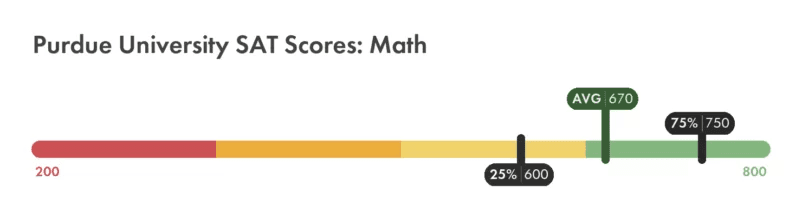
Purdue's SAT Math Middle 50%: 600–760 and What It Signals for STEM
Purdue's admitted students score between 600 and 760 on the SAT Math section, according to published admissions data. That 160-point spread tells you more than the composite ever could. The floor at 600 is the real warning line: fall below it and you are outside the middle range for the university as a whole, not just for Engineering.
Students applying to STEM-heavy programs should treat 700-plus as the practical target, not a stretch goal. This is exactly the kind of profile gap that Kollegio's onboarding profile is designed to surface before it costs an applicant an acceptance. When a student completes their profile at the start of the Kollegio onboarding process, before any recommendations are generated, the platform maps their section-level scores against program-specific admit data, so the Math floor for Engineering is visible as a concrete benchmark rather than a vague warning.
Reading/Writing Middle 50% Runs 590 to 720 — What the Lower Floor Actually Tells You
The SAT Evidence-Based Reading and Writing middle 50% sits between 590 and 720, a pattern consistent with what most admitted-student profiles reflect across the market. The lower floor here (590 versus 600 for Math) signals that Purdue's admitted pool skews more technical than verbal. For a student applying to the College of Liberal Arts or Education, a strong Reading/Writing score carries more weight.
For an Engineering applicant, it is almost background noise compared to what the Math section says about you. That distinction matters when building an application strategy. Kollegio's personalized college recommendations factor in exactly this kind of program-level signal, matching a student's section-score profile against the colleges and majors where their specific strengths genuinely compete, not just where their composite looks acceptable on a list.
Why a Composite Can Look Fine While a Section Score Silently Disqualifies You
The failure point is usually invisible until it is too late. A 1350 composite built on a 770 Reading/Writing and a 580 Math sits below Purdue's Math middle-50% floor, even though the composite looks respectable. The same 1350 composite flipped (660 Math, 690 Reading/Writing) tells a completely different story for an Engineering applicant.
Beyond the numbers, the rest of the application has to hold up that story. A section score that sits at the floor of Purdue's range means the essays, activities list, and recommendation letters carry heavier lifting than they would for a student sitting at the median. Kollegio's AI Essay Planner helps students write essays that sound authentic and stand out, not by inflating the narrative, but by making sure the genuine strengths in a student's profile are legible to a reader who is already scrutinizing the math section.
The Activity Feedback feature works the same way: it ensures the breadth and depth of what a student has actually done is communicated clearly, not buried in a generic list. And because missing a deadline or a financial aid requirement can undo a well-built application entirely, Kollegio's plan tracking keeps every critical date visible so no requirement slips through.
What SAT Scores Do Different Purdue Colleges and Majors Actually Require?
Purdue is not one admissions pool. It is at least seven distinct colleges, each with its own score distribution, and the spread between the most and least selective is roughly 240 points at the midpoint. A 1310 composite can be a strong match for one Purdue college and a near-disqualifier for another. Here is what each college's range actually looks like.
The 240-Point Spread — Why Your Target College's Range Matters More Than the University Composite
A student with a 1310 composite sits above the 75th percentile for Exploratory Studies and below the 25th percentile for Engineering. Same score. Same university. Completely different competitive position. Benchmarking against the university-wide range without knowing your target college's range is the single most consequential mistake applicants make.
A student with a 1310 composite sits above the 75th percentile for Exploratory Studies and below the 25th percentile for Engineering. Same score. Same university. Completely different competitive position. Same university. Completely different competitive position.
1. Purdue College of Engineering — Middle 50% SAT Range: 1380–1520
280 Point spread between Purdue colleges' midpoints
Engineering is the highest bar on campus. According to 2024 admissions data, the middle 50% runs from 1380 to 1520, with the Math section serving as the primary filter. A student scoring a 1350 composite sits below Engineering's 25th percentile floor, even though 1350 clears the university-wide midpoint comfortably.
If your Math section is under 700, that gap matters more than the composite number suggests. This section-level detail is where applicants routinely get tripped up. A student targeting Purdue CS, for example, might carry a 770 Math and a 670 Reading & Writing, a 1440 composite that lands squarely inside Engineering's middle 50%.
The anxiety is real: will a lower R&W score hurt chances even when Math is competitive? The honest answer is that Math is the dominant filter for Engineering and CS admissions at Purdue, but composite still anchors the initial read. Knowing which number matters most, and for which program, is the kind of section-level clarity that changes how you position your application.
Kollegio's onboarding profile captures both section scores at the start of onboarding, before any recommendations are generated, so the college matches it surfaces reflect your actual Math-versus-verbal split, not just your headline composite.
2. Purdue Polytechnic Institute — Middle 50% SAT Range: 1200–1390
Polytechnic sits in the middle tier, with a middle 50% range of 1200 to 1390. For students pursuing applied technology, computer and information technology, or aviation, this is the relevant benchmark, not Engineering's range. A 1280 composite is genuinely competitive here.
The upper end of Polytechnic's range overlaps with Engineering's floor, so students near 1380 face a real choice about which college to target, and that choice carries meaningful consequences for admit probability.
Related Reading
- Boston University SAT Scores
- UPenn SAT Scores
- UF SAT Scores
- UCLA SAT Scores
- Clemson SAT Scores
- Northwestern SAT Scores
- Villanova SAT Scores
- Georgetown SAT Scores
- Vanderbilt SAT Scores
- Boston College SAT Scores
- Johns Hopkins SAT Scores
- Brown SAT Scores
Purdue Admissions Requirements Overview — Test Policy, Deadlines, and What Else Gets Reviewed
Purdue reinstated its standardized testing requirement for the 2025–26 cycle, meaning every applicant must submit either an SAT or ACT score. There is no test-optional path available this year. Per the official admissions criteria page (updated May 2025), all first-year applicants must submit SAT or ACT scores as part of a complete application. The test-optional window that opened during the pandemic has closed.
If your score report is missing, your application is incomplete, full stop. This is a sharper source of confusion than it sounds. Students applying to multiple programs, graduate or undergraduate, domestic or international, regularly carry uncertainty about whether Purdue's test requirements apply to their specific program.

International applicants, for instance, are often uncertain about whether the GRE is required or waived for programs like Purdue BME, and that same policy ambiguity bleeds into undergraduate planning. When you are tracking requirements across several schools at once, one misread rule about one school can cascade into a missing score submission and a rejected application. Students who assume otherwise because a friend applied two cycles ago under different rules are working from outdated information, and that assumption carries real consequences.
Kollegio's Direct Admissions and personalized college recommendations are built precisely for this multi-school tracking problem. At the very start of the Kollegio onboarding process, before recommendations are generated, your Kollegio profile captures your intended major, current test scores, and coursework so that every school's live requirements are matched against your actual file, not a cached memory of what policy used to be.
November 1 Early Action vs. January 15 Regular Decision
The stakes around Purdue's deadlines are higher than most students realize. Purdue's admissions page identifies November 1 Early Action as the recommended deadline for scholarship and housing consideration. Regular Decision closes January 15, and while you can still gain admission through that round, merit aid eligibility effectively resets.
A student who applies in January forfeits scholarship consideration that November applicants receive, even if both students are ultimately admitted. Missed scholarship deadlines are one of the most preventable, and most common, setbacks beginners face when managing applications across multiple schools. Deadline timing compounds on top of score positioning; missing November 1 is not a scheduling inconvenience; it is a financial decision.
Kollegio's Plan Applications feature tracks each school's deadline calendar and required materials in one place, surfacing the November 1 cutoff against your score submission and essay status so nothing falls through the cracks.
Beyond the SAT — Holistic Factors Purdue Weighs
Purdue uses a holistic review process that evaluates GPA, rigor of coursework (AP, IB, and dual-credit courses count), extracurricular involvement, and intended major alongside your test score. No single factor is automatically disqualifying in isolation, which matters for students whose composite sits below the middle 50%. Kollegio's Activity Feedback tools help you present extracurricular involvement in the specific language admissions readers respond to, concrete, contextualized, and aligned to your intended major, rather than a generic list of clubs and titles.
Can You Get Into Purdue with a Low SAT Score, and What Actually Compensates?
Picture two students sitting side by side, both holding the same SAT score, both eyeing Purdue. One applies to Engineering and faces a steep climb. The other applies to Exploratory Studies and lands squarely inside the program's admitted middle range. Same score. Opposite outcomes. The difference is not luck; it is knowing which door to knock on.

A 1000 SAT at Purdue — Honest Probability Framing
Applicants regularly describe feeling penalized by a low SAT Reading & Writing score even when their math score is competitive (770M), and say it creates real anxiety specifically around Purdue and other top CS programs.
A 1000 composite falls below the floor of every published college-level range at Purdue. Honest framing matters: a 1000 puts an applicant well outside the admitted distribution for any program, making acceptance a low-probability outcome regardless of major. The practical path forward involves either a retake, a community college transfer route, or redirecting energy toward schools where the score is genuinely competitive. Kollegio's College Finder surfaces schools where a 1000 composite is inside or near the admitted middle 50%, so effort goes toward applications that can actually convert, not toward reach schools that will quietly reject without feedback.
Is 1300 a Good SAT Score for Purdue — With One Important Caveat
A 1300 composite is above Purdue's university-wide average for many programs and sits at the upper end of Exploratory Studies' admitted range, which is consistent with what broader admitted-class trends show. The caveat is section distribution. A student with a 730 Reading and 570 Math carries a 1300 composite that Engineering's admissions readers will read as a Math-floor miss, not a borderline case.
The composite number is the headline; the section split is the story. That section-split anxiety is real and specific. Applicants carrying a strong Math score, say, 770M, but a weaker Reading & Writing score (670 R&W) face a composite that looks adequate on a spreadsheet but flags immediately in a program like CS, where readers weight Math performance heavily.
Equally, a 1340 superscore built on solid individual sittings can still fail to compensate for weak academic context. A 33/45 IB predicted score alongside that superscore, for instance, signals to selective programs that the test performance may be the ceiling of the academic profile rather than a floor. Kollegio's onboarding profile captures these dimensions together, superscore, section split, predicted grades, course rigor, so the recommendations generated reflect the full picture, not just the headline number. There is a separate layer that composite-only framing erases entirely: testing conditions.
International students sitting the SAT outside the US frequently encounter structural disadvantages, including limited testing windows, fewer available centers, and, for applicants with disabilities such as cerebral palsy, reduced access to accommodations that US-based students can request more readily. A suppressed score in that context does not mean the same thing as the same number earned under standard conditions. This is context that matters in how you present your application and which schools you target. Kollegio's onboarding profile is the right place to record and surface that context, so it informs every downstream recommendation rather than sitting in a footnote.
Is 1400 Good Enough for Purdue Engineering — Where It Lands
A 1400 composite lands inside Engineering's middle 50% range of 1380 to 1520, a pattern consistent with what most admitted-class profiles reflect. That makes it a viable, not comfortable, position. Students at 1400 are competing against a pool where the median skews higher, so GPA rigor, AP or IB course load, and demonstrated fit for the specific engineering discipline carry real weight at that score. At this point in a profile, the application itself, essays, activities, and the coherence of the whole, becomes the differentiator. Kollegio's AI Essay Planner and Activity Feedback tools are built for exactly this scenario: when the score gets you into the conversation, everything else determines whether you stay in it.
Where Purdue Fits on Your College List, and How to Know Without a $10,000 Counselor
Knowing your composite SAT score is a starting point, not a verdict. The students who build the strongest college lists understand that placing Purdue correctly requires more than a single number, and that getting it wrong costs real opportunities, not just time. One of the most common mistakes we see students make, and one that genuinely hurts outcomes, is placing Purdue in the wrong tier because they relied on a composite range without accounting for the variables that actually drive the decision.

The Three Variables That Actually Determine Reach, Match, or Safety at Purdue
The correct categorization requires three inputs working together: your intended college's selectivity, your section-score composition, and your GPA trajectory. Purdue's College of Engineering carries a middle 50% SAT range that tops out at 1520, while Exploratory Studies tops out around 1320. A 1310 composite is a reasonable match for one and a reach for the other.
Strip out the major, and the composite range tells you almost nothing actionable. Students who face structural disadvantages in their profiles, limited extracurricular access, fewer leadership opportunities, or no formal school clubs, feel this ambiguity most acutely, because a thinner activity record makes every academic data point carry more weight. Knowing whether your GPA and score trajectory make Purdue a genuine target or a reach isn't just reassuring; it determines how you allocate the time and energy you do have.
Kollegio's Activity Feedback tools exist precisely to help students surface the strength of what they've built, even when conventional extracurricular pipelines weren't available to them, so that the admissions case being made to a school like Purdue is as complete and accurate as possible.
Related Reading
- NC State SAT Scores
- Auburn SAT Scores
- Columbia SAT Scores
- Ivy League SAT Scores
- Carnegie Mellon SAT Scores
- Tufts SAT Scores
- UC Berkeley SAT Scores
- UNC SAT Scores
- University of Michigan SAT Scores
- UConn SAT Scores
- Good ACT and SAT Scores
- Wake Forest SAT Scores
Next steps
If your SAT score falls somewhere in Purdue's published 1200–1480 range and you still can't tell whether you're competitive, the path forward starts with recognizing that the composite is a blended average across wildly different programs. Engineering's middle 50% opens at 1380; Exploratory Studies closes at 1320. A single number cannot place you accurately across a 420-point spread.
The section-score composition insight makes this concrete: a 580 Math paired with a 770 Reading produces a 1350 composite that sits below Engineering's Math floor, while the same 1350 flipped tells a completely different story. Major selection as an admissions lever compounds that finding. Entering through a lower-bar college like Exploratory Studies with an upward GPA trajectory gives a borderline applicant a structurally higher probability of admission than applying directly to Engineering with identical credentials. Together, they point to one action: run a multi-variable analysis that holds your section split, intended college, and GPA trajectory together before you finalize your list.
Start with the AI college counselor at Kollegio to map your section scores against program-specific admit data. The platform surfaces where your actual Math-versus-verbal split places you across Purdue's distinct colleges, flags whether your composite is a strength or a liability for your target program, and builds a list where reach, match, and safety tiers reflect real selectivity rather than a university-wide average that obscures more than it reveals.
Frequently Asked Questions
Is Purdue test-optional for the 2025–26 application cycle?
No. Purdue reinstated its standardized testing requirement for the 2025–26 cycle, meaning every first-year applicant must submit an SAT or ACT score for a complete application. The test-optional window that opened during the pandemic has closed.
What SAT score do I actually need for Purdue Engineering versus other colleges?
Purdue's College of Engineering has a middle 50% SAT range of 1380–1520, with Math serving as the primary filter; students with a Math section below 700 face a meaningful disadvantage there. By contrast, Purdue Polytechnic Institute's middle 50% is 1200–1390 and Exploratory Studies runs 1100–1320, so the same composite score can put you in completely different competitive positions depending on your target college.
Does it hurt my Purdue application if my composite SAT looks fine but one section score is weak?
Yes, and it is one of the most common traps applicants fall into. A 1350 composite built on a 770 Reading/Writing and a 580 Math sits below Purdue's Math middle-50% floor, even though the composite looks respectable, and for Engineering applicants, that Math section gap carries far more weight than the composite suggests.
What is the deadline difference between Purdue Early Action and Regular Decision, and does it affect scholarships?
Purdue's Early Action deadline is November 1 and is the recommended deadline for scholarship and housing consideration; Regular Decision closes January 15. A student who applies in January forfeits merit aid eligibility that November applicants receive, even if both are ultimately admitted.
What factors does Purdue look at beyond the SAT?
Purdue uses a holistic review process that evaluates GPA, rigor of coursework (including AP, IB, and dual-credit courses), extracurricular involvement, and intended major alongside test scores. No single factor is automatically disqualifying in isolation, which matters most for applicants whose composite sits below the middle 50%.