Caltech admits fewer than 430 students a year out of tens of thousands of applicants. Those odds sound brutal, but knowing the real score ranges, GPA expectations, and how the process works can help you put together an application that actually fits what they're looking for.
Stop wondering.
Start matching.


TLDR:
- Caltech's acceptance rate hit 2.27% for the Class of 2028, the lowest ever recorded at a US four-year institution.
- Admitted students score 1530 to 1580 on the SAT; a near-perfect Math subscore carries more weight than a strong composite.
- There is no acceptance rate by major at Caltech: you apply to the whole Institute and compete in one pool.
- Faculty readers look for deep, consuming interest in science or math, plus research experience beyond the classroom.
- Kollegio offers AI-powered essay review and activity evaluation for students applying to highly selective schools like Caltech.
Caltech Acceptance Rate: Historical Trends and Recent Data
Class | Applicants | Admitted | Acceptance Rate |
|---|---|---|---|
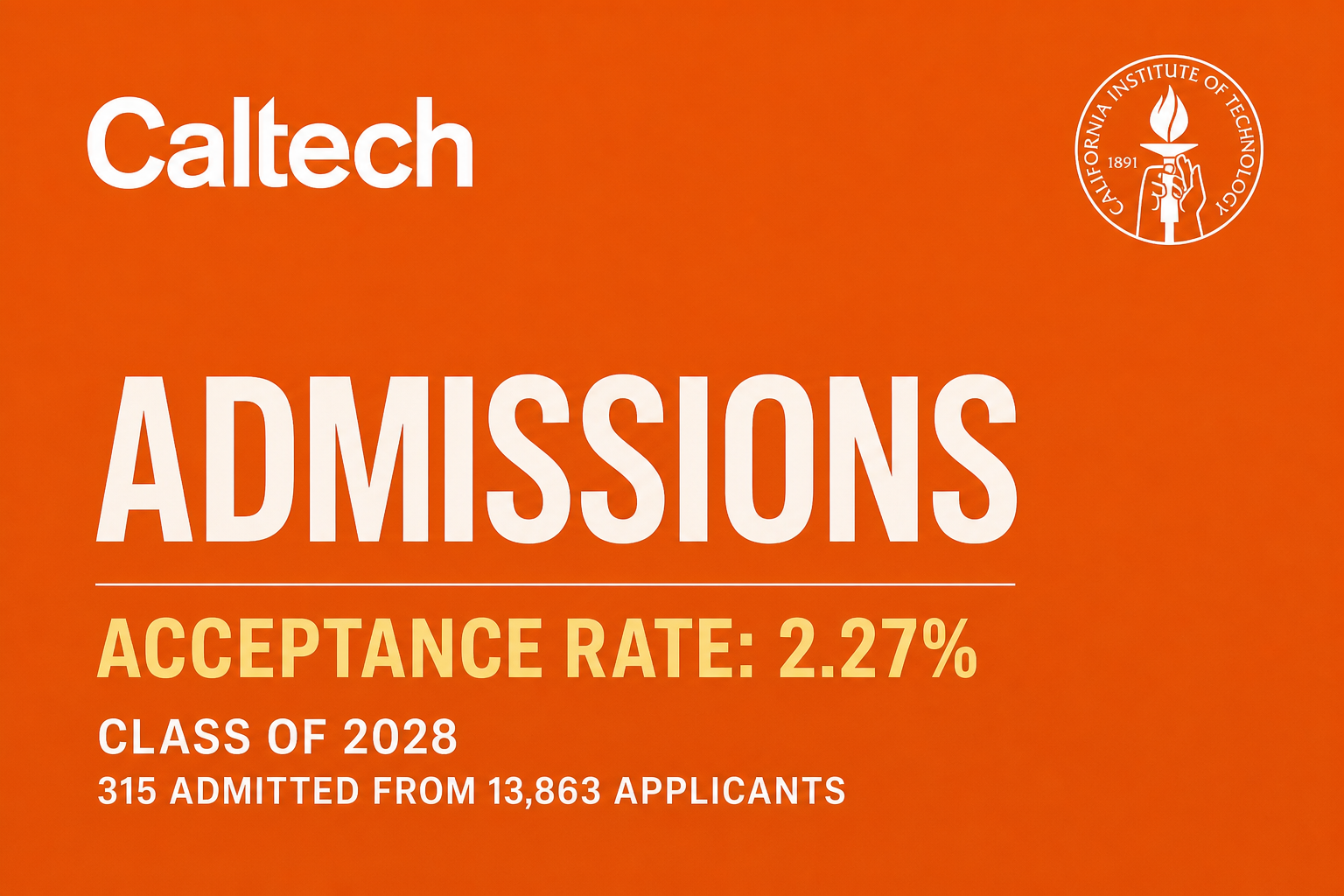
2028 | 13,863 | 315 | 2.27% |
2029 | 11,285 | 427 | 3.78% |
2030 | Not yet published | 428 | TBD |
Caltech's selectivity has swung sharply over just a few years. The Class of 2028 set an all-time record at 2.27%, the lowest acceptance rate ever recorded at a four-year institution in the US. The Class of 2029 saw a rebound to 3.78% as application volume dropped to 11,285. For the Class of 2030, Caltech admitted 428 students in March 2026, though the full acceptance rate has not yet been published. Caltech enrolls roughly 230 students per year, keeping its class sizes smaller than a single residential college at most Ivy League schools.
How Caltech Compares to Other Highly Selective Universities
Caltech's 2.27% acceptance rate for the Class of 2028 made it more selective than Harvard, MIT, and the Ivies in that cycle. MIT's acceptance rate that year was 4.55%, and Harvard's sat near 3.59%. Even in a rebound year like the Class of 2029, Caltech's 3.78% rate still placed it among the most selective institutions in the country. Its applicant pool is already self-selected toward high-achieving science and math students, which makes the comparison to broader research universities all the more striking.
Caltech GPA Requirements for Admitted Students
Most admitted students carry a weighted GPA near 4.0, with transcripts full of AP, IB, or dual enrollment coursework in math and science. A 3.9 from multivariable calculus, physics, and chemistry signals stronger preparation than a 3.9 from standard-level classes.
Caltech states that admission is based on "strong academic performance in a rigorous course of college preparatory study, especially in the areas of math and science." Admissions readers are looking at whether you pushed your coursework as far as your school allowed, beyond simply earning A's.
Caltech SAT and ACT Score Ranges
The mid-50% SAT score range for admitted students is 1530 to 1580, with an average composite around 1550. ACT scores follow the same pattern: the mid-50% range is 35 to 36.

Caltech was test-blind from 2021 to 2023, but reinstated SAT/ACT requirements for the Class of 2029 after 95% of applicants submitted scores anyway under test-optional. For fall 2027 applicants, scores are required, with limited hardship exceptions.
Worth noting: per their standardized testing policy, individual subscores are reviewed separately across Math, English, Reading, and optionally Science and Writing. A near-perfect Math subscore carries more weight than a polished composite built on an uneven profile.
Caltech Admissions Statistics by Major
Caltech does not admit students to a specific major. You apply to the Institute as a whole, not to an "option" (Caltech's term for what most schools call a major). So if you've been searching for a Caltech acceptance rate by major, or a CS acceptance rate, that number simply does not exist.
All incoming students complete the same rigorous common core before declaring an option, covering math, physics, chemistry, biology, and humanities. An applicant interested in computer science competes in the same pool as one interested in astrophysics or chemical engineering, a different model than schools like Georgetown, whose SAT score profile varies considerably by program.
Caltech Restrictive Early Action Acceptance Rate
Caltech offers Restrictive Early Action as its only early option, with no Early Decision binding plan. Applying early means you cannot apply to other private colleges' early programs simultaneously, though you may apply regular decision elsewhere.
What makes Caltech unusual is how little data it releases on the early round. Caltech has never published detailed REA statistics in its Common Data Set filings. What the institute has stated publicly is that admit rates are "under 5% for both REA and Regular Decision," with negligible early advantage.
REA decisions for fall 2027 entry were released in December 2025, with Regular Decision notifications following in March 2026.
Caltech Application Deadlines and Decision Dates
Caltech runs on two tracks for fall 2027 entry. REA applications are due November 1, with decisions released in December. Regular Decision applications are due January 4, 2027, with notifications typically in mid-March. Admitted students have until May 1 to commit, a deadline shared by peer institutions like Princeton.
Caltech Application Requirements
Caltech accepts applications through the Common App or QuestBridge, with an $85 fee that can be waived. Per Caltech's requirements, applicants must submit:
- Common App or QuestBridge application
- SAT or ACT scores, required with limited hardship exceptions
- Two teacher recommendation letters, one from a STEM teacher and one from humanities or social sciences
- Official transcripts, a school counselor recommendation, and Caltech-specific essays
Letters of Recommendation at Caltech
Caltech requires exactly two teacher recommendation letters, drawn from your last two years of high school. One must come from a STEM teacher in math (calculus or beyond preferred), physics, chemistry, or biology. The other must come from a humanities or social sciences teacher covering English, history, government, or economics.
The subject pairing is deliberate. Caltech wants evidence that you can think rigorously across disciplines. Per Caltech's writing advice for recommenders, letters should be about a page and reflect direct personal experience with you, covering both academic ability and personal characteristics. A calculus teacher who can speak to how you approach an unfamiliar problem will carry far more weight than generic praise.
What Caltech Looks for in Applicants
Caltech's 25 faculty readers are looking for students with a single, deep, almost consuming interest in science or mathematics, alongside the intellectual drive to pursue it at a graduate level. Understanding what colleges look for in applicants more broadly can help frame how Caltech's priorities compare to other selective schools.

"What really impressed us was how strong these students are academically, and so much more," said Omer Tamuz, chair of the First-Year Admissions committee, describing the Class of 2030. Faculty involvement in reading files is unusual at most schools. At Caltech, it's built into the process.
Beyond grades and scores, readers weigh research experience, problem-solving depth, and whether an applicant has genuinely pushed beyond classroom material. Nearly 90% of Caltech undergraduates participate in research during their degrees. The admitted class also includes a national chess master, an origamist, and one of the youngest security researchers to work with Microsoft, suggesting Caltech values genuine individuality over polished extracurricular packaging.
Caltech Class of 2030 Demographic Profile
The 428 admitted students for the Class of 2030 came from 43 U.S. states and 23 countries. Beyond geography, the class includes a national chess master, an avid origamist, one of the youngest security researchers to work with Microsoft, and an International Economics Olympiad gold medalist.
Caltech Graduate Admissions Statistics
Caltech's graduate programs operate on a completely different scale than undergraduate admissions. Each department runs its own selection process, and published acceptance rates are rarely disclosed. The CMS department's PhD program in computer science requires a minimum of three years of residence and expects original research that makes a meaningful contribution to the field.
Physics, CS, and engineering programs typically receive hundreds of applications for a handful of spots. A Caltech machine learning professor described the CS PhD program as highly selective, with admitted students generally holding strong research backgrounds and publications. Graduate decisions weight research fit, faculty interest, and publication record heavily over GPA alone.
How Kollegio Helps Students Apply to Highly Selective Schools Like Caltech
Applying to a school with a sub-4% acceptance rate means every part of your application has to carry weight. Kollegio was built for exactly that kind of pressure, and a step-by-step college admissions guide can help you sequence each piece before deadlines hit.
At kollegio.ai, you get access to AI-powered tools covering essay review, activity evaluation, college list building, and deadline tracking. Students can join for free and access $1,000 worth of services, making the kind of guidance that used to cost thousands in private counseling fees available to anyone with an internet connection.
For a school like Caltech, where faculty read every file and generic applications get filtered out fast, the details matter. Kollegio's essay review gives you personalized, specific feedback instead of boilerplate suggestions. The activity evaluation helps you present your actual depth of interest in science or math, which is exactly what Caltech's admissions committee wants to see.
Final Thoughts on Caltech Admissions and How to Approach Your Application
Caltech's process is unusual in ways that actually work in your favor if you know what to expect. Faculty read your file, scores are reviewed by subsection, and your recommenders are given clear guidance on what to cover. Going in with that knowledge means you can shape your application around what the committee genuinely wants to see.
FAQ
What are Caltech's acceptance rates for the Class of 2027, 2028, and 2029?
Caltech's acceptance rate hit an all-time U.S. low of 2.27% for the Class of 2028, then rebounded to 3.78% for the Class of 2029 as applications dropped to 11,285. For context, MIT's acceptance rate ran around 3.9% in that same cycle, making Caltech more selective than every Ivy League school that year. The Class of 2030 admitted 428 students in March 2026, though the full acceptance rate has not yet been published.
Does Caltech have different acceptance rates by major, and is the CS acceptance rate lower than average?
Caltech does not admit students to a specific major, so there is no Caltech acceptance rate by major or separate CS acceptance rate to reference. Every applicant competes in a single pool, and all admitted students complete the same common core before declaring an option in their second or third year.
When do Caltech decisions come out in 2026, and what is the RD decision date?
For fall 2027 entry, REA decisions were released in December 2025, and Regular Decision notifications followed in mid-March 2026. The Caltech application deadline for RD was January 4, 2027, and admitted students had until May 1 to commit.
AI college counselor vs private admissions consultant for Caltech applications?
A private consultant can cost several thousand dollars, while AI-powered tools like Kollegio give you essay review, activity evaluation, and deadline tracking for free, covering services that would otherwise run over $1,000. For a school like Caltech, where faculty readers actively filter generic applications, the specificity of feedback matters more than the price tag of who delivers it.
What GPA and SAT scores do you need to get into Caltech?
Most admitted students carry a weighted GPA near 4.0, built on rigorous AP, IB, or dual enrollment coursework in math and science. The mid-50% SAT range runs from 1530 to 1580, with Math subscores reviewed separately and carrying considerable weight in the evaluation.