
BU's average SAT score of 1466 is a midpoint, not a threshold. Here is what the middle 50% range, section splits, and superscore policy actually tell you about where your score lands.
Stop wondering.
Start matching.


Boston University's SAT data is more layered than most students expect, and collapsing it into a single number is exactly where list-building goes wrong. Most high school students (college applicants) think they just need to know if their SAT score is above or below BU's average, and that number tells them whether they're in or out. But before you decide whether BU belongs on your list as a reach, match, or safety, you need all three layers of the picture: the middle 50% range, the composite average, and the section-level splits.
Each one tells a different part of the story. See our AI college counselor for how this works in practice. Boston University's middle 50% SAT range is 1420 to 1530, according to the most recent Common Data Set figures.

That band means 25% of admitted students scored below 1420, and 25% scored above 1530. A student with a 1460 sits almost exactly at BU's average, meaning half of admitted students scored above them and half below. That is very different from being "safe."
25% of admitted students scored below 1420
BU reported a composite average SAT score of 1466 for its Class of 2029, according to the university's own published admissions data from 2025. That figure is the midpoint of a wide distribution, not a floor. Treating it as a pass/fail threshold is the single most common misreading students make.
A score of 1466 puts you squarely in the competitive zone, but it does not tell you anything about how your GPA, course rigor, or extracurriculars compare. The section-level data sharpens the picture further. BU's middle 50% for SAT Evidence-Based Reading and Writing and Math sections each span distinct ranges, based on CDS figures, and the Math band sits notably higher than the Reading/Writing band.
That asymmetry matters if your scores are unbalanced. A student with a 710 in Reading/Writing and a 760 in Math reads very differently to an admissions reader than a student with the inverse split, even if the composites match.
Section-Level Splits (Math vs. Evidence-Based Reading and Writing)
BU's section-level middle 50% ranges reveal a meaningful asymmetry that composite scores hide entirely. According to the most recent Common Data Set figures, the Math section middle 50% runs from approximately 720 to 790, while the Evidence-Based Reading and Writing section middle 50% runs from approximately 700 to 750. That gap is not trivial. The Math ceiling is higher, the Math floor is higher, and the spread is wider, which signals that BU's admitted class skews toward quantitative strength even in programs outside of engineering and computer science.
BU's Math middle 50%: 720–790 vs. EBR&W middle 50%: 700–750
What this means practically is that an unbalanced score profile gets read differently depending on which direction it tilts. A student with a 760 Math and a 700 Reading/Writing sits comfortably inside both section ranges and is unlikely to raise any flags. A student with the inverse, 700 Math and 760 Reading/Writing, sits below the floor of the Math band, which can draw scrutiny for STEM-track applicants in particular. If your composite is strong but your Math score is below 720, that is worth noting before you categorize BU as a match rather than a reach.
Section | 25th Percentile | 75th Percentile |
Math | 720 | 790 |
Evidence-Based Reading and Writing | 700 | 750 |
Key takeaways
- Boston University's middle 50% SAT range sits between 1420 and 1530; where you fall inside that band matters more than whether you clear the average.
- BU is not test-optional for the 2025–26 cycle, meaning every fall 2026 applicant must submit an SAT or ACT score.
- The average SAT misleads most applicants because it flattens a range into a single number, making borderline candidates feel safer, or more doomed, than they actually are.
- BU superscores the SAT, which changes how you should approach retakes and which score combination you report.
- A 1460 at BU lands differently than a 1460 at Northeastern, Tufts, or Boston College — the four schools share a city but not the same admissions math.
- GPA trajectory, course rigor, and extracurricular depth carry real weight once your SAT clears BU's threshold; the score opens the file, it does not close the case.
- Kollegio.ai's College Finder lets you enter your SAT alongside your full academic and activity profile so the AI can show you exactly where BU sits on your list, reach, match, or safety, based on the complete picture, not a single number.
SAT Score Competitiveness for BU — Why the Average Misleads Most Applicants
Staring at a single number and trying to decode an entire admissions decision is one of the most common traps BU applicants fall into. Most high school students and parents think that all they need to know is whether their SAT score lands above or below BU's average, believing that number alone tells them whether they are in or out. The problem is not that students check the average SAT score; it is that they treat it as a binary gate instead of a statistical midpoint, and that one misread quietly distorts every list-building decision that follows.
A student positioned well above the midpoint is not guaranteed admission at an 11–13% acceptance rate school. Getting list placement right, knowing where a given profile truly belongs among reaches, targets, and likely schools, is exactly the kind of judgment that requires more than a single data point.

The Average SAT Score — Midpoint, Not Admission Threshold
Based on our market understanding, the average SAT score for admitted students is approximately 1466. That figure sits exactly in the middle of the admitted pool, meaning roughly half of admitted students scored below it. A student who hits that midpoint has not cleared a bar; they have landed at the center of a wide distribution. Treating that midpoint as a floor is the single most common list-building error BU applicants make.
What BU's Middle 50% Range Actually Tells You
BU's middle 50% SAT range runs from approximately 1420 to 1530, per the same Common Data Set. That spread matters more than the average because it shows the realistic competitive band. Notice that a student scoring exactly 1530 sits at the very top edge of the middle 50%, still inside the range where the bulk of competition lives, not safely above it.
The range tells you where competition is densest, not where acceptance begins or ends. Building a balanced, realistic college list that matches a student's academic profile, interests, and family financial situation requires reading the full distribution, not just one landmark number.
Is 1400 a Good SAT Score for BU?
A 1400 is a strong score in absolute terms, but at BU it sits just outside the competitive band: it falls below the 25th percentile of roughly 1420. A 1400 falls below BU's 25th percentile of roughly 1420, which is worth noting honestly. It is not an automatic disqualifier. BU uses holistic review, meaning a below-25th-percentile score raises the bar on every other component: GPA, essays, and activities all carry more weight when the SAT is light. A student with a 1410 who removes BU from their list entirely misses that reality. Kollegio's Activity Feedback and AI Essay Planner are designed precisely for this situation: when the score alone does not tell the full story, the surrounding application components have to do more work, and students deserve structured support building those out.
BU's Acceptance Rate and What It Means for Your Odds
Boston University's acceptance rate is approximately 11 to 13%, according to BU's Common Data Set. At that selectivity level, a score inside the middle 50% earns you a thorough review, not an offer. It means your entire application is evaluated, which is why understanding list balance matters as much as understanding a single score. A well-constructed list accounts for how competitive the admitted pool is at every school on it, not just whether a student clears an average. That is the work Kollegio's College Finder and AI College Recommender are built to support from the very first step of the process.
Does BU Require SAT Scores — and Does It Superscore?
Boston University's test requirements and superscoring policy have direct, practical consequences for how you build your application strategy, and getting either wrong can cost you before anyone reads your essays. BU is not test-optional for fall 2026 entry, and it superscores both the SAT and ACT, which changes how you should approach retakes and which scores you submit. What follows breaks down exactly what both policies mean in practice, including how a superscore gets constructed and what it actually signals to admissions.

BU Is Not Test-Optional for 2025–26 — What That Means for Fall 2026 Applicants
BU requires either an SAT or ACT score for the 2025-26 admissions cycle (fall 2026 entry). According to BU's official admissions page, the school is not test-optional this cycle. Students who apply without a score will have an incomplete application. The pandemic-era flexibility is gone, and planning around it is a miscalibration that closes doors before review even begins.
BU Superscores Both the SAT and ACT — How It Works in Practice
BU superscores both the SAT and ACT, pulling your highest section scores across every test date you submit and building a composite from those peaks. Take a concrete example: a student scores 700 EBRW and 710 Math on one sitting, then 680 EBRW and 760 Math on a second. BU constructs a superscore of 1460 from the 700 EBRW and 760 Math, even though neither sitting produced that number independently.
That is not a loophole; it is the stated policy. That example score, 1460, is one many applicants arrive at and immediately second-guess. That anxiety is real and understandable: a 1460 can feel like a liability when you don't know where it actually lands in BU's admitted pool.
The honest answer is that context matters enormously. That same superscore built from two strategic sittings tells a different story than a flat single-sitting result, and how it weighs against the rest of a profile — coursework rigor, activities, essays — is what actually determines competitiveness. Because BU superscores, each test date is a chance to bank a strong section, not a single high-stakes verdict.
The catch: BU's published middle 50% range is built from enrolled students whose composites may themselves be superscored, so comparing your superscore to that range is not a clean apples-to-apples read. Knowing where you actually stand requires mapping your section scores against the full range, not just the headline average, and then situating that score within a balanced, realistic college list that accounts for your full academic profile, your interests, and your family's financial picture. That whole-profile view is exactly what Kollegio's College Finder and AI College Recommender are designed to surface: at the very start of onboarding, before any recommendations are generated, the platform reads your academic record alongside test scores so that school suggestions reflect genuine fit, not wishful thinking.
Self-Reported Scores and Official Reports
Students may self-report scores on the application itself, per BU's admissions guidelines. The requirement to send official score reports kicks in before enrollment, not before admission. Skipping the official send entirely is a mistake: scores must be verified, and missing that step can jeopardize an acceptance.
BU Admissions Requirements - What the Full Profile Looks Like Beyond the SAT
A 4.3 GPA and a 1520 SAT should feel like a safe combination for BU. And yet students with exactly that profile get rejected every cycle, while others with softer scores get in. That gap is not random. It reflects how BU actually reads applications: the SAT establishes whether you belong in the conversation, and everything else determines how that conversation ends. This is the central confusion we see among students navigating private-university admissions. Strong numbers alone are not a guarantee, and the process is far less transparent than most families expect.

GPA Sets the Academic Floor Alongside the SAT
Admitted students at BU typically carry strong GPAs, and that pattern matters because it reframes how you read your own risk. The SAT and GPA work together; a strong score cannot carry a weak transcript. Where this becomes urgent in practice: students applying to programs like BU RISE face an additional layer of pressure because specific test-score thresholds matter at the program level, not just the university level. A student with a score significantly below BU's published ranges confronts a concrete barrier, not an abstract one, and the anxiety that their overall profile cannot compensate is well-founded without a clear, structured plan for addressing that single lagging metric before the application deadline.
Kollegio's College Finder surfaces exactly this kind of gap at the start of the process, so the score deficit is visible and actionable early, not discovered the week before ED2 closes.
The SAT Is One Input in a Holistic Review System
BU employs holistic review, meaning essays, extracurricular activities, and school counselor recommendations all factor into the final decision. The SAT is one input among many, not a standalone gating factor once you are within the competitive score range. Here is where the distinction matters most: a student with a strong GPA and an SAT that sits below BU's 25th percentile is not simply a weak applicant.
Their GPA already matches the admitted-student profile. The SAT is the single lagging metric in an otherwise competitive record, and holistic review is the actual mechanism through which they remain legitimately competitive, provided their essays, activities, and recommendations carry the narrative the number alone cannot. That "provided" clause is where most students lose ground.
Navigating a holistic process is genuinely complex: knowing which parts of your profile are pulling weight, which are neutral, and which are actively hurting you requires the kind of systematic profile analysis that gut instinct cannot reliably supply. Kollegio addresses this directly. The AI Essay Planner and Essay Review tools help students build the narrative layer that holistic readers are looking for, while Activity Feedback surfaces the extracurricular depth that moves an application from statistically acceptable to genuinely memorable. These are not cosmetic additions. They are the materials that make holistic review work in the student's favor rather than against them.
Application Deadlines Shape Your SAT Strategy
BU's Early Decision deadline is November 1 and Regular Decision is January 5. ED applicants signal demonstrated interest and commitment to BU, which factors into how the full profile is read. If your SAT score sits in the lower half of BU's middle 50% range and your other materials are strong, applying ED gives the rest of your profile more weight relative to a larger, more anonymous RD pool. Missing a deadline, or misreading which deadline governs which program requirement, is one of the most preventable ways a competitive application fails.
Kollegio's Plan Applications feature tracks these dates so that critical requirements and financial aid opportunities are never quietly missed. The Scholarship Finder and Kollegio's financial aid tools layer on top of deadline management, ensuring that the ED commitment decision is made with full visibility into what financial aid is and is not available before a binding choice is locked in.
What BU's Record Applicant Pool Means for In-Range Students
BU's acceptance rate has dropped sharply in recent cycles to one of the most competitive figures in the university's history. At that selectivity level, an in-range SAT is necessary but far from sufficient. The students who succeed are the ones who understand exactly where their profile is strong, where it is thin, and how to close the gap before the application is submitted, not after. Kollegio's personalized college recommendations match students to schools where their full profile is genuinely competitive, so BU sits in the right tier of a balanced list rather than serving as an aspirational reach with no strategic backing.
Related Reading
- Boston University SAT Scores
- UF SAT Scores
- UCLA SAT Scores
- Johns Hopkins SAT Scores
- Clemson SAT Scores
- Northwestern SAT Scores
- Villanova SAT Scores
- Georgetown SAT Scores
- Brown SAT Scores
- UPenn SAT Scores
- Boston College SAT Scores
- Vanderbilt SAT Scores
- Purdue SAT Scores
How BU SAT Scores Compare to Northeastern, Tufts, and Boston College
Four schools, one Boston zip code, and a prestige ranking that feels obvious until you look at the actual numbers. Students building a Boston-area list routinely sort BU, Northeastern, Tufts, and Boston College into a mental hierarchy, then slot their SAT score into whichever tier seems to fit. The problem: the data does not support that hierarchy nearly as cleanly as the assumption does.
How to Use Your SAT Score to Compare BU, Northeastern, Tufts, and Boston College
Most students spend hours pulling SAT ranges from four different websites and still leave uncertain whether their score makes any school a reach, match, or safety, because raw numbers cannot account for GPA, activities, or essay strength. Kollegio.ai's College Finder ingests all of that context at once, so a student gets a calibrated fit picture across all four schools rather than four isolated numbers with no interpretive frame. The honest trade-off: the tool's value scales with how completely you fill out your profile; a sparse input produces a generic output.
PrepScholar aggregates Common Data Set figures into side-by-side tables, a straightforward way to see that BU's and Tufts' middle-50% ranges overlap far more than most students expect. The real limitation: it reports admitted-student ranges, not enrolled-student ranges, which means the bar it shows is consistently higher than the one most enrolled students actually cleared.
1. Kollegio.ai — Best for Personalizing Your Boston University SAT Strategy Across All Four Schools

Kollegio.ai is the free AI-driven platform that replaces the $10,000 college coach by giving students personalized SAT target scores for BU, Northeastern, Tufts, and Boston College in one place. It delivers essay feedback, school-fit recommendations, and direct connections to admissions teams. The one tradeoff: it lacks the decades-long human relationship some families prefer from boutique counselors.
2. PrepScholar — Best Static SAT Score Database for BU vs. Tufts Middle-50 Comparisons

PrepScholar publishes detailed middle-50 SAT score ranges and GPA data for both Boston University and Tufts, making it easy to see at a glance where BU's 1420–1530 range stacks up against Tufts' higher band. It's the right pick for students who want raw admissions data quickly. The tradeoff is that it offers no personalized guidance or context about how your specific score fits within a holistic review.
3. Oriel Admissions — Best for Understanding How ED Strategy Shifts Effective SAT Thresholds at Northeastern and BC

Oriel Admissions goes beyond raw SAT scores to explain how Early Decision acceptance rates at Northeastern (~43% ED vs. ~5% RD) and Boston College effectively lower the SAT bar for committed applicants. This is the right resource for students whose scores sit in the middle range and who want to understand whether applying ED changes their odds. The tradeoff is that content is editorial and not updated in real time with each cycle's data.
4. Boston College Common Data Set — Best Primary Source for Enrolled vs. Admitted SAT Score Reality Check
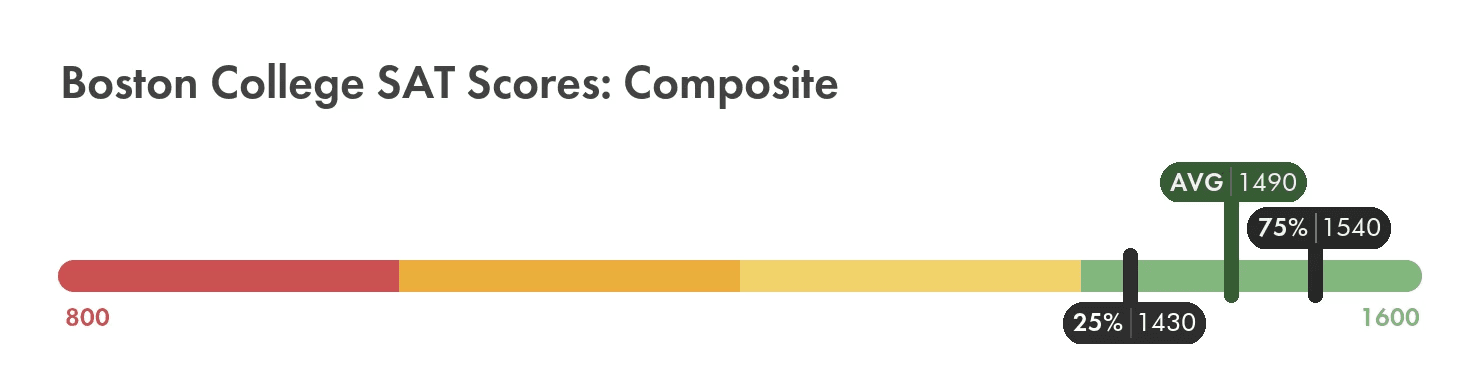
Boston College's official Common Data Set reveals the gap between admitted and enrolled student SAT scores, a critical distinction when comparing BC to BU, since enrolled medians run notably lower than headline admitted stats. Students targeting the Boston school cluster should use this to calibrate realistic score goals rather than chasing inflated admitted-student figures. The tradeoff is that the raw CDS requires manual interpretation with no guidance or comparison tools built in.
What Your BU SAT Score Actually Means for Your College List — and What to Do Next
Two students walk into BU's admissions cycle with the same SAT score. One treats that number as a green light and submits a generic application. The other uses it as a diagnostic, recognizes they sit right at BU's average, and builds an application where their activities and essays carry real weight.
Only one of those students is thinking strategically, and the difference has nothing to do with their score. One more reality worth naming before we break down the tiers: the process itself is expensive before a single application is submitted. The $80 BU application fee is one line item on top of SAT prep costs, score-sending fees, and the cumulative weight of applying to multiple schools.

That financial pressure is real, and it makes every strategic decision, including which schools make it onto your list in the first place, matter more, not less. That is exactly why building a balanced, realistic college list that matches a student's academic profile, interests, and family financial situation is not a nice-to-have; it is the first genuinely consequential step in the process. Kollegio's College Finder results and its Scholarship Finder and financial aid tools exist specifically to make that step rigorous rather than a guess.
Related Reading
- NC State SAT Scores
- Auburn SAT Scores
- Columbia SAT Scores
- Ivy League SAT Scores
- Carnegie Mellon SAT Scores
- Tufts SAT Scores
- UC Berkeley SAT Scores
- UNC SAT Scores
- University of Michigan SAT Scores
- Good ACT and SAT Scores
- Wake Forest SAT Scores
- UConn SAT Scores
Next steps
If your SAT score has you second-guessing whether BU belongs on your list at all, the path forward starts with reading your number inside the full competitive band rather than against a single average that flattens everything it touches. Start with our AI college counselor.
BU's superscoring policy means the 1460 you're comparing against the published middle 50% range may not be a clean apples-to-apples figure, because that range is built from students whose composites were assembled the same way yours was, making the comparison less precise than it looks. And once a score clears BU's 25th-percentile floor, every additional point yields diminishing admissions returns relative to what essays, activities, and demonstrated fit can do, because score variation inside a band that holds far more applicants than available seats collapses into a near-tie that only the rest of the application can break. Together, those two realities point to one action: stop optimizing the number and start building the profile around it.
Start by mapping your full academic record, including GPA, course rigor, and extracurriculars, through an AI college counselor that reads all of it together rather than one data point at a time. From there, you get a calibrated picture of where BU actually fits on a balanced list, and which application components need to do the most work given where your score lands in the range.
Frequently Asked Questions
Does BU superscore the SAT?
Yes, BU superscores both the SAT and ACT, pulling your highest section scores across every test date you submit and building a composite from those peaks. For example, if you score 700 EBRW on one sitting and 760 Math on another, BU constructs a superscore of 1460 from those two bests, even though neither sitting produced that number on its own.
Is BU test-optional for the 2025-26 admissions cycle?
No. BU requires either an SAT or ACT score for the 2025-26 admissions cycle (fall 2026 entry). Students who apply without a score will have an incomplete application.
What is a good SAT score for BU?
BU's middle 50% SAT range runs from 1420 to 1530, with an average composite of 1466 for the Class of 2029. A score inside that range puts you in the densest band of competition and earns you a thorough holistic review; it is not a guarantee of admission at a school with an 11–13% acceptance rate.
Can you get into BU with a low SAT score?
A score below BU's 25th percentile of roughly 1420 is not an automatic disqualifier because BU uses holistic review. However, a below-25th-percentile score raises the bar on every other component of your application: GPA, essays, and extracurricular activities all carry more weight when the SAT is below range.
When should I take the SAT if I'm applying to BU?
BU's Early Decision deadline is November 1 and Regular Decision is January 5, so your test timeline should work backward from whichever deadline you're targeting. Because BU superscores, each test date is a chance to bank a strong section score, making it worth sitting for the SAT more than once if your scores are unbalanced across sections.